


Lynley Edmeades on writing Hiding Places
In the first of a new series called Craft kōrero, writer Lynley Edmeades dissects her cross-genre book Hiding Places (Otago University Press, 2025), in conversation with poet and editor Sophie van Waardenberg.
‘This is a story about a book about becoming a mother. None of it is real.’ Lynley Edmeades, author of two acclaimed poetry collections, opens her fourth book, Hiding Places, with a disclaimer signalling its slant intent and form.
Hiding Places is creative nonfiction that questions and roams, embracing fantasy, memory, research, experience and debate. The ‘leaky essay’ form – as Edmeades discusses here – gives fluid shape to her material. The book interrogates the way ‘nonfiction’ can both disclose and dissemble. It resists the glib tags of personal essay or memoir, switching genres and playing with point of view to explore the complexity of lived (and remembered) experience.
A number of other writers are quoted or discussed in Hiding Places, including Deborah Levy, Chris Kraus, Janet Frame, Maggie Nelson, Rebecca Solnit and Rachel Zucker. ‘This book is in conversation with, and indebted to, the works of Kate Zambreno,’ Edmeades writes, drawing on Zambreno’s Appendix Project (2019); Drifts (2020); and To Write As If Already Dead (2021). The unsent letters to ‘K’ that punctuate the book are to Zambreno; it is ‘in part a love letter’ that expresses the intense engagement we have as readers with books and their writers.
This kōrero took place in March 2026, with van Waardenberg in Auckland and Edmeades in Dunedin, where she teaches at the University of Otago and edits New Zealand’s oldest literary journal, Landfall Tauraka.

Dear K
Yesterday the world was teeming with possibility and then: this. You never told me it would be this way. You said everything would be okay and that there is nothing stopping me. Why do people never say what they actually mean? When you say: nothing is stopping you, you actually mean: everything has the potential to stop you. I have an idea. I’ll write a book addressed to you, asking you if you’d like to be my mother. I’ll fabricate replies. I’ll make stuff up. I’ll project. I’ll talk about my therapist. I’ll make a new mother that is kind of a hybrid of you and all the women that I love and I’ll pretend that she’s my mother. It will be a book about mothers and becoming a mother and how we all fail.
Bye for now
.
SvW: I loved the way Hiding Places resisted falling into the expectations of what is allowed – what we’re allowed to say. I was so buoyed by it, the proof that you can (and probably should) write about being a mother, for example, without moralising or apologising or neatening things up, and that you can play at so many different selves while you’re doing that.
The book is playful, and it’s just as serious as it is playful, and I think a lot of that is due to the multiple forms that weave together here: not only the letters to many different people but the sections called ‘Stories’; the sections in third person and second person; the severe, grandiose excerpts of Truby King’s Feeding and Care of Baby:
The ‘can’t-be-so-cruel’ mother or nurse, who won’t bring herself to wake the baby a few times, if needed, in order to establish once for all regular feeding habits; or who weakly gratifies every whim of herself and the child, rather than allow either to suffer temporary discomfort for the sake of permanent health and happiness—such a woman is really cruel, not kind. To save a lusty, honest cry she will pacify an infant with a ‘comforter,’ or with food given at wrong times, and may thus ruin the child in the first month of life, making him a delicate, fretful, irritable, nervous, dyspeptic little tyrant who will yell and scream, day or night, if not soothed and cuddled without delay.
How did you decide all these different forms and voices would end up in Hiding Places – did you work on one strand in concentration, then another, or flit between them?
LE: The initial idea for the book was an essay collection, loosely organised around the idea of ‘hiding’, the result of doing some of that initial research on my grandfather – which forms another (albeit small) strand of the book. I wrote a few essays toward this, and was really endeared by the form and all its affordances. But increasingly, I became interested in the ‘leaky’ essay that resists the neat and tidy conclusion, which then led me to read more experimental and cross-genre work. I realised what I was interested in was actually letting the material guide and inform the shape of the work, which I realise is largely to do with my training in poetry (not just what the work says, but also how it says).
At some point, after having my son, I also accepted that I was never going to have time or brain capacity to write these lovely long considered essays, and that having the ‘essays’ (if that is what they are) fall apart or ‘leak’ was a lot more interesting to me, because it was performative of my life, my body, and the literature I am increasingly interested in. I don’t think I could have written this book if I’d tried – that is, it was never by design. I simply wrote and gathered and then spent a lot of time shaping and sculpting those pieces into the whole.
There’s a lot I could also say about motherhood and just general moralising too. I was really struck by how dishonest so many new mothers and health officials were about how bloody awful those first few months can be (for some), and then of course I started researching Plunket, which led me to Truby King and The Feeding and Care of Baby. I really wanted to get something of that moralistic atmosphere – the severity and grandiosity as you describe so aptly – into the book.
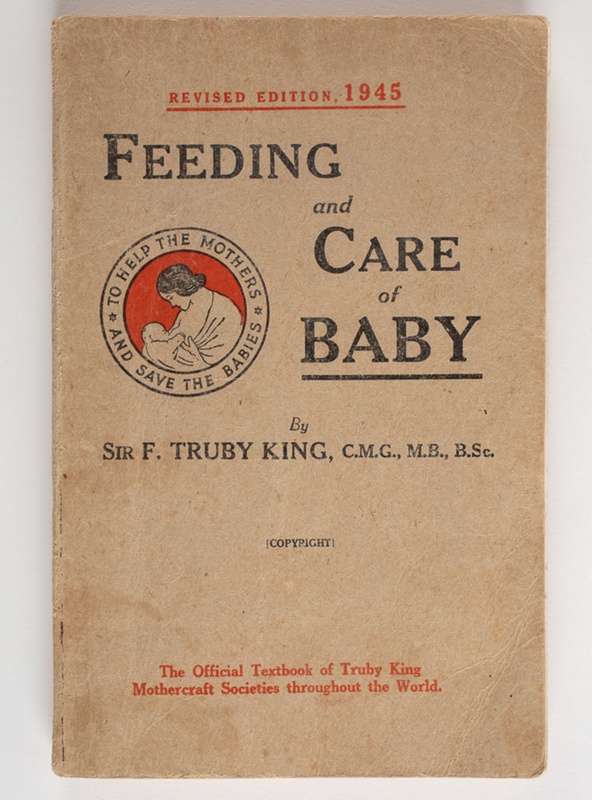
In the end, I simply took verbatim fragments from that book, as they said so much without any further treatment. I am really interested in the way those ideologies, like the kind that King was espousing in early 20th century Aotearoa (and what became the foundation of Plunket) have come to inform so much of what we otherwise think of a secular and liberal society. Especially in those days, when King was setting Plunket up, the moral power of the Empire was immense – mothers were told to train their babies by the clock, that the clock was ‘the answer’ to building strong and resilient individuals who could, if needed, go to the front line. Mothers must behave ‘in the interests of national efficiency’, King said.
On 17 February 1913, the Armory Show opened in New York. It featured Marcel Duchamp’s Nude Descending a Staircase (No. 2). The work tried to capture movement, a human figure held within the temporality of time. Cinema and photography were exploding; trains were getting faster. Duchamp was ridiculed for it. What’s hidden in this ridicule? you wonder. Movement should not be seen, perhaps, or painting should be reserved for still life.
The same year, Sigmund Freud published Totem and Taboo: Resemblances between the psychic lives of savages and neurotics in Germany, and Frederic Truby King published Feeding and Care of Baby in New Zealand. You make a note to look up what your family were doing in 1913. Then you think, Maybe I don’t want to know. There is never nothing beneath something that is covered.
SvW: ‘I don’t think I could’ve written this book if I’d tried’ – that makes a lot of sense to me. The book comes at things slantwise; you eschew the first person in favour of the second- and third-person perspectives most of the time, and because it’s written in these really short sections, the book is in constant motion, the angle always shifting. You anonymise the other figures in the book, blanking out names or using placeholder initials: ‘S’ for ‘son’, ‘F’ for ‘friend’, for example. You even include those as a list of characters at the front of the book, like a playwright would.
L: Spouse
F: Friend and writer
T: Therapist
K: Writer
S: Son
G: Grandfather
P: Publisher
There’s so much refraction and invention. How did the fictional elements and the formal experimentation free up the writing process for you? Were you surprised by the different selves that leaked out? And how did you know – if you ever felt this way – that you had veered too far into fiction and had to pull back?
LE: The fictional elements and the formal experimentation were really freeing for me. I suspect the formal aspect is due to my poetic training (as I mention above, the how and the what working together), but I turned to fiction to free myself from some of the ethics of writing from life. I wanted to thwart the notion that the book was a memoir, being very taken by what Chris Kraus said about I Love Dick – it is written about her life but it’s not a memoir. So, I used second and third person to slightly unsettle the neat projection of the ‘I’ being ‘me’. Once I’d done that, all kinds of doors opened to me and I started writing the parts that become ‘Stories’ throughout, which then let me play with the line between fiction and non-fiction. I also wanted to protect some of the people and memories I wrote about, so adding some fictional elements (or at times completely fictionalising things) felt a lot more comfortable.
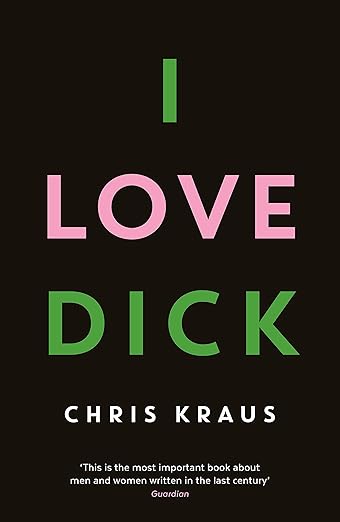
So yes, I was surprised by the different selves and it has absolutely given me a taste for writing fiction. I love how you can play around in fiction like that. As Robert Louis Stevenson said, fiction is to adults what play is to a child (or something like that). I never felt like I’d gone too far into fiction, to be honest. The whole book is really about performance and performativity, so maybe it is about performing fiction, or performing as a writer trying to write fiction.
I’m also consistently excited and stimulated by the fluidity of genre, what I have written about elsewhere as genre-queerness (borrowing from queer theory to talk about genre distinctions). I have this in mind a lot when I’m teaching, as I’m often teaching creative writing across several genres, so I’m interested in how genres can cross-pollinate and how sometimes something quite magical can happen in between.
Writing this book got me thinking a lot about reader expectations and limits of genre. It’s been really entertaining to me how many different ways people find to categorise Hiding Places: some people refer to it as poetry, some as a novel, a memoir or a long essay. I even saw that one library had put it in a ‘meditation’ section (not really a genre, but still so interesting to me!). In describing it to people (and publishers) I’ve called it an autosocial biography, but that’s really a portmanteau made up of several genres that just illustrates the leakiness and fluidity of genre to begin with, I think.
Chris Kraus:
The word “confessional” is not a good descriptor of my work …. [The] New York School poets – they were the ones who pioneered this use of this “I,” an active “I” that’s turned out onto the world. “I” in this case isn’t the point – That would be memoir. The story of “I.” And mostly I hate that – everything else becomes merely a backdrop to the teller’s personal development. It’s an utterly false, uninteresting view.
Writing I Love Dick, I understood that women have been denied all access to the a-personal. Look – the “I” in Celine’s Journey to the End of Night – it’s an “I” that’s scabrous and hilarious and personally revealing. But is Journey read as a confession? No, it’s one of the great books of the 20th century.
From an interview with Denise Frimer in The Brooklyn Rail, April 2006
SvW: I’m so pleased you mentioned the collision of queerness and genre experimentation. I think one of the most exciting moments in the book, for me, is when you address that really directly. ‘By inviting uncertainty’, that section goes, ‘writing might also push beyond the fetishisation of ambiguity towards something that lies outside of binaries – knowing and not-knowing, categorisation and blurring, essentialising and destabilising. And, in doing so, go beyond dominant hegemonic discourses and master narratives in favour of the queer.’
Chris Kraus and Kate Zambreno, who appear in the book, are obviously examples of other writers who challenge those discourses and narratives, but I wonder if you had any examples of those master narratives – about motherhood, or about memoir, for example – in mind that you were trying to challenge or push past as you were writing Hiding Places. Were you ever motivated by writing directly against those narratives or received forms, or even against any writing ‘rules’ or advice that you might have previously held to?
LE: There are many ways to address these questions, but ‘in favour of the queer’, I’ll try to do so in a very un-essentialising way. There are absolutely examples of master narratives around motherhood. The most obvious of these is Truby King, but there is plenty of parenting advice that exhibits (attempts at) such mastery. There are, too, memoirs of motherhood and parenting that felt to me very neat and tidy; my experience of parenthood is simply not that, so I guess I was trying to find another way of thinking it through.
I guess in part I was motivated by pushing back against the idea of the book being a memoir, which I really tried to stay away from. My aversion to that as a genre for this material was largely to do with my desire to gesture toward the illusion that an individual’s subjectivity is knowable. I know that sounds very ontological, but I have just never felt that there is one discreet and tidy version of myself; in some ways, I think the concept of the ‘individual’ is a myth, and a dangerous one at that. So, perhaps that is one of the ‘master narratives’ I was pushing against, trying to undermine this neat category of subjectivity.
I really admire what good memoirs do, in that there seems to be a cogent understanding of one’s subjectivity at the heart of them; I’ve never experienced that myself, and so wanted to try and explore and exemplify that, hence the playing with perspective within the book. Even though I know ideas of fluidity and multiple subjectivities exist in theories of postmodernism or poststructuralism, it was reading a lot of queer theory that really helped me think some of this through. It is likely more to do with where I’m at in my own thinking, but queer theory and writing feels like the space of so much interesting writing at the moment. I hesitate to call it a genre, because that would be trying to master it, but maybe it’s the space that queer theory has opened up for writers.
SvW: One of the several strands of Hiding Places is a series of letters addressed to another author, ‘K’. K is an obsession of the speaker, and their relationship – an imagined one, or at least one that only exists in these unsent letters – is one of the structural pillars of the book.
Did these letters emerge from the project of Hiding Places, or were you writing them before the book started to take shape? Given that the letters are public and performative, did you find you could access attitudes or dynamics in them that you wouldn’t have if they were private? One of the letters just reads, ‘Dear K, Will you be my mother? Thanks in advance.’ I guess another way to ask this is: did the fact that the letters were public make you bolder in writing them, or more self-conscious, more inclined to hide?
LE: I had to really think about the answer to this question! As you’ll know, so much of the process of writing a book is mysterious. I can’t remember what the impetus was for writing these letters to ‘K’, but I do know that it began at some point during the writing of the book (i.e. I wasn’t writing them before the book started to take shape). At some point in the process I read I Love Dick and that kind of changed everything, opening up the possibility of a kind of public confession through letters.
The letters were always a conceit, really; that is, I wasn’t writing them to ‘K’ with the intention of sending them to her (although I’ve since tried to contact her and I do love the idea of corresponding with her one day). It is a technique I’ve used before in my own writing and have since done it with students too – I get them to write to their heroes with imaginary questions about their favourite poems or lines or characters.
But the letters to ‘K’ were also a lot more playful than that around the idea of hiding. I really wanted to play with the idea of the confessional, to think about what constitutes confession today, how it carries such negative connotations in literature (especially by women), and how even the most honest ‘confession’ is still only ever a performance of something.
The playful part comes about through the idea of performativity, I guess: I started to wonder how a reader would respond to the boldness of those confessions and how it casts the other parts of the book into a new or different shade. Like, I would never ask ‘K’ to be my mother in real life, and so what am I actually hiding (from myself, from the reader) by saying that?
Kate Zambreno:
First-person narrative by men is still published and reviewed as more serious and gets a lot more money and coverage. It’s also usually not dismissed as merely autofiction or memoir, instead read as literature encompassing psychogeography, philosophy, art criticism. Even if a woman is doing exactly that, she’s usually still marketed as merely writing a woman’s experience or, worse, a mom memoir, if she has children.
From ‘By the Book’ in The New York Times, March 2024
SvW: There’s obviously a lot about hiding in Hiding Places, and it suggests that stories are a place for us to hide but also that, as writers, we can hide when we’re in the drafting process. If we decide we aren’t finished with something, or that we’re not ready to give it up to a reader – if we haven’t yet shared our work – we can keep hiding within it. The character of the mother doesn’t want to give away too much of her project: ‘She is guarding her hiding, like a precious toy she doesn’t want to share.’
Is that how this writing process felt to you – and has writing, generally, been something you usually prefer to do privately (even secretly)? Practically or emotionally, how did you retain some of that hiding feeling while you worked through the pitching and editing process, which of course involves being exposed to other eyes?
LE: I have quite an evolving relationship with hiding. I used to be a very secretive writer, and I also spent a lot of time hiding as a child. But, as the Donald Winnicott quote that I use as an epigraph to Hiding Places says so beautifully: ‘It is a joy to be hidden, and a disaster not to be found’. So, yes, I love hiding and, like most writers I know, I do need to do a lot of stuff in private. But – like that child that Winnicott is referring to – I can only hide with ease in the knowledge that I can be found. Otherwise it becomes an absolutely existential catastrophe, right? To hide also encapsulates the corollary, which in this case is a sense of performance, perhaps.
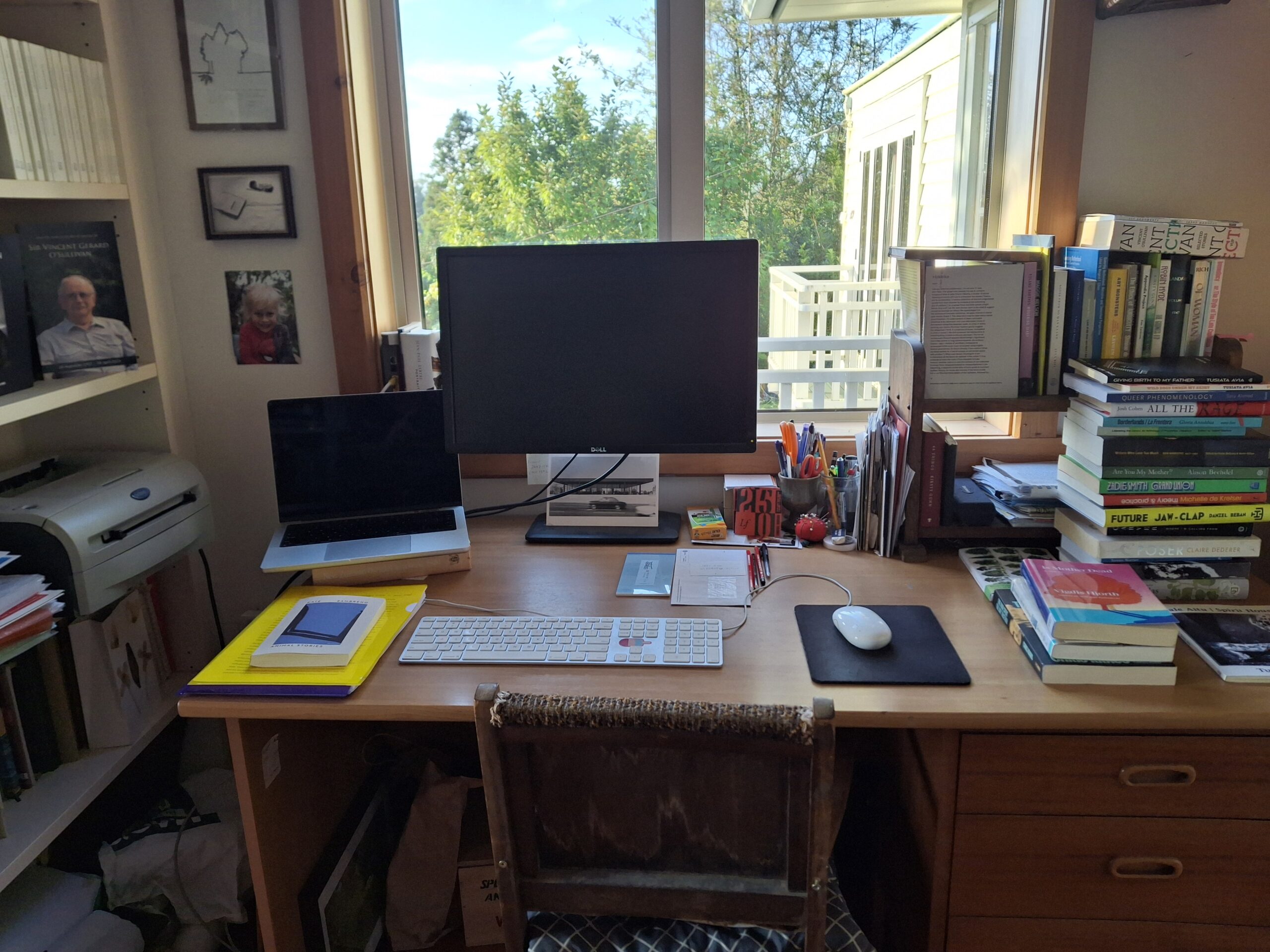
Lynley Edmeade’s workspace.
This also has ramifications for motherhood, too, whereby so much of that social reproduction that allows capitalism to continue to flourish happens privately. Motherhood is a lot more visible now than it used to be, but people only really want a baby around if it’s not crying or shitting or putting their precious things in its mouth. So, the reality of parenting is largely still hidden, I believe.
I also feel that I was able to play with the idea of hiding by doing what we talked about earlier, in queering the borders of fact and fiction. I really wanted the reader to question their assumptions by moving between a confessional tone and more ‘fictional’ moments. There are moments that could be read as extreme confession in the book, and I’m personally really comfortable with that — I don’t really feel like I have any ‘secrets’ that I need to hide.
But I also play with the idea of confession by urging the reader to question the reliability of the narrator, to think about if the confession is really true and what hides behind the confession. Again, it’s the murky, leaky in-between spaces that I love and that I wanted the book to inhabit. The truth tends to leak out from its hiding places if you read between the lines.
Some of the names will be real. Some won’t. And in wondering what is real and what isn’t, you will start to question the stories you tell yourself. Are the stories I tell of myself a fiction? As the text unravels you won’t know what’s a projection and what isn’t. But really, everything is a projection: you can’t not see the world through your eyes. You’re projecting right now. See: you’re thinking: What even is this? How am I supposed to read this? Well, try writing it, she says. Try writing a projection. Then try writing something that isn’t a projection. Good fucking luck.
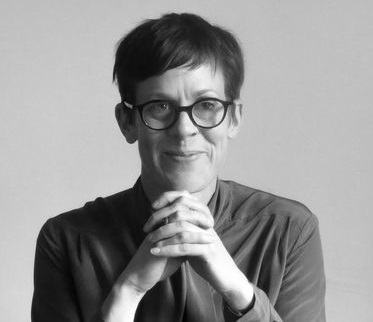 Lynley Edmeades is a poet and essayist, and the editor of Landfall Tauraka. In addition to Hiding Places (Otago UP, 2025), she has published the collaborative work Bordering on Miraculous (Massey UP, 2022) with painter Saskia Leek, and two collections of poetry, As the Verb Tenses (2016) and Listening In (2019), both published with Otago University Press. She teaches English and creative writing at Ōtākou Whakaihu Waka, the University of Otago.
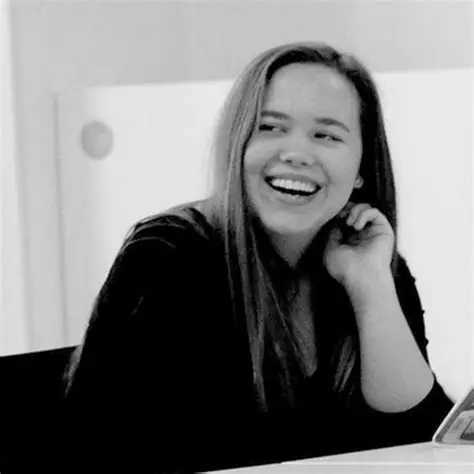 Sophie van Waardenberg is the author of No Good (Auckland University Press, 2025), a poetry finalist in the 2026 Ockham New Zealand Book Awards. She holds an MFA in Creative Writing from Syracuse University. Her poetry and reviews appear in Cordite, Copper Nickel, Landfall Tauraka, the Aotearoa NZ Review of Books, takahē, The Spinoff and elsewhere.
'Many of our best stories profit from a meeting of New Zealand and overseas influences' - Owen Marshall