Photo credit: Tom Moody

The Interview – Kevin Ireland

Kevin Ireland has such a deep association with the Devonport Peninsula of Auckland’s North Shore it comes as a surprise to learn he was, in fact, born on the south side of the city: in Mt Albert, as Kevin Mark Jowsey, in July 1933. While still a babe-in-arms, he was taken by his parents to London. According to family lore, he spoke his first words with an East End Yiddish accent.

His parents’ marriage began to unravel not long after the Jowseys returned to New Zealand. Kevin spent part of his childhood on a Waikato farm with his maternal grandfather (whose storytelling brilliance was a formative influence) and unmarried aunts, then moved to Takapuna to live with his father. In late adolescence he enrolled at Auckland University College, but he did not complete a degree, preferring to work in a succession of short-term jobs – low-ranking civil servant, Whitcombe and Tombs shop assistant, guide to the Waitomo Caves – while concentrating on poetry.

With a friend, John Yelash, he co-founded the literary magazine Mate in September 1957. An early short story, ‘Albert and the False Alarm’, appeared in the first issue with the imprimatur ‘K. M. Jowsey’. By the time the second issue was published in early 1958, he had had adopted the pen-name Kevin Ireland, by which he has been known ever since.

In 1959 he sailed to Sydney and then on to England, expecting to spend just a year or two abroad. Instead, he lived in Europe for more than quarter of a century, mostly in London, where he worked as a sub-editor for The Times, but also for a period in Sofia with his Bulgarian wife, Donna, with whose help he translated Bulgarian poems and plays into English. He always considered himself first and foremost a New Zealander, however, and throughout the 1960s and 70s he continued to contribute to New Zealand literary journals.

Shortly before his departure from Auckland , he had met and befriended Barry Crump and helped knock the raw material for Crump’s first book, A Good Keen Man, into publishable shape. Crump returned the favour by writing a hearty, vernacular introduction to Ireland’s first poetry book, Face to Face, which was published in Christchurch by the Pegasus Press in 1963. (‘He’s a good bloke. Generous as you’d find anywhere. Give you his last metaphor.’)

Ireland’s rate of production since Face to Face has been steady, with a new poetry book appearing every three or four years. As time passed, trips back to his homeland became more frequent, especially after the dissolution of his first marriage. In 1985, while holidaying in New Zealand with his second wife, Caroline, he decided to return for good and purchased a house in Devonport.

Honours, eventually, have come his way: the Sargeson Fellowship in 1987, the Auckland University Literary Fellowship in 1989, an honorary DLitt from Massey University in 2000, the Prime Minister’s Award for Literary Achievement in 2004, the A.W. Reed Award for Contribution to New Zealand Literature in 2006. His sixth book, Literary Cartoons, won the poetry prize in the 1979 New Zealand Book Awards and his memoir, Under the Bridge & Over the Moon, won the Montana Award for History and Biography in 1999.

Although primarily known as a poet, he began writing fiction again in the 1990s. A collection of short stories, Sleeping with the Angels, appeared in 1995. Five novels have followed: Blowing My Top (1996), The Man Who Never Lived (1997), The Craymore Affair (2000), The Jigsaw Chronicles (2008) and Daisy Chains (2010). Other prose works include The New Zealand Collection: A Celebration of the New Zealand Novel (1989), a second volume of memoirs Backwards to Forwards (2002), How to Catch a Fish (2005 – fishing having been one of his favourite pursuits since childhood) and an extended essay On Getting Old (also 2005).

Caroline died in 2007. In 2012 Ireland married Janet Wilson, a New Zealander who is Professor of English and Postcolonial Studies at the University of Northampton. Ireland now divides his time between England and Auckland. The following interview took place in September 2016. Ireland was soon to embark on another lengthy plane journey although he had been suffering from back pain caused by two slipped discs.


Can I start by asking about your beginnings as a writer? Where did the poetry impulse come from? Were you already writing poems at high school?

‘Poetry’ was Palgrave’s Golden Treasury when I was at Takapuna Grammar School in the 1940s. It had some great pre-World War I poems in it, but also a lot of worthy, dull ones. I learnt only to loathe Wordsworth and Tennyson, to accept an insipid version of Byron and Shelley, and altogether to think of English poetry as a kind of literary tea party, with tepid tea and a scattering of splendid crumbs. A smug and lazy English master, who gave weekly readings from his MA thesis on Wordsworth as our preparation for School Certificate poetry, helped reinforce this impression. The one memorable lapse in this systematic indoctrination against poetry was the marvellous Phoebe Meikle [later to give up teaching and work in publishing], who read us Ron Mason in the third form. It never happened again while I was at secondary school, but at least I was able to reconfirm that there was gold to rediscover when I was released from my conformist educational incarceration.


palgraves-golden-treasury


I used the word ‘reconfirm’ because I already knew that the experience of poetry could be intoxicating. Through the good fortune of unhappy circumstance, I happened to spend a couple of formative years, isolated during a time of wartime petrol rationing, at the age of about nine and ten, in a remote Waikato dairy-farming community, where the nearest boy to play with was a kilometre away. Here my grandfather, ‘Mac’ McKenney, treated me several times a week to solo evening performances of superb baritone singing, plus recitations – almost always from his gigantic memory – mainly of Byron, Coleridge, Burns and Henry Lawson [whom he had known], with a broad assortment of odd poems from here and there thrown in for entertainment. What superb shows he turned on for me and my aunt, who was the sole-charge teacher at the local school. What great performances. And how blessed I was to curl up on his chest, in front of the Champion kitchen range, with the low murmur of a kettle always in the background, in a delicious fug of Tasman Plug pipe tobacco, listening to it all in the snug folds of his thick, woollen cardigan.

I simply didn’t think of being able to write poems while I was at school. Poetry was for reading or listening to. It took a first year at university to discover that I was at liberty to write.


There’s a rather cryptic passage in Phoebe Meikle’s autobiography, Accidental Life, where she writes: ‘When I think about my TGS years two forms in particular come to mind, one of them being that very interesting mixed Three B Kevin Ireland was in, the form that in 1946 surveyed their families.’ What was the intention of that 1946 survey? Surely it would have been an awkward and probably painful exercise for you given the separation of your parents.

Phoebe Meikle was my form mistress in 1946 when I was in the 3rd form at TGS. She told me when she came to visit me in London some time during the late 1970s, that she had only two ‘exceptional’ forms to teach when she was at TGS: that 1946 third form and a fifth form she was also in charge of during the late 1950s or early 1960s – I’m sorry to say that I’ve forgotten the date. The 1946 lot all became achievers in one way or another. It was an extraordinary class to be in.

Phoebe taught us a broad and impossible mixture of history, geography, sociology and economics [and probably several other subjects] which was called ‘social science’ – for God’s sake. I don’t know whether it still exists, but it was a daft and fashionable amalgam for a while. One of the tasks she set us was to do a survey of our homes and families. It was interesting but nosy stuff, with lots of questions about such items as degrees of relationship, income and personal activities and habits – and people were not used to such intimate disclosures at the time, though it seems to be the common stuff of so many surveys now, including the nuisances who, almost daily, wish to interrogate us over the telephone. I believe that the headmaster put a stop to it after complaints from several families, including my very upset father. I definitely remember getting agitated about it all and I was very happy the following year to go back to old-fashioned history – it was dead and quite safe.


As a little side-question, I notice that in your earlier poems and consistently throughout Under the Bridge & Over the Moon you spell your old Takapuna address Rewhiti Avenue, but the current street sign says Rewiti. Has it changed over the years? Is this a rare instance, running counter to Whanganui/ Wanganui, of an ‘h’ being whipped out on re-inspection, rather than inserted?

Rewhiti Avenue was the accepted spelling when I was a boy. It was spelt thus on the street sign at the top of the road, and on all documents, bills and mail. A zealous and particular Takapuna Council at some time during or after the 1960s investigated and reformed the spelling of several streets in its area. Thus, Rewhiti became Rewiti [named after the son of the chief, Te Kawau] – and Esmond Road, which Frank Sargeson lived in, was corrected to Esmonde Street [named after one of the children of the Napier – who gave his name to ‘Napier Street’ nearby, and who bought and subdivided that part of central Takapuna.

Frank Sargeson’s father picked up a holiday section at some stage and he turned out to be far more generous than Frank ever allowed in his writing or conversation, for he gave it to Frank so that he would have a place to live in and get on with his writing [as well as far away from the family home in Hamilton, I suppose]. The old man may well have been a starchy, one-eyed puritan, as Frank always maintained, but that single gift counts well for him in my reckoning – and alters the picture a bit.


sargesonflat

The Sargeson flat, Takapuna.


You say in Under the Bridge your grandfather, Joseph ‘Mac’ McKenney, wrote poems too. Do you remember any of them? Have any been published? Did you show him any of your own early efforts?

My grandfather never recited any of his poems to me. And he did not write them down, for they were not to be found after his death. I asked him about them, but he would never open up and tell me, and with the diffidence of youth I didn’t think to pursue the matter. None were published in journals or books, so far as I know, though he was for a while, in his 20s, in the Sydney literary set to which Henry Lawson belonged. I just never thought to question him about such matters. I was used to him being alive and in my teens it did not seriously cross my mind that he was not immortal. His daughters, including my mother, recounted to me how he would raise boards and palings on his farm at Whangamomona and paint his poems on them for all to see, and they also said that no locals thought this to be in any way eccentric. They described his poems to be rather like declarations, which probably suited his strange manner of broadcasting them.


You’ve said on several occasions that you see yourself as continuing a poetic tradition begun a generation earlier by Ron Mason, Rex Fairburn and Denis Glover. I’m curious how well you knew these three on a personal basis. Do you remember when and how you first encountered their poems?

It’s really for others to say whether I fit a particular New Zealand tradition, if they are interested to do so, for I think there are now several braids to the flow of it.

I couldn’t help appreciating, as I felt my way along, that Mason, Fairburn and Glover assisted me, sometimes secretly, in theme and form. But I don’t know whether anyone else sees it that way. All three of them were excellent models, but I also think that there’s a time when most writers detach themselves from early influences and discover their own voice. I hope I’ve done so without entirely losing a reliable old accent.

I knew Fairburn only from a distance; he called occasionally into Somervell’s coffee bar, where he was selective about which cubicle he chose to sit in. There was the peril of enthusiastic, young hangers-on, such as myself, but even worse were the several determined and long-winded, arty tosspots, who bored the boots of brilliant conversationalists, such as himself.

Mason also came in from time to time, but in the early 1950s he was already a shut shop; the blinds were down and the door was locked. He was charming and encouraging to talk to, but you soon became aware that it was all front and no longer was there a poet at home.

Glover was marvellous, though I saw him mostly when I was in Wellington. He was approachable, kindly, funny, shrewd and clever – or at least he was before he got completely drunk, which he was busily working his way towards every time I saw him. Glover was up-to-date in his reading and he gave good advice. I liked him enormously and he told me once, in a pub in Molesworth Street, that he thought I sometimes wrote a bit like him. He seemed pleased.

I imitated them all quite consciously and it helped me to imagine that I was an inheritor of their new New Zealand ‘tradition’. This was something that I clung to while I lived in London for a quarter of a century. I believed that I would stop writing without their voice, standards and protection. The younger poets seemed to follow the American ‘new directions’, but I felt that it was vital to me, in my ‘exile’ [the exalted term I used for my expatriation], to think of myself as part of a continuity. I may have been mistaken in my sloganising, but the placard I marched under was real enough at the time.


I know you struck up an enduring friendship with Maurice Shadbolt during your time at Auckland University. Were you aware of Karl Stead or Keith Sinclair back then? Were Allen Curnow and M K Joseph part of the English Department at the time? I’m assuming you were enrolled in English literature, but perhaps you studied other things.

Curnow and Joseph were lecturing in the English Department at Auckland University, but you are wrong in surmising that I enrolled in English. I only completed units in history [two], political science and education. I never enrolled or attended any English classes. I knew that it was compulsory for an arts degree at the time, but I put it off because I had little interest in the books being studied. In the end I simply drifted away from university anyway, and I’m a bad example to all those industrious students who knuckled down to their texts for, all in good time, Massey University simply gave me a DLitt and proved my point …

Keith Sinclair was a very good lecturer in a strong History Department. I would have stayed at university if I could have stuck with history and not been required to piss about with such diversions as its then academic notions of ‘English’, etc. Karl Stead made everyone aware of him when he was a very bright student. But he worked hard, and engaged in a mad pursuit of Louise Henderson’s attractive daughter, so appeared very infrequently at Somervell’s or at boozy parties, even though Curl Skidmore’s adventures suggest the opposite.
 

mxb160525blin-0084-matb-freebie-if-i-recall

Photo credit: Matt Bialostocki


Where were your first poems published?

My first properly ‘published and paid-for’ poem was published in the Listener, some time during the mid-1950s.


Was not wanting to choose between your parents part of your reason for deciding not to use Jowsey as your writing name?

I rather liked being able to choose a name for myself – and I desired independence from both parents – but if I had had the same chance later I would undoubtedly have chosen a quite different label. ‘Ireland’ meant nothing personal to me; I chose it because I had an appointment with Frank Haig to change my name and I hadn’t thought of one [or, more correctly, I hadn’t chosen an outright winner from the dozens I fancied from time to time]. Then, because I had time to kill, I found myself walking down Ireland Street, from Ponsonby, towards Haig’s office, and I saw the street sign and thought on the spur of the moment that that would do for a surname. There are people who have given their names to streets, but I am the reverse: I named myself after a street in Ponsonby.


How did you get involved with John Yelash in running Mate magazine?

One issue of Mate magazine was put together [and paid for – 20 pounds was Bob Lowry’s fee] largely by myself, but the idea of it was hatched over much beer at parties or over coffee late at night, by Ross Fraser, John Yelash and myself – and by several others who appeared enthusiastic then disappeared or withdrew. I felt that the journal needed three editors to cast a wider net – and to share the blame if it all turned out to be a fiasco. Ross is dead now, but JY possibly has a different version of it all; I haven’t seen him in decades.


I’ve known for a long time you were a kind of ghost writer for A Good Keen Man, but it’s only just dawned on me that this was your first book – published three years before Face to Face and 36 years before your own first novel. Were you always interested in writing fiction as well as poetry? How did you and Barry Crump become acquainted? I’ve always thought he was at least as much of a beatnik as he was a bushman. Was he part of the Somervell’s Coffee Bar crowd when he was in Auckland?

I met Crump at a party in a Grafton Road flat when he was 18 and I was 19 or 20. I picked up on his gifts straight away. He was unique and I told him so on that first night. I certainly had a few beers in me, but when I insisted that he start writing I turned out to be far more percipient than I had any right to be at that age. He filled a gap in New Zealand writing that had once, fleetingly, been occupied by Frank Anthony, who made very little money out of it.

When I took Crump to meet Frank Sargeson, Frank cleverly defined him as ‘an anachronism’. It was true in every sense, but it was a perfect time to be one – the 1950s was a time for the luxury of literary nostalgia for a non-existent golden age of male, outdoors derring-do, good mateship, women knowing their place at the stove or wash tub and men without a care in the world. And in a newly urbanised, socially uncertain New Zealand there were huge sales and royalties in it – Frank Anthony, who was such a good writer and commentator, came just a couple of decades too soon.

I do agree that I more-or-less wrote one of the stories in A Good Keen Man for Crump, and had a hand in certain others, but it was really Crump’s own work. He dictated and I recorded, correcting automatically as we went. At the end of that first story, he got the hang of it, and he insisted on doing the rest himself. I deny writing the book. Jean Watson had a hand in it – and Alex Fry, who worked at A H and A W Reed at the time, before going on to the Listener, put a stylistic gloss on the final proofs. I don’t think that Alex ever claimed authorship himself, but I did hear it put about unkindly and absolutely wrongly that he had ‘virtually written’ the book. Alex certainly didn’t write ‘my’ story in the book and he didn’t write the others I looked at in manuscript – and the several times that Crump was mentioned when I worked on the Listener and saw Alex from time to time he never claimed anything other than that he had had to clean up [ie, edit] a very untidy manuscript, which was true.


bcrump-agoodkeenman-harley


Crump was no fake bushman and shooter. He was the real thing. I spent a fortnight with him deep in the Ureweras and he was the genuine goods. Brilliant in the bush and a hard and dependable man. He played up to the gallery later and he behaved stupidly; we all did, but by then his stage was larger and his actions seemed more gross – and they were certainly more tragic. Somewhere along the line he lost dependability.

Crump was a born beatnik too. He loved the Bohemian life that had developed in Auckland in the 1930s, survived the war, shot away again in the 1940s and blossomed in the 1950s. He adored being part of the literary world, with all the fun, the parties, the wit, the booze and the girls. When he found himself not being taken seriously and eventually criticised, put down, then censured, he turned his back on it all and denied ever being part of it. Another of his attempts to create his own manly, lonely myth. The real bits of Crump made him exceptional, but they became harder to define as he smokescreened his mistakes and disappointments; he kept trimming and changing his story and by the last time I saw him – when he wrote his final untrue and absurd memoir – he had actually come to believe his fictions. A fatal inner condition. Jean Watson and I were the only two ‘literary’ people who turned up at his funeral.


Can I come back to the Mason-Fairburn-Glover-Ireland poetic tradition again for a moment and ask what you’d consider its main attributes? Wit? Economy? Song-like musicality?

All true. But mostly a New Zealand accented ‘voice’. Or, at least, that’s what I felt at the time. I think that not only has the accent changed since then, but that there’s no single voice booming loudest any more – more of a choir, all warbling from different song-sheets.


When you began as a poet, metre and rhyme were still the order of the day for New Zealand writers. Was it difficult to adjust to freer concepts of form later on? Did you read American poets like William Carlos Williams, Wallace Stevens and Ezra Pound when you were young?

I was lucky to be there just in time for the death throes of Georgian poetry. There was more than a touch of it in Mason and Fairburn, though their best poems rise above it. The Americans saved us all, though I found e e cummings and Hart Crane easier and more useful as models to begin with – and I’ve always found Stevens too cool and stuffy; and I’ve never been able to see much more than a handful of glittering silver in Ezra Pound. The book of poems that most astonished me when I ‘discovered’ it by chance was Seamus Heaney’s 1966 second collection, Death of a Naturalist. It rang every bell in my head.

 death-of-a-naturalist-cover2


In an interview with Mark Broatch a year or so ago you referred to keeping office hours and putting in a daily stint of writing. Do you still stick to the same work routine? In recent years you’ve become beautifully adroit at writing poems that apologise for the failure to write poems. (‘Tonight, I am afraid, / I shall have to write you a poem/ about not writing you a poem.’) How post-modern is that? Although I guess you could reply that Coleridge was a dab hand at this too.

I have now totally relaxed my writing routine. Some months before I broke the tape at 83 I decided that it was nonsensical to follow a plan of work any longer. I have acquired a habit of arriving at my desk at some time during almost every morning, so why bother at this age to keep office hours?

And I write a lot of poems most years, so I think you overestimate the proportion of poems that centre on the act of writing. There are always one or two, not because I think that the problem of ‘why bother to write’ is of great concern [in fact, some attempts at this kind of poem can be irritating or boring or both] but because I find that the question remains a puzzle and because I sometimes find absurdity and wry humour in it, the possibilities of which continue to grip my interest. I guess that it also has a post-modern aspect, but that’s not a spur. Coleridge was great at everything. He and Byron are there in the first rank in my pantheon.


I was looking the other day at your 1989 book on local fiction, The New Zealand Collection. How did that come about? Have you considered doing a sequel? Which New Zealand novels of the past 25 years would you be keenest to celebrate?

It came about because it was brought out [in spite of the publication date], with state funding, in the sesquicentennial year. It was a rush job, and though I made an early start on it, by the time I got the final go-ahead, I had a six weeks’ deadline to finish assembling paintings and profiles and plot summaries for 52 NZ works of fiction – one a week for a year’s reading. I managed to do half the books myself and farmed the rest out among obliging and enthusiastic helpers, at reasonable rates for the time. I’d need a whole lot longer to attempt the job again and don’t think the challenge would be worth it any more. There are far too many good contenders. I read 37 new New Zealand novels in one year’s overview. How could you ever pick your way through so many, multiplied by 25? Eleanor Catton would be a certainty. And so would Vincent O’Sullivan, C.K.Stead and Fiona Farrell. It wouldn’t be hard to choose another 48, but it would be very difficult to be forced by a neat number to deny some their rightful place.


Some of your own novels – Blowing My Top and The Jigsaw Chronicles, especially –strike me as satirical extrapolations from the socialist ideas that you grew up with? Is that how you would regard them?

Yes. That’s the angle they’re written from. But their takes on politics are very different. The Jigsaw Chronicles is really a work of science fiction, so that always allows a writer to take monstrous satirical liberties.


In Backwards to Forwards you tell a marvellous anecdote about the painter Francis Bacon’s generosity to your son and you write warmly about distinguished Bulgarian writers you’ve known, such as Pashanko Dimitroff and Georgi Markov, but you don’t seem to have been acquainted with English poets and novelists. Were they a stand-offish bunch, or were you simply not that keen to become part of London’s literary circles or is it just a matter of happenstance that during your years in England you knew Francis Bacon and the Bernard brothers [Jeffrey and Bruce] but not the Amises or Christopher Logue or Craig Raine or Jon Silkin?

I just didn’t have time to pursue a personal acquaintance with English writers and though I may have liked their books, they didn’t appeal to me as company, just as I could hardly have interested them. My days were full enough.


I’ve just been looking at the poem ‘Happy twenty-first’ in your latest book, Looking Out to Sea. The inscription reads ‘for MFRS and 4 June 1953’. It took a moment for the penny to drop that the addressee is Maurice Francis Richard Shadbolt, who did, indeed, turn 21 on the fore-mentioned date. I can imagine Maurice enjoying the poem hugely, but, alas, he’s been dead for more than a decade. Which prompts a question about who you see as the ideal audience for your poems. Is it a consortium of literary-minded friends, not all of whom are still breathing?

Maurice Francis Richard Shadbolt’s 21st was the most exciting I ever attended – and that was in the heyday of big 21sts. The Shadbolt uncles trading bruises and spilling blood as they bare-knuckled each other across the back lawn remains forever as the family party to end them all. It had to have a poem to itself one day …

Balladeers and troubadours write for public occasions, big audiences and gate money – and some make a fine job of it. I don’t ever put them down. I’m on their side, for the best of them provide great entertainment, they’re good for business generally and, after all, they operate in one of the many Heinz varieties of poetry. I have done several readings that paid well by my standards, but I think about $800-$900 is the most I’ve ever made on an unusual night, of course counting in my private book sales. I got a four-figure fee once just for a reading – but that was a one-off so doesn’t really count.

Which means that readers are probably what I aim at – though I don’t think of any specialised ‘audience’ as such. I’ve seen my books being read very occasionally on buses and trains, and I haven’t been surprised to observe that none of these non-unusual and un-cartoonish readers would fit any high-falutin’ notion of ‘poem addicts’.

I have just completed my 23rd book of poems – Humphrey Bogart’s great sacrifice – and I can only hope that the usual suspects and the curious, the collectors and [who knows?] the infatuated will continue to buy me.


02eb4555f5732d68389da4c63558ffb7

Humphrey Bogart


I love the title. Which of Bogart’s sacrifices did you have in mind? Giving up Ingrid Bergman at the end of Casablanca or giving up the tramp steamer at the end of The African Queen? I’ve never been convinced that Rick in Casablanca is all that keen on women anyway. He seems so much more at ease with Claude Rains’ Captain Renault. Whereas Charlie Allnut in The African Queen loves the hell out of his smoky old boat. But perhaps you had neither movie in mind and were thinking of Bogie’s prowess as a chess-player.

This really happened. I hope it answers your question. The poem was published recently in the Australian Poetry Journal [ed, Michael Sharkey].


Humphrey Bogart’s great sacrifice


Catching a long-haul flight one night from Mascot I heard

the intercom cry out:  ‘Would passenger Mister Victor Laszlo –

Victor Laszlo – please report urgently to the front desk.’

Maybe all the other characters in Casablanca – Ilsa Lund, Sam,

Ferrari and the rest – are waiting to be called for flights as at last

their yellowing letters of transit come through. Even Rick

and Renault would have to be there. The Heart of Darkness

wouldn’t have suited their style and I’ll bet that somehow,

they would have made it back to the bar to play it all again.

Strasser and Ugarte, of course, being dead on film,

would have been let off all these tedious years of hanging about,

swapping airline chitties for cheese rolls while having to watch

each other day and night for bad nerves and a double-cross.

And think of it – the survivors of those passionate, perilous days

in Rick’s Café Américain (and his booze) must now be well over

a hundred years old, confused and coddled in blankets,

with nurses toting colostomy bags, bandages and medications.

They would need to be wheeled gingerly out to their planes –

to carry on to Portugal and a freedom that must now mean

something utterly different to them as they are hoisted

into their seats, then strapped in and wedged with pillows.

I wonder whether Humphrey Bogart’s misted mind

ever wonders whether the pain of sacrifice was worth it?

Life with Ingrid Bergman mightn’t have been such fun.

I know I’m mixing real life with shadows on a screen, but who

could be blamed for speculating after watching Bergman

‘painting Bogart with her eyes’? Anyway, as I distinctly heard

that night in Sydney (and however long and convoluted

the itinerary) they’re definitely on their way – and with no hope

of trying to be their true selves ever again. It’s all confused.

The only certainty is that every time I watch that magic movie

I wonder who could possibly resist risking another spin

of the wheel, cognac at elbow, knocking gingerly on wood?


One last collection I can’t resist since I’ve also been re-reading Dreamy Days and Nothing Done [Ireland’s 2012 poetry collection]. Did Pam, in spite of the ‘yellow paint’ and ‘flaky question mark’ after all marry the bloke who tried to woo her with a home-made slogan?

I saw the invitation for Pam to marry some jerk painted in huge letters on a long, solid wooden fence while I was on a bus journey from Oxford to London. I didn’t know either of them, so I’ve no idea of the actual outcome, though we all ought to put our money on Pam rejecting him – on the grounds the poem unequivocally declares.

And now for another lie down and stretch. Bugger sciatic nerves!


kevin-ireland-no-credit

Kevin Ireland


Iain Sharp is a writer and librarian. His most recent book is Sharing Our Ghosts: Poems by Joy MacKenzie and Iain Sharp (Cumberland Press, 2011).

'NZ literature is such a vast and varied thing' - Pip Adam

Read more

High Fidelity?


David Larsen investigates recent film adaptations of contemporary New Zealand fiction.


I’ve often wondered whether Andrew Adamson chose the title Mr Pip for his film adaptation of Lloyd Jones’s novel as an act of tacit acknowledgement. The novel is called Mister Pip. There are as many ways to adapt a novel for the screen as there are to write a novel in the first place, but whatever else an adaptation does or doesn’t do, it will always, always abbreviate.

‘Even if you have the most passionate and creative studio on your side,’ the novelist Cornelia Funke told me once, ‘what happens is this: you spend two years weaving a magic carpet, you hand it to the movies, they give you back a napkin and they say it’s the same. And you can only blame yourself, because you know they’re in the napkin business.’

In theory it should be so tidy. A novel is too roomy: it holds more narrative information – and usually more psychological information – than a standard feature film can accommodate. But then film is too rich: a few seconds of screen time drench audiences in visual and sonic information pages of words cannot easily convey. So adapting books to film means balancing what prose lacks against what films can’t do. Exteriorise the depths of the mind, and create complexity in the accumulating moment-by-moment rush of images and sounds to compensate for the plot details you’ve had to lose.

In practice this balance is very hard to achieve. I watched twelve New Zealand films for this essay, all of them relatively recent adaptations of New Zealand literary works, novels mostly. The films are all over the map in terms of adaptation approaches and degrees of artistic success. But the common issue facing most of them is the brute quantity of story beats: you will find fewer long takes in them than in twelve randomly chosen comparison films. They don’t, as a rule, have the time for them.


white-lies-poster


An instructive exception: the childbirth scene in Dana Rotberg’s White Lies (2013). The film is one of the weakest I’ll discuss here, but this scene is extraordinary, both in itself and in how it focuses the film’s larger concerns. It lasts a little over seven minutes. It consists of 15 takes. The first two of these are each around a minute long, and nearly static: exceptionally long, still expanses of screen time for a 90-minute feature film. Three women form a triangular composition in the lower right third of the frame, two kneeling in support of the third, who stands over them, naked except for a white shawl. They are in a dark cellar, earth-floored, in the centre of a pool of light. The room’s one dim window provides a balancing point of light to the upper left of the frame. The two kneeling women wear earth tones. The naked woman’s white skin and white shawl create a strong contrast, which carries charged meaning within the film’s story. (Consider the title.) The tableau is at once severe and arresting, and the scene overall is one of the most powerful representations of childbirth I’ve encountered in any art form: partly for its stark beauty, suggestive of some of the more austere high Renaissance paintings, and partly for all the things it has the courage not to do. It largely excludes motion and dialogue, and it doesn’t cut away from the pain it asks us to watch. It creates a still, quiet space and fills it with a single slowly evolving image.

Long, slow, dialogue-free scenes are notable only by their absence in most novel adaptations, good or bad. White Lies serves to underline this point, because it isn’t a novel adaptation. The source story, Witi Ihimaera’s ‘Medicine Woman’, is only 45 pages long. Its birth scene occupies precisely one of these pages, which by comparison with the film feels almost synoptic: a textbook example of a film departing from its source material in order to make fuller use of the medium’s inherent strengths, in this case by using the techniques of slow cinema.

So would film-makers looking for adaptation material be better advised to look at short stories and novellas, rather than novels? Certainly there’s an argument that the more natural form for novel adaptations is the long-form TV drama, with episodes loosely equating to chapters, and no particular need for the total number of episodes to be either more or less than happens to suit the source material. In absolute terms this strikes me as a convincing case, despite the tendency of television writers to impose a formulaic episode shape on bits of story that might not easily lend themselves to a 45- or 60-minute arc.

In practical terms, contemporary TV adaptations have to work within pre-existing series formats. Even something as powerful and intelligent as the author-adapted BBC version of Hilary Mantel’s Wolf Hall and Bring Up the Bodies feels artificially constrained: the BBC allows this adaptation of two enormous novels the same six episodes they allowed the Andrew Davies version of Pride and Prejudice, with the result that the series feels airless and far darker than the books. Anything not entirely essential to the grim core story had to be jettisoned.

So even though Eleanor Catton is writing the screenplays for the BBC version of The Luminaries herself, I am by no means confident that the resulting six episodes will constitute a better or more faithful example of adaptation than Alison Maclean’s recent film version of Catton’s first novel, The Rehearsal. The weasel word in this question is ‘faithful’. Whether or not you find Maclean’s film version, co-written with Emily Perkins, successful on its own terms (and I do), there is no simple way to argue that it’s a faithful adaptation.

It summarily amputates one of the novel’s two intertwined narrative strands, which involves the loss of Catton’s most interesting character, her unnamed saxophone teacher. It moves the scandal at the story’s heart from a Christchurch high school music department to an Auckland tennis club. It flips the gender of a major character and reassigns the racial and regional backgrounds of others. It creates an entirely new character and then has him commit suicide, setting up an ending which not only departs from the events of the book’s, but also departs from their narrative mode, via an audience-challenging swerve into self-referential meta-narrative. To call this a faithful version of Catton’s novel is to call the whole notion of adaptation fidelity into question. So let’s do that.

In the same way that there can be no strictly faithful translations – traduttore, traditore (translator, betrayer) is the Italian adage – fidelity in adaptations is a useful concept only if it’s defined loosely. A truly faithful adaptation of a novel would consist of the unabridged projected text, scrolling slowly down the screen. Even an audio reading of the text adds interpretive elements to the source material, and as soon as you add images, you’re on a different planet. Consider Dana Rotberg’s ability to capture so much of ‘Medicine Woman’ – the vitality of Maori midwifery traditions and the importance of this particular child’s birth, the emphasis on the colour of its mother’s skin, the heavily coded presence of contrasting darker colours around her – in a scene which contains none of Ihimaera’s dialogue, does not follow his descriptive language closely, and which rebalances the story’s structure. Absolute fidelity to the writing would not serve it nearly as well, even if this were possible – which it isn’t, because words are not pictures.

The best adaptations are ones that treat the book as raw material rather than gospel. A roll call of my favourite adaptations from the last decade and a half would include Andrea Arnold’s spartan Wuthering Heights, which strips away not only Brontë’s framing narrative but most of her dialogue, relying instead on a mix of images and ambient sound. It would include the giddy Joe Wright/Tom Stoppard Anna Karenina, which foregrounds the artificial theatricality of its almost parodic narrative compression by setting much of its story in an actual theatre. It would include Brad McGann’s bleak, glossy version of In My Father’s Den, of which Maurice Gee said, ‘he has lost the book … I can just make out the skeleton of it in his story’. And it would include The Rehearsal.

But it’s also true that a lot of the worst adaptations depart wilfully and wildly from their sources. Niki Caro’s Whale Rider (2002) simplifies Witi Ihimaera’s novel, excluding nearly everything from the chapters about the whales and the origin of the Whale Rider mythos; it jettisons the frank, earthy exchanges between Koro and Nanny Flowers and makes Koro, in particular, speak in a much higher register; and it makes Paikea (Kahu in the book) the main point of view character, rather than her uncle. These changes all have consequences. But the film still hews closely to the book’s core story, which is simple enough that the result feels like an unforced marriage of pre-existing Hollywood tropes (the excluded student who studies in secret and triumphs; the rejected child who wins her grandfather’s acceptance) with Maori history and traditions.


vintners-luck

The Vintner’s Luck


Compare this with Caro’s 2009 version of The Vintner’s Luck. There are so many problems with this film at a basic craft level that it’s hard to winnow out a sense of exactly what went wrong in its production process; clearly many things did, and the causal flow behind any really bad film is generally more complex than critics manage to acknowledge. But if you squint past the inconsistent use of aging make-up, the uneven acting, the risible special effects, and so forth, you can see two adaptation strategies at work. On the one hand, Caro’s screenplay imposes a circular shape on Elizabeth Knox’s linear story: the film opens with its main character, Sobran, about to die, and then offers us his story as a long explanatory flashback. The rough edges and false starts that are so crucial to the book’s telling of this story are smoothed out to a single quasi-spiritual quest for the ability to make the great wine Sobran will drink on his deathbed. Wine-making as the expression of a life’s accumulated wisdom: it’s a long way from the book’s treatment of the art form. Caro appears to be reaching for something comparable to Whale Rider’s easy-to-grasp genre tropes, though in this case that requires distorting her source material, rather than simplifying it.

And then there are the choices Caro makes around the sexual relationships in the film, and specifically her treatment of the interspecies, same-gender relationship between Sobran and Xas the angel. In the book this is either the great love of Sobran’s life, or one of them; the fact that the answer could be given either way tells you something about the nuanced complexity of the writing. In the film Xas and Sobran make love once, in a scene whose indelibly awful flying effects are so jerky and unevenly edited that visually it’s very hard to parse.

After Sobran’s mentally unbalanced wife walks in on them, Sobran furiously shoves Xas out a window, screaming, ‘Leave us in peace!’ The next time they meet, the two are rueful, calm, fond: they want to stay in each other’s lives, but Xas tells Sobran that for this to happen, Xas will need his help. Cut to a wordless scene of Sobran severing Xas’s wings. In the book this is an act of extreme violation, inflicted by a much stronger angel – by Lucifer, the Lord of Hell, in fact – for reasons no one in the story grasps at the time. The amputation is not explained in the film either. Making it Xas’s free choice and having his (renounced) lover commit the act at his request does not have to be read as the symbolic self-castration of the film’s one gay character, but that reading would be coherent. I find it persuasive myself. On the other hand, the film is in many ways not a coherent work. Perhaps the homophobic subtext is just the unfortunate cumulative side effect of an unhappy production process.

The Vintner’s Luck is a difficult film to assess definitively, because it’s badly botched. But it looks a lot like a film that would have dismayed admirers of the book more, rather than less, if Caro had managed to realise her vision for it more fully. Whale Rider, meanwhile, remains a sweet-souled, powerful film, and its power feels rooted in the book’s: Caro’s changes seem both relatively minor, and interpretively astute. Compare these two films with In My Father’s Den and Fracture, the two Maurice Gee adaptations of 2004 – one of them widely considered a high watermark of New Zealand film, the other more or less forgotten, I think in large part because of the burden it imposes on itself by being too faithful to Gee’s text.


fracture-hospital-scene-2-same-source

Fracture


Of the various films I mentioned to friends while piecing ideas together for this essay, Fracture drew the largest number of comments. The comments were versions of, ‘…there was another Maurice Gee film the year of In My Father’s Den?’ Fracture, Larry Parr’s adaptation of Gee’s novel Crime Story is beautifully shot, crisply edited, and makes cunning use of well-chosen locations. In some ways it’s clear why Gee himself liked it. (He described it approvingly as ‘sharp, hard’, and its script as ‘skillful, balanced and intelligent’.)

But for all that, the film’s a chore. The mood and the power of the book come from the interplay of external events with internal reflections: Gee dances from mind to mind across a large dramatis personae, letting us see the distorting weight of character and personal history on perception and comprehension. The film attempts to match this easy access to a large range of differing minds via a mix of expository dialogue, expressive music, and impressionistic cinematography and editing – one sequence, in particular, tries to convey a character’s collapse into insanity though images and editing tempo. The failure of these efforts is easy to understand when you consider the simultaneous effort to accommodate the entirety of the book’s intricate plot. If you stand close up and count off story beats, it’s a notably faithful adaptation (possibly the thing Gee appreciated?) but when you step back and compare the book with the film, one is moody and rich, and the other is cluttered and opaque.

In My Father’s Den makes none of these mistakes. It can happen that when you go back to a film or book everyone loved on its first appearance, you find it smaller without that boost of consensus approval –  clumsier, slighter, all very well but nothing special. I was ready for that experience, but a decade and more after its release, Brad McGann’s film remains a dazzling achievement. It feels like the successful adaptation of a major novel – so long as you haven’t read the novel.

Because although the film shares Gee’s characteristic concern with the depths of difficult memory that can hide behind someone’s eyes – its beautifully interfolded mysteries impel us to get to know several characters in a way that feels hard-earned and distinctly novelistic – the particular difficult memories we encounter here are not at all Gee’s creations. So does the film betray the book, and if so, does it betray it because a good film was unachievable any other way?

The film’s least important change: it relocates the story from a small Auckland fringe suburb to a small Otago town. Or is this actually a major change? As a practical matter it makes obvious sense; there is nowhere around Auckland now that could stand in for the mid-20th century West Auckland Gee wrote about, and McGann’s southern locations are well chosen and gloriously well shot. But aside from being a signature Gee location, his ‘small Auckland suburb’ is actually a small independent township in the earlier of his novel’s two time periods, and in the later 1960s chapters, the locals think of their ongoing envelopment by Auckland as an encroachment and a threat. This sense of threatened identity, and the associated sense of time as the bringer of corrupting change, flavours the book’s story. In the film, the unnamed town to which war photographer Paul returns after years overseas is a sleepy backwater hiding some of his worst memories: his initial (misleading) impression is that time has scarcely passed here at all.


in_my_father_s_den_gallery_2-jpg-552x402-nzonscreen-com

In My Father’s Den


In the book Paul is not a war photographer, he’s an English teacher. (The way in which the film’s Paul becomes an English teacher too, after returning home, is McGann’s least convincing plot contrivance, though he slides us past the extreme implausibility of it smoothly enough.) The film’s Paul is also fond of autoerotic asphyxiation and morphine, and he has scars on his wrists suggestive of attempted suicide. Celia, the teenage girl whose intense friendship with Paul comes under public scrutiny after she goes missing, has interests far more to the teen goth side of the street than in the book. And in the film we eventually discover that her background is tangled with Paul’s in complex and difficult ways, closely linked to the things that drove him to leave home, and perhaps to slit his wrists. None of this is in the book. The secret den of the title, which in both the film and the book is disguised as a storage shed for poison, is also closely tied to these revelations. You can easily imagine McGann thinking, yes, poison: Gee filled this room with books and ideas and called it a poison shed, and the ways in which he plays with the irony and the bitter partial truths of that for Paul’s later life are too tame. Let’s have Paul’s secret refuge become more powerfully poisoned for him. And then his discovery that Celia exists, and badly needs a mentor, and deserves love, will begin to free him from that. And then she’ll die, and he’ll be blamed.

The film’s handling of all this is assured: beautifully balanced in purely formal terms and emotionally devastating. The various ways in which the story is at once darker than the book’s, and less coloured by Paul’s self-dislike and his characteristic Gee-protagonist religious shame, could nonetheless be taken as an adaptation failure. The book lacks the easy attention-grabbing power of war stories and sexual kinks and drug habits; its revelations don’t flirt with incest. Does a film, with less time to build audience investment and less ability to access complex interior experiences, need the intensifier effect of this sort of material for the level of emotional power McGann wanted?

Of course not. A quiet film can punch just as hard as a loud one; McGann’s self-evident craft mastery argues against any idea that this was the only strong version of Gee’s story he could have found a way to make. In My Father’s Den is a magnificent film and we’re lucky to have it. But when Gee – according to Rachel Barrowman’s 2015 biography – told his agent that it was questionable ‘whether the film should be presented as an adaptation of his novel at all when it had moved so far away from it’, he was raising a reasonable point.

I described In My Father’s Den earlier as one of my favourite recent adaptations. I think of it that way; its nature as a work shaped by the process of engaging with Gee’s novel is obvious, and inextricable from its strengths. It’s also true that completely faithful adaptation is a contradiction in terms. But if I want to say that Caro’s The Vintner’s Luck is an offensive distortion of the novel even when you discount the film’s technical weaknesses – and I do – then I’m forced to agree that an adaptation should not be free to reconceive its source material without any limits at all. Fidelity to the book has to mean something, or, whatever the strengths or weaknesses of your film, you are not making an adaptation.


whale-rider

Whale Rider


This is easy enough to arbitrate when we’re talking about a film like Whale Rider. Another nice example of a film that departs from its source only where it seems necessary or helpful would be Mr Pip (2012): it simplifies Lloyd Jones’s story to fit its two-hour running time, and it finds visually inventive ways to show us the growing importance of a Charles Dickens novel in a Bougainville teenager’s life. (The fantasy sequences, in which we see Matilda’s conception of Victorian London, are particularly good – so startling, so obvious in retrospect, that everyone in this London would be black, and that so many aspects of the cityscape would mirror Bougainville.) In these ways and others, it tells the story Lloyd told.

But what is the useful meaning of fidelity when the book you’re adapting is The Rehearsal?

There are things text can do that visual art cannot easily match. My assumption, sitting down to watch The Rehearsal for the first time, was that I was about to see some species or other of train wreck: or, at best, a good film that resembled its source far less than In My Father’s Den resembles Gee’s novel. This is because when you read Catton’s book you are constantly evaluating and re-evaluating the ontological status of the events that make up the story. Even to say that a lot of what seems to occur in the book may not occur at all is a crude betrayal of the writing, because of course every one of Catton’s artful scenes occurs as written. It occurs on the page, and in our heads. But the book’s ‘real’ is not always the real of realism. Things can be true and false at once; scenes can occur in multiple mutually exclusive versions each of which ‘really’ happens. Possibly characters may be imagining some of these things: possibly some scenes are merely written in slipperier and more self-aware language than others. How do you translate a book like this to a screen?

It has occurred to me since that first viewing of The Rehearsal that there are films which do play ceaselessly and successfully with uncertainty over whether what we’re seeing is real, and over what ‘real’ means. Leos Carax’s Holy Motors and Guy Maddin’s The Forbidden Room are two recent examples. Carax’s film makes hay with the concepts of acting and performance in ways that are loosely comparable to Catton’s novel — not just to its drama school storyline, but also to the saxophone teacher chapters, excised by Maclean and Perkins. So my initial sense that certain aspects of the novel are simply not filmable now strikes me as a failure of imagination; though it does seem worth pointing out that Holy Motors and The Forbidden Room are aggressively unstable works of lunatic genius, with a heavy emphasis on the lunatic.


the_forbidden_room_still

The Forbidden Room


Maclean and Perkins’ response to Catton’s book in some ways appears far more conventional. They cut the more overtly anti-realist half of the novel entirely, thus bringing the story down to a filmable length. They shift a dilemma which crops up only very late in the book to a central position – in the book, drama student Stanley has no idea that the ripped-from-the-headlines story his drama class is using as the basis for a show is actually a story about his girlfriend Isolde’s sister. He finds out at the eleventh hour. In the film, Isolde tells him about her sister’s involvement in a sex scandal well before his classmates come up with the idea of making it the basis for their end of year performance, meaning that for a lot of the film’s length, this becomes its main moral and emotional point of suspense: what will Stanley do? If you ignored the way the film constantly shifts register and uses visual grammar to destabilise our response to it, it would seem like just another story about a young man wrong-footed in love by peer pressure: will our innocent hero betray the even more innocent Isolde to keep his cynical though secretly wounded classmates happy? Find out in the third of our three standard acts!

What actually happens in the film’s third act is an overt shift into meta-narrative. Stanley persuades his classmates to abandon the sex scandal play in favour of an experimental show based on a YouTube meme, in which they attempt to spark a mass audience exodus from the theatre by way of the stage. As the idea catches on with the audience and the stream of participants swells, the camera flips position so that we see them from just behind the stage curtains, looking out towards the auditorium. They approach us, they pass us, and they vanish: they have stepped off the stage and out of the film, moving in our direction, the direction of non-story-space. The film is over.

The brilliance of this is that by abandoning the book’s ending to do something possible only for a film, Maclean and Perkins create an acknowledging counterweight to all the things the book does that are possible only for a book. The ending would come as a rude shock if you had been perceiving the film strictly as a coming-of-age story – it comes as a shock in any case – but in fact the film prepares the ground, and in the process mirrors the book’s formal challenges in many other ways. Successive scenes use different modes and appeal to different conventions, in ways that constantly foreground the film as an artefact. There are scenes where we spend long moments unable to tell whether music is coming from a source inside the film, or is audible only to us. Characters are acting parts for an audience in some scenes, and we can’t always tell this immediately. (This allows the film to make powerful use of a passage from the book where Catton describes the precise appearance of a girl at the moment of orgasm, a beautiful piece of prose of precisely the type adaptations should usually avoid at all costs. Here, a character’s abrupt shift to a more poetic and arresting linguistic register is just one bit of stylistic playfulness among many, and turns out, of course, to be part of a rehearsal.)

One of the central arguments in literary translation is over the question of equivalence. If translating a passage literally would produce a very different effect in the new language than in the original, should you attempt to find some different way of translating it, less literally accurate but more equivalent in effect? All film adaptations of books answer this question with a firm ‘yes’ simply by existing; but some seem not to know it, or to understand what it means.

Others do not look for cinematic equivalents for their source books so much as use them as booster rockets, to be discarded on reaching escape velocity. This is why I consider The Rehearsal a faithful adaptation, as perverse as the usage may seem. The experience of seeing the film is not really very close to the experience of reading the book. It hardly could be. But the film responds to the book, reflects the book, plays with the book, and knows better than to try to be the book. It reflects a sophisticated sense of what adaptation can and can’t do. There are worse kinds of fidelity.


the-rehearsal-ecatton-sourced-nziff-may-need-permission

The Rehearsal


David Larsen is a freelance writer based in Auckland.


'...we were there as faith-based writers, as believers in the mana of Oceania...' - David Eggleton

Read more

Letter from Shanghai


Heidi North-Bailey returns to China as the New Zealand Fellow on the Shanghai Writing Program.


A room of one’s own

I was last in China 12 years ago. I lived not in Shanghai but Huizhou, Guangdong province, southern China. I was there teaching English and drama for a year. The studio room I shared with my then-partner was tiny, decorated in every shade of brown. It was also deeply inauspicious, apartment number four on the fourth floor, double bad luck.

The bathroom/shower/kitchen was one tantalising unit. Tucked beside a squat toilet with shower nozzle dangling over it was a sink and hotplate attached to a dubious-looking gas bottle – it did once leak gas and almost kill us. The small bar fridge doubled as a bedside table. If either of us wanted any privacy in the space we had to pull the thin nicotine-coloured curtain around the bed (careful not to snag on the fridge) and sit inside the yellowy polyester walls.

I did not do any cooking in that apartment. And after the gas incident we removed even the possibility of using the hotplate.

I knew that China had changed rapidly since I was last here, and that the Shanghai Writing Program probably has a better budget for accommodation than the language school I worked for last time, but still I braced myself for what to expect of my accommodation.

Comparatively, the room I’ve been given is palatial. An air-conditioned oasis of calm, a studio one-bedroom hotel unit much as you’d find anywhere in the world. I have a separate bathroom – a Western toilet, whole shower unit all to itself, a large glass basin. And a small kitchenette with two electric hotplates, a rice cooker and a slightly unusual collection of cutlery. No toaster, but I’m very happy to have a kettle to make tea.

My writing space doubles as my kitchen table, but because I don’t plan on cooking much in this city of divine food, it quickly becomes just my writing desk.

Best of all, this room, for two months, is all mine.


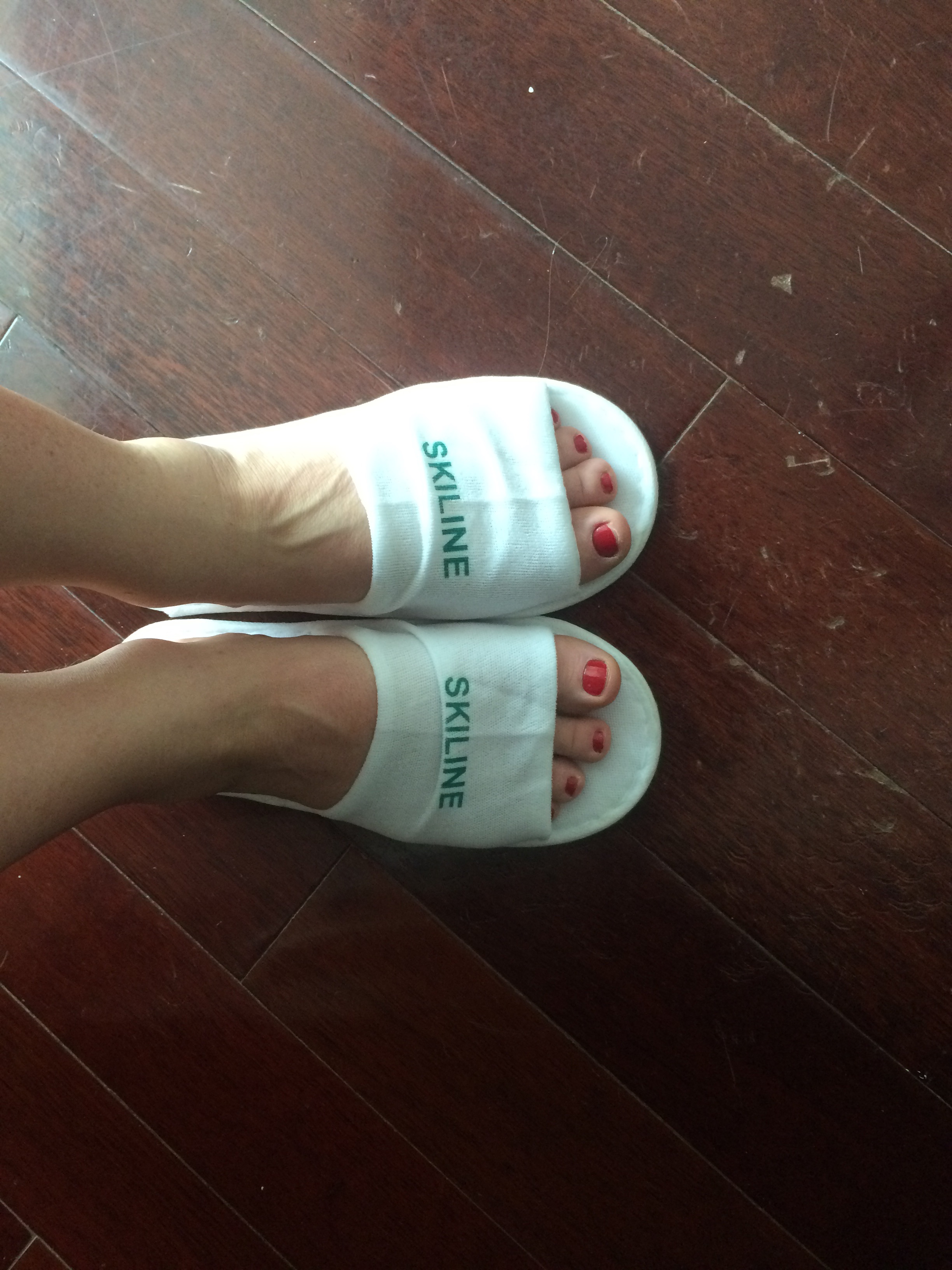
My writing desk. And why my bags were so heavy. Thrilled to have Paula Morris’ Hibiscus Coast, set partially in Shanghai with me, and also Alison Wong’s As the Heart Turns Silver. Alison was my predecessor on this program.


slippers

Essential for quality writing.


Three writers in the plum rain

On my second night we had our welcome reception at the Shanghai Writers’ Association headquarters. Some of us had met informally, but this was the first time all ten writers would be together.

I’d been out that afternoon when it was slightly cooler – still around 30 degrees but the sun wasn’t beating down quite so hard. I was looking for a teapot, and in my jetlag haze I’d been distracted by a whimsical laneway. So vaulting back to the hotel, teapot clutched under my arm, I only had time for a quick shower before throwing on a red dress and applying a sweep of red lipstick before going down to the lobby.

A car arrived to pick us up, which was lucky because as we stepped through the hotel’s glass doors the tropical downpour started. The season of plum rain, as they call it here: we arrived at the tail end of it. But that night rain fell in waves, hissing on the steaming pavement.

Once safely stowed in the air-conditioned cabin of the car we made our way through the city, inching through water and heavy traffic. When the car stopped, the driver indicated to the two people in the front seat where to go. By the time the three of us in the back had exited the car, the others had disappeared into the night.

‘This way!’ exclaimed the Polish YA writer I’d just met in the car, rushing off on her skinny heels into the thundering rain. ‘I saw them run this way!’

The Argentinian poet and I ran after her, hands over our heads, trying uselessly to stay dry. By the time we all got under the cover of a flimsy awning, there was no sign of anyone. We checked the two restaurants on the narrow street, looking for a welcome banquet. Nothing but some very helpful staff trying to usher us in from out the rain to eat at their deserted restaurants.

We traced our steps back to where the car had stopped. No sign of our destination. No sign of anybody. The plum rain continued.

Three writers lost in Shanghai. The Pole was concocting such a tantalising adventure story for us – focusing around me, the lady in the red dress – that I almost didn’t use the phone number I’d taken from one of our hosts when she picked me up at the airport the day before. She tried very honourably not to laugh when I explained our predicament, and, in less than one minute, a man materialised to lead us to our dinner destination – right opposite where we’d been dropped off, but tucked at the end of a dark garden. However, had we not listened to our dazzling Pole, we might have noticed our fellow writers running down the garden path.

The rain. The novel I want to write is tentatively titled In the Shanghai Rain. It does not, as yet, feature getting lost with two other writers, but it might now feature a woman in a soaked red dress.


The hallway of sweet messages

Starting to write this morning, but stalling, filled with questions about how exactly to structure my novel, I went adventuring instead.

I wandered towards the Bund with a willowy American writer with a cascade of dreadlocks, and we decided to step inside the Peace Hotel. The lobby is pure Art Deco – dark panelled wood, beige tiles, shimmering crystal chandlers, jazz crackling in the background.

But one floor up it transforms to über-modern, all white walls, blond wood and steel. The place is deserted. We wander through the hallways, and discover we’re in the heart of a flashy artist residency, the Swatch Art Peace Hotel. We’re surely not supposed to be here, but there’s no one around ask us to leave. The vast white door to one studio is open and we peek inside the space-age modern smooth space to see a laptop, a man’s cracked black leather shoes and stacks of plastic neon cut-outs strewn over a table. We back out quietly, and that’s when I see the first message, tacked on the otherwise immaculate white hallway wall:


Give me that dark moment, I carry it with me like a mouthful of rain.

                                                                                                              Mary Oliver


mary-olivier


And wandering further down the hallway, there is another, on a torn piece of paper:

            Live your questions now, and perhaps even without knowing it

you will live along some distant day into your answers.

                                                                                                 Rilke.


rilke


After that everything felt like a sign.


The hallway of sweet messages


Live your questions now, Rilke urges

one day the answers will rise


like the one tight pink lotus flower

in People’s Park


holding tight, unbudded while

others around it bloom in abandon


Give me the dark moment

I will carry it


like a mouthful of rain

Mary Oliver’s voice torn at the edges


scrawls over a scrap of lined paper

a murky surface


in the shimmering steel white

hallway lined in artworks and light


the artist tells me

There are so many new walls


in today’s Shanghai all those empty spaces

and nothing to fill them


even t-shirts jostling along The Bund

might contain the answer


I disappoint myself /

It’s not ok


in the bathroom I turn to a Warm tip!

everything is not as it seems


in this city of soaring heat

snowflakes are indicated


The Window Finder

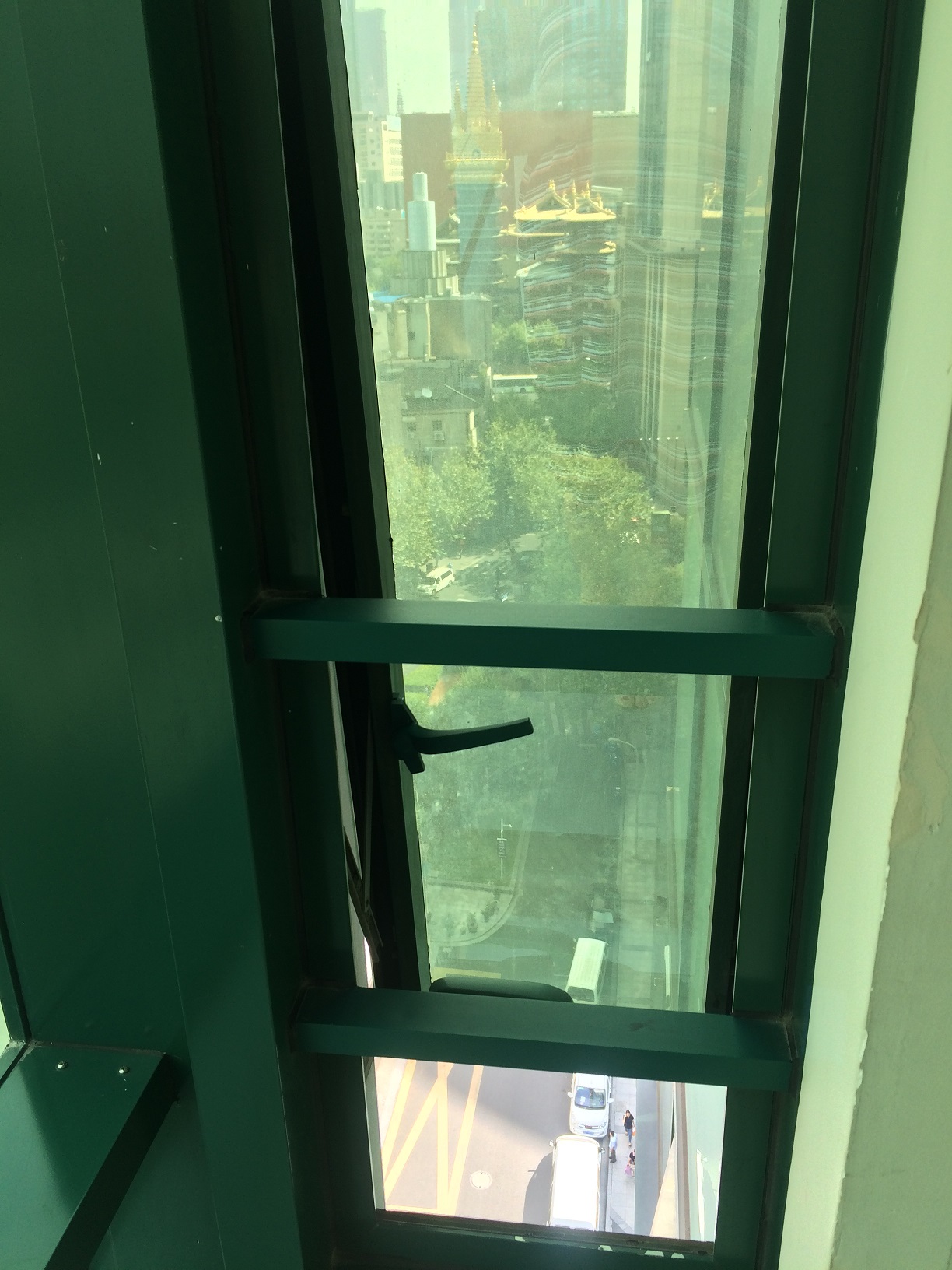
I quickly become known in the group of writers as ‘the window finder.’ I’m not sure what possesses me to crawl along the window ledge behind the bed exploring every inch of my room, but there I find it, tucked in the corner, the one narrow window in the room that can be opened. I open it, because even if the air is smoggy, there is something about being able to open a window that makes all of us writers breathe easier.


The one window.

jingan-temple-rising-out-the-window

Jing’an temple rises through the smog out my window.


my-view

This is my view when I sit or stand in my nook, with my face pressed to the window and look beyond the building just in front of my apartment.


I often take my laptop and a cushion and sit in this secret nook. I’m trying to write a novel, for the first time, while I’m here. It’s daunting.

The American writer from Boston who’s written five novels and been translated in 16 languages gives me some excellent advice.

‘Novel writing is like rock climbing,’ she tells me. ‘It’s not hard until you look down.’

I think of this sitting at my open window. The view is much better when you look out, not down.


On being here

Shanghai is a city of extreme extremes. There are almost 25 million people packed into this place. It’s the most populous city in China, and the most populous city proper in the world. The numbers are unimaginable.

The city is like a crazy mirror maze at a fun house – distorted versions refracted and reflecting, each direction you turn a totally different vista, and even if you look back again, it’s never quite the same.

If I walk ten minutes from where I’m staying in one direction I will be in Gucci-land: air-conditioned malls, slick stores with gleaming glass doors selling all manner of designer goods I have no hope of buying.

On the road, claiming space from the electric bikes, beat-up taxis, the thrum of people on foot, and women huddling under bright umbrellas in the beating sun, teenagers drive past in their Porsches.


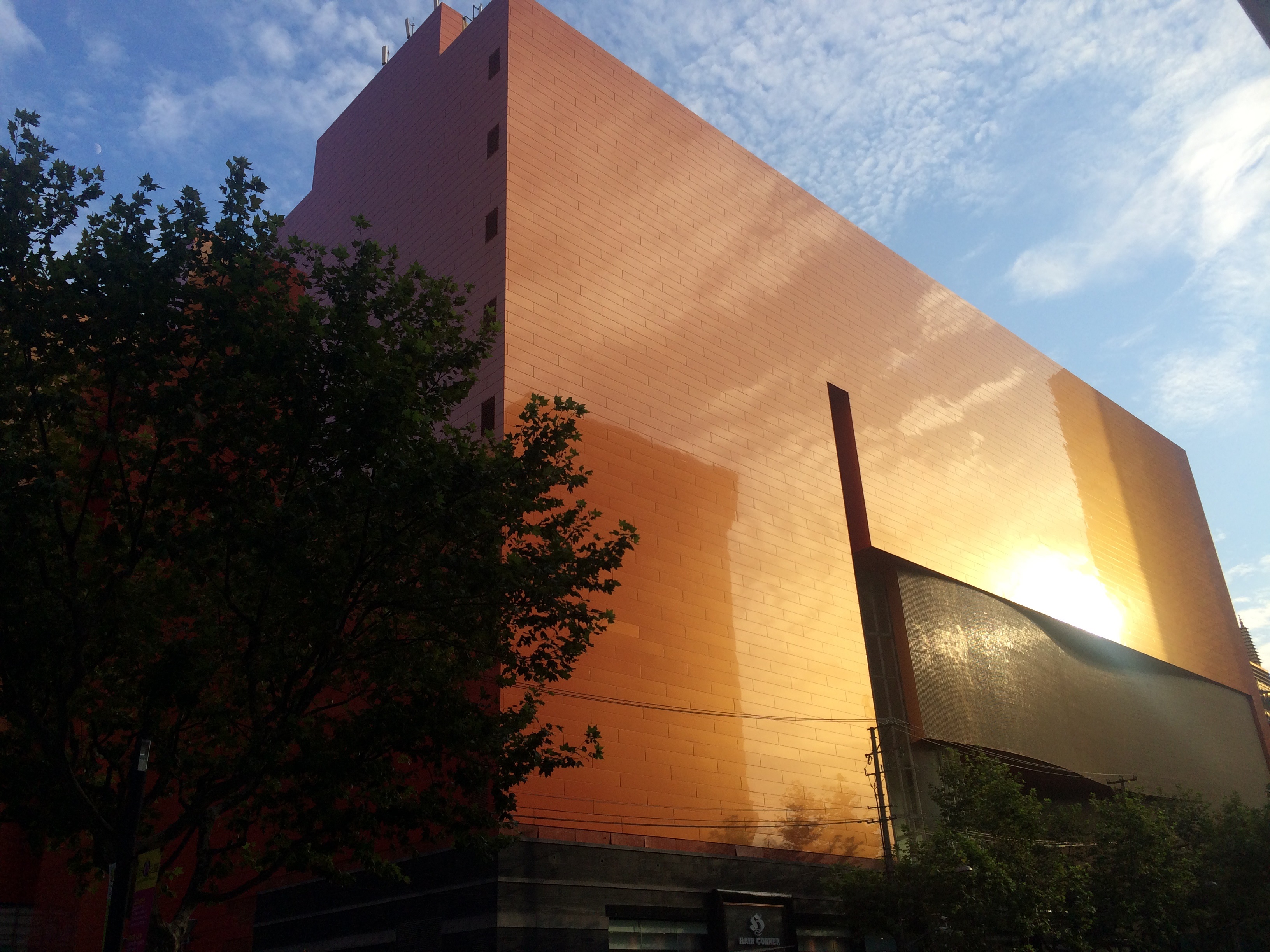
The smooth face of one of the many, many malls.


If I walk in the other direction I’m in lilongs, older-style Shanghai laneways, and stepping into one of these alleyways is an instant relief. There is no traffic save the odd motorbike and older people wandering on foot. Here you can hear the sound of their plastic slip-on sandals scuffing the pavement, their bursts of language.

The laneways are too narrow for cars, although I do occasionally see one forcing its way though, inching forward, the driver’s hand jammed on the horn as people flatten themselves into doorways, tutting.


A sneak peak into a lilong backyard.


While I’m here I want to absorb this city as if my skin was steamed open, unwrapped like a dumpling before it’s sealed tight with expert lightening-fast fingers at the outlets on every corner. I want to soak in the feel of this city, this crazy, bustling, bursting place. I walk around and around these streets because I want to have a body memory of the way the sky is low-slung purple on the evenings when the smog is thick. The way neon lights shine like beacons when the sky is damp with rain. The way the constant waves of people part and lush piles of vegetables – tomatoes, bok choy, spinach and skinny long aubergines, heaped in woven baskets sold by a toothless granny with a fistful of money – surprise me when I round a corner. The way a four-year-old, glossy and immaculate in a dress made entirely of white frills grins and gasps and points, tugging on her grandfather’s hand, saying, ‘Hello, hello!’ as I pass her.

And then when it becomes too much, I hurry back to my air-conditioned room, stopping only to stock up on the essentials of life: watermelon, water and bao zi (feathery fat steamed buns filled with chopped vegetables).

For a few dazed moments when I return to my room I sit there, only the hum of the air conditioner and the sounds of the street drifting up nine floors punctuating my breathing. I don’t turn on any music; I just breathe in the sweet clean quiet.

Then I make a pot of green tea, watching as the dark tight leaves begin to unfurl in the glass teapot I bought on my second day here. And then I start to write.


Heidi North-Bailey, the author of a poetry collection, Possibility of flight (Makaro Press, 2015), is the second New Zealand Fellow on the Shanghai Writing Program, joined by nine other writers from the USA, Israel, Denmark, Argentina, Russia, Poland, Spain and Catalonia.

Every second year a New Zealand writer is invited to attend. In the intervening years, a Chinese writer is invited to a residency hosted by the Michael King Writers’ Centre in New Zealand. Heidi’s residency is made possible by the Michael King Writers’ Centre, the China New Zealand Friendship Society, the Shanghai Writers’ Association and the Association for Friendship with Foreign Counties in Shanghai.


'I felt energised by the freedom of 'making things up’' - Maxine Alterio

Read more

Photo credit: Tracey Wong

The Interview – Elizabeth Smither

Elizabeth Smither is one of New Zealand’s most acclaimed poets, the author of eighteen collections. Her latest include The Blue Coat, (AUP 2013) and Ruby Duby Du (Cold Hub Press 2014). A new book, Night Horse, will be published by AUP in 2017. She has also written five collections of short stories, five novels, and two volumes of journals, most recently  The Commonplace Book (AUP, 2011). If this sounds like a literary shopping list, it’s more a recognition of her versatility and the depth of her achievement across multiple forms.

Elizabeth’s work has won numerous awards, including the NZ Book Award for Poetry (A pattern of marching, AUP, 1989) and the Montana NZ Book Award for Poetry (The Lark Quartet, AUP, 1999). Her fiction, non-fiction and poetry have been published in journals throughout NZ, Australia, the US, France and the UK.

She was the Te Mata Estate Poet Laureate from 2001 – 2003, received the MNZM for Services to Literature in 2004, and won the Prime Minister’s Award for Literary Achievement in 2008. Also in 2008, Auckland University awarded  her an Honorary D Litt. She has also won the 1987 Scholarship in Letters, the 2014 Janet Frame Award for Literature, and the 2016 Sarah Broom Poetry Prize.

Elizabeth lives just five kilometres from interviewer David Hill, a distance they regularly traverse for fish-and-chips and damaging cakes. So this email interview was supplemented by numerous telephone conversations, plus a session around the Hills’ dining table where the final format was achieved with a large pair of scissors.

The interviewer wants to thank his subject for her patience, her tolerance of his lumbering questions, and for the continued pleasure of receiving her rich, thoughtful, delightfully allusive and oblique replies. 

The ways in which even the most mundane events or ideas move Elizabeth Smither to unexpected, rewarding analogies, plus the meticulous, multi-levelled quality of her spoken words on writing and writers wind through the printed words of this interview.


Shall we begin by looking forward? Next year, AUP will publish your new poetry collection, Night Horse. This puts us in the singular and privileged position of being able to ask for a sneak preview. Can you tell us anything about the content / structure / direction of Night Horse? Can you offer a trailer for the title work?

Though Alice is not the only animal in the collection, she is the most important. An amazingly dominant mare, liable to throw a rider or bite. I approach her gingerly, with a half-apple on my palm. One winter’s night, while I was turning my car beside her field, I saw something of her secret life. Mist was rising and Alice in her canvas coat and face mask with ghostly eye-holes was stepping through the field as if in a trance.

Another poem in the collection, ‘Blaming the horse’, debates Alice’s life now, compared to her life in Melbourne as part of a herd. Her present companion is a Shetland pony who waits devotedly on her like Juliet’s nurse in Romeo and Juliet.


Let’s talk about one of your most recent collections, The Blue Coat (AUP, 2013). One online reviewer admired your ability ‘to find something magical in what most people overlook’. It’s true that you show significance in a chipped plate, a pen, library issue slips, ‘the littlest gardens, small backyards’. A touch of Blake here, is there? ‘….a World in a grain of  sand…..Infinity in the palm of your hand.’?

I’ve always thought that there are two parts to being alive: the self we all possess, in its physicality and inner life, and the world itself which has its own existence, its physical laws and endless variety. It’s the meeting of these two that is so fascinating. Rather like a painting that has a window with a receding view and, in the foreground, a domestic scene: someone sewing or writing a letter. The outer world regarding the inner world and vice-versa.

Often there is some irony involved or a comment is implied. ‘High wind in the garden’, for instance, contrasts the little tamed domestic garden which is undone and has its flowerpots bowled with the sweeping Capability Brown garden which positively embraces the magnificent storm.


          Only the widest gardens can hold it.

          The great vistas, the enormous fountain….


The Blue Coat also has poems which confront those much-trumpeted Big Issues: Birth, Leaving, Death. Actually, is ‘confront’ the right word? Anyway, there’s one word here, ‘Dying’, which makes my eyes brim whenever I read it, and not only because it includes people I know or knew. Throughout the collection you celebrate and / or farewell several friends – and a favourite dog. How does it feel to write such quietly cleaving lines? How does it feel after you’ve written them?

The big issues are always lurking, even in the smallest subjects. More important, I think, is to go as deep as you can. In writing about a funeral it might mean a wildness in the language to match the inchoate feelings of grief; another technique might be a detachment as cold and clear as winter light.

Afterwards I feel a mixture of things: the pleasure of writing, which applies even to unsuccessful writing, an exhausted, drained feeling. Followed shortly after by the image of a looming school inspector: ‘Is this the best you can do?’ And my feeble response: ‘So far.’


Photo credit: Jane Dove Juneau

Photo credit: Jane Dove Juneau


I realise this may be just a fatuous variation on “Where do you get your ideas from?” But I’m always intrigued by the genesis of works: the moment / awareness / shift which begins the process of making. You’ve recently written a series of poems for your American friend and author of art historical texts,  Amy Reigle Newland. Can you tell us the narrative behind these?

I should hit you with a brick. ‘The moment / awareness / shift’ are all correct. You could add unease  /false daring / a galvanising awareness of ignorance and the need to bluster.

In the case of the Amy poems they began with a Pilates class in which neither of us were exactly stars and led to Tuesday dinners at a Chinese restaurant, ‘The Laughing Buddha’. One evening in a heavy downpour I watched Amy approach carrying a bag of books she could hardly lift.


   Amy strides across

   the zebra crossing, a bulging bag of books

   in each hand. Head bowed against the rain. 


It ends in gratitude which is greater than any approach or difference in temperament…


        … I will hold an umbrella over her


      for her pristine devotion to scholarship

      for her seeing in the heat of careless writing

      a parallel longing for a jewelled fact.


                               from ‘Amy brings the thesaurus’: The Blue Coat (AUP, 2013)


The subject of Amy’s thesis was Toyohara Kunichika (1835-1900), the Japanese woodblock artist, drunkard and womaniser, over whose grave Amy had the temerity to speak farewell words in Japanese.


      Amy in hospital with broken wrists
  

       The last time you were in Tokyo you told me

         you stood at the grave of Toyohara Kunichika

         the artist you loved so much and bowed


         despite his paramours, despite his reputation

         (we used to carouse a bit on Tuesday nights

         gorging ourselves at the fish restaurant)


         compared to Kunichika we were paper dolls

         he would have laughed at the sauce running

         down our chins, our modest two glasses of wine


         and now, the day we’re due to feast again

         in another city, with other friends, he strikes

         at a crossing in the guise of a madwoman


         knocking you to the ground and breaking both your wrists.

         At your grave visit, under your breath, you’d given him

         his marching orders: your thesis was complete and handed in.


         In your hospital robe, in your curtained stall where

         we all push in to commiserate, you seem

         from your high bed to be holding court.


        An orderly appears. The pain you say is 6.

        The orderly is sceptical. I think you’re overjoyed your

        lover’s risen from the tomb and eaten all the shrimps.


from Night Horse (AUP, 2017)


Long before the broken wrists, Amy and I were driving in her sporting MG with the top down, Amy in a stylish cotton dress she had just ironed and a straw hat with a black ribbon, worn at a rakish angle. It is one of those glancing poems that, thanks to cheap sunglasses, turned into white gum trees, fumbling hands and suspenders.


        Driving with Amy in the MG


         We sweep around corners in the Adelaide Hills

            and red light flashes through my cheap sunglasses. ‘Do

            you see red?’ I ask Amy but she shakes her head.


            The gums are unclothing themselves. Mainly beige

            are their undergarments. Soft grey the carpet

            the undergarments fall on. Long stockinged legs.


            I think I am in a red light district. My head

            aches as we drive through red flashes, underwear

            white stringy hands reaching for suspenders.


from Night Horse (AUP, 2017)


There’s a coda, after the broken wrists, because a poet or a scholar should not be broken by superstition. Paul Hetherington had asked me to contribute an ekphrastic poem to Cordite. I chose the less common meaning: ‘a vivid description of a scene’ (rather than a painting) though painterly qualities were present as well.


Elizabeth Smither at her desk. Photo credit: Liz March.

Photo credit: Liz March.


        An extra oyster for the Doctors


      Entrée: raw oysters on the shell. Price

         on application but they will be raised high

         on a bed of ice and lemon slices.


         A dozen and a half is not available

         so we take a dozen, abashed

         that oyster eaters cannot have their number


         which would have given us three each.

         Who forks the first and slips it down his throat

         would like to seize the rest and lick the platter


         or hurl the oyster shells over one shoulder. An

         alumna of the University of South Carolina proposes

         the final three go to the most distinguished scholars


         first to the one whose golden thesis sits beside her plate

        another to a prodigal undeserving Hon D Litt., the last

        to an unassailable Distinguished Professor. The moon


         looks down on three tipped back throats

         once tugged by gowns and Gaudeamus notes

        processing stagewards to receive the precious oyster.


from: Night Horse (AUP, 2017)


Perhaps the real model for autobiographical poems involving friends is not words but music, the equivalent of Elgar’s ‘Enigma Variations’.


The eponymous young lady of Ruby Duby Do (Cold Hub Press, 2014) is your first grand-daughter. Any comments re writing on such a potent topic?

Grandchildren waken such a fierce love, it’s a wonder a poem can contain it. Everything gets re-examined and poetry as well.

We took Ruby to an Italian restraurant in Melbourne where she was remarkably well-behaved, apart from taking a bite out of a polystyrene Greek pillar. When we were leaving, I knelt down under her high chair to pick up the leftovers, and it felt like homage.


How do you know when a collection is ready to submit (apart from the publisher saying ‘Elizabeth, it’s time we….’)?

I like to have 60 poems, without sections or themes (though themes and connections appear between individual poems). Four years is a good gap; in that time a fair number of poems will have been published in journals or online, like children who have gone out into the world and got diplomas.

I have a folder labelled Next Collection, in which poems come and go; the evaluation of a poem can go through many stages: favourite one minute and then ‘Whatever did I see in this?’ the next. And sometimes a poem has something odd or new about it, and is favoured because of that.


You’ve been one of New Zealand’s Poets Laureate. What does the honour (and it is one) do for the recipients? What does it do for poetry in NZ?

I’ll list some of the pleasures. John Buck and family, top-shelf wine, the tokotoko with a whale’s tooth, the swelling company of fellow-laureates, a packed reading in the National Library where the audience formed a long avenue down which we walked later; the hush that poetry can produce; the amazing resurgence the laureateship has begun; the fun of sitting at the airport with Cilla McQueen and wondering if we should stand on one another’s shoulders to make one tall laureate.


Have the ways in which poems begin changed as you’ve written more? I’m asking because – forgive the interpolation – I find that I used to be able to trace the ideas behind a piece of work back to a single source, more or less. Now things seem to begin more from a nexus, a combination of ideas. Is it anything like this for you?

Definitely nexus or nexuses. I’ve always admired your vocabulary! I think memory can be a crucial element, something in the present that ties itself to the past, something vague and even disturbing, a taste, a scent, or something that does that E M Forster dance of ‘Only connect!’ Or it can come as an answer to something puzzled over and half-analysed to death: one day the last piece of the puzzle falls into place.

Of course it is always important to remember when writing poetry or prose that the answer is not quite there – we write to discover it and the relief and pleasure is so great we don’t quite close the door on it, there may be even more to find. I’ve always thought the Person from Porlock was not an enemy but a friend.


A pointless question, which of course is the point of my asking it. Your first poetry collection, Here Come the Clouds (Alister Taylor) appeared in 1975. If you had been able then to glimpse the poems you would be writing and publishing….. ahem….forty years on, how might you have felt?

I think I would have felt pleasure at being able to go on writing, at visualising the shadowy books that had not yet come into existence. I’m always interested in the next thing, the next poem. When a real school inspector bent over my exercise book at primary school and asked me to show him my best page, I turned automatically to the last page I had written on, and said ‘The best, so far’.


Photo credit: Tracey Wong

Photo credit: Tracey Wong


Have you been surprised / diappointed by which of your works receive most acclaim? There are certain poems and stories of yours that I always extol to people. Would you like me to change my list every so often?

You should definitely change your list from time to time. A much-anthologised poem can become a bit of a pariah. ‘A cortège of daughters’ (one poem I constantly praise – DH) has a very flat first stanza, but now I think it serves a purpose: an image arises out of a less-than-charming occasion, just as a melody can break out of discord (and is more rewarding when it does). Sometimes it takes only a word, like ‘queenliness’:


           And in the midst of their queenliness

           one in dark flowered silk, the corpse…


Some of the poems I feel most affection towards are nestled in quotations. ‘Engageants=detachable sleeves’; ‘A book of Louisiana Plantation Houses’; ‘Two adorable things about Mozart’, and from Night Horse ‘Ukelele for a dying child’, written for Stephanie Grace Voice (miraculous name!), my son’s music pupil, which was written in a whirl of almost incoherence whose underlying feeling was ‘What can I or anyone say about this?’


Tabloid, Paul Henry question. What would you like to see change most about attitudes to poetry in this country? I’m typing this question on the morning the nation descends into darkness because our Men’s Rugby Sevens team has just been knocked out of the Rio Olympics. Could poetry save us in such tragic circumstances?

We could do with a lot more Captain Benwicks: he has long conversations with Anne Eliott (in Persuasion) and clearly understands poetry’s deeper purpose. It’s also important that Benwick is very good at slaughtering rats which makes him a ‘real’ man in the eyes of Anne’s brother-in-law.

A poem before an All Black game? Something scrumlike by Byron – The Assyrian came down like a wolf on the fold….Paul Henry could emulate Garrison Keillor and read a poem every morning.


I’d like to talk now about The Commonplace Book (AUP, 2011). It comprises three separate collections of quotations and reflections which you complied over a period of ten years. They’re your thoughts, associations, ‘ponderings’ – to use one of your favourite words – on numerous topics. I’d actually like to call them ‘musings’, though I dislike the squeezed-out sound of that word, because they evoke the intimate, considered, meticulous nature of your responses to others’ words. ‘There is an art in using a commonplace book,’ you write. So what was your art / method in assembling this one?

The commonplace book(s) are firstly physical journals into which the entries are copied from scrawled writings in my customary 1AE exercise books. I dislike lined paper, and find writing neatly a torture. The paper is usually thick and the pen tends to stub on it.

The really important thing was not to feel compelled to write to any kind of schedule. Seasons might make good divisions.

I felt some thought – ‘pondering’ – should go before an entry: perhaps something long held and now reactivated by something in the present – the most satisfying poems often have that duality. But the essential thing was to go on pondering in the writing, so the reader, if it interested them, could share it. I didn’t want it to be all sobersides; there should be levity and silly juxtapositions because what attracts each one of us is different.

If there is an art in reading a commonplace book I think it would be ‘dipping in and out’, reading haphazardly, for as long or short a time as you please. It’s the way I like to read  poetry. If I were writing a journal now I think I would go on a great deal about Jane Austen. I continue to discover things I’ve missed in her novels: repetitions and themes. For instance, I suspect her of being a geneticist before her time. Lady Catherine de Burgh and Dowager Viscountess Dalrymple, both with sickly enfeebled daughters. Inbreeding or the damage of over-bearing mothering?


In The Commonplace Book, you quote Rilke on enduring; a bogus graduation address; St Augustine on ‘the cloisters of memory’; Ian Conrich on Poems to Inspire the All Blacks; scores of other delightfully disparate sources. Their words move you to write (not in the same order) about the Tomb of the Venerable Bede; eye-gouging; your brother in the Luxembourg Gardens; even Shrek the Sheep and Pierre Teilhard de Chardin in consecutive paragraphs. How soon were the others’ words followed by yours? Were you surprised / pleased by the associations they evoked? Do such associations make you feel reinforced, in the sense of being part of a community of writers and other humans?

How soon were the others’ words followed by mine? Immediately. Probably before I’d got to the end of the quote, a train of thought was beginning….Wallace Stevens in that profound and lovely poem, ‘Final Soliloquy of the Interior Paramour’, speaks of our interior thoughts as the ‘intensest rendezvous’.


        It is in that thought that we collect ourselves,

        Out of all the indifferences, into one thing:


But Stevens doesn’t end there: there is also the mysterious world lit by the ‘highest candle’ we possess: imagination. I might be related to the Walrus in ‘The Walrus and the Carpenter’. (‘The time has come,’ the Walrus said,’ ‘To talk of many things’.)

It makes for a kind of leaping but not a reinforcement. How many juxtapositions have been missed? It might have been a low candle day. When I was a child and was taught ballet, I soon realised that perfection was out of reach.

Once, wearing a blue tutu, I was awarded a blue spotlight which moved whenever I moved: I could never escape the circle it made around me: there was no great leap I could make, though I sometimes tried. Master something, it seemed to say, and there is a further darkness beyond. Just recently – and this is probably as unconnected as any of my thoughts – I’ve been thinking about the layers of meaning that exist in even the simplest of conversations.


Author at The 2016 Auckland Writers' Festival. Photo credit: Trevor Read.

Winning the Sarah Broome Poetry Prize at the 2016 Auckland Writers’ Festival. Photo credit: Trevor Read.


So tell me about those layers – and about your comment ‘juxtapositions always charm me’, from The Commonplace Book. And before I let you answer, in the same work you quote Henry James: ‘Try to become someone on whom nothing is wasted’. Those two comments seem to show your distinctive ability to find unexpected resonance and significance in all sorts of quotidian objects and events. You appear to be someone for whom Louis MacNeice’s phrase ‘the delight of things being various’ is particularly relevant. How wrong or right am I?

Henry James was very thrifty – didn’t he serve the same pie, re-heated, for lunch as well as dinner? I think he felt the same about life: not a particle of it should not be considered. Not only events but the tiniest details of landscape and furnishing, dress – he rather liked rustlings – the subtle signals of clenched hands or downcast looks. And that’s before he’d got to the main course: human relations and desires and subterfuges. The world is not only marvellously various, but it often seems to me to be making comments.

I’m constantly impressed by the precision and apparent pleasure with which you name objects – including human ones – in your work. An example is your recent short story ‘Baking night’. You don’t say ‘a novel’; you say ‘Nemesis’. You don’t mention ‘baking products’; you list ‘flour, sugar, raisins, coconut’. Your description of grating cheese would make a celebrity chef slaver. Why are you so meticulous? Do you hope readers will linger over the specifics as you seem to? Am I right in thinking it gives you pleasure to write in this manner? 

I thought you were going to say ‘ardent’ pleasure. Because that’s how it feels. Clothing the story, plating the food, dressing the character. Partly it’s the love of writing but also respect for so-called inanimate objects that, if carefully preserved, will outlast us. The gloves wrapped in tissue in a drawer, the owner of the gloves drinking coffee at a table. The third part of this trilogy must be animals, the cat sitting at its mistress’s feet, the dog trained to drive a car which it does with a lugubrious expression as if it doesn’t trust the internal combustion engine.* The more I write the closer these elements become and the more mysterious.

*Porter, the dog taught to drive for an SPCA promotion.


One of your recent short stories, ‘Baking night’, appeared in the (damn prestigious) Harvard Review online. How do you feel about being published in this form, as opposed to print on paper? And while we’re at it, it’s typical of your fiction in the precision and apparent pleasure with which you render dialogue. Any comments on this?

Though I had previously published in the physical journal, this time Christina Thompson suggested I might like to  be published in the Harvard Review online. ‘Some authors hate it,’ she wrote, but it offered the chance to work with an intern who was responsible for the appearance of the story and publicising it.

The intern wrote that she had read it several times and found something new each time. It was fun to write –  and based partly on truth, partly on truthiness and partly on downright lies.

I had been reading Eudora Welty’s definition of dialogue being what characters do to one another. I haven’t reached any splendid levels of viciousness yet and probably never will but I have marvelled at the levels of meaning that exist in even the  most banal and plain-seeming conversation. Some of the writers I admire most write dialogue that resembles sword fighting. Recently I re-read Hotel du Lac and marvelled at the many levels Anita Brookner operates on. Truly a serene swan furiously paddling below.


Let’s use Freddy of ‘Baking night’ to talk about WRITING THE OPPOSITE GENDER (portentous capitals).  When I meet a male character in your fiction, I start looking forward to the ways I will see my sex, and especially its pretensions, skewered with mischievous, almost forensic accuracy. Does Writing The Opposite Gender present particular problems, issues, rewards?

I’m very fond of Freddy, despite his aborted attempt at seduction. It’s really a story of male and female stratagems. If the baking didn’t take so long perhaps Freddy could have gobbled up everything as it came out of the oven or stuffed some of it in his pockets.

You can tell it is not serious by the way Magdalena disposes of it, throwing it out to the birds, forgetting to put it in airtight tins. The truer stratagems are smearing flour on her face. Freddy wants to go faster and Magdalen wants to slow him down but she doesn’t want him to go away either. He sulks to regain his power but in the end he can venture a joke.

Perhaps what males and females most require are those half-hours of quiet reflection recommended by Jane Austen to quieten their racing hearts and confused emotions. Think of Anne Elliott and Captain Wentworth.


In 2012, you won the Landfall Essay Competition with ‘Reading a Bad Book is Like Getting Food Poisoning’ (enviable title). David Eggleton, who judged the competition, noted that your essay ‘read like a bit of personal literary journal’. In it, you look ironically yet intensely at reading, writing, publishing, marketing. ‘There is no sentimentality in publishing….I am prone to wild enthusiasms about books….the whole of literature might be considered a turning of various predicaments in a snow globe’. I know that the making and reading of books concerns you passionately – and I use that adverb very deliberately. I remember an uncle in my boyhood saying to me (not approvingly) ‘Got your nose stuck in a book again?’ What should I have answered?

‘There is no sentimentality in publishing,’ was said to me by Dennis McEldowney, decades before it became apparent.

Dennis was the most circumspect of editors: I never dared enquire about the fate of a manuscript while I was in his presence, drinking tea and eating a dry little cake like those served by Alice B Toklas. In the essay I wanted to turn several thoughts around in my head – the use of Spem in alium as a soundtrack and whether royalties can compensate for such bad writing?

What could you have said to your book-denigrating uncles? Perhaps: ‘Would you care to step outside?’

It was quite a hard essay to write and at times I wondered how to go on. Then an idea would come: the amusing furtiveness of bookstore patrons buying Fifty Shades of Grey, the tills ringing, even the Tallis Scholars benefitting. There’s a certain didacticism about essays which lingers in spite of its bold and often successful attempts to reinvent itself. Instead of preaching, I thought it could ruminate, even partly shape itself into the mind of the person doing the writing.

As for the making of books, how much I like marker ribbons (sometimes two instead of one), deckle edges and pages that don’t yellow, generous margins complementing the author’s care to find the right word, and my chief bugbear, covers too frail not to curl up before you’ve reached fifty pages or the end of the first chapter, whichever comes sooner. And although there have been cats and dogs that have sat under my desk while I have written, I am never going to name and thank them in the Acknowledgements, along with sixty friends and mentors.


DSC_0053 - CopyCropped


David Eggleton also described your essay as ‘a memorable chunk’ (love that noun) ‘of prose, with the sparkle of rock crystal….astute and witty’. How does it affect your writing to receive such praise from another author? Before you answer, I’ll say how I’ve always liked David Copperfield’s comment as he starts to build a literary reputation: ‘The more praise I got, the more I tried to deserve it’. Do you react the same way? Does being praised bother you?

Leaving aside David Eggleton (astute critic and considerable sparkler himself) for a moment, I think praise must always be the element you can subtract. I tend to think of it as a hazard, like a High Riser sign or No Engine Brakes. Still, what a chunk of obtuseness one would be, unworthy of digging any spark out of the rock crystal, not to celebrate. It’s more a matter of equilibrium, that strange mystery sometimes resembling a malaise, that compels a writer to stop sharpening and lining up pencils or looking at a line of books on a shelf and get to it.

Secretly I find Margaret Thatcher very useful with her brutal interrogation of a complaining woman in a wheelchair and it all coming down to a simple replacement of a socket.

Recently I had an acceptance from an editorial team which said ‘We love this poem’. It was a poem I was thinking of putting into a collection (into a file marked ‘Possibles’). I was rather sick of it. But I opened the folder and shoved it in.


Another bizarre and speculative question. Is there a genre / form you haven’t written in, which you sometimes wish you had attempted? Do you harbour secret yearnings to write a 19th century trilogy, or a detective story in verse, like Dorothy Porter’s The Monkey’s Mask?

Not really. Perhaps a play with long soliloquies which would bore the audience to death, with different lighting for each character. Slashed sleeves, V-shaped necklines, ruffs and those ornate detachable sleeves called engageantes –


     Why put such work by rush or candlelight

     into tucks and pleats and slits that open like flowers

     when the important shoulders inside fall to dust?


I am deeply fond of travel writing and thrillers, but not in verse.


And now a random tradecraft question. I’m pretty sure it was Zadie Smith who said that the best time to edit your work was two months after it’s been published and five minutes before you go on stage to read it for the first time. When and where and how do you edit?

Editing during a reading would be terrifying, though it’s a good time to check for musicality, to notice a loss of attention. I always think of audiences as rabbits – white rabbits with pink ear linings – you can sense when the ears go up. I’ve grown to like editing, thanks to Jane Parkin.


The state of publishing – something which all writers like to shake their heads over. Are you optimistic / pessimistic about outlets and markets for writers at the moment? What do you think has brought about the precariousness that so many of us seem to be feeling? 

Oddly, I’m optimistic. We owe a lot to young writers who are determined not to be thwarted, who will find new channels and make new boats of walnut shells with paper sails to launch themselves. But I don’t think you can better a publisher with a ‘nose’ like a wine taster. New Zealand has had a few of those – Bert Hingley, Geoff Walker, Bridget Williams. Profit is not the most important thing.


We’ve talked on other occasions about reviewing – writing reviews and being reviewed. Iain Sharp feels that New Zealand reviewers are too pussy-footed (should that be pussy-pawed?)  when it comes to assessing the works of local authors. I remember writing that I didn’t feel severe reviews were automatically beneficial or even honest. What do you feel about the state of reviewing in New Zealand? And have reviews of your work ever changed the way you write – as distinct from the way you feel?

A good review, I think, runs alongside the work that is being considered, like a horse running towards a train. (I have Alex Colville’s Horse and Train pinned on the wall.) The palette needs to be as clean as you can make it and, if there is a hint of prejudice (small country, everybody knowing everybody) you can have confidence that a good book always has the power to convert, to seduce. If that happens, the critic, like a reader, must go along with it. It’s helpful if he or she can tell us why.

As for criticism changing the work I think we write  the only way we can and all we can do is try to improve on that.


What are you reading? How do you read? Why do you read? Can you identify the couple of books (we’ll allow you more than the customary single volume) that you’d take to the desert island / the fallout shelter?

I forgot to change my library books so I am re-reading Persuasion. I think I could write a thesis on it. I’ve noticed so many new angles, re-immersed myself in Jane’s worldly wisdom. How does she do it and still write such sentences as this: ‘Prettier musings of high-wrought love and eternal constancy could never have passed along the streets of Bath, than Anne was sporting from Camden place to West-gate buildings. It was almost enough to spread purification and perfume all the way.’

I’d take Patrick Leigh Fermor to a fallout shelter. And Mavis Gallant to a desert island.


Sorry, Elizabeth, but you’ve been writing and publishing long enough for me to ask you a few historical questions. First – writing schools. They’re a phenomenon of the last couple of decades. What do you see as their benefits and possible pitfalls?

I can’t make up my mind. I turn it around in my head, looking for angles. There are dangerous compromises, as if money = praise. Hemingway’s ‘the most essential gift for a writer is a built-in, shockproof shit detector’ still holds true. Perhaps if that is what a student leaves with as well as a diploma or a degree. For all that, some great work is being produced and a Creative Writing School can create its own revolution.


And now THE STATE OF NEW ZEALAND WRITING: a topic so portentous that it must be rendered in capitals. What impresses / pleases you most about our literature – in the broadest sense –  at the moment? Are there aspects of our writing and writers that puzzle or concern you?

I liken it to travelling to the northernmost point of New Zealand where the landscape seems to unfold every known exemplar in a series of rapidly-succeeding tableaux. There’s rock and bush and barrenness and fertility and after the vista of the lighthouse the two oceans meeting, leaving a koru-like curl on the surface to mark the spot.


Our writing changes as we grow older. There – I’ve just written the century’s most fatuous observation. In what ways have your writing habits, your topics, your approaches, your techniques – anything about your writing – altered over your pretty terrific four-plus decades of being published? Are there ways in which you wish it had (or hadn’t) changed?

I think the word is ‘develops’. I don’t feel much has changed: the same erratic, never-quite-disciplined habits, the same desire to put energy and complexity in, to not know what’s going on and to end opening-up or -out. I think as you get older the desire to get wilder arrives. An interior wildness.


We often grouch, bitterly or ruefully, about a writer’s usually meagre and erratic income as opposed to other occupations. You’ve written in The Journal Box ‘It would be a fool who thought the position of the writer was improving … it’s so galling to be dealing with people on regular salaries.’ What would need to change for New Zealand writers to be paid a reasonable income? Should they /we be paid one?

I often have the pleasure of grouching with you. All professions have grouching; it’s a sort of lubricant. You sometimes hear a parent say to a child who is about to explode: ‘Use your words’. Do you think it is because we all have words and speak, that the written language is undervalued, regarded as common?

It is galling to be asked to write something for no fee when the administrators are being paid and the printers and designers. But we keep doing it anyway. What we need is the Prime Minister clutching a copy of Middlemarch as he hurries to a caucus.


I’ll push another phrase at you. In ‘Little Gidding’, Eliot talks of what he seems to see as consummate writing, ending with that wonderful phrase ‘The complete consort dancing together’.  Are you happy with this as one image of the sort of felicity you hope to achieve?

The complete consort dancing together’: it sounds like a pavane, one of my favourite dances.

I also like ‘Rhymes may be so far apart, you cannot hear them, but they can hear each other, as if whispering on a toy telephone made of paper cups and a length of string.’

(A.E. Stallings – poetryfoundation.org/poetrymagazine)


A corollary to the previous question. I (sorry again about the first-person intrusion) wrote recently that the pleasure, the satisfaction, and….well, the virtue of writing meant I’d always choose this occupation over that of merchant banker. Do you feel the same way?

I’d be no good as a merchant banker.

Wasn’t there an ad once about a beer ‘that touches the places other beers can’t reach’? That’s how writing feels to me. It may be going badly – ‘Badly’ is a standard reply when someone asks ‘How’s the writing going?’ –  but whatever state the writing is in, it always feels, while it’s happening, as though every part of me is alive and engaged. It teaches the wonder and danger of the unconscious that brings material to the surface; that organises a new plot direction while you sleep; that retrieves some deep-buried unexamined memory which has left a trace like Proust’s madeleine and clothes it in a poem. There’s a cost, of course: after feeling so fully alive and hot-wired, the downside is you feel a little dead.


Mountain view from David Hill's bedroom window.

Photo credit: David Hill


David Hill is a New Plymouth fiction writer and reviewer. His novels and short stories for teenagers and children have been published in twelve countries, and he likes showing people the Croatian editions. He’s had the enormous pleasure of knowing Elizabeth Smither (who went to school with his wife Beth) for over half a century.

'NZ literature is such a vast and varied thing' - Pip Adam

Read more

Southern Exposure

Philip Matthews explores the glorious past and isolated present of Dunedin, now a UNESCO City of Literature.


If you are driving in the South Island, everything changes as soon as you cross the Waitaki River, the natural border between Canterbury and Otago. You notice the geography first, the shift from Canterbury’s flat, tamed plains to the wild and unruly landscape of Otago. The land feels darker and more dramatic, and drivers who have been dozing through Canterbury need to have their wits about them.

Time seems to change as well. You hit Oamaru first and then Dunedin – two once-grand commercial cities that have been in decline for more than a century. They feel isolated and the winters are longer down there, the skies are a deeper grey. But there is romanticism in that feeling of decline. In Dunedin especially, history is still very present. Everyone knows the early stories. Those who grow up there or adopt it are proud of its roots and traditions.

Whenever you talk about literature in Dunedin, you talk about Charles Brasch. When I asked poet David Howard if Dunedin deserves its status as one of 20 worldwide UNESCO Cities of Literature, he said: ‘I think in terms of New Zealand, yes. It’s because of Charles Brasch, really.’

An intellectual poet in his late fifties, Howard grew up in Christchurch but has spent the past 13 years living at Purakaunui outside Dunedin. He is well placed to consider the follow-up question.  Given the importance of Ursula Bethell, Denis Glover, Allen Curnow and the Caxton Press, couldn’t the case also be made for Christchurch? In fact, it has just been made by Peter Simpson, in his book Bloomsbury South: The Arts in Christchurch 1933-1953.

‘You can argue that,’ Howard agrees. Glover was ‘a nexus’ and Caxton Press was seminal, and yet. ‘Dunedin is a smaller town. Possibly the cultural legacy is more obvious. Dunedin only has 123,000 people. A quarter of the population are students. They are the life of the city. Once they go home, the stadium’s empty and the test match is finished. We just pick up the rubbish.’

The relative heft of Otago University – it’s usually considered New Zealand’s second-best university, behind Auckland – and the disproportionate student numbers were a selling point when a group of four from Dunedin pushed for the city to become an official City of Literature. The promotional material mentions ‘the quality of education and the vibrant cultural life of the city’ and draws a link with former Prime Minister Helen Clark’s championing of a creative economy. Many declining manufacturing and commercial cities are trying to reinvent themselves as cultural capitals. Dunedin got there early, almost by accident.


Landfall cover4


Again, it goes back to Charles Brasch, who sits at the centre of the Dunedin story. As the well-educated son of a wealthy family, he is emblematic of the commercial power Dunedin had in the 19th century, when it was briefly New Zealand’s richest and most important city, as well as the philanthropic cultural traditions that are still strong within the so-called ‘Tartan Mafia’.  Brasch is famous for founding Landfall in 1947 and establishing the Robert Burns Fellowship at Otago University 11 years later. Still New Zealand’s most important literary journal, Landfall remains based in Dunedin and, after a long period of short-term or guest editors, it’s been steered for the past six years by poet David Eggleton, a transplanted Aucklander.

In an interview with Fairfax Media last year, Eggleton explained that if you come from the North Island, Dunedin’s darkness and insularity takes some getting used to. ‘When I first shifted here, the city struck me as a miserabilist’s paradise run by the Brothers Grimm – which is probably why the alternative music scene was so vibrant. Since then, gentrification has set in, both of myself and the city. So now I think my poetry’s more mellow, less frenetic. And I’ve grown to appreciate Otago’s many subtle shades of colour.’ Eggleton is a former Burns Fellow as is another Dunedin writer, Philip Temple, who claims that the Burns is different to residencies offered by other New Zealand universities.

‘It is the only one that is actually secure because it’s an endowment,’ Temple argues. ‘The university couldn’t do anything about it even if it wanted to, without an act of Parliament, whereas the other ones are subjects to the whims of current university administration and Creative New Zealand. It’s also the richest by far because a writer gets the equivalent of a lecturer’s salary.’

A celebrated novelist and non-fiction writer who is now working on a major biography of writer Maurice Shadbolt, Temple sees that the Burns Fellowship regularly provides the city with an infusion of new writers.

‘There is quite a large community of writers down here, especially for the size of the city,’ Temple says. ‘What has tended to happen is that Burns Fellows often stay here.’ That happened to him, in a roundabout way. He had the residency in 1980 and came back for good 10 years later.

‘The educational, cultural, literary ambience of the city is strong. It goes way back with the Scottish educational heritage and the foundation of the university. It’s the only real university town in the country. It really does strongly influence the character of the place. It’s always been a fairly cheap place to live.’


1361839660769


Temple admits that when he moved to Dunedin in 1990, ‘it had an atmosphere of a city that had been great and had gone into decline and stagnated’. But like Eggleton, he sees that it has picked up over the past five or six years. As well as the UNESCO honour in 2014, there has been the renewal of the Dunedin Writers and Readers Festival, an increase in visual arts activity and bold street art around the increasingly gentrifying Vogel St area. Temple is even enthusiastic about the controversial Forsyth Barr Stadium that was opposed by many Dunedin ratepayers.

Along with his wife Diane Brown, a transplanted Auckland writer who runs Creative Writing Dunedin, Temple now feels deeply embedded in the city’s literary culture. He is happy to act as an ambassador and the couple will use a German holiday in September to call in at Heidelberg, another of the UNESCO Cities of Literature. The UNESCO scheme is akin to a sister cities programme in which geographically diverse centres communicate with each other and develop links and networks. Temple and Brown will present a session on Dunedin and its writers within Heidelberg’s autumn literary festival.

The UNESCO push started in 2010, inspired by Edinburgh’s example as the first City of Literature. Dunedin won its status in December 2014 but it took the Dunedin City Council longer to figure out how to run it. In May 2016, the council appointed Nicky Page as director. Born and raised in Dunedin and with a background in publishing, she reports to Bernie Hawke, the council’s Group Manager of Arts and Culture and one of the four who launched the UNESCO bid. The others were design lecturer Noel Waite, writer Annie Villiers and the council’s Marketing and Design Team Leader Liz Knowles, who became the ‘bid co-ordinator’.
Page believes her role is about communications and connecting people and she hot-desks around the city, doing two days a week in the Dunedin Fringe Festival office, two days in the University Book Shop and one day in the Dunedin City Library. The first two institutions donated their space which, she says, reflects the strong collaborative atmosphere in the city – the University Book Shop is also launching a writers’ residency with the Robert Lord Writers’ Cottage Trust, understood to be the first bookshop residency in New Zealand. ‘There is a lovely networking across the streams of arts in Dunedin,’ Page says. ‘It makes for an exciting cross-pollination.’


1380064971625


The supporting documents that the Dunedin four provided to UNESCO have been turned into an impressively-designed 58-page promotional booklet that describes the city’s cultural past and present, and is reproduced at the website. Besides the legendary influence of Brasch and the all-pervading university, there are many other names and highlights. Wordstruck!, which preceded the Dunedin Writers and Readers Festival, was said to be New Zealand’s first writers’ week. The New Zealand Young Writers’ Festival, which launched in 2015, is probably the country’s newest.

The history of Dunedin writers stretches back to early newspaper editor Benjamin Farjeon, who wrote plays and novels during his time in Otago in the 1860s. Other writers claimed by the city since include Janet Frame, James K Baxter, Brian Turner, Cilla McQueen, Hone Tuwhare, Barbara Else, Chris Else and Neville Peat. Dunedin has been a setting for fiction by Dan Davin, Eleanor Catton and Duncan Sarkies. There is a new wave of Dunedin crime fiction, driven by Vanda Symon, Paddy Richardson, Rogelio Guedea and Liam McIlvanney. Guedea, who is Mexican, and McIlvanney, who is Scottish, show the continuing importance of Otago University as a magnet for international writers.


CillaMcQueeninconversationwithDavidEggleton

Cilla McQueen in conversation with David Eggleton


Due respect is paid to publishing history, particularly AH and AW Reed, John McIndoe Publishers and Longacre Press, and present-day publishers Otago University Press. The UNESCO material broadens the definition of literature to include the explosion of literate alternative music – the so-called ‘Dunedin Sound’ – in the 1980s.

For David Howard, the City of Literature status can also provide Dunedin with some other, contemporary meanings. As an advocate of South Island writing, he sees that the UNESCO links can help the city overcome its isolation from Wellington, as a political and cultural capital, by forging connections with like-minded people abroad.

‘I am part of a quite healthy network of South Island writers,’ he says. During an hour-long interview, he names poets Brian Turner, Rhian Gallagher, Emma Neale, Richard Reeve and Sue Wootton. ‘That’s important to me personally because, like a number of South Island writers, I note that we don’t do terribly well in invitations to the North Island for anything. The same old reputable, honourable, decent and accomplished people get the invitations.’

I spoke to Howard in a café in Christchurch, where he is spending the second half of 2016 as Canterbury University’s Ursula Bethell writer-in-residence. He had recently returned from Prague, where he had a two-month City of Literature fellowship. They gave him an apartment, a stipend and a translator. He liked Prague and he liked the seriousness of Czech writing, its engagement with deep subjects like politics, sex and history. As a combative literary outsider, he connects to that European tradition more than he connects to ‘the minor key’ that New Zealand poetry is mostly played in.

‘The thing I found in Prague is a boredom with irony, a boredom with this received view of how you should respond to political, moral and ethical questions, a slight disbelief that as a writer you would waste your time talking about your trip down to the dairy unless through using the particular, you’re opening out into universal themes. All of this was something I was sympathetic to as a writer because I dislike this aspect of New Zealand poetry. The domestic lyric has had an absolute stranglehold during my lifetime.’

Could these links with Prague and Heidelberg and other UNESCO cities create a new seriousness in Dunedin, perhaps a new kind of New Zealand writing free of irony and the inconsequential? If seriousness and opposition is to break out anywhere, it will break out in Dunedin, where even the world famous songwriters have a ‘rueful bitterness’, as Howard puts it. It is a place where people hang on for years despite the gloom, the rough weather and the isolation.

‘If Dunedin didn’t have the tertiary network, it would be stuffed,’ Howard concludes. ‘It would be a small service town and people might get there on the way to Queenstown. It would still have a beautiful landscape. It would still have bitterly cold winds that cause your testicles to vanish into the back of your throat. And it would still have a fairly significant number of quite introverted but very skilled artists, because there is something primal in that landscape. It’s a brutal environment.’


Landfall cover3


Philip Matthews is a senior reporter and feature writer with Fairfax Media in Christchurch. He is thinking of writing a book about earthquakes, films and Christchurch. 


'My readers turn up...and I meet them as human beings, not sales statistics on a royalty statement.' Fleur Adcock

Read more

Rethymno and the Aegean from the University

Letter from Crete


Dear Ms. Manasiadis

Looking much forward to meeting you.

All the best, L.A


Dear Vana (if I may) Angela and I will both be on campus this coming Monday, June 27.

All best, L


If you plan to come on Monday, please do come as my guest to dinner.

All best, L


Excellent.  I think I’ll be at my office earlier, around 18.00, very near to the amphitheatres.

L


I lived on Crete for nine years until eighteen months ago, but in Heraklion, home of the university’s Science Faculty, not in Rethymno, home of the humanities. But I’d visited, and remember the first time – twenty or so years ago – when my sister and I turned up at the youth hostel, put our packs on the bunks in one of the smaller rooms, and were gently asked to move into the larger hall by the sole occupant, because there was a naked young guy asleep on her bunk; because she was running her business out of that small space. She said something about love and asked our names. (Then, what’s your’s?/what day is it today?/Sunday/then my name’s Sunday). This was an early example of translation, I think. An early example of surprise and shift.

And no doubt there will be others. Because here I am again, having arrived to translate poems by Greek contemporary poets; to be disorientated again by the various rituals like the locals who disappear each midday, and then reappear each night to perch on stools like owls; like the elderly woman who greets me everyday until I feel I’ve lived here thirty years, and the grocer who takes off his apron and hops on his clanging bike to deliver my bottles of water leaving his store unattended. And then there’s my room – high ceiling, mysterious cupboards, showerhead in the corner of the W.C – in a composite complex of old village houses, with a deserted mansion across the street: open windows, powdery walls slipping into piles onto the floor, staircase bending, heavy doors shut against the decades (centuries?) of presence and absence.

And I think: presence and absence might be a way to describe all this activity. Because after waiting across from markets that take over the municipal carpark on Thursdays, under the huge tree on 25th March Square that shelters all the waiting passengers before they vanish, and after flagging down the bus, (gruff driver tearing my ticket in two and handing me back a scrap), and riding up the hill to the campus, which is really a labyrinth, and walking to my office camouflaged by bougainvillea, I sit down and try to collect myself in the physical space: resume my spot opposite the sea, against the wall of books, focus on the poets and their immaterial company.

Vassilis Amanatidis, Theodoros Chiotis, Phoebe Giannisi, Lena Kallergi, Patricia Kolaiti, Katerina Iliopoulou. I contacted these contemporary Greek poets months ago with a request for a poem I could include in the first Seraph Press’s Poetry in Translation series, launching – hopefully – in October. And I said: In 1863, the Orpheus became the largest shipwreck in New Zealand’s short history; in April 2015, a shipwreck off the coast of Rhodes became a symbol of the growing refugee crisis; and in other years, 2007, 1999, ancient shipwrecks were (re)discovered in deep Mediterranean waters. So wrecks then, (and reefs), are informing the form, or vessel, or body of the Greek edition of the series.

The idea had come during an afternoon at Huia Beach, after coming across a mast from the Orpheus shipwreck, recycled as an exhibit, memorial, totem. Here was Orpheus, singer, poet, musician, who’d survived trips to the underworld and grief, naming a warship carrying troops in the middle of the New Zealand Wars. Why did he do that, and then make the ship go off course, hit a bar, and sink with 189 of its human cargo? That afternoon, walking down Huia Road, I felt sadness at the whole, sorry, futile story. But, a few days ago, during a visit to the Rethymno’s Archaeological Museum, I came across the finds retrieved from the Aghia Galini shipwreck in the south – 3rd century CE sword hilts, coins, lamps, statuettes of ineffectual Gods – on their way to be recycled but miraculously saved by storm. And I thought: navigation, recycling, gale, they must also be iterations of translation; and that as notions, calculation, provocation, and energy, could surely inform the rhythms, fidelities, elasticities of my own.


Finds from the Aghia Galini Shipwreck.

Finds from the Aghia Galini Shipwreck.


Then, there’s this: one of the goals of this project is to try to translate the Greek into New Zealand [Engl]ish, or ‘Aotearoian’. But what does that mean, or should it mean, in practice? Because personally, (and isn’t language always personal?), I think one of the things it should mean, is Te Reo. Where Greek words and phrases resist English identities, I want to seek out meeting points in Te Reo instead; and I think there should be at least one poem translated into Te Reo Māori. And then this question: should the Māori be translated into English? Because in fact, I don’t want it to be, feel like saying: hey if we’re New Zealanders, why don’t we understand this? Why is translation a one way street, has been so for over150 years. Is this our bi-culturalism, is this our bilingualism?

I ask these things as an immigrant’s daughter for whom multiculturalism is crucial, who can’t help but recoil at the idea of borders, restriction of the freedom of movement, refugees floating in water or limbo, or purgatory or hell; as in Nauru, or at the refugee centres in a Greece left to its own devices by its wealthy neighbours to the west. But really, in our case, shouldn’t we be a little more bilingual by now, in this country we think quite lovely? (You know: pristine nature, a country of healthy homes, and families and teens; if we don’t apply the magnifying glass too close; if, after working with teens in South Auckland, you don’t blame me when I don’t sing the country’s praises too loudly).

But let’s keep it simple. Obviously, knowledge of language grants membership, fosters franchise. When I teach [English] academic literacy, I tell my students that learning it is like learning a new language, a key to a door that seems tightly locked. But the terrain of language acquisition is slippery. At the Rethymno markets I’m a fluent dealer of everyday Greek, of various Cretan variants that give me entrance; but then, with the university staff, I attempt, (really embarressedly), an intellectual tone – a version of academic Greek maybe – and am mortified at my various gaps and self representation.  I feel frustration, constraint, a kind of un-power. When a group of academics from all over Europe, (Italy, Germany, Austria) get together over dinner/a museum trip/lunch and swim the next day, and the lingua franca is not English, but Greek, and I am stunned.

White mountain vocabularies, Waitakere grammars. Communication can feel like an uphill climb, an exhausting backwards and forwards crossing into and out of self. For example, when Angela Kastrinaki, the Head of Philology, finds one of my poems in English difficult, and asks me to translate it into Greek, I find that I can’t really do it; and not because I find it particularly untranslatable, but because the act itself feels transgressive – as in I can’t relate to it in Greek, as in the deliberate disorientation in the English version, will be lost in the Greek. That it will become an unintended thing. But in this I lack courage, because communication is of course something to aim for, to work hard at, like community, commonality, communitatem, fellowship; connexio, connectere, I join together.

Yes, there are many ways to get it wrong, (if there is such a thing in the first place), but also quite a few to get it right (or quite a few ways to approximate ‘rightness’). One night I go up to the fortress theatre to see a production of Socrates’ Apology performed in Ancient Greek, with surtitles in modern Greek and English. The staging is Beckett-esque: spare, desolate, a bit bleak, and Socrates stands in the centre of a dark stage (stars above, town and lights reflected on the water below the fort), dressed shabbily. Meanwhile, the klepsydra drip-drip-drips, and the language –  that is, language as sense – recedes. (I find reading the Modern Greek too confusing, because too similar, and the English too jarring). So, I experience language as sound primarily, not as semantics; as chant, not as flagged meaning. Which is why when I walk back to my room afterwards, children playing and yelling still, Greek ‘hybrid’ music playing out of the anarchist collectives, coded syllables caught from under darkening doorways, Russian hitting the sides of the souvenir shops in the tourist quarter, all I want to do is respond with a long note of my own, a karakia, a psalmodia. It is then, simply a case of joining in.

What language did these people speak? Professor Alex Politis asks, after our visit to the archaeological museum at ancient Eleftherna: not Greek. Linear B has been deciphered, Linear A not. But in the Rethymno town, just along from the Historical and Folklore Museum, whole walls are covered in graffiti, some in other languages, most in Greek, and all those, lines of poetry that point to love and revolt. So I feel I want to leave the taxonomy to the linguists and focus on this beautiful disobedience: script, defacement, memoir, mark. When I tell Alex I’ve taken photos of the walls, it’s not the fortress ones I’m talking about. I try to translate the signatures, but leave the syntax intact.


Poetry walls on Vernadou St.

Poetry walls on Vernadou St.


Nights with moons Ι’ve liked


What are you thinking?

If you were here to see

πως         περνάω,

looking for you wherever

I go         αν ήσουν εδώ

νύχτες και μέρες με σένα

uninterrupted rhythms

in the beehives του

μυαλόυ μου          the favelas

I can love you without

your help               έχω ελέυθερη

καρδιά και της επιτρέπω

να κάνει οτι θέλει


I’m a little cross as you can make out


the most accurate thing

to ask is: how many times

you         loved another,

πόσες φορές ο άλλος αγάπησε

εσένα και               how many

times the two collided

δεν κλαίμε πια μεγαλώσαμε

so consider: that roots exist

so we might          βγάλουμε

κλαδιά                    not so we return to them


I photograph the graffiti on campus as well, and the posters urging political action. Not this road, that; no to bankruptcy, debt. With half the population of under 25s unemployed, and most people unable to pay rent, utilities, medical bills, the fury’s justified; and kōrero is the only thing that keeps regenerating, that still permits agency. Because there is a lot of speaking, writing, singing in Crete, in Greece – traditionally and currently. People talk back. There is momentum in the visual and performance arts, in the country’s New Wave Cinema, in poetry, in the emergence of independent publishers and grassroots writing festivals (such as the Festival of Sand launched by Rethymno publisher Strange Days where writers read their work on tiny Gavdos island, whose inhabitants shared all their stores when boatloads of refugees came to shore. (Sharing, the breaking of bread. Is that what translation looks like?)


‘Generation Crisis. You can cut all the flowers but you can’t stop the spring.’


In Heraklion, my friends Australian artist Mathew Halpin and Greek writer Antonis Tsirikoudis, have moved into three adjoining dilapidated houses in the poor  central area of Lakkos (condemned space where refugees from Asia Minor – like my grandfather – and Greek blues players and dealers set up residence in the 1920s). And they have a plan.  Over the next five years they intend to restore the structures, run artist residencies, host street artists, and paint the facades of the area’s derelict homes in bright colours. Then, in Athens, I have dinner with Laura Preston at a repurposed-as-tavern old school. Art curator, expat New Zealander, alert and open, she is working on Documenta 14, Learning from Athens, in a city with many of its post-apocalyptic shop-fronts boarded up, and its people on the streets until the wee hours. We talk about transition, acceptance, forgiveness.  I wonder whether the heat is the catalyst, she says. And I wonder whether translation is about forgiveness plus heat, as in heat transferal, as in the movement of molecules from stasis to action, from me to you.

It’s true that back at the university, the heat makes everything seem unsteady: asphalt, olive trees, water laid out below, a sheet. I think: it’s all up for grabs, the my, the yours, the fixity of language, of sequence. My collection of poetry years ago saw my mother reincarnated as Penelope, and here Angela Kastrinaki gives me her Versions of Penelope to read, her own contemporary, irreverent translations of the archetype; and she herself ungraspable, unpin-pointable; ironic or generous and direct. She immediately gives me several of the books I show interest in, from her second office – for the time being my office – a space all art exhibition and book launch posters, framed cards and prints, including one of Cavafy – poet, polyglot, iconoclast – on the floor.


Looking west from Rethymno.

Looking west from Rethymno.


These people I meet, are they at least expressible? Will I find words to reflect their layers? Come on, the sun is falling into the sea, and everything is becoming less distinct. The borders over here have been crumbling and reforming for centuries; and when I join Alex and Angela in the water, at dusk, their features become less clear, less sharp. She thought ‘Shipwrecks’ a bad idea, and I was relieved when Dimitris Chantzopoulos, thought it a good one. Every day he provides the political cartoon for Kathimerini, the country’s biggest newspaper. Every single day he translates noise into image. Imagine that, says Angela, the diligence required. Dictionary, brush-stroke, dialogue, imperfection, attempt, offering. I keep using lists of words, but perhaps what I’ve been getting to is this: exchange, and also negative space, as in the space that opens up after the fact. Because shipwrecks can become reefs too – like the sunken frigate back home in Island Bay – and translations can build new places to stand; and what about Dante’s idea that, the endings of last verses are most beautiful if they fall into silence, into that space where language is finally able to communicate itself – in Coral, in Water, with one eye open. Speech and pause.


INTERLUDE ΜΕΣΗΜΕΡΙ1

είμαι κλεισμένη στη σπηλιά του Κύκλωπα.

το ένα μοναδικό του μάτι με φρουρεί.

εγώ αγρυπνώ.

– Κύκλωπα, άνοιξέ μου την πόρτα!

– Κύκλωπα, άφησέ με να φύγω!

ο Κύκλωπας χαϊδεύει το τρίχωμα της ράχης μου.

ανάβει φωτιά

τρίβει τα χέρια

τρώει το κρέας το τυρί το κρασί μου.

κοιμάται ευτυχισμένος

ενώ με φυλάει

ρεύεται

με το ένα μοναδικό του μάτι ανοιχτό.


KA TŪ I TE AWATEA2

Ruru iho au ki te ana o te Karutahi

Whakamau tonu mai tana karu kotahi

Noho ake au

Karutahi, huakina te kūaha!

Karutahi, tukuna au kia haere!

Ka morimori a Karutahi i ngā huruhuru o taku tuarā

Ka tahu i te ahi

Ka kōmirimiri i ōna ringaringa

Pau katoa te mīti, te tīhi, taku waina anō hoki

Au ana tana moe

I a ia ka tiaki i a au

Ka tokopuaha

Tuwhera ana tana karu kotahi


PAUSE MIDDAY

I’m cooped up inside Cyclops’ cave.

his one single eye watching me.

I sit up.

Cyclops, open the door for me!

Cyclops, let me leave!

Cyclops strokes the hair on my spine.

he lights a fire

rubs his hands

eats the meat, the cheese, my wine.

he is sleeping happily while he guards me

he burps

his one single eye open.


1 – from Chimera, by Phoebe Giannisi

2 – Māori translation, by Hemi Kelly


Vana Manasiadis on campus.

Vana Manasiadis on campus.


Vana Manasiadis is the author of Ithaca Island Bay Leaves (Seraph Press 2009), which draws, wrote Dame Fiona Kidman, on Vana’s ‘personal experiences as a Greek woman growing up in New Zealand, her family heritage, and mythic elements of Greek lore and culture’. For more on Vana’s work, visit her website.


'I started to feel very guilty, as though I’d perpetrated a crime, a rort' - Stephanie Johnson

Read more

The Interview – Fiona Kidman


Fiona Kidman was born in Hawera in 1940. She has worked as a librarian, journalist, radio producer, and script writer, and has published more than thirty books – among them novels, story collections, memoirs and poetry. Her first poetry collection was Honey and Bitters (1975) and her first novel was A Breed of Women (1979). In 2009 the writer Sue McCauley described her as an inspiration to many New Zealand woman writers in the 70s and 80s, because she was someone ‘else without a university education or the right kind of family connections. Another outsider’.

A staunch advocate of other writers, Kidman has been awarded an OBE and DNZM for services to literature, and the 2011 Prime Minister’s Award for Literary Achievement, as well as numerous international awards. She even has a street named after her in Rolleston, a town in Canterbury.


‘Stare, pry, listen, eavesdrop. Die knowing something. You are not here long.’

                                                                                                              Walker Evans


You’ve written three novels that I know of to date, using a factual canvas: The Book of Secrets (1987) about the migration of a religious community to Waipu in New Zealand from Scotland via Nova Scotia in the mid-19th Century; The Captive Wife (2005) about Betty Guard a white woman who was taken as a prisoner by Maori in 1837; and The Infinite Air (2013) about New Zealand aviator Jean Batten. There’s a few things I’d like to talk to you about in terms of turning fact into fiction, but we’ll start with the most obvious. In a world full of the most marvellous real life stories just waiting to be plundered, what do you look for in a subject?  And is there a moment of absolute clarity where you know this is the one?

In a sense, I think I’ve written a quartet of historical novels, because there was Paddy’s Puzzle (1983) about Auckland in World War II and a young woman called Clara who defies convention and lives and dies on her own terms. I can honestly say that I have never gone looking for any of my subjects, I’ve simply tripped over them; they’ve hurled themselves out from behind the bushes, in the same way that a dose of poems do every few years. I can’t tell you where Clara came from – the source is something I’m not prepared to reveal. Suffice to say that my husband lived in the building of the book’s title when he was child.

The Book of Secrets is based on an old woman who I used to see when I passed her house on the school bus on the way to Waipu District High School. In terms of real life, I realise that I got her wrong and I paid a price for that in terms of my relationship with the Waipu community, although that was later resolved. In a way, from a writer’s point of view, it’s probably just as well I was naive about that, because there would have been many constraints on the fictional work and I don’t think I would have written the book that I did. That book appeared in 1987 and its never been out of print and is still being translated abroad. I was haunted by the woman at that house though, and from very early on in my writing life I knew that I would write about her.

The Captive Wife arises out of a narrow escape from living on Arapawa Island. My husband, Ian, worked as a school teacher at the whaling station there in 1951. He left there but planned to return. After we were married he put it to me that he apply for a position at the school again, and I yelped a horrified ‘no’. I couldn’t see myself in that environment. It wasn’t that I was afraid of the countryside and isolation, I’d had plenty of that as a child, but I didn’t want to enter what I perceived as a closed community. But over the years Ian would talk about the island and it began to acquire a mythical quality. Then I read somewhere about Betty Guard and her captivity and it just fell into place, that this was a story that epitomised so many aspects of women’s lives – being anchored in one place, discovering one’s sexuality in surprising ways, and so on. I had to write about her.

The Infinite Air? Again, an early life experience. I went to Rotorua and worked at the public library for some years in my teens. That’s where the aviator Jean Batten was born, in the street a block away from the library, and people used to come into the library and ask me – or any of us young women on the desk – if we knew where Jean Batten was these days. Of course we had no idea because by then, in the 1950s, she had begun her long reclusiveness, and few people knew where she was then. As it turns out, at that time she was living down the road from Ian Fleming and Noel Coward in the Caribbean. It took me longer to acknowledge the way Jean had dogged my footsteps, and it was actually a television documentary that depicted her in a very negative way that made me sit up and take notice. It didn’t fit with my image of Jean. Anyway, I capitulated, she wouldn’t leave me alone. And the other thing was that Ian had learned to fly in Tiger Moths and he has had a lifelong association with aviation and knew such a lot about the planes she flew.

You will notice I talk about Ian a lot in relation to all these books, except for The Book of Secrets. We have been married for 56 years, some would say a marriage of opposites although I don’t think that’s really true. We have, on the one hand, kind of egged each other on, on the other, allowed each other the space to do our own thing. I doubt that I would have written the books if I had been in a conventional marriage, but without the marriage we have had, I don’t think there would have been the layers to the work that I’d like to think I’ve achieved, difference has in its own way been rewarding. I suppose, too, that it is one of the signature notes of my work. Difference. I haven’t thought about it quite like this before, but I do see that I’ve turned over and again to women whose lives are different as a source of inspiration. You asked if there was a moment when I knew they were the right subject. I guess so, the moment when we turned and looked at each other, those women and me, a kind of flash point that said, that’s it, you’re on.


Waipu. Photo credit: Kelly Ana Mory

Waipu in Northern New Zealand, the setting for The Book of Secrets. Photo credit: Kelly Ana Morey


Making up stuff about real people which of course you have to do when you’re turning historic events into fiction felt a bit transgressive to me when writing about Phar Lap’s people and subsequently I was very gentle on my characters . Do you find it hard to make that leap from the bare threads that research turns up and into a full-fledged character complete with all the usual flaws and feet of clay? Some characters must be harder than others to find a way into … surely?

I think I have a ruthless streak which, by and large, I manage to keep under wraps, except when I write. When I sit down at the computer, the ‘real’ people and their relatives often fly out the window. But as I mentioned, had I been more aware of the real story of the woman who I deemed ‘the witch of Waipu’ in The Book of Secrets, I’d probably have been more circumspect, but the book would have been less in terms of a fiction. I tend to live inside my characters for a long time when I’m thinking about a book. They go with me wherever I go, and sit beside me in the car. This is true, I’m talking to them all the time. And what is happening is that for the most part I’m thinking about how I would have responded to their situations had I been in them.

This was particularly true of Betty Guard, about whom very little was known – and I take some credit for uncovering her true origins and giving her to her descendants – generally, in historical references she was a footnote and referred to as ‘the woman’. I loved giving her a full-blooded persona and thinking myself into the pa sites where she was taken, and discovering both captivity and a wild freedom of the self.

Jean Batten was undoubtedly the hardest. There is an image of her out there which I disagreed with, but it pervades pretty well all the existing literature and the Internet. She is portrayed as conniving, greedy and arrogant. I read her own works closely – two memoirs, one a young woman’s glorious adventure story in Solo Flight and the other harder-going, rather disjointed account in Alone in the Sky, written just after her fiancé Beverley Shepherd had been killed in an air accident. The person I read was spirited, often kind, but also driven by the circumstances of her early life which included considerable hardship.

I didn’t get a lot of help from her surviving relatives. In fact one of the younger ones was so astonishingly rude to me that it took me a while to pick myself up from that. But in a sense that offered me a freedom to invent, I wasn’t beholden to anyone really. The Jean I had to put on the page was my own interpretation. For instance, she has been portrayed as having grasped from the wealthy family of another man called Victor Dorée who provided a plane for her first attempt at a record. If you look closely at what happened, they dispatched her from London with great fanfare and a camera crew, and then when she crashed in Karachi just a week later, they abandoned her to her fate.

Now my interpretation of that is that they wanted the glamour of a long-distance aviation star and were willing to pay for it. When they didn’t get it, they dumped her without ceremony. A bad investment in fame, in other words. Had it not been for Lord Wakefield noting her plight, who knows how she would have escaped that. Anyway, I had to determine for myself the Jean who emerged from my research and then go with it, in the different situations that history has provided.


Fiona with the Jean Batten statue at Rotorua airport. Photo credit: Jill Nicholas.

Fiona with the Jean Batten statue at Rotorua airport. Photo credit: Jill Nicholas.


I did wonder if Jean was the hardest because of her mythology (which is always skewed) and the fact that there was quite a bit of existing writing about and by her which, from my own experience with Phar Lap I know can mire a narrative. Funny how in order to find a “true” voice you’ve got to almost throw out the research and let it find its own life.

I don’t try to bend clear historical fact. When I was researching Jean I came across a woman who believed she was Jean’s daughter, and had said so in a magazine article. This woman is dead now and her name doesn’t matter, but I was sidetracked for months trying to establish whether this might have been true or not. There did seem on the face of it some evidence in her favour. It would have been great to have put that in the story but it became clear as time passed that it could simply not have been true. Indeed, to the woman’s dismay, I was able to establish who her mother really was, and that was very sad. I did contact one of Jean’s more helpful relatives, and as the story unravelled I could see that imposing a child of Jean’s, fictional or otherwise, on the family was not on. I wouldn’t have served any of them well had I used this story, nor Jean, nor myself as a writer for that matter.

But in the sequence to do with Ian Fleming, it is really true that they lived close to each other, and partied a lot, along with Noel Coward. I don’t know the exact nature of their relationship but there are some clues, not least that Jean and her mother left  Jamaica a week or so after Fleming had to make a hasty marriage to another woman. I don’t take them inside the bedroom, but I do imagine the sexual tension that almost certainly existed between them. I genuinely believe that there are elements of Jean in Solitaire in Fleming’s Live and Let Die, and if I’m right about that then it opens up some very interesting possibilities, which is more or less where I leave it in the book.


Moving on to your short stories, but still keeping with my theme of true stories and other fictions. Your short fiction really blew me out of the water … you legend. I particularly like how you crack open characters in just a few lines of dialogue, exposing them but never judging. I get the feeling that the stories are built on the foundations of those amazing oddball moments, sometimes your own, more often others, that you store away, earmarked for future use. An archive of all too human failings and foibles. That killer line in ‘The Italian Boy’ … you know the one … that’s got to be true. Right? You can’t make that stuff up. Is this the case? And are you a frightful eavesdropper and the person who people tell things? And how does your short story process differ from your fiction? I suspect it gives you far more opportunities to really have a bit of fun.

Yes, I was an eavesdropper without peer until my hearing went, and it’s a great disappointment not being able to hear conversations three tables away in a restaurant. I’m a good lip reader but hearing aids just don’t offer the same piquancy of other people’s dialogue. I used to listen in to conversations on the party line when I was a child. This, of course, is the sort of nastiness one expects of only children, but it takes a certain skill to go undetected. Although, looking at it in a more positive (or defensive) light, the only child is constantly on the look out for nuances in people’s behaviour towards them, there is none of the cut and thrust of sibling lives. And yes, people tell me things but I don’t use things friends have told me without their permission. At least, not intentionally, because of course things get embedded in memory and it can be hard to recognise where they came from.

I do clip oddball things out of newspapers and store them away. For instance, there is a story of mine [in 2011’s The Trouble with Fire] called ‘Preservation’, about three school friends who are reconnected when one of them goes to prison and wants the others to borrow a dress from a shop for her mother’s funeral.  After the dress is returned it causes havoc for its next wearer because it’s infused with embalming fluid. This is based on a story I cut out from a consumer column perhaps twenty years ago. It was a story just itching – if you’ll forgive that – to be written but it took years and years for it to take shape. I’d been visiting a women’s prison and it all clicked into place.

Yes, my short stories are different from my novels. They usually arrive fully formed in my head, the shape of them established when I begin, even though I will do lots of re-writing. I am a follower of Alice Munro, I guess like hundreds of other writers writing contemporary fiction. But she offered up the possibilities of that long, loping kind of story that is so different from, say, the well-made O. Henry story. Actually, I love O. Henry, but these were not the kind of stories I wanted to keep writing. I’d begun to try out stories like that (the long form) as early as 1980 when I wrote ‘Desert Fires’ [published in Mrs Dixon & Friend (1982)], before I’d read Munro. Coming across her work for the first time was like a validation. And, at the same time the Mrs Dixon stories were developing, stories about a particular woman that kept recurring over nearly twenty years. Eventually she had her own book The House Within (1997) and I don’t want to resurrect her in old age, she is where I left her. She had a little of me in her I guess, perhaps of ‘the road not taken’ variety.

Which brings me to ‘The Italian Boy’. There is quite a lot of Fiona in Hilary, and some of the more disreputable aspects of her childhood that don’t appear in the memoirs [At the End of Darwin Road (2008) and Beside the Dark Pool (2009)], I have to give you that. But there is a kind of angle from a writing point of view and about where my fictions developed. I’ve talked a lot about my childhood friend M. with whom I spent a great deal of time, and summers writing magazines together. The good children’s childhood. But there were others. There was T., the Māori friend, the forbidden friend who I used to visit and sit on the steps of her grandmother’s whare, where I shared the unspoken language of the outsider.

Then there were the bullies, some of whom appear in ‘The Italian Boy’ and who T. used to protect me from with her fists in the school ground. And there was another friend who I’ve never mentioned at all. I used to stay at H’s house quite often and she at mine. Our mothers’ were friends and it suited them for us to stay together. H. had an extraordinary volatile imagination and we used to tell each other outrageous stories which we convinced each other were true. They were scatological, sexually although mostly inaccurately explicit, and full of terrifying apocalyptic stories of the world blowing up, Stalin taking over the world and so on. Sometimes she told me she had done things which it became clear were not true, although I tried to match her.

When it came time for high school, H. was sent off to a boarding school as nice girls with parents who could afford it did, and I went to college on a long school bus trip each day. I continued in the vein of outrageous storytelling, as Hilary does. And I suppose the whole point of what I’m trying to tell you is that the fictions I told were compelling to my listeners and I enjoyed the power of my own narrative. Lies catch you out and so they do with Hilary, even though the better part of a lifetime has passed when hers finds her out. The whole ‘what is truth, what is fiction, what do you make up’ comes into it.

So now you want me to tell you if anyone ever told me I had a beautiful c**t. Well, no, they didn’t. However, when I was sixteen a very attractive young man told me that I had a beautiful body and he was sure I would be a good fuck. My cheeks scorch when I tell you that I was both flattered and excited at the time. I was still a virgin but I liked the idea that I was desirable. Although the ‘c’ word goes back centuries, it still has the power to shock in a way that ‘fuck’ doesn’t any more, and I thought it would carry greater weight. I recognise the obscene and derogatory implications of the word and I don’t use it myself. But in the mouth of the boy it still carries a kind of longing that makes Hilary tingle.

In the archive of my human foibles, as you so aptly put it, there lurks a latent desire to shock, and its amazing how just a word can do it. I’ve learned over the years that less is more.


The c**t sentence was so great because it just comes out of nowhere and punches the reader between the eyes. I hooted with laughter because it was so unexpected and perfectly vulgar.

Last question. What are you reading/writing about at the moment? You can say none of your beeswax. My current party line is Im writing a social history about Glad Wrap. Fascinating subject.

At the moment I’m reading a huge pile of New Yorkers which my friend Michael Harlow sends me each week. I’ve got behind with them because I’ve been away. I love the short stories and the reviews. The book I’m about to start is the very well-reviewed Stalin’s Daughter by Rosemary Sullivan. It comes via a recommendation from a friend in Ottawa. Her book club is reading it. The nice thing about this group is that they read my work as well. But this is a bit of a departure from my usual reading which is almost always fiction and poetry. Piles and piles of poetry, read and to be re-read.

My own new work is a novel called All day at the movies. I describe it as an ‘episodic novel’ that follows the fortunes of one family from the 1951 waterfront strike to 2015. I’m tentatively beginning a new novel that I’m not ready to talk about yet. It’s set in the 1950s and the research has recently taken me to Belfast. But one thing at a time. I need a bit of a break between books.  ’I can’t wait to read your new novel Daylight Second, what a great title. I’ve always been a huge fan of your work. Bring on Phar Lap.  Best of luck with it.


Photo credit: Kelly Ana Morey

Photo credit: Kelly Ana Morey


Kelly Ana Morey writes both fiction and creative non-fiction and occasionally dabbles in the poetic dark arts. Her latest book, Daylight Second, is a novel about the Depression-era racehorse Phar Lap.


'Many of our best stories profit from a meeting of New Zealand and overseas influences' - Owen Marshall

Read more

A Natural Utterance for the Era

Lawrence Patchett explores the riches of creative nonfiction in New Zealand


The sheer force is bringing the walls down. That’s how Witi Ihimaera describes the pressures that are driving the vitality and change in creative non-fiction. One of New Zealand’s most celebrated novelists, Ihimaera is now also a prize-winning memoirist. He’s the author of Māori Boy, winner of the General Non-fiction category at the 2016 Ockham New Zealand Book Awards.

That particular category was arguably the most diverse and hotly contested, including Rachel Barrowman’s landmark biography of Maurice Gee and Fiona Farrell’s The Villa at the Edge of the Empire, a response to the Canterbury earthquakes that, like Ihimaera’s winning memoir, travelled far into the past and abroad to contextualise the present’s shuddering impact. The quality and diversity of the leading contenders sparked a call for a separate award. ‘Creative nonfiction is enjoying a flowering in Aotearoa at the moment,’ wrote Lynn Jenner, author of another shortlisted book, Lost and Gone Away. ‘How about making space for that?’

And, as ever, beyond the realms of such prize lists were yet more works of thrilling innovation, in both books and other forms, some of which will soon be reprinted in the annual anthology Tell You What: Great New Zealand Nonfiction. With some major new essay collections also about to emerge, and a stream of essays appearing from BWB Texts, it’s an exhilarating time to write nonfiction in New Zealand, and to read it.


Gen_nonfiction_longlist


The first Tell You What was launched in the Civic Theatre in Auckland and a Wellington pub. As I remember it, the Wellington event was rowdy and close, a gathering of some of the most active and exciting writers then working in creative nonfiction. For some time the short nonfiction of such writers had been breaking new ground, in print and blogs and elsewhere, according to the anthology’s co-editors Jolisa Gracewood and Susanna Andrews. But it was at risk of being lost in the moment or, as they put it in the 2015 introduction, disappearing into the browser cache. It was time to collect and celebrate that work.

Few publishing events have done more to raise the status of such a range of contemporary New Zealand nonfiction. Shortly to appear in its third edition, Tell You What has the power of a major publisher behind it, Auckland University Press, to endorse and expand the reach of the work it collects.

Tell You What has been great,’ says AUP Director Sam Elworthy, ‘at taking a new generation of writers who might be known in some blogs, newspapers, magazines, etc, and putting them together in one package. I think that most readers are impressed with the liveliness and creativity in the short nonfiction that’s going on out there and the number of great new voices we have.’

Jolisa Gracewood sees ‘our project as part of a growing nonfiction ecosystem’. Encouraged by the success of Tell You What and other new anthologies, she now feels as though ‘our intuition was spot on, that New Zealanders (and beyond) are as hungry as we were for access to well-told true stories about how we live, what we’re thinking, what’s happening around us.’


DSC09183

Susanna Andrew (left) with Jolisa Gracewood (right). Photo credit: Marti Friedlander.


A month after the launch of Tell You What, another event intensified the sense that, as Cherie Lacey puts it, creative nonfiction is ‘having its day’. At Massey University’s campus in Wellington, Lacey and her fellow essayist and critic, Ingrid Horrocks, gathered some of the most prominent writers and critics of the form, including long-time nonfiction writer Martin Edmond and former poet laureate and essayist Ian Wedde. Published in July 2016, Extraordinary Anywhere: Essays on Place from Aotearoa New Zealand (VUP) includes a critical essay that discusses the current ‘upsurge’ in the personal essay exploring place. In one of those telling moments of zeitgest, soon it will be followed by another essay collection, this time edited by academic and writer Thom Conroy and published by Massey University Press, that also explores questions of place and belonging.

Horrocks sees daily evidence of ‘huge interest’ in creative nonfiction in her university classes. ‘There were 80 students from all over the country in the creative nonfiction paper I taught this year,’ she says. ‘Massey’s papers in life writing and travel writing have also been consistently popular with students for years.’ The form attracts students by offering them ways to investigate and understand the world without having to arrive at neat or logical solutions. ‘Creative nonfiction seems to me to not provide answers,’ she says, ‘but open out questions.’

But perhaps it’s not in formal institutions or even in published books that creative nonfiction is flowering most vigorously. ‘Some of our freshest writing is definitely to be found online,’ Gracewood and Andrew contend in the introduction to the first Tell You What. One frequently anthologised example is essayist and poet Ashleigh Young, winner of the prestigious Landfall Essay Prize and author of the blog Eyelash Roaming. Her first book of personal essays, Can You Tolerate This? (VUP), will be released later this year.

‘Writers from the new blogging, tweeting internet communities are creating the pressure by bringing new structures of delivery into existence,’ says Ihimaera. ‘They are creating new kinds of practitioners, new perspectives, and just as important, new audiences. It’s a migrant compulsion, allowing a greater democratisation of all previous art forms.’

Chief among these innovations, according to writer John Summers, is a turn towards the personal essay, ‘writing where the author plays a more visible part.’ Summers is the author of The Mermaid Boy (Hue & Cry Press, 2015), a collection of nonfiction stories that read like a series of carefully crafted autobiographical fictions. But he’s careful to make sure they’re not fictional. Being faithful to personal experience, or at least his remembered version of it, forces him to write something that is ethically and technically better than ‘thinly disguised fiction.’ Dealing with the truth, he says, ‘forces me to see how things actually are part of a story, rather than simply make up scenes that would more obviously progress the narrative.’

Summers isn’t alone in identifying the trend inward. Writer and critic Harry Ricketts points out that Tell You What is made up predominantly of the ‘personal lyrical essay.’ But this use of ‘the self as instrument’ doesn’t mean, as Martin Edmond states in his contribution to Extraordinary Anywhere, that the self is the only focus of the inquiry. Far from it. In fact, using ‘the self as instrument’ can allow writers and readers to find out, among other things, about the volatility of the self, ‘its provisional nature, its multifariousness’.

Even when the writer explores dream and memory, it can reveal something about the mind itself, about consciousness. Edmond’s own work often takes this turn, examining the nature of memory as well as what it recalls—in The Dreaming Land (Bridget Williams Books, 2015), for example, and Chronicle of the Unsung (Auckland University Press, 2004), which touch on his childhood and early adult life, and its complex layers of lived and literary experiences.

The ability to explore such connections without oversimplifying them, says Lacey, is one of the reasons why New Zealand writers are turning to creative nonfiction in such numbers. ‘I think the essay form allows non-Indigenous writers—Pākehā, settlers, migrants—to claim a relationship to place, a deeply felt relationship to place, in a tentative, personal, and questioning way.’ Similarly, it offers Māori writers, she says, a way to explore a relationship to place that can be much more complex than others might assume.

For example, novelist and essayist Tina Makereti’s piece in Extraordinary Anywhere, ‘By Your Place in the World, I Will Know Who You Are’, uses the essay form to explore her own disconnected experience of childhood and home. Her experience of tūrangawaewae and papakāinga has been limited by parental and cultural conflict, making her ‘a Māori who doesn’t come from any place in particular’. The essay is an investigation of family and cultural disruption, the notion of ‘home’ complicated – for Māori and Pākehā – in a colonised country.

Arguably there’s been no greater recent rupture of human connection to place than the Canterbury earthquakes. As Philip Matthews illustrates in his feature about contemporary writing in Christchurch, in the aftermath the form’s agility attracted big-name novelists and new bloggers alike. But for essayist and fiction writer Nic Low the earthquakes were only the most recent disturbance in a place already layered with the shock of colonising displacement. Republished in the 2015 Tell You What, his 2011 essay ‘Ear to the Ground’ refigured the earthquakes as a deep rupturing sound, one that could signal a renewed place in the city for the Māori people who lived there first.

His new project explores the South Island trails his ancestors followed in search of pounamu. It’s an experience that forces experimentation, a departure from the romanticism of some overseas walking books. ‘It’s hard to run an argument,’ he says, ‘about walking as reverie and meditation when you’re up in a Fiordland swamp. It’s impossible to maintain a discussion about walking in nature in New Zealand without considering Māori history and questions of whose land you’re walking on.’

For Ihimaera the urgent need to innovate comes from a similar place — conventional Western forms just can’t accommodate a Māori world view. One of the problems of memoir, for example, is that its impulse is ‘centripetal,’ he says, ‘in the sense that the world of the memoir is mainly about the person at the centre of it. Māori thought sees the individual as part of the tribal. With Māori Boy I was constantly fighting these forces, always trying to think from the inside out rather than from the outside in.’ The result is a book that he can’t define as either memoir or autobiography — there’s a tipping between objectivity and subjectivity that balances it between both.

There’s a clear tipping away from convention in the nonfiction of Peter Wells too, a writer noted for his experimental techniques in historical storytelling. The author of several prize-winning novels and nonfiction books – including Journey to a Hanging (Publisher, 2015), longlisted for the Ockhams – Wells lives in Auckland and Napier, and much of his historical writing explores the period of early contact between Pākehā and Māori in Hawke’s Bay. Intimate in their narration, they often seem more like interactions with the people and places of history. ‘It’s a comfort to me,’ he writes in The Hungry Heart: Journeys with William Colenso, ‘that Colenso is buried just along the road from where I sit writing …. You could say that, invisibly, he surrounds me.’ Working inside the presence of this long-dead missionary, he delivers first-person digressions on descendants he’s met, theories he’s developed, and even a poem he’s written about his subject.

Eschewing the pose of objectivity, this form seems refreshingly honest in its dealings with the reader. Wells describes it as a meditation on history. ‘The essay form seemed very enlivening to me,’ he says. ‘I felt very free to go where I wanted and I thought it freed me up to actually say “this is who I am, these are my concerns and prejudices and preoccupations – and this is the story I am telling.”’ The book was conceived, he says, as storytelling as much as history.


horrocks-ingrid-lacey-cherie

Cherie Lacey (left) and Ingrid Horrocks (right).


A poet writes a PhD thesis that becomes a creative non-fiction book. If that seems an unusual trajectory for a piece of higher research to take, consider that it’s happened twice recently. Stephanie de Montalk’s How Does it Hurt? (VUP, 2014) began as a PhD project and combines memoir, poetry and the imagined biographies of thinkers and writers to craft an articulation of chronic pain. That combination suggests the flexibility of the form, precisely what de Montalk enjoys about the personal essay.

‘Given the shapelessness of chronic pain,’ she says, ‘this needed to be a work in the form of a personal journey, so that became quite important — to portray it not only as a personal journey but as a journey with Daudet, Martineau and Wat as my travelling companions. This all blended the attributes of memoir and personal essay, not only reflecting on pain but also easing the weight of those reflections on the reader.’

Similarly initiated by PhD research, Lynn Jenner’s Lost and Gone Away (AUP, 2015) was initially designed to combine critical and creative inquiry in the one document. The finished book deploys techniques of poetry and prose, pastiche and collage. Starting with what seems a straightforward first-person narration of loss in the Christchurch earthquakes, it breaks into short prose sections and poems that interact with lost, broken and reassembled fragments of culture, including Sappho’s poetry and DJ samplings. Given the precise and careful assembly, it’s astonishing to notice how widely the book travels, how expansive its thinking becomes. It’s not surprising to hear Jenner, also an award-winning poet, speak of creative nonfiction’s ‘inclusiveness’ as one of the attractions of the form.

Some argue that in a form so personal in its approach, voice is the key element. Certainly ‘distinctiveness of voice’ is a key criteria for selection in Tell You What. With so many voices now gaining attention, there’s one that has become very recognisable.

Among his many accolades, Steve Braunias won the 2013 New Zealand Post Book Award for Non-Fiction for Civilisation: Twenty Places on the Edge of the World (Awa), a strangely riveting account of ordinary New Zealanders in unglamorous places, all united by ‘their nothingness, their banal and exhilarating New Zealandness’. Braunias’ narrations seem disarmingly close, the in-your-ear yarning of an intimate friend, who just happens to have met some irregular characters in Civilisation, or attended some intriguing cases in The Scene of the Crime (HarperCollins, 2015).

But the voice of each book is developed with great care. When he writes, Braunias is conscious of the need to be alert to different voices or approaches for various kinds of writing. So readers may encounter an intimate atmosphere in How to Watch a Bird (Awa, 2007), suffused with the narrator’s joy at becoming a father. But in Madmen: Inside the weirdest election campaign ever (Luncheon Sausage Books, 2014), there is instead a very deliberate attempt at achieving a writerly style. ‘It’s a kind of ventriloquism,’ he says, ‘of Norman Mailer and that whole super-charged, whooping ‘New Journalism’ prose. I’d not written like that before but it suited the subject.’


BWB7780_Sales_Material_028 - Copy - Copy


Back when two of the key publishers set up shop, Bridget Williams Books and Awa Press, the market for nonfiction was limited. Yet they’ve helped build the market and sustain the careers of a growing diversity of authors, and not only by releasing their full-length books. Canny publishing ideas have further stimulated the market they helped to grow. In a panel talk at the Auckland Writers Festival in 2007 on the ‘explosion’ in New Zealand’s nonfiction, Harry Ricketts pointed to the How to series from Awa Press as one example. Its wide success gave writers like Braunias (How to Watch a Bird) and Ricketts (How to Catch a Game of Cricket) the chance to connect with new readers via their most deeply loved pursuits.  Another example noted by Ricketts was the Montana Estates Essay Series, twelve titles selected by Lloyd Jones and published by Four Winds Press. Engaging and often funny, these pocket-sized books – including Under the Influence (2003) by Bill Manhire, about growing up in pubs and On Kissing (2002) by poet Kate Camp – have had extraordinary resonance and lasting power.

A decade on, Bridget Williams Books has developed a ‘digital first’ format to disseminate a staggering number of essays at low cost. Publishing ‘short books on big subjects from great New Zealand writers’, BWB  offer both digital and print texts in a series that includes personal essays and memoir as well as investigations of economics, science, history, the housing crisis and immigration, BWB Texts have the urgency of a TED Talk in essay form. This highlights the essay’s enduring ability to provide, as Horrocks puts it, ‘accessible engagements with questions of urgent public debate’, and, as Fiona Farrelll suggests, it presents writers ‘as citizens, voicing a point of view about life in this country at this point in its history.’

Nicola Legat, publisher at the new Massey University Press, says she doesn’t ‘need to be persuaded that there’s a market for creative non fiction; I started my life in journalism steeped in it. I joined the staff of Metro magazine in its fourth year [1984] and quickly discovered that what its founding editor, Warwick Roger, wanted was the sort of fly on the wall/ check out what’s right down the back of that dark cave journalism that Americans were calling The New Journalism.’

Legat went on to edit Metro herself, valuing both ‘the creativity’ of the magazine’s writing and its ‘bedrock of solid and credible observation and accurate reporting’. Metro no longer the readership of its first decades, and Legat suggests that ‘under the pressure of time and budget constraints, the print media (essentially, the serious magazines and occasionally the newspapers) in New Zealand to all intents and purposes stopped’ investing in creative nonfiction. The work of Steve Braunias, she believes, is ‘one of the rare exceptions.’ (Braunias, a former Metro writer and Listener arts editor, currently writes for the New Zealand Herald and politics-and-culture site The Spin Off).

But readers, she says, haven’t lost their enthusiasm for creative nonfiction, and ‘its power has never diminished’. This is why ‘book publishers have moved into that space’, and why Massey ‘will join the club this November’ with the first edition of its The Journal of Urgent Writing, a collection of especially commissioned long-form essays.

If you’re cynical, says Peter Wells, you can see creative nonfiction as ‘the selfie of the literary world: It’s all about me.’ But these kinds of connections suggest it’s not, or doesn’t have to be. It’s a form that fits in, as he puts it, ‘with the contemporary mood of jumping all over the place, collapsing hierarchies, attacking formalism, rearranging time and place and meaning. It is a natural utterance for the era.’


Photo credit: Matt Bialostocki

Photo credit: Matt Bialostocki.


With additional reporting by Kirsti Whalen.

Lawrence Patchett is the author of I Got His Blood On Me: Frontier Tales (VUP 2012). He was awarded a PhD in Creative Writing (Victoria University) for research into biographical fiction.


'...we were there as faith-based writers, as believers in the mana of Oceania...' - David Eggleton

Read more

Take Two: two views on writing funny

Barbara Else and Robert Glancy debate contemporary wit in the New Zealand novel.


Are you allowed to do that?

Barbara Else on daring to be funny.


My fourth novel for adults, Three Pretty Widows (Vintage 2000), was once discussed on a radio book show. Listeners could phone in. The first, a woman, said, I found it very funny. Even the funeral scene. My question is: are you allowed to do that?

What did she mean? That funerals aren’t fit fodder for comedy? I felt the question was also part of a local uneasiness towards any comedy in fiction.

Humour is highly personal, of course. As the PC version of the saying goes, one person’s meat is another’s poison. What I find funny can make other people go cross-eyed. But my mother’s dry comment often comes back to me: ‘If you don’t laugh, you’ll cry. Look on the funny side.’

Especially when I write for adults a lot of the comedy can come from a dark or even sad place. There are usually several years of sea-change between any event or situation and its reappearance in my fiction. Most often I don’t know from which vessel a coin might originally have dropped. But that funeral scene in Three Pretty Widows came fairly directly from my own experience. Like one of the three widows, Bella, I attended my first husband’s funeral, though some time after our divorce. Like Bella, I had someone sit beside me swearing she’d be support and comfort. As happened to Bella, my support burst into tears during the first hymn and stayed sobbing till the hearse drove away on its solemn tyres. Like Bella, during the service I grew more and more aghast at the eulogies. They extolled the very qualities that had wrecked the marriage and in the end destroyed the man. I mean to say, as a tiny example, on how many committees can one person usefully and, more important, healthfully sit? Twenty-eight? And that’s praise-worthy? Really?

The real-life event and much of what surrounded it were far more awful than the fictional. I toned it down. I left out plenty. But how marvellous in its awfulness was the real event. It illustrated so many idiocies in human beings. Over twenty years later I still can’t think of it without rearing back, appalled. If you don’t laugh, you cry.

People laugh for many reasons: shock, recognition, seeing something in a new way. They laugh out of relief or companionship and a sense of community. Out of subversion. Humour is a weapon of the oppressed. It’s a defence as well as a way of pointing out the absurdities of The Authorities.

My first novel, The Warrior Queen (Godwit 1995), has been called satirical and feminist. It was more writing down what I’d observed in the social life of those authorities, professionals. Kate, the protagonist, suspects her surgeon husband Richard of having an affair. She sets about trying to make him admit it. I didn’t want to write about a woman crumbling and weeping. I was careful not to make fun of the actual professional activities of doctors. But the social life was representative of any profession. Fair game. I thought the humour would be underground, that a few readers who’d suffered those social events where you’re even less than an accessory, would find it funny and true. Book reps told me that wives of bankers, architects, lawyers and doctors, as well as bankers, architects, lawyers and doctors themselves, bought it in truckloads. I stood back, open-mouthed …

Sorry, officer, I didn’t mean to do it.

Phone call from total stranger: I admire your New Zealand recipe book. Me: Pardon? I wrote a novel. No, it is recipes. I am travelling in your beautiful country and have bought very big Maori carving $800. I will send it to my husband and tell him, exactly like your recipe, it is because he is so special to me. I truly hope this was a hoax call. (In the novel it was golf clubs.)

Elderly woman tapping my hand as she passes: Dear, why didn’t you write it twenty years ago when I needed it? Ouch.

Another stranger: Your novel saved my life. I phoned Samaritans and the Samaritan of the evening said: Don’t do anything drastic. Read this novel, it will make you laugh and see your cheating husband in a new light. Shit. Too much responsibility.

Librarian shaking with laughter: A surgeon came to choose books for his wife laid up at home. I put The Warrior Queen in front of him. He read the blurb. Grim-faced he said this would not appeal at all. When the wife was better, I showed it to her – she loved it.

My publisher, whispering: the wife of [a talk show host] has forbidden him to interview you.  Whaa…? Why!? When my second novel came out he set up an interview without telling his wife before it went to air. Again, whaa…?

Elderly male reviewer offended that the author described such goings-on among medical people. (Cross-eyed.)

Young literary novelist publicly bemused that a funny book should be selling more than his.

Wife of prominent civil servant: yes, there wasn’t much philosophy in it. (Cross-eyed. Its subtitle wasn’t, e.g., Bertrand Russell for Dummies.)

Male reviewer not terribly amused that the male characters should be objectified. Um. Hadn’t male writers been doing that to female characters for quite some time? Was I not allowed to do that? I had figured that if my two best literary advisers at the time, both male and one my publisher, found the humour worked, then it worked. Goodness, even the Germans published it, under the title: Can Revenge Really Be a Sin?


South Island West Coast sign - Copy


Comedy is serious

Comedy in fiction is not really about jokes. Or not as such. Humour can smuggle serious material under its cloak. It develops as part of the narrative voice. In my contemporary fiction, my historical novel Wild Latitudes (Vintage 2006) and my fantasy quartet for children, Tales of Fontania (Gecko Press) humour comes from the underdog or side-lined protagonist. As the voice develops it begins commenting on the oddities in the world of the novel while the character actively tries to achieve a goal. So it’s a three-way relationship: character, voice and action.

For me, as reader or writer, the protagonist in a comic or satirical novel has to struggle, not just be snarky. And I believe that effective satire comes from a warm understanding of the target. For example, early drafts of The Warrior Queen didn’t work till I thought deeply about why the husband behaves like such a narcissistic dick. In order to understand him I wrote a piece in his point of view though I didn’t use it in the novel and never intended to.

A hit list  

Whenever the question of the NZ comic novel is raised most commentators flounder. There aren’t many such novels anyway. But it’s probably also partly because the way a reader reacts to a particular voice is very individual.

I’ve read only some of the novels published here in the last ten years. But I’ve also looked at recommendations by key booksellers, key commentators, best friends. Stay with me while I flounder along.

The Quiet Spectacular (Penguin Books 2016) by prize-winning novelist Laurence Fearnley has a side-splitting scene of a teenager skinning a stoat. But Fearnley isn’t usually laugh-aloud funny and one scene doesn’t make a comic novel. Prize-winning poet Emma Neale has a novel out soon, Billy Bird (Vintage 2016), with a scream-aloud-funny scene starring a rat. Aside: my own Gingerbread Husbands (Godwit 1998 and overseas publications) has a possum electrocuted in an outside loo. Possums being noxious animals in this country, I found it funnier as well as thematically apt to have it survive. There has to be a PhD topic somewhere here: women and furry vermin in NZ lit.

I’ve heard that John Tomb’s Head (Vintage 2006) by Stephanie Johnson is very funny but I can’t pick it up. The premise of a decapitated head as narrator is too much for me. Johnson’s scope is admirable. But in some work there’s a tendency towards gratuitous description where the author is just too visible. I felt this, for instance, in The Shag Incident (Vintage 2002) in a scene with New Age feminists. This is not to say that I won’t address early New Zealand feminism at some stage. Black and bleak humour waits there to be mined when I dare.

Shonagh Koea is both light and sharp in her revenge novels centring on the put-upon woman. But I don’t feel ‘comic’ is the right term for her oeuvre. She’s satirical but there’s often an other-worldliness about the only-apparently-vague protagonists. I think Koea is a category of her own.

I still recall when I discovered Kelly Ana Morey’s first novel Bloom (Penguin Books 2003). In a wasteland of conventional and even pedestrian material I fell upon it as on an oasis. She crashes through literary rules and genres as if they were toothpicks. Daylight Second (HarperCollins 2016) is her forthcoming novel about Phar Lap. I’m looking forward to it, though horse-racing has always left me cold (except for when my second husband and I gatecrashed the Members’ Stand at Trentham).

Of recent novelists some people suggested the chick-lit writers. How I loathe the way that term smacks of condescension. I know it’s used worldwide. But it still links with a local sniffiness to any writing with a light touch no matter how deeply serious the subject matter. Anyway, local books by Catherine Robertson, Nicky Pellegrino, Sarah Kate-Lynch are light, well-done, often funny. Large numbers of followers gobble them up.

My personal preferred easy reading is the thriller. So I’m not always squeamish. I’ve laughed aloud at turns of phrase in the novels of Paul Cleave even when the speaker is the murderer. Again it’s a matter of voice. Cleave manages the mordant in masterly fashion. The Germans love him.

I was recommended King Rich, (Fourth Estate 2015) the first novel by Joe Bennett. Bennett is a sharp and funny columnist. I did laugh aloud. Many times I smiled in recognition. He’s especially good at insight into people and relationships. I admired detail of Christchurch after the earthquake and how the destruction related to upheavals in the characters’ emotional lives. Rich, the main character, is a troubled, kind figure, terribly hard on himself.  I hoped he’d find a way out of his three-layered disaster area – geographical, physical health and emotional need. He and the dog Friday are a wonderful double act. But it’s not what I’d call a comic novel. It’s poignant. I loved it.

Now I have to say sorry. The Demolition of the Century (Penguin 2013) is the second novel by Duncan Sarkies.  I didn’t read his first, Two Little Boys (Penguin 2008). I feared it would be too much in the vein of many unpublished ‘comic’ novels I’ve seen written by young males, sharp and even cruel, trying to shock the reader with a string of crass activities. But Demolition of the Century is a charmer. It’s truly funny. The poignancy of human relationships is treated with respect. The two key characters each dwell in an aura of self-irony. I found it edge-of-your-seat reading, hoping that Spud, the demolition expert and Tom, the confused older man would at last see each other clearly. It’s a many-carat gem that makes the reader laugh and cry at the same time. Duncan, I’m sorry and I will read Two Little Boys.

Finally I dare to list Janet Frame’s In the Memorial Room (Text 2013). It was written 40 years ago but published after her death as the author intended. That makes it contemporary if I say so. It is delicious with a sharp clear taste. Laugh aloud, yes. Literary –from this author how could it not be?  Comic and satirical and by a woman writer. Is that one reason there have been some uncomfortable responses? Most reviews I’ve read have been gasps of admiration. Let me join them.

Narrator Harry Gill is the latest Watercress-Armstrong Fellow at Menton in the Cote d’Azur. The fellowship commemorates not-terribly-good New Zealand poet Margaret Rose Hurndell. Wondering if Harry Gill is Frame herself when she was Katherine Mansfield Fellow is pointless. Only she could say what’s from real life and what alchemical selection has occurred in the creative process. The core of the novel is a gloomy truth: so often a gift or prize has concealed fish hooks. Harry stands for many, many authors whose work is somehow misinterpreted, misjudged or silenced. The character of Michael Watercress, a beginner writer mistaken for the Fellow, is treated with humour but also pathos. Frame deftly depicts the wannabe’s fragile balance between innocence and ignorance. Frame is having fun. It’s a novel. She is allowed.

To some degree, like Harry, all writers in all genres stand outside society. They observe, comment, wonder how the hell the world manages to work at all. That’s their job, to paint the truth using whatever palette of language and style they choose.  

What is the question?

There are two main sorts of comedy in fiction, I suppose. There’s the novel that makes a reader laugh a lot (as long as that is what the author intended – ouch, another topic.) Then there’s the Shakespearean meaning of comedy where a novel may have a farcical scene or two and characters make ridiculous mistakes. But generally, as Christopher Booker contended in The Seven Basic Plots (Continuum 2004), comedy’s just tragedy with a happy ending.

With any humorous novel, what is the author’s prime intention? With some blokey fiction in particular it seems to me the aim is to make the reader think what a remarkable chap the writer is rather than to illustrate flaws in – whatever.

For me humour works best when it illuminates or affirms the ordinary person. When it illuminates society through the angle it takes. When it leaves the reader to make any judgement that might be called for. It pokes fun, maybe. But it isn’t mean-spirited. It gives the characters full value (well, most of them).

But of course comedy will offend anyone who feels targeted. They might be right about being the bull’s eye. Or they might not. The thing is, if they feel uncomfortable the author has probably got something right, but about type rather than an individual.

We’re a very funny nation with dry wit and subversive comment much enjoyed in conversation. Some of our film and TV comedy, especially political satire, is terrific (White Man Behind a Desk … oh yes!) But I still detect a whiff of Calvinist mothballs in the general attitude towards humorous fiction. Someone – actually my first husband – once told me he admired anyone who could see themselves with self-irony. Maybe the more a society can see itself with irony, the more grown-up it is.

Barbara Else is a novelist for adults and children, and a developmental editor. This year she is Children’s Writer in Residence at the University of Otago and was awarded the Margaret Mahy Medal.


Copenhagen - resized


Did you hear the one about the funny Kiwi?

Robert Glancy hunts for the comic novel.


I met Kiwis long before I read any Kiwi books. I lived in London and so, naturally, most of my friends were Kiwis. My Kiwi friends all shared one characteristic – they were all funny. Which made me logically assume Kiwi books would be funny too. They’re not. Having ploughed through many a dark and brooding tome, I thought – Could I have met the only five funny Kiwis in the world? Seemed highly unlikely.

When I came to live Auckland in 2003 I’d take the ferry from Waiheke to work. I’d look out over the crystal waters of this exquisite place, chatting and laughing with my funny Kiwi friends, and then I’d crack open a Kiwi book and want to slit my wrists. Many of the novels came under the category of what Joy Cowley calls ‘bleak books’. I asked a friend how sunny isles packed with witty Kiwis churned out such grim tales. He shrugged, then took me out to a drunken evening where the most inebriated man in the bar was the legendary poet Sam Hunt, who managed – overcoming obstacles of waning memory and slurring tongue – to have us all in stitches.

Then I discovered Steve Braunias, the epitome of Kiwi wit. A man who brings as much clarity and humour to stories about steak-eating competitions as he does to tales of dark Kiwi crimes. From Fool’s Paradise (2001) to his latest book, The Scene of the Crime, his nonfiction books are comic gems. So I went in search of the man who’s succeeded in translating Kiwi wit into words. Talking to idols is a treacherous business, and I feared he might be one of those writers who are funny in print but unfunny in the flesh. So, feeling nervous, I called and politely requested an interview, and he politely requested that I – ‘Get fucked!’

Braunias is just as funny in life as he is on the page, and inventively offensive too. Upon offering a summary of my article – Kiwis aren’t renowned for funny books and, as an outsider, I wanted to uncover a few amusing authors – he said my angle was ‘crap’, that I should, ‘risk having an original thought for a change’, and offered the sage advice that I should ‘go to a fucking library and read some fucking books.’ I thanked him for his time and his kind words, and said it was probably best I continued my odyssey alone. He then promised he’d ‘try his best to be less offensive’ in an email. So I sent him an email and awaited the purest invective. A lovely email came back. So Braunias, reluctantly and begrudgingly, became my guide to the funny side.

He gave me a brilliant reading list, from A.K .Grant’s I Rode With The Epigrams to Tom Scott’s Ten Years Inside, as well as poems by Bill Manhire. However, Braunias is resistant to the idea of comic novels. ‘Because, with the exception of the singular genius of Woodhouse, most comic novels are no good. There are many NZ novels shot through with humour, and the likes of Grant and Scott are working within the humour tradition, but if either attempted comic novels it’d be a flop, not because of any failure of wit, just that comedy at length is a dreary proposition.’

I don’t entirely agree with this as my favourite books fall firmly into the genre of comedy fiction – Catch-22, Portnoy’s Complaint, Breakfast of Champions, Money, Confederacy of Dunces – and many of these are not just long but also hilarious. Which makes me wonder where the classic Kiwi comedies are hiding.

Assisted by my cranky guide, I had uncovered wry Kiwi poets, as well as Braunias’s merry band of mocking men, caustic wits of the nonfiction tradition. But I still wanted to find comic authors working in the more ambiguous waters of fiction. So I took Braunias’s advice and visited a fucking library to read some fucking books.

When I asked about funny Kiwis the librarian shot me a suspicious look, as though I was taking the piss. Then she gave me The Penguin Book of Contemporary New Zealand Short Stories, a great gateway book to Kiwi authors. And alongside its darker material – such as Selina Tusitala Marsh’s haunting ‘Afakasi Pours Herself Afa Cuppa Coffee’ – comedy nuggets twinkled, the best being Jo Randerson’s ‘Our New Boss’.

The book was edited by Paula Morris who has written her own funny book – Trendy but Casual. Morris, known for more serious novels, says some New Zealand reviewers treated her ‘funny book’ as if it was a hiatus from the serious business of writing. Which touches on a sore point that may explain why many shy away from the funny side. Comedy isn’t taken seriously. Comedy has a strained relationship with culture.

However, the disposability of comedy isn’t merely the effect of snobbery: there are technical reasons too. Comedy comes with built-in obsolescence; it often contains the seed of its own disposability. One of the technical tricks of comedy is shock and misdirection. Shock and awe is key, and Eleanor Catton pulls off some cracking examples in The Rehearsal:

‘What’s the most common cause of paedophilia in this country?’

‘I don’t know.’

‘Sexy kids.’

Dark, disturbing, it trips you up. But it only really works once. As the great comedian, George W Bush, once said, ‘Fool me once, shame on – shame on you. Fool me … you can’t get fooled again!’ Some comedy is like gum: once chewed it’s done.

But not all comedy is equal, nor disposable. Some comedy is born great, some has greatness thrust upon it; some ages well, and some ferments. I had a teacher who’d laugh his arse off at Shakespeare, then had to explain the joke. Which of course killed it. The words the reason it’s funny are the assassin’s bullet to a joke. A joke must be an autonomous package. But though some of the Bard’s gags are dead to all bar a few snickering scholars, the core of his comedy remains. Malvolio still makes us think, The guy is a pompous arse with no self-knowledge, he’s just like David Brent. It’s a joke that’s so entwined in what makes us human, it’s simply truth.


Asking Google about funny Kiwi authors resulted in: Andy Griffiths. The two issues here are: first, he’s a children’s author; second, he’s Australian. Oh dear. My kids assured me his Treehouse series is the ‘funniest thing in the universe!’, which I don’t doubt, but the fact remains Kiwi authors have yet to tickle Google’s algorithm.

So I visited the fount of all my New Zealand literary knowledge, the Oracle – otherwise known as the two old ladies who run the local bookshop. Usually they jump to help. This time they glared as if I’d asked for something inappropriate, like a pack of flavoured condoms.

The First said, ‘No, we don’t do funny!’ and the Other agreed – ‘No, we don’t!’

There followed a silence in which I fought the sense that I’d slipped into a sketch from League of Gentlemen, until the First said, ‘But we do do dark humour,’ which was echoed by the Other – ‘Yes, we do do dark.’

‘And we do,’ added the First, ‘do a good line in irreverence, too.’

‘Yes we do!’ rhymed the Other, stumbling into Dr Seuss.

Then the First said defensively, as if the honour of the nation was at stake, ‘We’re very funny people actually, but …’ and here the First spluttered out leaving the Other to pick up the telepathic thread – ‘We’re just not flashy with our humour!’

This was said with a tint of reprimand as if I was a dealer of flashy humour. They then recommended ‘everything by Nigel Cox’ and also Warrior Queen by Barbara Else, a book crackling with quiet humour – funny but not flashy.

The final wise man on my comedy odyssey was Damien Wilkins, Director of the Institute of Modern Letters at Victoria University, who has a new funny novel out called Dad Art. We’ll be on a ‘humourous novels’ panel together – along with Danyl Mclauchlan and Paula Morris – at the WORD Christchurch Readers and Writers Festival in late August so Wilkins seemed the perfect person to talk to.

I ask if the lack of funny writing in New Zealand is to do with nerve. That while many confidently craft heavy scenes knowing they’ll inspire heavy emotions, arguably there’s more at stake when crafting a comedy scene. For there are few feelings as grim as being singed by the furious silence of a failed punch line.

Wilkins doesn’t think this is the case but contends that the ‘default of writers is seriousness. The vehicle of the novel tends to lead to profound places. We put on our best clothes, as it were.’ But to counter this he then reels off a long list of his favourite funny books, including Barbara Anderson’s Girls High, Kirsten McDougall’s The Invisible Rider, Bird North by Breton Dukes and Son of France by Geoff Cush.

Kiwi have an idiosyncratic sense of humour: dark and irreverent, it spills into everything – into odd bookshop owners, into the giggling wit of Billy T James and bro’Town, the deadpan genius of Flight of the Conchords, even into the design of a potential national flag featuring a killer Kiwi with murderous laser eyes. When I ask why more of this wit is not spilling into literature, Wilkins says that it is. In fact, he says, it’s so often deftly executed that ‘jokes slide by with great elegance.’ Humour, he argues, ‘is simply an intrinsic part of great writing.’

This brings us back to the Braunias-Catch: funny should infuse, not fuel, books. Though I can see his point I also believe there’s still room for more funny books. Now I say this with the utmost respect, for I have an immigrant’s fear of losing my most prized possession, my Kiwi passport, but – New Zealand is hilarious.

Comedy is conflict and New Zealand is fizzing with the stuff. It’s a prosaic place with people rubbing along; yet bubbling below is a violent unresolved history of who owns what. It’s a stunning land where Kiwis potter about on the most volatile fault lines. It’s renowned for the greatest feat of human endeavour – conquering Everest – and for the shaggiest sheep – Shrek! This is a funny, and need I add beautiful and incredible (please don’t revoke my passport I love it here!) nation. Frankly, if you made New Zealand up people wouldn’t believe it. They wouldn’t believe these tiny islands could contain such heaving contradictions. I’m thrilled to have hit a few seams of comedy gold but there are still rich pickings in this strange and brilliant land.


Hobbiton North Island


Author of the novels Terms & Conditions (2014) and Please Do Not Disturb (2016), Robert Glancy was raised in Malawi – The Warm Heart of Africa – before being frozen in Scotland. He is now thawing in New Zealand, writing book three.


'Many of our best stories profit from a meeting of New Zealand and overseas influences' - Owen Marshall

Read more

Devil's Peak from a descending Table Mountain Cable Car.

Letter from Cape Town

 Selina Tusitala Marsh on coconuts and colonialism.


Nearly There

There’s a poem that needs finishing. It began in London and will end in Cape Town. It started on the night of March 14 after a conversation with Prince Philip, the Duke of Edinburgh, at Malborough House. I had been commissioned to write and perform a poem for Queen Elizabeth II, Head of the Commonwealth, for Commonwealth Observance Day on behalf of its 53 member states. After the Westminster gig we were invited back to one of the palaces, where I met the Duke of Edinburgh and had the following exchange:

‘Good evening, Your Highness.’

‘Yes. And what do you do?’

‘I’m a poet.’

‘Yeeess. But what do you dooo?’

‘Oh, I teach postcolonial literature at the University of Auckland in New Zealand.’

Cocking his head and holding my gaze, the Duke replied, ‘Post?

Slight smirk on his face, he then moved on down the line to other greeters.

After sharing this story with some poets, it was suggested that I record the conversation and turn it into an audio poem, capturing as many people with as many different accents saying the word ‘post’. I said I could do one better, that in July I was going to the Association of Commonwealth Language and Literature Studies conference in South Africa. There, I’d have Commonwealth representatives galore to give me their own accented enunciations of ‘post’: ‘POST!’ ‘post –‘, ‘post?’, ‘PoSt’, ‘Post!’, ‘P**T’, and perhaps even ‘!//post’ (if there were any Khoisan speakers around).

So, I’m off to Cape Town to finish a poem, write some poetry, and give my conference paper on an experiment where I apply avante garde poetry techniques (a mixture of Found Poetry, Erasure Poetry and Open Field Composition) by blacking out Albert Wendt’s classic 1977 novel Pouliuli (which happens to mean ‘black’, ‘void’ and refers to a metaphysical darkness). I’m also running a poetry workshop with Glen Arendse, a Boesman Mouthbow musician (the hunting bow is also a traditional instrument of the San Boesman – yes, think The Gods Must Be Crazy, then think again).

I’ve previously run workshops using my identity chant, ‘Fast Talking PI’, as a vehicle for cultural adaptation. It’s worked well with Somali Refugee Youth who, keeping its basic structure, had replaced it with their own Somali rhythms, sounds, metaphors and images, creating ‘Fast Talking AS (African Somalis). The audio poem was part of The Mixing Room: Stories of Young Refugees in New Zealand exhibition at Te Papa Museum for three years.  The conference workshop was given a really imaginative title (‘Workshop’) and so I’d suggested to the Head of ACLALS the title ‘Coconuts in Cape Town’ – alliteration and assonance being the Alpha and Omega of poetic oral and aural acrobatics, and cultural conundrums being its raison d’être (for the ‘Fast Talking PI’, in any case).

Here in Aotearoa New Zealand, the word ‘coconuts’ has largely been reclaimed by the Pasifika community from its derogative, racist context, popularised in the heyday of the 1970s when the milk-and-honey-coloured gates of immigration, formerly flung open to fill the blue-collar labour shortage of the ‘60s, were slammed shut during the Dawn Raids of the ‘70s and tightened with targeted immigration policies of the ‘80s. I still remember reading graffiti sprayed in sans serif stupid under the Kingsland/Morningside bridge: ‘go hom cocanut’ [sic]. The reclamation of the coconut, Pacific icon of cultural wealth, health and identity, is now evident in Pasifika businesses, books and multi-media resources. Siliga David Setoga’s Popo Hardware Ltd sells ironically logo-ed t-shirts, subverting commercial logos and sardonically skewering them to represent Pasifika identities.  ‘Popo’ is a Samoan word for coconut and an acronym for ‘People of the Pacific Ocean’. Self-proclaimed as the politically incorrect voice of the people, the tag line notes that ‘Popohardware is not a label. It’s an attitude.’  It’s these kinds of attitudes that centre Pasifika worldviews and stories and inform everything from anthologies like Niu Voices (Huia Publishers, 2006) taught in universities and schools (‘niu’ being the Polynesian cognate for coconut) to multi-media websites about all things Pasifika, such as The Coconet TV.

But in Cape Town, I discovered that ‘coconut’ remains off-limits to acts of agentic reclamation.  It is still used, according to Glen Arendse in communication prior to my trip, in a derogatory sense. ‘I know of no attempt locally to recuperate the term for positive popular use,’ he wrote, ‘and so it remains in use with the derogatory hooks and spikes …. So much about identity politics remain tricky in our context at present.’

According to a colleague based at the University of the Western Cape, ‘coconuts’ is a word ‘generally used by black people, to refer to a black person who has been educated in a formerly white school and who seems to have taken on the values of the “white” world. It signifies deracination and even cultural betrayal.’

Both the musician and the academic note the potential for vibrant conversations around issues the word ‘coconut’ raises.  They both mention the possibility of the term instead being used, in the words of my colleague, to ‘celebrate cultural hybridity and the ability to straddle diverse worlds’.  However, as both the musician and academic note, that time is still a long way off.  I’ll get a better indication of how far off when I get to Cape Town.


Relaxing in front of 'the line' between the Indian and Atlantic Oceans.

Relaxing in front of ‘the line’ between the Indian and Atlantic Oceans.


There

I fly from Auckland (where the conveyor belt is broken and we have to manually pile our bags in the corner) to Sydney (where we are delayed two hours) to Johannesburg (where no Auckland bags arrive and my connecting flight is missed so I am put up at City Lodge for the night) to Cape Town.  Bagless and in a taxi to Stellenbosch (about a 40-minute drive) I ask the white driver about the word ‘coconuts’.  You can say ‘white’, ‘black’ and yes, even ‘coloured’ here quite unselfconsciously – everyone knows who and what you mean.  But when I use the word ‘indigenous’ it always receives a quizzical look – ‘Okay, okay, you must mean the Khoisan, but they’re long gone’, or ‘You mean the Dutch in the 1600s?’ or ‘Oh, the Khoisan? We all part Khoisan, especially with the recent land reclamation cases!’

The driver says he personally doesn’t see it as offensive but he personally wouldn’t use it (he says ‘personally’ a lot, as if it legitimises any opinion he might have in race discussions which might easily tip into being volatile). It just describes someone brown on the outside and white on the inside, like an African or a ‘coloured’ person with an education.

‘But personally,’ he says, ‘my advice to you is that even if you hear them call themselves that, it’s best that you don’t.’

Just like ‘coconut’ back home, I guess. I mean, ‘we’ can call ourselves coconut, freshy or FOB (Fresh Off the Boat), but its use is dependent on PI group membership.

My Sydney to Jo-burg transit companion, Charlene, an affable white South African photographer born and raised in Jo-burg, is more direct in her response to my question.

‘Ooo, don’t say that word my dear’, she says, leaning into me and clutching my shoulder. ‘It’s like the N word and it’s plain insulting! People are people and most of them are good and honest and friendly – I know this, I live in Johannesburg!’

But, I gently remind her, Jo-burg does have a reputation for being the murder and crime capital in South Africa. I was told only to transit through and not wear my blingy wedding ring (or to wear it diamond-side palm down) if I valued my life or my stuff – and this by South African immigrants, a number of whom have resettled where I live, on Waiheke Island (AKA a comparative ‘fantasy’ island where houses and cars are still left unlocked and where ‘fast running PIs happily do so, at night time, and alone).  These are people who walked away from their farms twenty years ago with just the clothes on their backs and what they could salvage from their bank accounts (one is now head of a medical practice; the other is mowing lawns on the island).

‘Oh, no one was forced off their farms by gunpoint! The media exaggerate! The government offered a bit of money for their farms. Those kinds of people can’t accept the changing times and what the Truth and Reconciliation process was all about. Everything is unfair for those people, they never saw that they got wealthy on unfairness. They never believed it could end.’  Charlene, with her coiffured hair, glittering shellac nails and ready smile will never leave Jo-burg, although she’s sad at the thought that one day her children – now 11- and 13- years-old – will.

Charlene then shares her exploits from her last night in Auckland with me – ‘Such a fun city! No guns!’ She clasps my knee and nudges me with her shoulder.  Her physically demonstrative behaviour strikes me as unusual from someone who looks like her (yes, strange white women usually don’t pull and push affectionately). In a pumping nightclub, she tells me, Charlene and the girls were talking animatedly in front of the bar. An ‘Asian’ woman standing behind them, waiting to place her drink order, impatiently asked: ‘Well, are you going to order or what?’

To the horror of her Kiwi girlfriends, Charlene whirled around to face the woman and did ‘the Robot’ (the 70s-80s dance craze), saying: ‘Hey, ching chong ching chong ching chong!’

She is laughing again at the memory. ‘I don’t know why they were upset with me, it was just a bit of fun!’

I say it might have something to do with calling someone a coconut in South Africa. She waves me away with her sparkly manicured nails and goes to refill our coffee.


There there

Still bagless, by Day Three I learn that I can travel much lighter than initially thought. I have ‘luxury’ accommodation (at the Oude Werf, the oldest hotel in South Africa, easily a third of Auckland’s prices and three times as nice as our nice-nice hotels), good wine (a mere $4 a glass), my red Moleskine notebook (the pages never fall out) and my red walking boots – I’m good to go!

The conference at the University of Stellenbosch kicks off with San boesman-inspired music, spoken word, and a gaggle of over 300 academics from 40 nations. But I don’t feel ‘there there’ in South Africa until I walk the land’s back and the most historically significant bits of Table Mountain National Park.  Michael, the President of ACLALS, takes the afternoon off to drive me to the Cape of Good Hope. He feels guilty about scheduling all three of my sessions on the sole allocated Tour day. I take full advantage of said guilt and we speed off to witness the clashing of the world’s two most contrasting bodies of water, the cold Benguela current of the Atlantic Ocean and the warm Agulhas current of the Indian Ocean. Its renowned (now non-functioning) lighthouse perches on the cliff 249 meters above the sea. Once its light could be seen 67 kilometres out to sea, but it was positioned so high that it was often covered by cloud or mist, as discovered in 1911 by the Lusitania. Another lighthouse was built below, on Dias Point, at 87 meters above sea level.


IMG_4281

Rock Dassie on Table Mountain.


The gorgeous ascent literally and figuratively takes your breath away with over 250 species of birds, wildlife (we spotted the San boesman’s revered Eland, the largest species of deer), and diverse vegetation, known as ‘fynbos’ – Afrikaans for ‘fine bush’. Indeed, with typical lack of imaginative flare (or more kindly, literal choleric precision), the Dutch tend to name things as they see them: Dorp Street, the main road in Stellenbosch, means ‘road’; the Eerste River, which I run along, was named by Dutch settlers in 1669 because it was the ‘first river’ they came across; Stellenbosch was named in 1679 after Simon van der Stel and his settlement in the ‘wild forest’ or ‘wilde bosch’.

The town is famous for its vineyards, oak trees (planted for wine barrels which, like the first lighthouse, turned out to be a dud idea as they leaked and French barrels were imported for the job) and the Hottentots Holland Mountains – you heard me. Hottentot – the Dutch name for Khoikhoi or Khoekhoe (depending on dialect) are the autochthonous people of the place.  Khoikhoi means ‘people people’ or ‘real people’. Their tongue-clicking infused language was heard by the Dutch as consonantal clashes and ‘hottentot’ approximated the sound and entered colonial vocabulary. ‘Holland’ refers to ‘homeland’ and ironically acknowledges that once these majestic mountain ranges, this land, was the homeland of the rapidly displaced Khoisan.

Vanessa, the black walking guide I hired on Day One had eagerly shown me van der Stel’s profile in the mountain range – what I saw were bodies, lots and lots of bodies, lying down. Hottentot is now an offensive term to use. The infamous colonial displaying of Saartjie Baartman (born around 1789, and from the cattle-herding Gonaquasub group of the Khoikhoi), was peddled and showcased as the ‘Hottentot Venus’.  Baartman was bought, sold and paraded around Europe as a freak show and scientific curiosity while alive. When she died, her body was cast, dissected, and her brain and genitals pickled and displayed in jars.  Her anatomy was displayed in a French museum until 1974. In 2002, as requested eight years earlier by Nelson Mandela, she was returned to her homeland and buried.

Back to standing by the lighthouse at the Kaap die Goeie Hoop, which, even if not completely accurate in its popular geographical assignation as the Southernmost tip of Africa (that’s Cape Alguhas, 150 kilometers away), Cape of Good Hope is the point where ships begin to travel more eastward than southward. Like Cape Reinga, you can see the current turn back against itself and on clear still days, Michael says you can see a line.

Seeing lines is what such trips are about.  With kids, cats, in-laws, a full-time job and contract work, I don’t do Writer’s Residencies. I make them happen inbetween the Indian Ocean of family and the Atlantic Ocean of work. Lines of poetry are created in the clash of currents, in the residual tides, in the crested peaks of time and space riding the energies of living.  My Writer’s Residency is mobile, fluid, and occurs in the marginalia of other main events like conferences (including plane, airport and hotel time which still counts as alone time and easily blossoms into writing time), workshops, and nature hikes.

Over the six days of my trip I find other lines. ACLALS 2016 honoured the nineteenth-century Khoisan figure of //Kabbo.  His name means ‘rainmaker’, ‘storyteller’, ‘visionary’, ‘dream’.  His stories provide one of the most comprehensive Khoisan language sources of information on the significance of rock paintings and petroglyphs.

A prisoner at Breakwater Prison in Cape Town in the 1870s, //Kabbo came to the attention of  linguist Wilhelm Bleek and his daughter Lucy Lloyd. //Kabbo and a few others lived with the Bleeks for several years while they recorded and translated his stories, archiving this rapidly disappearing language in over a hundred notebooks and 12,000 handwritten pages. It was //Kabbo’s desire to preserve the stories of his people.  The Keeper of the Kumm, //Kabbo’s story, was a book I saw in many students’ hands at the conference.  On Day Two when I enter the University of Stellenbosch, there is a basket of rocks on the top of the steps. We are asked to take a rock and place it by the large photo of //Kabbo in honour of his dream for his people’s stories to live on. I pick up an orange oblong piece of shale and add it to the mounting pile.

I don’t call my conference paper ‘Coconuts in Cape Town’. I don’t want to shut any stories down.  But on Day Three, standing on the Cape Fold Mountains, the oldest in the world and formed more than 500 million years ago, I begin serving up words on the famed Table Mountain. At this ancient juncture, the point where southern Gondwanaland broke up, collided and drifted away, I begin to walk this land, talking its stories, listening to its poetic rock paintings and petroglyphs:


Perlemoen Lines


Southern Gondwanaland

has a sandstone palette

of burnt orange shale

pinks, greys, purples


of quartz and granite stories

ground in ochre, blood,

egg white, and animal fat

mixed in perlemoen shell

and dipped with brushes

of delicate quill and hair


by San Boesman

painting shamanic poems

on cave walls and rocks


the spider sun waves

climbs, bathes.


Back Here and Everywhere

I come back with lines and opportunities. Lines remain in my head and I’m hoping that the principal of contiguity will help them tell a story.  I think of a fellow conference attendee, Cheela from the University of Zambia, who specialises in onamastics, obsessed as he is with names and naming systems. He wants to collaborate. I mention this idea of working together to a colleague who researches in postcolonial literature back in Auckland.  ‘Zambia?  Hardly a prestigious university.’ I take that as a ‘No’ and go ahead and accept Cheela’s Facebook friend invitation, emailing him some promised resources and consider the possibilities of a collaborative project.

I think about that beautiful word ‘Masiphumelele’, how it luxuriantly rolls off the tongue. I’m told it means ‘let us rest here’; in Xhosa it means ‘we will succeed’.  Once a shanty town of 8,000 known as Site 5, post-apartheid Masiphumelele has grown into a resilient township of over 30,000.  Such townships consist of semi-permanent metal shacks and in equal portions are filled with the horror of poverty, disease and a lack of infrastructure; and the allure of mad variety in the beauty of people, cultures, and food. During apartheid Masiphumalele residents were regularly removed to Khayelitsha, the largest and fastest- growing township in South Africa. These townships formed as a result of the Group Areas Act of the 1950s where the separation of whites, coloureds and Africans was enforced. Khayelitsha is now considered a city in its own right, complete with varying levels of infrastructure, and more importantly, voting power. But that’s another story.

The opportunity I’m left with is that in 2019, I will host the next ACLALS conference here at the University of Auckland: 40 nations and over 300 international delegates telling their stories in the largest Polynesian city in the world. And that’s a story for ‘everywhere’.


IMG_4355

Glen Arendse, Mouthbow Musician, me, and Cheela Chilala from Zambia University.


Selina Tusitala Marsh teaches Pacific Literature and Creative Writing at the University of Auckland.  Since 2005 she has employed her roving Writer in Residence mentality and while working, written poems in 17 countries.  She is currently editing Tightrope, a third collection of poetry.


Save

'I felt energised by the freedom of 'making things up’' - Maxine Alterio

Read more