'Owen Marshall', Deidre Copeland, 2008.

The Interview – Owen Marshall

Owen Marshall needs no introduction to New Zealand readers, amongst whom he is considered to be one of our finest writers, and by most to be our best practitioner of short fiction — although, curiously enough, it was for a novel, Harlequin Rex, that he won the Deutz Medal for Fiction at the 2000 Montana New Zealand Book Awards.

 He has published six novels, 13 collections/selections of short stories and three volumes of poetry. A memoir of his early career as a writer, Tunes for Bears to Dance To, was published in 2014 by Bridget Williams Books.

Owen has been much honoured for his work — he has held fellowships at the universities of Canterbury and Otago, and was the 1996 Katherine Mansfield Fellow to Menton, France. In 2000 he became an Officer of the New Zealand Order of Merit (ONZM), in 2012 he was made a Companion of the New Zealand Order of Merit (CNZM) and in 2013 he received the Prime Minister’s Award for Literary Merit in Fiction. He was the inaugural recipient in 2003 of what has since been named the Michael King Fellowship. He graduated with an MA (Hons) from the University of Canterbury, which in 2002 awarded him the honorary degree of Doctor of Letters and in 2005 appointed him an adjunct professor.

Although time and circumstance did not allow John McCrystal the pleasure of interviewing Owen in person this time around — Owen lives in Timaru, and John in Wellington — they were able to hold a back-and-forth conversation by email. The following is the fruit of that dialogue, more or less. John and Owen had previously collaborated on a Q&A piece for the 2010 collection, Words Chosen Carefully (edited by Siobhan Harvey), and for this reason, much of their recent exchange was focused upon Owen’s most recent work. All the same, both felt some of the ground they covered overlapped with the 2010 interview, and they are grateful to Siobhan and to Cape Catley for their permission to use some of that material.

In his emails, as much as in person and on the printed page, Owen shows himself to be a thoughtful practitioner, engaged with and fascinated by the work of others even as he cultivates his own, highly distinctive voice.


Thanks for agreeing to submit to interrogation. What I propose to do is concentrate on your most recent work, although we can feel free to range more widely. So I’ll start with the most recent — Love as a Stranger (2016) — and work back from there. I presume the inscription on Emily Keeling’s grave in the Symonds Street cemetery was the inspiration. Where and how did you stumble across it?

Yes, several years ago after an Auckland Writers Festival event at the Langham Hotel with Fiona Kidman and Jenny Pattrick, I walked over the road and into the cemetery for some quiet time. I came across the grave with its poignant inscription. It intrigued me and I did a little research concerning it which proved that the murder had arisen from obsessive love. It was a theme that I thought would be interesting to explore in a contemporary novel.


Was the general idea to tell the story of a crime of passion (or at least, a tragedy inspired by passion) in a modern context? 

I suppose so, but I wished to avoid the more melodramatic possibilities of both crime and passion, and concentrate on the plausible growth of affection between two people, and the difficulties that created given the circumstances of each.


Was there any temptation (or pressure from publishers) to make this another historical novel? After all, the Keeling murder is a fascinating and poignant story, almost too gothic to have happened on King Street.

Historical novels are very popular at present both here and overseas, and I have no doubt the story of Emily Keeling and her suitor would make an interesting and powerful novel, but my concern in Love as a Stranger was to present a contemporary couple in very different circumstances.


How (and I suppose, why) did you choose to tackle it in the way you did — the eye-of- God point of view, inside the heads of both protagonists?

I thought it important that a reader have the means to understand both characters, see the development of the affair from the perspectives of two very different personalities. I especially wanted to avoid the creation of a deranged stalker and a cowering woman in peril.


Were there any difficulties for you in writing the inner life of a middle-aged woman? I have to say, I think you’ve pulled it off pretty well, but I’m a middle-aged man …

Challenge rather than difficulty, perhaps? And a serious writer enjoys that. Whether I have been successful others must judge.


Do you ever seek readers’ opinions on your work, other than through your publishers? Would you, for example, get your wife, Jackie, to read a piece and give an opinion as to whether you have got the feminine perspective right, or whether the voice sounds like a middle-aged man in drag? Not that I’m suggesting it does, of course!

I don’t like to discuss my work when it’s in embryonic form, or even an incomplete draft. It may not be logical, but I feel that the essence of the thing may be lost by premature exposure: that if I talk it out, I’ll lose the urgency to write it out. Once I have a version that I know will work, I’m happy to have comment and interrogation, and when it’s finished I willingly bore people with any amount of discussion concerning the book.

I wasn’t part of any like-minded fraternity when I began writing. I was living in provincial Oamaru and my writing was a personal thing, separate from my community interests as a teacher and sportsman. As the years have gone by, I have become more comfortable with the role of writer and so more ‘open’. My wife does comment perceptively on my work, and I’m fortunate to have scrutiny from such talented professionals as Harriet Allan and Anna Rogers.


You write under a pseudonym. Is that a reflection of that desire for separation?

Partly. I did want to keep my writing distinct from my teaching and so decided  to use my Christian names as a pen name. Also Marshall is my mother’s maiden name. She died when I was a small child, and so the use of  that name is also a sentimental choice.


You’ve spoken before about the tendency of some readers and reviewers to see you pushing quasi-Methodist morals in your work. You are careful not to judge your characters in the novel, but is there anything of a cautionary tale about Love as a Stranger?

I would say not. In the relaxed moral environment of 21st-century New Zealand the situation addressed is so common, and so often represented openly in a variety of ways in the media and art forms, that outrage, or judgment, seems passé to most I imagine.


I’d like to ask a couple of questions about Carnival Sky (2014), which I have only just come to read, and which I think might be my favourite of your novels. I have a sense that it mines more closely personal material than your others. There are echoes of some of the phrasing you have used in your memoir: ‘Our first selves are strangers to us’ [from the memoir] and  ‘Looking back on all of it, I do indeed find my young self largely a stranger …’ [from the novel]. Does the central plot in any way represent your own father’s last days? Is the awful, slow death of a loved one something of which you’ve had personal experience?

No. My father did die of cancer, but at eighty-five-years-old, and quite quickly and without prolonged pain. And he retained his mental alertness till the end, which was the boon he most desired. I have however heard sad stories of prolonged, agonising deaths of loved ones from people close to me, and I am a supporter of voluntary euthanasia in controlled circumstances.

What is reflected in Carnival Sky from my own life is the importance of the father/son bond. My mother died before I was three-years-old and my father was a very important figure in my life. I have talked at length of him in  Bill Sewell’s collection, Sons of the Fathers: New Zealand Men Write About Their Fathers (1997).


I imagine the sudden death in infancy of Charlotte derives from the kind of waking dream with which the parents of young children torture themselves, and that I gather from psychologists are an unconscious reaffirmation of the parent/child bond.

Again, thankfully, I have no personal experience of such loss, but any parent can imagine the terrible impact it would have.


Once again you’ve chosen the eye-of-God perspective — a God who is mostly interested in Sheff’s perspective, but who does allow his (or her!) eye to wander from time to time.

Yes, third-person narrative method again, but this time the `limited’ version.  Sheff’s view is dominant throughout. I find the distance provided by the third-person narrative allows profitable objective comment.


You choose the decline and fall of the newspaper industry as a setting rather than an ‘issue’ (to use a much abused word) that you grapple with or even comment upon. This seems typical. Do you have a view on the state of news media in New Zealand? Your work is, without exception (unless I’m mistaken) always largely aloof from ‘the issues’, even if they’re reflected, from time to time, in the mirror. Is this a conscious thing? Are you more concerned in your work, do you think, with the universal than with the mêlée around you? Or is it an artefact of narrative perspective — the hovering god who scrupulously withholds judgment?

I don’t completely agree with your view of issues being absent from my work.  In the novel Drybread (2007) for example there is considerable examination of the issue of contested child custody, and various social themes appear in the short fictions – treatment of the aged, role of the artist,  for examples.

However I think it’s true that in general my focus is on character, motivation and relationships rather than specific and topical issues. In Carnival Sky I deliberately make some observations concerning the declining standards of journalism, and the changing nature of the newspaper industry that to some extent explains that decline. This is subsidiary however to the main themes of the novel and largely to establish the character and views of my protagonist.


 I suppose I mean you aren’t exactly an activist in your writing. It seems to me you’re drawn to areas of moral complexity, and hence the child custody situation in Drybread, the euthanasia question in Carnival Sky and the eternal triangle in Love as a Stranger and The Larnachs (2011).

I’m not a political, or polemical, writer, and topical issues are rarely the origin of my work. I’m more interested in human predicaments and motivation than making judgments, or influencing opinions. My support of voluntary euthanasia is perhaps an exception to that general stance.


I’m intrigued by the choice of the names of the characters Sheffield and Belize. For me, one is a slightly squalid, utilitarian place, historically associated with the manufacture of quality steel, while the other is a slightly exotic place, whose glamour is both fabled and probably a little overstated. Were you seeking to evoke such associations with these names? Warwick, meanwhile, seems right for an accountant (I even know a Warwick who was an accountant before retirement). Do you have a method for naming your characters?

Names have significance and carry association. Those associations can be confirmed in the writing, or deliberately dispelled. I like watching the names when the credits roll after films and television programmes. Some wonderful names of actual people. Polly Coldsnow appeared in the credits of a Canadian programme.

I wouldn’t use a complete name deliberately, of course. Normally it’s a process of mix and match. Sometimes the names have associations known to me alone. Quite often in the course of writing, characters will shrug off the name they have been assigned and demand one more appropriate to the people they have become.


Polly Coldsnow sounds like a Bond girl. Carnival Sky saw the return of the Ransumeens.

The appearance  of minor characters with this name in various stories and novels  began as a personal idiosyncrasy, but it has begun to be noticed. I should therefore stop the habit, but who knows?


Please don’t on my account.

I’m interested that you have chosen Central Otago as the setting for two novels in which you have explored, in stark, pared-back realism, stories of raw, human emotion. What is it about Central that draws your imagination back, time and again? And why is it, do you think, that so many of our distinguished writers and artists are preoccupied with that place rather than some of the other (and many) spectacular places with which this country is blessed?

Almost all my life has been spent in the lower half of the South Island, and I often use my familiarity with landscapes there in choosing physical settings. Central Otago has a very individual and recognisable physical character and also a fascinating history. I find myself strongly drawn to it.  Also two friends of mine, Grahame Sydney and Brian Turner, live there, and powerfully represent it in art and poetry respectively.

The landscape affects the people within it, and the people affect the landscape they inhabit.  I like to reflect this relationship in my writing.  I like readers to have a sense of where my characters are, as well as who they are. My Central Otago tends not to be the tourist centres of Queenstown or Wanaka, but the sparsely populated  natural areas such as the Maniototo. I love the space, the sense of a landscape composed of essentials only, and of a history of stern endeavour and trial.
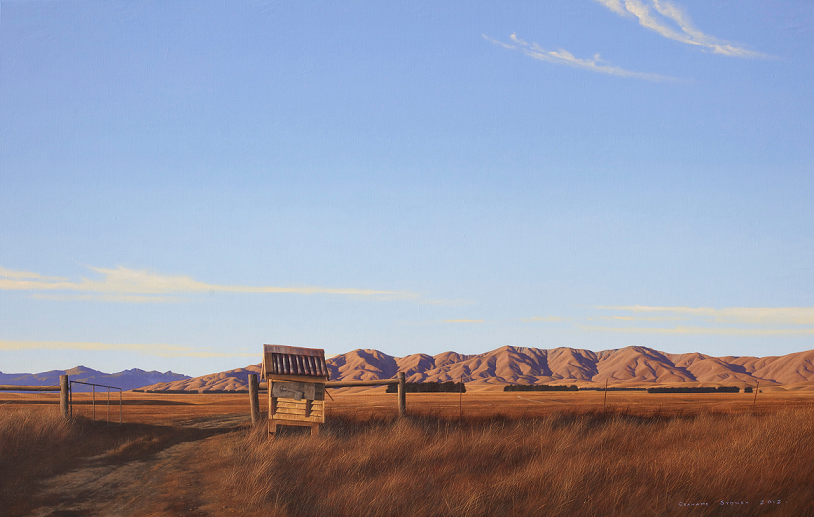
 

'Rural Delivery', Grahame Sydney, 2012.

‘Rural Delivery’, Grahame Sydney, 2012.


You are often congratulated on how powerfully you evoke a sense of place.

I do feel I’m a visual writer – that’s the sort of writing I like to read, rather than bloodless abstraction. I try to achieve strong settings, cityscapes as well as landscapes, for characters are partly defined by their physical context. In my novels Drybread and Carnival Sky the Central Otago setting is closely realised, but also functioning symbolically in relation to character and theme.


 Character is central for you?

Characterisation is fundamental in fiction for reader and writer. People are our vital interest in life – first ourselves as centre of the emotional world, then those around us with whom we form relationships, or merely observe.  So it is no wonder that readers come to books programmed to look for the people. What an advantage that is for writers. All the great authors, such as Dickens, Austen and  Flaubert, are superb creators of people on the page.

If  writers can create characters who hold the reader’s attention, they may possess many deficiencies of technique and still succeed, but if characterisation fails then it’s likely so will the fiction. What a tribute to  writers if their creations outgrow the book, outgrow the literary world itself, and enter the general consciousness of a people, or language. It happened with Oliver Twist, it happened with Quasimodo, some might say it happened with Harry Potter. People who never existed, yet are better known than millions who have. Character not only becomes story, it is story, and even more – it’s life.


Randomness is a big part of your writing.  The situations your characters often find themselves in through casual or disrupted lifestyles – any situation which throws unlikely mixtures of people together  where their lives intersect for a while, where some sort of exchange has to go on.

Life is precarious, happiness is fragile, triumph and disaster are only a random incident apart. My studies in history perhaps incline me to think in this way, but all the more reason to savour what is fine and good. There’s great apprehension, restlessness and also exhilaration in the kaleidoscopic free-fall that is human experience. I’m aware of the essential isolation in life: `Alone we are born, and die alone,’ Baxter says, yet that doesn’t make life any less worthwhile, our loved ones less precious.

I’m interested in the relationship of people to their environment. I’m interested in the clash of expectation with reality, the manner in which people cope with disappointment and diminished opportunity. For a writer, failure is often more fascinating than success.  I’m attracted by the natural humour of life, wry and sardonic though it may often be. Life is often a theatre of the absurd.


I apologise for this question, which is a bit like the kind of question people ask magicians when they are baffled by a trick. One of the blue notes (to slightly misuse the term that George Sand used of Chopin’s playing) of your writing for your readers is your ability to write concise, wry, often hilarious but always startlingly vivid physical descriptions of people. I think of the description of Attlee Kellor (from the story ‘Sojourn in Arles’): ‘a man whose insignificant body seemed just the necessary bearer of a large and pleasant face.’ I think of the character in Carnival Sky who has ‘a nose like a ploughshare’; I could name countless other examples.

Do you deliberately go out into the world and formulate such descriptions for people whom you observe, carrying their likenesses back in triumph to your fiction (Oh, look. There’s a man with a nose like… a ploughshare!)? Or does imagination work hand in hand with language here? As with all good magicians, the execution seems effortless: do you labour hard over such descriptions?

Writers need to be close observers, attentive listeners and shrewd assessors. I keep a journal, as I think most writers do, and jot down an assortment of notes, some of which surface in published work. In physical description, as in so many aspects of writing, what has come from life and what has come from the imagination finally become indistinguishable.


Since Harlequin Rex, your novels have all concentrated, in one way or another, upon the place and power of love in human relationships. It’s as often a destructive force (The Larnachs, Love as a Stranger) as it is a redeeming one (Carnival Sky, Drybread). Is there a reason for this preoccupation?

An interesting observation, and true enough if love is defined in its widest terms. Love of others, love of place, love of the  principles and histories that bind us together. Human aspiration, motivation, character and relationships are so central a part of life, and offer such opportunity to the artist/writer. John Cheever said that loneliness is a kind of madness. We search for fellows to hold hands with in the surging progress that is human experience.


Do you have a notion of your own literary preoccupations, or are they (to steal Gavin’s superb line from Carnival Sky) `like your own arse — you carry it your entire life, but couldn’t pick it out in a crowd?’

I have become aware of my own preoccupations, and probably inflicted them too often on readers. Despite myself I tend to circle back to certain central concerns, but also life’s experience tends to provide opportunity for fresh observation and understanding. I think my writing has been enriched by travelling and living overseas, something that occurred comparatively late in my life.  Also there are changes in perspective during life’s journey. Some of the things that interest me now, didn’t when I was younger.  I hope I can maintain enthusiasms, old or new. Alice Munro said, `This may be the beast that’s lurking in the closet in old age: the loss of the feeling that things are worth doing.’


You’ve published 13 collections/selections of stories now, and you have been much anthologised. For a lot of people, you are still first and foremost a writer of short fiction. Why did you start out writing short fiction (if there is a single reason)? And what draws you back to it?

There are two reasons, one artistic and one practical. From the time I became a serious reader I have been especially drawn to the challenges, possibilities and emotional rewards of literary short fiction. I found much satisfaction as a student in reading the stories from a wide range of international authors, and was drawn as a young writer to attempt the form myself. I have continued to enjoy more recent writers of short fiction, and observe the evolution of the genre. I admire the precision and balance of  the short story. A novel can often stumble and recover, but a short story cannot afford a slip. The best short stories it seems to me have a powerful sense of one-on-one — a direct arrow from author to reader.

Frank O’Connor called the short story the ‘lonely voice’, and said it spoke for the disenfranchised. I sometimes think of the successful story as being a combination of intransigence and poetry. Short fiction has an honourable place in New Zealand writing and, despite the marketplace’s preference for novels, it continues to be  produced in large numbers, given prominence by well-established national competitions, featured in school and university courses and gathered into collections. Our first internationally significant  authors, Mansfield and Sargeson, were short-story writers. In recent years, both here and overseas, there has been a noticeable growth of interest in flash fiction, perhaps because it suits online sites so well.

There is also a more mundane reason for my concentration on short fiction for much of my career — it suited my lifestyle at the time. I had a full-time job and a family, and writing had to be fitted around those priorities. I didn’t have sufficient confidence then, that years spent on a novel would result in something worthy of publication. Since becoming a professional writer in the early nineties I have had the blocks of time necessary for writing novels, and the encouragement  of publishers to do so. My love of the short story is abiding, but I also welcome the  challenge of writing full-length prose and poetry.


You have said that you find writing a novel is a daunting prospect. Has it become less daunting, now that you’ve stayed the course six times? Or does the investment of time and creative energy on that scale still make it scary?

I still find it daunting. Writing a novel requires a very considerable investment of time and intellectual energy, though it’s no more technically challenging than a short story. If a short fiction fails, you may have lost two or three weeks of your writing life. If a novel refuses to come together you may have lost many months, even years. I talked to Witi Ihimaera once about how daunting the novel can seem at its commencement. He agreed and said he focused on one chapter at a time. Good advice — the stage camps on the mountain ascent. And I think momentum is important in the first draft of a novel.


Your short fiction has many elements in common with the long, but there is a character to many of your short stories that doesn’t necessarily appear in your novels. I suppose it’s what one commentator calls the ‘suburban gothic’ quality, or what Vincent O’Sullivan once identified as your penchant for writing the horror of the everyday. Is this a fair observation?

The essential skills of fiction writing  are the same for both novel and short story, just adapted for the genre and the demands of the specific work. But each form has its particular strengths and advantages.

One example is structure. A short story can succeed as just a list, one half of a telephone conversation, or a physical description. It’s over before the lack of a plot is apparent, or damaging. Writing a short story is like coming to a creek and leaping over it: writing a novel is like building a bridge across a river. Some stories of course are very tightly plotted indeed.

As for ‘suburban gothic’ — because the story is a short course of treatment it can be a strong one, more powerful than can be sustained or tolerated in the novel. I suppose that illustrates another attraction of the short story for a writer: a chance to write in a variety of registers, and over a range of themes in a comparatively short time. A prose poem last week, a satirical piece this month, and a character-based homily the next.


How was the selection of your ‘best’ short stories made for the collection edited by Vincent O’Sullivan in 2008? Were you consulted, and if not, did you agree with this choices?

Vincent made the initial selection, but he did consult with me following that. I think my only suggestion was perhaps to include a couple more of the later pieces. I thought that Random House was very generous in allowing us 60 stories and 622 pages. Even that selection is not entirely representative, as the collection Living As A Moon was published in 2009 after Vincent’s selection.


What is it like being anthologised by others? Have you always agreed with their selection of stories to showcase?

It’s interesting to see what people choose, but I don’t try to influence that. Sometimes the anthologies have particular themes to address, or modes of writing to exemplify. Readers bring their own backgrounds, interests and obsessions, their own level of perception as far as life is concerned, and so response to one’s work is varied. Reading is a form of collaboration and each outcome is unique.


Sargeson is highly regarded as a short story writer. So is Mansfield. But when you began writing, there was something of a conventional view of the short story as a sort of transition, a rite of passage for a fiction writer en route to their real work, which was the novel. The short story seemed somewhat devalued — and it is tempting to connect this with the fact that while you have been very highly acclaimed for your short fiction, it is your novels that have received awards.

I can’t agree with the first part of your comment.  I would argue that, for much of the 20th century, the short story was more characteristic of our New Zealand fiction than the novel, and more fully developed. Our leading writers then, such as Sargeson, Maurice Duggan, Dan Davin and Maurice Shadbolt, were all renowned short-story writers. That has changed. The New Zealand novel has come of age, partly through the cumulative authority of Janet Frame, and that’s to be celebrated. What is certainly true is that literary short fiction does not sell as well as novels, and that lack of ‘profile’ may disadvantage the genre. You may well be right that short fiction is at a disadvantage when it comes to major literary awards. Perhaps the unity of the novel gives it a monolithic quality that’s hard to get past for judges. On the other hand there are several well established national competitions for short stories alone.


Is the short story an endangered form? There are fewer publishing outlets than ever for individual stories, and collections of stories aren’t exactly flavour of the month with book publishers.

J.G. Ballard, who began as a writer of short stories, said in a Literary Review interview in 2001: ‘The short story seems, sadly, to be heading for extinction.’ Such predictions have been regularly made for most literary genres, often with cogent supporting evidence, but somehow the literatures themselves will not so readily give up the ghost. I have mentioned the upsurge of flash fiction, especially online, and some of our best writers continue to write short fiction. Fiona Kidman, Sarah Quigley, Frankie McMillan, and Carl Nixon come to mind. I believe there will always be those discerning readers who are aficionados of the literary short story. Who would deny the majesty of the best work of James Joyce, Chekhov, or Nobel Prize-winner Alice Munro?


You have become somewhat more prolific as a writer of novels than you were. Are they crowding out your own short fiction, or is there room for both?

The professional writer is nudged by commercial considerations towards the novel, but I write first for myself, about what interests, or obsesses me. Also serious artists wish to challenge themselves. I am working towards a fourth collection of poetry in 2017, and I think there will be more short stories in time.
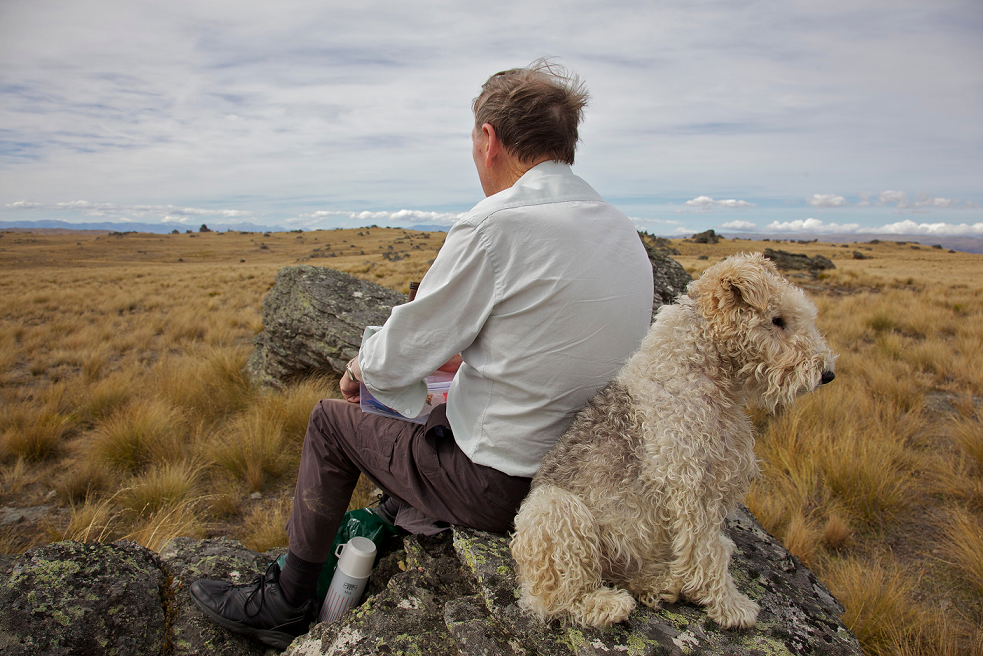
 

Photo credit: Grahame Sydney.

Photo credit: Grahame Sydney.


Are you one of these people who can keep a number of pieces of work on the go? A short story or two, perhaps a few poems, while your novel proceeds?

If I’m concentrating on short stories, I may well have a couple on the go at any one time, usually very different in nature, and I will push on with the one that accords with my mood on the day. My sad story and my happy story, if you like. If I’m writing a novel I concentrate pretty much on it alone, to maintain momentum and involvement. I cannot will the poetry the way I can prose, and poems tend to come when they please.


You have, on a couple of occasions of which I’m aware, beautifully described the gap between your vision for a piece of work and its execution as ‘the work twisting in the hand’. Does it cut both ways? Are there times when writing turns out unexpectedly better than you had imagined?

I find it intriguing that sometimes what seems a strong, promising passage or concept, is ultimately resistant to achievement, and another that initially seems rather doubtful, strengthens considerably in the process of writing. Almost always I’m aware that I have fallen short of my goal, by varying measures.

After reading some of the best passages from such as William Trevor, John Cheever, or Cormac McCarthy, I sometimes wonder why I bother writing at all, but thankfully that passes, and perverse self-belief resumes. We can’t all be first violin, and I find satisfaction enough in being second, or third, fiddle.


Do you ever go back and read your earlier work? Many writers remark that when they revisit their old material, they feel they could not write that way now. Does that strike a chord with you?

When I re-read early work, I often see things that I would do differently now, but I have no wish to alter them. The writing is a reflection of myself at that point in my life, and best left to be so. My writing has certainly changed, mostly for the better I think, but others should be the judge of that. There is an élan and daring in one’s early writing that is characteristic of youth, and often attractive despite imperfections. John Updike  wrote: `Most of the best fiction is written out of early impressions, taken in before the writer becomes conscious of himself as a writer. The best seeing is done by the hunted and the hunter, the vulnerable and the hungry: the “successful” writer acquires a film over his eyes.’


You have made little obvious effort to shake the label of a ‘provincial’ writer. Does this mean you are comfortable with it?

I’m a provincial writer in the obvious sense that I live there, but also to some extent in my choice of subject matter.  Almost all my life has been spent in smaller centres. In my reading I’m drawn to regional and rural writers. People like T.F. Powys, Alice Munro, H.E. Bates and William Trevor – more recently Annie Proulx. There are a lot of people writing about urban, cosmopolitan life and I like to give a voice to rural place and people. More so in my earlier work, perhaps, and it’s certainly not a fixation. I much admire Ian McEwan’s urbane, sophisticated books for example, and my latest novel is set in Auckland with city characters.


You’ve mentioned some of the people whom you consider to have influenced your writing. Are there others you’d add to that list?

Austen, Dickens, Chekhov, Joyce, Hemingway. Of the more recent brigade, I’d say Angela Carter, Bette Pesetsky, Donald Barthelme, Flannery O’Connor, David Malouf, Anne Enright … the list goes on.


And what about contemporary New Zealand writers? Are there any in particular whom you admire?

We have a large number of excellent writers. Lloyd Jones, Maurice Gee, Patricia Grace, Vincent O’Sullivan, Fiona Kidman, Fiona Farrell. Among younger ones Charlotte Grimshaw, Carl Nixon, Craig Cliff and Eleanor Catton. I first encountered Catton’s work when I was judging the 2007 Sunday Star Times Short Story Award, and realised she was  a major emerging talent. But mentioning individuals is invidious. We have so many gifted writers.


There’s a tendency to suppose that with success, there comes a certain immunity to criticism and less of a need for the support and recognition of others. You have been much honoured for your writing, with numerous awards and prizes. Do you nevertheless feel the need for recognition, support and encouragement?

Unless you’re particularly ego-driven, or super-confident, you need reassurance to persevere in the often flaky life of a writer. There are many reasons and pressures to give up, especially early on. Recognition and success are more important as incentives than rewards.

I owe a debt of gratitude to many people. My wife has been brave enough to support me in the risky life of the professional New Zealand artist. Frank Sargeson offered early encouragement – I have a letter he wrote to me framed on my study wall. Brian Turner and Barbara Larson were my first publishers, at a time when there was little other interest. Vincent O’Sullivan, Andrew Mason, Donna Chisholm, Patrick Evans, Grahame Sydney, Fiona Kidman, Bill Manhire, Roger Hall and Malcolm Gluck have all encouraged me in various and significant ways. I’m fortunate to have, as my long-term editor, Anna Rogers, who’s an accomplished author in her own right. My publisher, Harriet Allen, has a fine sense of literature and is personally supportive.


You were a teacher in your professional life before you became a full-time writer, and you have been a teacher of creative writing. Has teaching had an influence on your writing, do you think?

I was a teacher for 25 years, including roles as deputy and acting rector at Waitaki Boys’ High School in Oamaru, and after becoming a professional writer continued to enjoy the stimulus of teaching fiction writing quite regularly, first at Aoraki Polytecnic, Timaru, where for ten years I ran a seventeen-week full-time fiction writing programme. Later at the University of Canterbury I led a fiction master class for some years. Writing can be a selfish and isolating occupation and I enjoy the stimulus of teaching, and of being challenged in a collegial way in my opinions and reading choices. A writer needs to keep in touch with life.


Speaking of extra-curricular activities, you are quite involved in the administrative side of New Zealand letters, aren’t you?

I’ve willingly been involved in the arts sector and so endeavoured to give something back in return for the considerable support I have received in grants, residencies and fellowships. I was on the Arts Board of CNZ, and later on the board of the New Zealand Book Council for many years. I am a long-term member of NZSA and was its president of honour in 2007/2008 and among its inaugural  Honorary Literary Fellows in 2014.


Having touched on your memoir a little earlier, may I ask what the impulse to write it was? I imagine you are at the age and stage where publishers are haranguing you for a full-blown memoir, or an autobiography, or to submit to a literary biography? Did you write Tunes For Bears To Dance To in order to supply or to forestall this kind of plea? I think I’m asking whether we can expect more.

Geoff Walker approached me to write an autobiographical work for BWB Texts. I had contributed two short memoir pieces to Sport magazine, and elaborated on those. I have no plans for a full memoir, or autobiography, and prefer to be seen through the prism of my work.


What was the experience like of writing with yourself as the central character?

I became aware of the fallibility of memory. And, as you have mentioned, I did find my young self something of a stranger. The memoir is concerned only with my writing life up to the early 1990’s.


You used to describe yourself as by nature an optimist and intellectually a pessimist. Has this changed over time, or at all? You have grandchildren: what sort of world do you think they will inherit from us?

The description still fits, I think. Despite many disheartening developments in the world and fears for the future, I tend to enjoy life day by day. Perhaps that is because of present good health, and family support and closeness. I do have apprehensions concerning the world our grandchildren will face.


Another random question. Your experiences in foreign climes have demonstrably enriched your work. But you have also been to alien climes. Can you tell me what the Antarctic residency experience was like? As a place, it is almost devoid of nourishment for an artist such as you, whose focus is character and human interaction. Did you find your visit inspiring or (as some have) baffling, or even stifling of your craft?

I went to Antarctica as an arts fellow in 2010 and found it a fascinating experience. My academic background is in history, and the most interesting parts of the stay for me were visits to Scott’s hut at Cape Evans and Shackleton’s hut at Cape Royds. Great care is taken in the preservation and restoration of both of these physical reminders of the heroic age of Antarctic exploration. It’s a spine-tingling experience and a privilege to step inside – and back in time. Aspects of my experience in Antarctica have surfaced in my poetry, but not so far in my fiction.


As I write these questions, I am moved to ask: what is the single most irritating question you get asked as a leading writer of fiction?

Not irritating, but certainly the most common and the most predictable is – Where do you get your ideas from!


So… Where do get your ideas from?

John, I hope we’ve covered that.
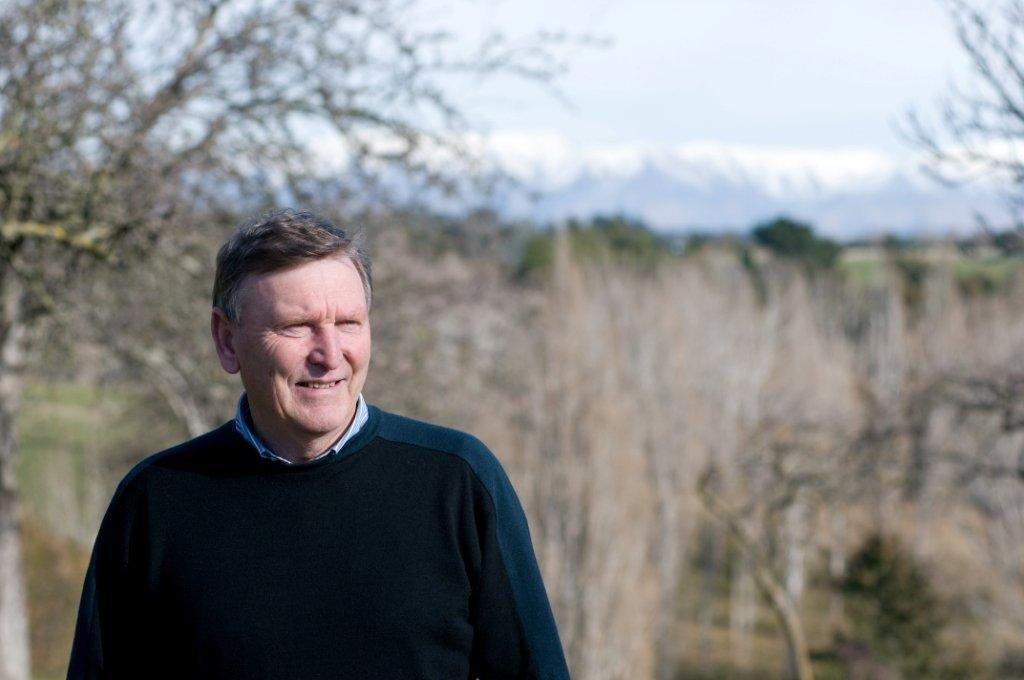
 

Photo credit: Liz March.

Owen Marshall. Photo credit: Liz March.


John McCrystal is a Wellington-based freelance writer, reviewer and former book review editor of North & South magazine. He has published eight books, including The Cars We Loved, a finalist in the 2002 Montana Book Awards, short stories, and a radio drama which was broadcast on National Radio.

'The thirty-five of us were in the country of dream-merchants, and strange things were bound to happen.' - Anne Kennedy
Read more

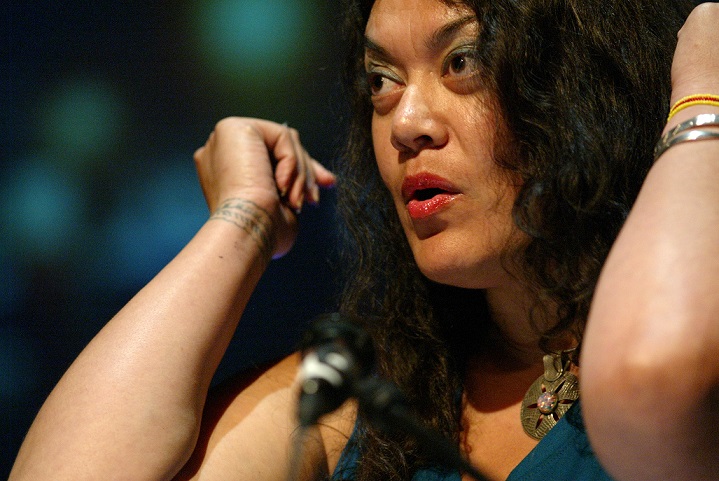
Photo credit: Karlo Mila

Pacific Writing in New Zealand: The Niu Wave

Victor Rodger wonders where all the Pasifika novelists are.


They stand, with their broken yellow spines, somewhere in between War and Peace and Linda Goodman’s Love Signs. They’re two of Mum’s books on the shelf: Sons for the Return Home and Flying Fox in a Freedom Tree by Albert Wendt.

They’ve always been there – or at least that’s how it seems. As a young Afakasi Samoan growing up with a Palagi mother, I think of them as The Samoan Books; the same way I think of mum’s LP with the smiling dusky maiden on the cover as The Samoan Album; the same way I think of my absent father himself as The Samoan Father – that is to say as Other. Foreign. Of no particular interest.

In 1986, my last year of high school, I begin to reassess my identity. I take Sons For the Return Home down from the shelf. The pages are thick and stiff; they don’t flop open easily like the works of Jackie Collins or Sidney Sheldon to which I’ve grown addicted; the binding is all but kaput, and the book has separated into three sections.

He was bored with the lecture…

And so begins the story of a young Samoan student in New Zealand juggling the Palagi world he has entered and the Samoan world he has left behind, and his doomed-to-fail relationship with a Palagi girl – a relationship which echoes that of my parents. Just as James Baldwin’s Another Country opens up another world for me around the same time, so too does Sons For the Return Home – it opens up the unknown world of my father. It’s a revelation.

When my father died last year, the last thing I grabbed before I flew to Brisbane for his funeral was my own copy of Sons For The Return Home. As I re-read it on the plane, I became something of a son for the return home myself, reassessing both book and author.

The boy of seventeen who was just beginning to explore his Samoan heritage couldn’t appreciate how provocative Albert’s work must have been in 1973 when it was first published. But the man of 46 who had become a playwright in the interim could certainly see how Albert pushed the envelope, bravely training a spotlight on some of the hypocrisies inherent within the culture, and making ‘us’ the protagonists; he’d taken charge of how we were represented.

I named my first play Sons (1995) in homage to Sons For The Return Home: it’s a book that’s meant a lot to so many writers. But mention this to Albert (as I did recently) and he’s bemused, like the veteran rock star tired of hearing people’s effusive praise of his long-ago hit song. In fact, it’s over forty years since he first laid a stake in the literary ground.

And so, in the beginning, there was Albert. But when we talk about other Pasifika novelists to come out of New Zealand, we have very little else to say.

Yes, the late Alistair Campbell and John Pule both produced well-received novels in the 80s and 90s. Campbell was born in Rarotonga and Pule in Niue, but they both moved to New Zealand at a young age. Campbell published four novels between 1989 and 1999, the first –  The Frigate Bird – a regional finalist for the Commonwealth Prize. Pule published The Shark that Ate the Sun in 1992 and Burn My Head in Heaven in 1998. But Campbell was best-known as a poet, and Pule is more active today as a visual artist. Albert’s the only Pacific writer writing in New Zealand to consistently produce novels.


Albert Wendt and Reina Whaitiri at home in Auckland.


Where, then, is Albert’s successor? Where’s our Zadie Smith with a Poly-esque White Teeth?  Where’s the PI book that a niu generation will cherish? Perhaps the novel isn’t a form to which Pasifika writers are traditionally drawn. Perhaps they’re hardwired for the oral versus the written. It’s probably not too much of an exaggeration to suggest the average Pacific Islander is more likely to read the Bible than the latest Ockham New Zealand Book Awards winner.

Poet David Eggleton, of Tongan and Rotuman descent, has been editor of Landfall, New Zealand’s oldest and most prestigious literary journal, for the past five years. He isn’t quite so quick to start issuing last rites. ‘We’ve begun receiving more work, mostly poetry, from a number of PI writers,’ he says, ‘especially ones associated with the MIT [Manukau Institute of Technology] programme in Auckland. This partly reflects recent numbers, increasing confidence in literary self-expression and new academic structures in place. So I think a big upsurge is currently underway.’

But this suggests that poetry is the medium of choice for the niu wave, the new kids riffing on everything from deadbeat partners and sexuality to those time-honoured classics, colonization and Christianity. Poetry is the starting point for many new voices, like Grace Taylor (Samoan, Japanese, English) – who moves between spoken word and theatre (My Own Darling). Taylor, a key player in the Rising Voices spoken-word movement based in South Auckland, was named the 2014 Creative New Zealand Arts Pasifika Emerging Pacific Artist. In May she was awarded the Auckland Mayoral Writer’s Grant to work on a new poetry collection.

Chances are if you ask your average non-University–going PI kid in New Zealand to name a Pacific Island novelist, the Wendt they’re more likely to have heard of is Albert’s Samoa-based niece Lani Wendt Young. Her self-published Telesa series for young adult readers are a Pacific version of Twilight, complete with an Afakasi Samoan/American heroine who journeys from Washington to Apia, discovers she has supernatural powers, falls in love with the hot captain of the First XV and has a fa’afafine BFF.

PI readers may be familiar with Sia Figiel and her groundbreaking 1997 novel Where We Once Belonged, which features one of my all time favourite first lines: The first time I saw the insides of a woman’s vagina I was not alone. But in terms of Pasifika fiction writers here in Aotearoa? Almost nada. Why?

Albert has a theory: ‘Trying to make a living through your art is very, very difficult,’ he says. ‘It’s hard enough getting a job and staying alive and feeding your family. So I think our younger artists are into art forms that have a greater possibility of making them a living. Writing novels also takes time and experience. I’ve been able to do it because I’ve also worked full-time as a teacher to feed my family. Teaching has allowed me time to write, especially at university level where writing, researching and publishing were part of my job.  Very few of our writers get that opportunity.’

Some of Albert’s best-known successors – all primarily poets – concur. Selina Tusitala Marsh (who made Waiheke-to-Westminster headlines when she performed her poem ‘Unity’ for the Queen in March) teaches Pacific literature and creative writing at the University of Auckland. ‘Many of us have a novel within, but poetry wends its way up through the dirt and into the light,’ she says, suggesting that ‘it takes less time away from the two jobs, the three sons, the elderly parents that need caretaking, the church responsibilities, [and] the social commitments towards our variously imagined Pasifika communities.’

My cousin, Tusiata Avia, whose latest collection Fale Aitu / Spirit House was published in May, teaches creative writing at MIT. She toured the world for eight months with her show (and subsequent poetry collection) Wild Dogs Under My Skirt: my theatre platform, FCC (Flow, Create, Connect), will re-mount it this September in Auckland. She thinks the prospect of writing a novel is especially challenging for ‘women writers who have children and jobs, [and] simply don’t have the time to write long-form fiction.’

It’s true that many of the better-known names in Pasifika writing in New Zealand are poets, like Leilani Tamu, Daren Kamali and Karlo Mila, author of Dream Fish Floating – who Albert Wendt credits with coining the phrase the ‘Caramello Generation’ to reflect the multiple identities and ethnicities of the Pasifika diaspora in New Zealand. ‘Poems have always fit in the cracks of my life,’ says Mila, who was awarded the 2015 Fulbright-Creative New Zealand Pacific Writer’s Residency at the University of Hawaii.


Tusiata Avia in performance.


Avia and Mila have long-gestating novels on their hard drives, and Tulia Thomson, whose short fiction was featured in Huia’s Niu Voices anthology in 2006, is writing a Fiji-set novel that began life on the University of Auckland’s Master of Creative Writing programme.

But in the short term, two debut short-story collections may provide the inspiration for a new generation of PI fiction writers.

Gina Cole (Fijian, Scottish and Welsh) is a barrister by day and writer by night. Also a graduate of the University of Auckland’s MCW, she’s soon to publish a story collection, Black Ice Matter, with Huia. The collection includes stories about a woman caught between traditional Fijian ways and the brutality of the military dictatorship; a young child in a Barbie Doll sweatshop dreaming of a different life; and a glaciology researcher who falls into a crevasse and confronts the unexpected.

Courtney Sina Meredith (Mangaian, Samoan, Irish) is a poet and playwright who will publish her first story collection, Tail of the Taniwha, in August. To me she’s the embodiment of the new breed of Pasifika writers: unapologetically ambitious, and someone who demands and commands attention (witnessed when we were on the same panel at the 2012 Frankfurt Book Fair, where she launched her poetry collection, Brown Girls in Bright Red Lipstick).

She can work a room with a seemingly effortless combination of charm, charisma and chutzpah. Thanks to a $25,000 grant from Creative New Zealand, she’ll be attending the University of Iowa’s International Writing Programme later this year, followed by a residency at the Island Institute in Sitka, Alaska.

Meredith gives props to her grandparents for her drive and self-belief. ‘All four of my grandparents were fierce migrants with a lot of personality.’ They had ‘big dreams and big ideas. They followed their hearts and that’s still what I see when I look around our communities today.’ This, she says, is ‘the heat, the energy that I want to capture on the page.’

Meredith’s just 30 but she’s been around long enough to witness ‘a changing scene where Pasifika artists were pushing down barriers and moving beyond the tiny corner we’d been assigned as our space to create with. I remember watching Sia Figiel read at Samoa House and feeling all the hairs on the back of my neck stand up.’

Still, arguably the only homegrown PI writer who’s a household name is Te Atatu’s own Oscar Kightley, because of his comedy – the Christchurch collective Pacific Underground, and later the Naked Samoans – and acting gigs. His collaborations with (mostly Palagi) writers have produced cross-platform successes in theatre (Niu Sila),  film (Sione’s Wedding 1 and 2)  and television (the animated hit bro’Town and the detective drama Harry).

Although Albert Wendt’s take on younger Pasifika writers suggests many of us find better-paid work in television or movies, we’re still not well-represented in key writing or decision-making jobs. Oscar and I are the only two PI writers to score long running gigs on Shortland Street as either a script writer or storyliner. ‘Maybe we’re suckers for seemingly unbearable workloads,’ Oscar suggests, ‘and other PI writers are more sane.’


Courtney Sina Meredith (centre-left) at the 2015 Mexico City Poetry Festival, which featured 52 poets from around the world. Fellow writers are (from left to right) Yuri Zambrano, Jorge Contreras & Bronwyn Lea. Photo credit Jorge Contreras.


Some PI comedians –  including Rose Matafeo, James Nokise and Josh Thomson – have moved from stand-up gigs to writing for TV comedy. But beyond Shortland Street and Harry, you’d be hard pressed to find a PI writer who’s been shoulder-tapped for TV drama, and when shows are produced – like Justine Simei-Barton’s Good Hands: Lima Lelei in 2002, or Rene Naufahu‘s Otara-set The Market in 2005 – they were given late afternoon or late-night time slots, ensuring the smallest-possible audience.

Three recent films written and directed by Pacific Islanders – Shopping by Louis Sutherland, The Orator by Tusi Tamasese and The Last Saint by Naufahu – all received critical kudos but didn’t set the box office on fire. However, there’s clearly an audience for PI stories, as the recent film Three Wise Cousins demonstrates. Shot for just $80,000 by Stallone Vaiaoga-Ioasa, and set in Auckland and Samoa, the film has already made $1.6 million at the box office in New Zealand and Australia.

But of all the written forms, theatre may be the likeliest place to find the niu wave of Pasifika writers. It’s certainly where some of the older guard broke out in the 90s, including myself, Kightley, Makerita Urale (Frangipani Perfume), Dianna Fuemana (Mapaki), and Toa Fraser (Bare and No.2).

A quick snapshot of PI plays in the last five years shows a diversity of practitioners and subjects, if not tone: there’s a clear reluctance to present truly provocative work. Arts Laureate Vela Manusaute made history with the first PI musical, The Factory; Iaheto Ah Hi represented for Tokelau in works like Tautai; Aroha Awarau took the shooting of Halatau Naitoko in 2009 as the inspiration for Officer 27; Suli Moa Fanamoa paid homage to a strong Tongan mother in The Kingdom of Lote, while David Mamea’s Goodbye My Feleni saluted PI soldiers who served with the Maori Battalion.

Arnette Arapai and Jason Manumu’a created the wonderfully daft Tongan Morris Men; Louise Tu’u explored homelessness with Providence; Moana Ete and Miria George waved the flag for Wellington with Versions of Allah and The Vultures, while The Conch are about to reprise their critically acclaimed White Guitar in Wellington and Auckland. In August Tanya Muagututi’a and Joy Vaele give us girls n gospel in Angels (re:Born), and the Black Friars – ‘educators and counsellors, facilitators and enablers, theatre-makers and storytellers’ – present Something Wicked This Way Comes, a Poly-fied Macbeth, at the Mangere Arts Centre in September.


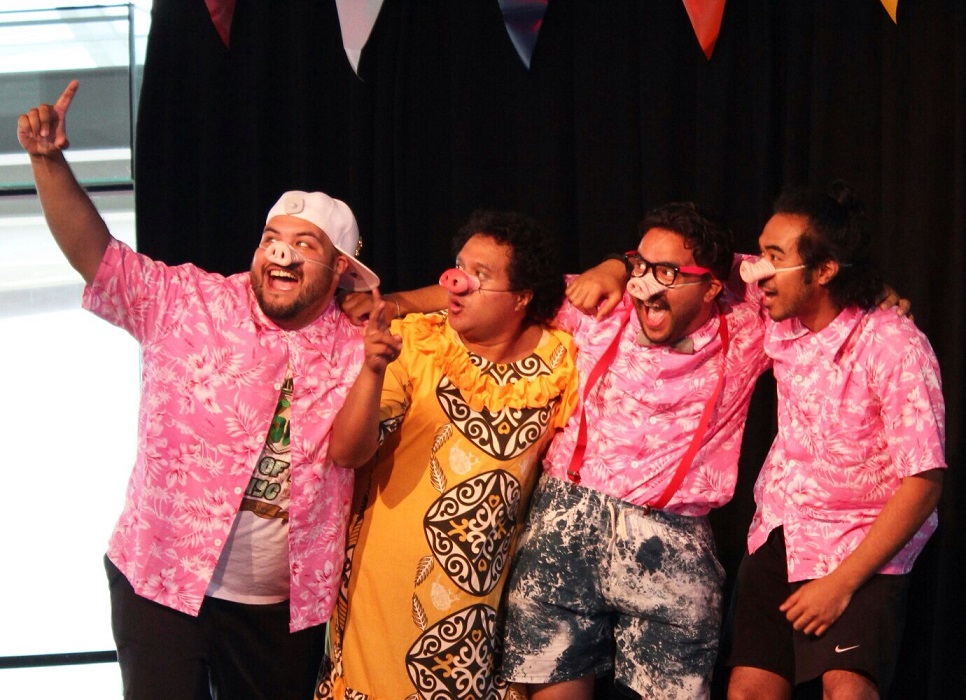
The Black Friars perform 'Goldilocks and the Three Little Puaka'.

The Black Friars perform ‘Goldilocks and the Three Little Puaka’.


The energy in PI theatre in New Zealand (acting, directing, writing) reflects, perhaps, the increasing importance of PIPA – the Pacific Institute of Performing Arts – based in South and West Auckland, nurturing dramatic talent the way MIT is nurturing poets. Two graduates, Leki Jackson-Bourke and Amanaki Prescott Faletau, took out the Playmarket Plays for the Young award for their transgender rom-com, Inky Pinky Ponky. Auckland Theatre Company has snapped up fellow grad Jono Soo-Choon’s The Eel and Sina for their Mythmakers youth initiative. Could it be a PIPA graduate who becomes a novelist post-drama school – like Emily Perkins, who was an acting student at Toi Whakaari: Drama School?

Perkins now teaches at Victoria’s International Institute of Modern Letters (IIML), where Assistant Vice Chancellor Luamanuvao Winnie Laban has organised a talanoa in August for PI writers from all over New Zealand – including myself, Albert Wendt and Selina Tusitala Marsh. The talanoa will address the dearth of Pasifika applicants to IIML’s writing courses. The Pacific Island graduates from all of IIML’s courses in fiction, poetry, creative nonfiction and writing for the stage/screen – like Avia and Tamasese – can virtually be counted on one hand.

In 2014 IIML introduced an undergraduate workshop for Māori and Pasifika writing. Convened by novelist Tina Makereti, this class will next run during the summer trimester in January/February 2017, and Makereti is hopeful this timing will attract larger numbers.

The writers in her course  ‘have very urgent, important stories to tell,’ says Makereti, ‘and often have that elusive thing, “a voice”. But in their previous lives and studies, they haven’t had the opportunity to use those things.’

At the creative writing programme in Auckland, Pasifika writers tend to be represented in higher numbers. Both Selina Tusitala Marsh and novelist Paula Morris, convenor of the Master of Creative Writing programme, are active in schools outreach at schools in South Auckland. Morris is working with Avia in an MIT/Auckland Writers Festival initiative to offer after-school writing workshops to students from three local high schools; she was also part of the Book Council’s Otahuhu project in 2015.

University creative writing courses ‘can’t just sit around waiting for applications,’ says Morris. ‘We have to be more proactive in our neighbourhoods, which includes the South Pacific, sharing skills and nurturing talent. And we need to offer scholarships, so university creative writing workshops aren’t prohibitively expensive.’

Will these initiatives lead to books getting written and published? We have to hope so. There’s nothing quite like seeing yourself represented specifically in literature, or of writing yourself into existence, as Albert did – and continues to do.  ‘We are all shit scared,’ he says in his 2015 essay Out of the Vaipe, the Deadwater, ‘of having no meaning or worth.’


Selina Tusitala Marsh on Waiheke Island.


Victor Rodger is a Christchurch-born playwright and television writer of Samoan and Palagi descent. This year he became the first writer of Samoan descent to take up the Robert Burns Fellowship at the University of Otago.  His plays Black Faggot and Puzzy (co-written with Hawaiian-based writer Kiki) will be performed on a double bill in Honolulu in 2017.

'Character to some extent is much a construction of the reader as it is of the writer.' - Lloyd Jones

Read more

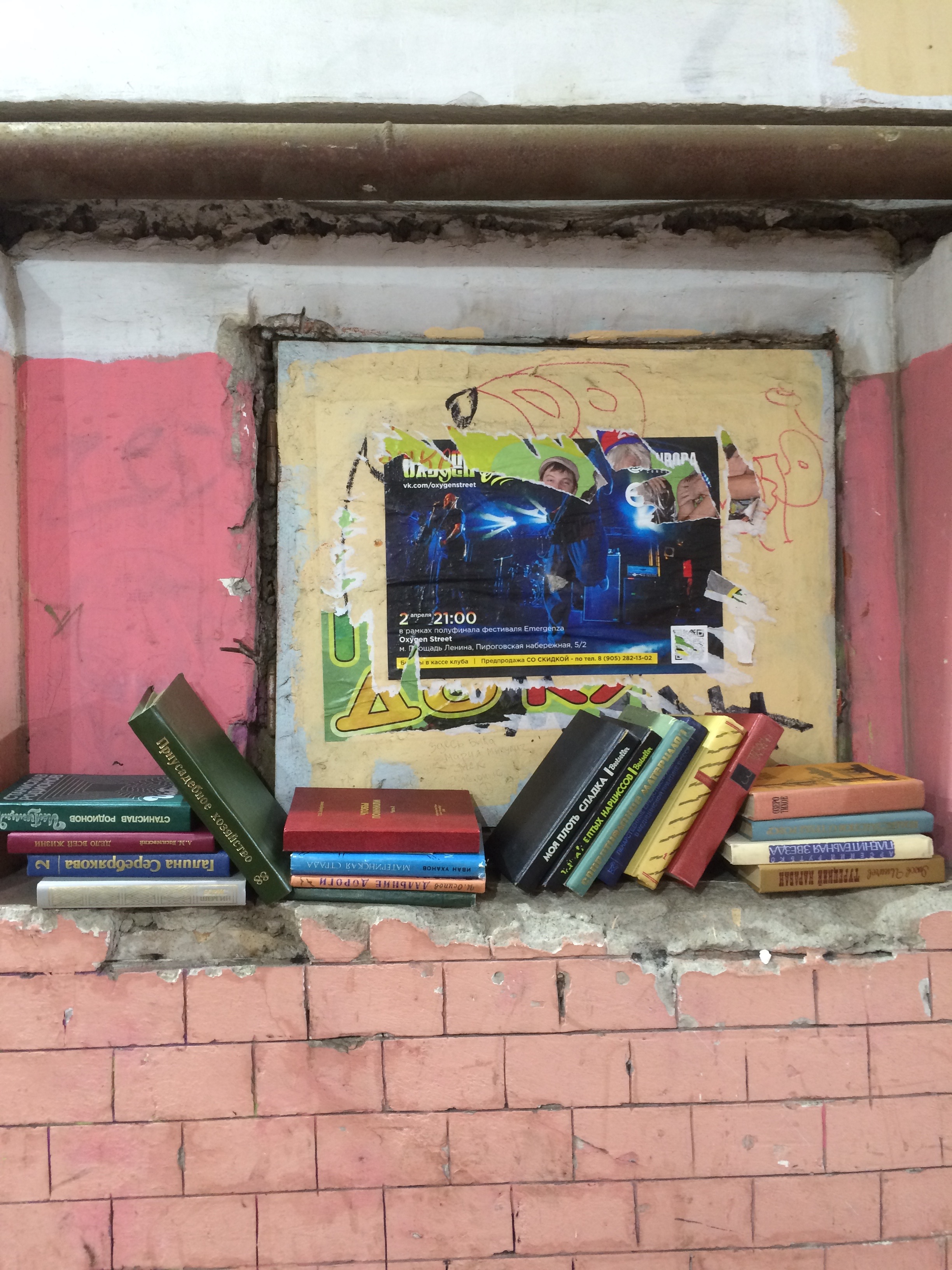
At an illegal rooftop café. The bill comes in a book.

Letter from St Petersburg

Rosetta Allan goes to Russia in search of monsters.


The view from the aeroplane window had been blue, blue, blue – underscored by white, white, white – for several hours. Then there was grey, and the white banked away. Below was a stretch of land – black barren winter trees, brown frost bitten countryside contrasted by white snow thin and beautiful and melting in the spring sun.

I was like a child looking out the window, my heart in my mouth as we descended into Pulkovo air terminal. I was prepared for anything. Well, I thought so anyway. I donned my brand new Kathmandu feather-down jacket and pulled on my most practical leather boots, expecting the cold to rush in as soon as the airplane doors opened. I had come to take up my position at the St Petersburg Art Residency – my first journey into a non-English speaking nation, as well as my very first writer’s residency. I was ready and eager to get started.

The Pulkovo terminal was a surprisingly small airport for a city of six million, and somewhat basic. Hands-on in a way that I would later realise is one of the idiosyncrasies of a country still adjusting in many ways from the era of Soviet-style manpower.

My first lessons were:  All interiors are heated to a subtropical temperature. There are no English signs, anywhere. There are no smiling assistants. If you need help, don’t expect anyone to care. There is no special queue for foreigners. In fact, you get the feeling that although St Petersburg is a tourist destination, the place as a whole really doesn’t want you there, except perhaps the young man/boy who keeps winking at you from the next queue.

When the green light buzzes you can make your way into one of the enclosed boxes that look like portable lunch rooms from a construction site, where a miserable security person considers for quite some time, without speaking, whether she will let you enter the country. If you have brought NZ honey with you as a gift, the declarations officer will look at you as though you are an absolute twit for wasting her time with it. Don’t hug the intern waiting outside with your name on a placard – she will freeze and stare back at you and blink. Don’t expect the woman at the currency exchange counter to speak English. Don’t expect her computer to work when it’s your turn to exchange your money. Don’t assume the swarms of men outside with laminated taxi signs hung around their necks are official taxi drivers.

Within five minutes of landing, and for the first week of my stay, I experienced culture shock – or, in writer’s mode, I was the ‘other’, floating around in a foreign city, unable to communicate my needs, unable to figure out the metro, the bus system or even the street layout. I was stuck, happily, in some kind of Gothic space-warp, and loving it.


Books left in the night.


Outside the taxi window, every surface looked brushed with a dirty brown taint. Barbed wire and barren soil. There was a pared-back kind of existence I hadn’t expected, and even though my accommodation was right in the middle of the city, this gritty existence was evident in the crumbling balconies of the beautiful buildings, in the dirty streets that followed you indoors on your boots, in the sudden foul rush of sewer odour, and in the note above the tap advising you to drink only purchased bottled water.

Pushkinskaya Street was lovely though. Pretty and quiet. A statue of the poet Pushkin in the centre of a street lined by two consistent rows of the 18th century northern baroque style architecture with elegant detailing, elaborate figurines from Greek mythology, scrolls and carved doorways, all coloured in warm autumn hues.

The St Petersburg Art Residency is situated at number 10 Pushkinskaya Street in the building that houses the Centre for Non-Conformist Art, located to the south west of the inner city. The centre is a living commune/museum/art gallery/music hall/music studio, with many, many doors: you may enter only if the artist who lives or works there invites you in, by way of leaving their door open.

The back entrance of the Centre passes through two arched tunnels, one belonging to their building, the other to a red/brown seven-story block of apartments with twin turrets, a common feature of the area. This side is situated on Ligovsky Prospekt, a main artery with the busiest metro station in St Petersburg right across the road, and right next to the Galeria – an exclusive mall that has been evacuated several times this year due to bomb threats. The street of Ligovsky Proskpekt is a constant flood of people clenched against the cold and six lanes of traffic, all of them in a hurry.

I soon learned to take the chidings of shop assistants, and security guards in my stride, apologising through sign language while they shook their heads. This was certainly the case at the Kunstkammer, the Museum of Anthropology and Ethnography, one of the oldest museums in the world, founded by Peter the Great. I went to see the anatomical specimens, skeletons and assorted freaks pickled in jars, and possibly even Rasputin’s penis (unfortunately not on display). It took me ninety minutes to walk there in the rain because I was so overwhelmed by the underground metro system that I just couldn’t figure it out.

After finding the front door, locating the right counter for foreigners, and securing my ticket to enter the museum (without any signs in English), I ventured upstairs to enter the exhibition halls. There I was accosted by an extraordinarily cross woman, who pushed me back down the stairs. At the bottom sat a security guard, an older man, miffed at having to get up from his stool. He seemed to be telling me off too. I shrugged my shoulders and meekly said ‘English’. He pointed to a set of stairs that went down into a cellar, and I wondered if there was a different entrance for foreigners too.

Down there was the largest coat-check area I have ever seen. Women moving along a stretch of wood and windows, all of them uniformed with aprons in a retro fashion. There my jacket, scarf and gloves were taken, and I was finally free to experience the exhibits without trouble. Until I tried to exit through the entrance, by which time I couldn’t help laughing: even the security man smiled as he ushered me through a warren of narrow hallways I would never have found on my own, out a small wooden latch door and onto the street beside the Neva, once again in the pouring rain on my own.


Free Library at Art Centre.


As much as I like the exotic sensation of difference, I have to admit that my first week was tough. Mary Shelley wrote that nothing ‘is so painful to the human mind as a great and sudden change.’ But nothing is wasted either, in the mind of the artist, and it pulled something completely unexpected from within me that poured into my art.

Before leaving for St Petersburg, I’d completed an online MOOC on the Gothic revival. While on the residency I couldn’t help perceiving the strangeness of my experiences inside a Gothic frame. It became a mind game, and when I was invited to participate in the St Petersburg Annual Poetry Convention, I let it loose and wrote poetry full of the play of Gothic tropes.

Actually, being invited wasn’t exactly what happened. One of the founding poets and artists of the art centre, Sergey Kovalsky, interviewed me. Initially he seemed unimpressed (in a typically aloof Russian way). I was presented with his book of poetry, based on his theory of ‘parrallelosphere’, which encompasses the struggles of the centre in times of Soviet rule, and the fight artists like himself took part in for the freedom of expression. He asked if I understood what it meant. I didn’t, though I said that I did, and asked for the book overnight so I could try to figure it all out before we next met.

That was a difficult task. Although the residency is run predominantly in English, the book was in Russian. I did find one essay in English in the back of a solid book published about the Pushkinskaya-10 centre, and I discovered two very helpful assistants at the visual arts gallery who spoke English. By the time we met again at the poetry convention, I was filled with respect for the artists and their fight for artistic freedom, as well as the right to occupy the building in which I was resident. The artists had squatted in that building for decades, refusing to give up, though some of them were exiled, some killed in deliberately lit studio fires, and some jailed for so long that their exhibitions were banned and carried out in secret ‘apartment shows’ that would shift throughout the city.

The Centre is now a monument to the victory of free culture over conformist Soviet ideology, and is the sole independent and self-organised artist commune that has survived for over 25 years. I was the first New Zealand art resident, and the first also to attend the St Petersburg Annual Poetry Convention. It was such an honour to stand on that stage and speak about the importance of poetry in our country.  The residency provided me with a translator who brought my poems to life in a completely different way than I have ever experienced. They fizzed like sparklers in her hands, and I was free to watch the audience listen and respond.

Afterwards I felt more comfortable. I stopped projecting my fears into my surroundings and instead opened myself up to the uniqueness of St Petersburg. In turn, I felt that St Petersburg opened itself to me. I figured out the metro and the bus system, how to order food by pointing and smiling; I left secret tips for cleaners under plates, and wandered the streets for hours babbling on in English as though I was being understood. I’ve read recently that joy is the opposite of fear, and that’s what I think happened: I simply stopped being afraid, and realised that the monsters I had come looking for were all my own.

I imagine that I still make some of them laugh, especially at the knife store in the Galeria. I was preparing for my end of residency show: I come in search of Monsters – the kiwi poet’s Gothic perspective of St Petersburg. There were to be five poems in both English and Russian with objects to speak to each of them. For the poem The monster with the bread and the knife, I required a hefty-looking knife to be thrust, rather didactically, into the head of a loaf of bread on a plinth. At the knife store I asked if they understood English. ‘A little,’ one of them said. So I rambled on about my knife and motioned how I wanted to jam it into the top of my loaf of bread. The assistant nodded, unlocked a display and handed me a rather brutal-looking titanium hunting knife while he attached its holster to my belt and Velcroed the straps around my leg. I felt very Lara Croft, but I’m sure whatever it was he thought I wanted to kill, it wasn’t a loaf of bread.


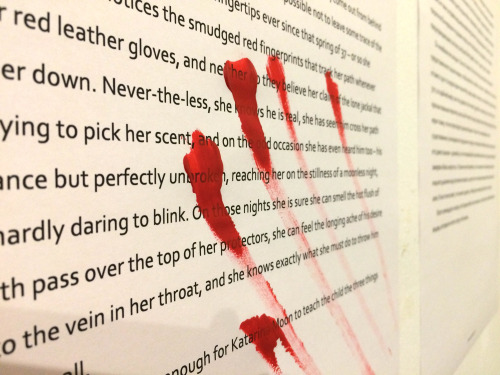
Final show blood.


During the last week of my residency I noticed my smiles being returned. Even Sergey’s eyes lit up when we greeted each other. There were definitely still times of frustration and misunderstandings. Often I would return to my room feeling battered by the difficulty of simple things. Like the exchange of a jacket I brought for my husband in the wrong size, which took half an hour and five attendants to figure out, one of whom was definitely berating me in Russian, but came up to me later, between aisles of coats, to apologise. Fortunately apologies are universal. As is gratitude and joy – not hard to understand in a foreign language.

My residency was a deliberately short one – three weeks in all, but still one of the richest experiences of my life. The two staff of the residency, Liza and Anastasia, were amazing. On my last day they drove me an hour out of St Petersburg to the Nevsky Bridgehead site, where the Siege of Leningrad was so intense that every square metre is the burial/death site of at least 12 men. In all, 29 villages were destroyed in this one area, one of the most vital positions to be held if the Russians were to win the fight against the German invasion – which, of course, they did.

In that field we discovered WWII helmets, shovels, hand-grenades, and bombs lying about, some of it displayed by diggers who had come and gone before us. There were broken bricks and porcelain from the old villages that no longer exist. I sensed the presence of an entire other ‘other’ while there, and acknowledged them out of earshot of Liza and Anastasia. Right at that moment, I felt my current novel-in-progress shift, just as it did when I visited the site of the Finnegans in my first novel, Purgatory. Somehow, visiting the sites of my stories brings my characters to life, and on the drive back to the residency, I knew that two or possibly three of my novel’s characters would be spending a great deal of time situated in that small village, and that the Neva itself had just become a very important character itself in the story.

I found my way into the residency through the novel I am currently writing, but I found my way into the city of St Petersburg through poetry. I hadn’t come to write poetry: I had come to research my novel. But there was something about being in the strangeness of this foreign environment that drove me inside myself in an investigative way, in a melancholic way. I found an absolutely unexpected focused energy, and the decision to allow it space alongside the research for my novel was the right one.

My end-of-residency show was exhibited in the small gallery of the Centre and attended by Friday-night visitors, as well as several of the original artists who fought for the establishment of the Pushkinskaya-10 Centre for Non-conformist Art. We drank Georgian wine and devoured six bags of pineapple lumps. I discussed my experience of St Petersburg and read one of the poems, after which the audience were free to read the poems on the walls in both languages and view the objects I had collated to speak to the poems. The most popular items were those from the field of fallen soldiers. A shoe with nails hammered through the soles, a piece of broken porcelain from a ruined village, wire from a barricade fence, and a thickness of greenstone brought from New Zealand and given to honour the digger who has dedicated 18 years of his life to recovering bones of the lost soldiers.

What I have on my return home is an idea of the character of the people of Russia, an understanding of the layout and history of St Petersburg for my novel, and the unexpected start of a new collection of poetry.  I plan to return to St Petersburg when the poetry collection is complete, this time not as a stranger with monsters in my head.

Rosetta Allan is the author of two collections of poetry, Little Rock (2007) and Over lunch (2010), and the historical novel Purgatory (2014). She received a Creative New Zealand Arts Grant in 2015 towards writing her second novel, set in post-Soviet Russia and Kazakhstan.


illegal rooftop cafe copy

Rosetta at an illegal rooftop café.

'Character to some extent is much a construction of the reader as it is of the writer.' - Lloyd Jones

Read more

Back to the Book Awards

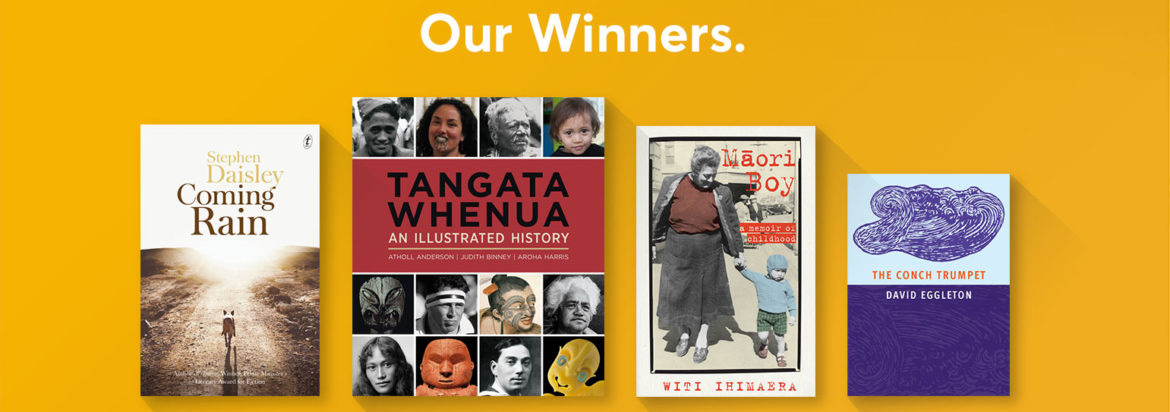
The last sponsor abandoned them, but David Larsen finds that reports of the death of our national literature awards have been greatly exaggerated.


As one would expect, the media were all over the inaugural Ockham New Zealand Book Awards, held in Auckland on 10 May. I am obviously referring to the social media. The morning after the awards ceremony, writer Linda Burgess pointed out (on Facebook) that the New Zealand Herald’s top stories that day included ‘Antique Roadshow’s $74k error’ and ‘CBD-Panmure tunnel to bypass gridlock’ – but nothing on our new national book awards.

The Ockham New Zealand Book Awards are in their first year. Actually, they’re in their first year and a half, that being the interregnum period these awards needed to cover after the New Zealand Post Book Awards folded in 2014. This collapse should not have been a huge surprise. New Zealand Post had been hit hard by digital disruption, and a major arts sponsorship is hard to square with major staff redundancies. But it was a body blow for New Zealand writing and publishing. The country has had annual literary awards in one shape or another since 1968.

They’re gone, people said. That’s it. The sponsorship era is dead. We hadn’t counted on the zeal of Ockham Residential Limited, developers and self-described urban regenerators. ‘Why sponsor these awards?’ said Ockham’s Mark Todd at the awards after-party. ‘We want to improve the state of public discourse. Also, we give a shit.’

Meanwhile the Acorn Foundation, based in the Western Bay of Plenty, were looking askance at Tui’s 2015 Catch A Million competition. Cricket fans could win a million dollars for pulling off a one-handed catch while wearing the lucky colour of the day. A million dollars for catching a cricket ball, in the year no one was willing to fund our book awards? Through Acorn, some far-sighted anonymous donors endowed – in perpetuity – a $50,000 prize for the fiction award each year.

Still, even after the announcement of this new support, there was much discussion – on social media, at book launches, anywhere you were likely to bump into writers or publishers or critics – of who literary awards should serve, and how, and why.

One frequent lament was the lack of media splash, year in, year out, once the awards were announced. Media failure? Awards failure? Both? Both! And certainly, the old awards ceremonies were crushingly boring affairs. Plastic chicken was served as haute cuisine. The public was not invited, and the press as a rule turned up only for the chicken. (We’re not well paid.) The most notable coverage of the old awards’ 2014 Last Supper was one well regarded literary editor’s tweet, ‘I don’t even know what this is’. She was referring to the dessert.

So yes, it was reasonable to give the old awards some small share of the blame for the media silence they seemed to inspire. It’s not reasonable now. The failure of the largest newspaper in the country to notice that a well-designed, streamlined, public, highly entertaining ceremony had just launched a rather startling slate of award winners into the national literary firmament is not surprising – digital disruption is doing nastier things to journalism even than to the world’s postal services – but anyone who takes this as evidence that the awards organisers are doing something wrong is badly wrong themselves.

‘We’re lucky, aren’t we?’ said the pleasant elderly woman sitting next to me in the main auditorium of Auckland’s Town Hall, as the lights were going down. ‘To have such good writers’. She was responding to the full list of past awards-winners scrolling down the screen at the rear of the stage. It was a list worth seeing. Names I’m not well read enough to know. Harry Morton. John Dunmore. (He won in 1970, for The Fateful Voyage of the St John Baptiste. I had not yet learned to read.) Names any New Zealand reader knows. Janet Frame. Maurice Gee. Anne Salmond. Michael King. Edmund Hillary! The literary whakapapa of our country, or a good few of them. Awards are subjective, and fair only in their cumulative equality of unfairness; there is no way around this, and it’s silly to think otherwise. The winners list, many of them long dead, was still deeply moving. As a way of saying, ‘These awards matter; writing matters; be glad you’re here’, it was a well-judged overture.

The full ceremony took under ninety minutes. I’ve sat through ninety-minute Hollywood thrillers that felt longer. Awards Trust chair Nicola Legat opened, coming on stage briefly for the necessary thank yous and hat tips, one of the many this-must-be-done items which have doomed previous ceremonies to a funereal solemnity. She said what had to be said (sponsors! we love ‘em! politicians who turn up to our awards! they gladden our hearts!) economically and gracefully, a difficult pair of adverbs to combine, and got off the stage.

The MC, comedian Michele A’Court, was ‘fine’, which sounds like damningly faint praise. But fine was in fact the exact right thing for her to be: funny but not hilarious, diverting but not under the impression she was the main attraction. She made a few jokes, gave a clear and concise outline of the evening’s shape, and mentioned that at the end of the evening, all the books on all the shortlists would be available for purchase. This has never been the case at an awards evening before, partly because members of the public have never previously been let through the doors. Think about that a moment.

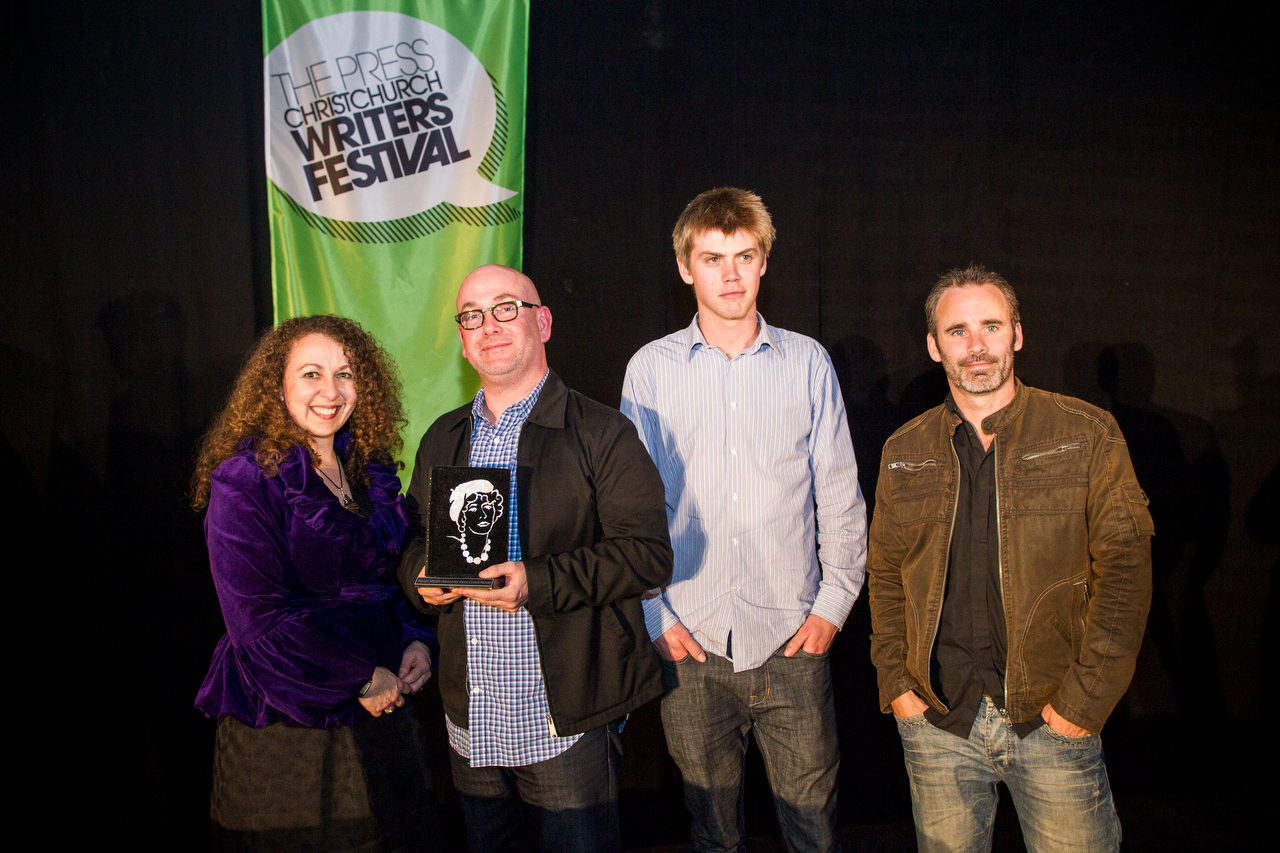
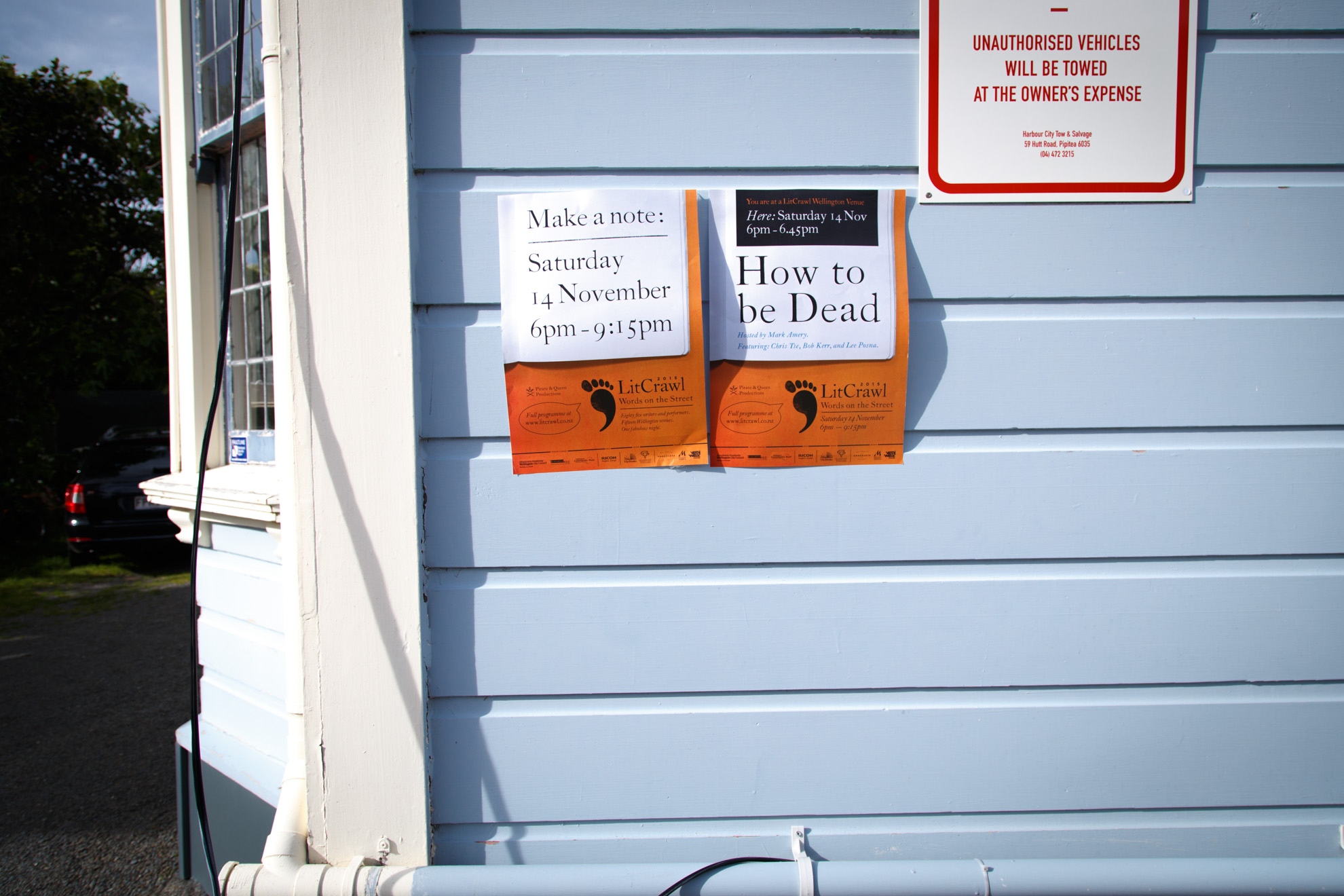
Maggie Barry, Minister for Arts, Culture & Heritage, announced the best first book awards. Offering a politician possession of your stage and a microphone is death, death, death. To the astonishment of all present, the Honorable Barry just did the job – only getting one winner’s name wrong.) The Judith Binney Best First Book Award for Illustrated Non-Fiction went to Richard Nunns for Te Ara Puoro: A Journey into the World of Māori Music. (He was ill, and his publisher, Robbie Burton, collected the award for him). The Jessie Mackay Award for Poetry went to Chris Tse for How to Be Dead in the Year of Snakes. The Hubert Church Award for Fiction went to David Coventry (or David Courtney, according to Barry) for his novel The Invisible Mile. The E H McCormick Award for General Non-Fiction went to Melissa Matutina Williams, for Panguru and the City: Kāinga Tahi, Kāinga Rua. It’s taken you longer to read this paragraph than these awards took to give out: bam bam bam bam, names announced, writers whisked on and off stage, done.

People I spoke to afterwards felt this was one of the moments of over-correction away from the languorous pace of the old awards. They wanted these writers to have mike time. ‘Some joy would have been nice,’ said one industry long-timer. It’s a reasonable point. I can only report my own reaction: ‘Adrenaline high, four awards in three minutes, awesome.’ It struck me as a well-calculated timing sacrifice: pare the four junior awards down, focus attention on the major awards, keep things moving. The desire to give everyone their time at the mike is admirable, and so is the desire to hold the audience right through the evening. Pick one.

The four major categories were handled very differently. For each, the four shortlistees were brought up on stage. In alphabetical order, each read a self-selected two-minute passage from their book, and sat down again with the audience. Then the convener of the relevant panel of judges – different judges for each category, a remarkably sane reduction in reading load from the old system – announced the winner and read a citation. The winner returned to receive the award.

This system is excellent. Everything about it is elegant, simple, and useful. There is an inherent risk in asking writers to read aloud, which is that not all of them can, but that in itself can be an interesting thing to learn. As it happened, the writers in three out of the four categories were solidly in the acceptable to excellent range as readers of their own work. Rachel Barrowman, reading a passage from her Maurice Gee biography in which the young Gee tries and fails to save a man’s life, and Witi Ihimaera, reading about his first few days at school and his grandmother’s stern response to Pakeha teaching, could each have been reading the kind of novels you’d run right out and buy; both of them were in fact shortlisted in general non-fiction.


Chris Tse and Tim Upperton, each reading their own poems, were arresting and entertaining in diametrically opposed yet similar ways, Tse dramatically understated, Upperton wry and laconic. Only the novelists, with the notable exception of Patricia Grace, failed to lever their books off the page and into the air. Even with the inevitable few weak readers, I cannot think of a better way to give an audience a sense of the quality and weight of the writing we were all there to celebrate.

The one clear error the organisers made was in the presentation of the illustrated non-fiction readings. One of the shortlistees, Athol McCredie, had asked to present a slide show from his book, New Zealand Photography Collected. ‘The photos are the substance of the book, they speak a visual language’. It was gorgeous, and it was essential. It became instantly obvious that the other three finalists should have been urged to take the same approach; getting the text of their books without the images was like being read the recipes in a cooking competition without being allowed to see the finished meals.

The winners in the four categories were Witi Ihimaera (Maori Boy: A Memoir of Childhood, Vintage) for general non-fiction; David Eggleton (The Conch Trumpet, OUP) for poetry; Judith Binney, Aroha Harris and Athol Anderson (Tangata Whenua: An Illustrated History, Bridget Williams Books) for illustrated non-fiction; and Stephen Daisley (Coming Rain, Text Publishing) for fiction. All four decisions were succinctly and eloquently explicated by the judges, which is the most you can ever ask; I doubt anyone in the room agreed with all four of them, because no one ever does. (Part of the social function of awards is to put pegs in the ground for subsequent literary arguments).

All four writers – Athol Anderson spoke for his team, Aroha Harris having done their reading – gave brief acceptance speeches. Daisley’s was my favourite. He was handed the golden Acorn and a cheque, and looked like a man who couldn’t believe he had just won fifty-thousand dollars for doing something he loved.

The great, much-missed New Zealand writer Nigel Cox once said that literary awards are a game. You have to take them seriously, or the game doesn’t work; but you mustn’t take them seriously, because it’s only a game. This is the most useful and sophisticated point of view I’ve encountered on the subject. My own point of view, heading from this awards ceremony into the Auckland Writers Festival for which they serve as curtain raiser, is that New Zealand’s literary awards have finally got the rules right.


David Larsen is a freelance writer based in Auckland.


Novelist Stephen Daisley with Nicky Wilkins, CEO of Acorn Foundation.


'There’s a kind of heaven that comes from hearing another writer interpret the mysteries of process' - Tracey Slaughter

Read more

Photo credit: Kelly Ana Morey

Not (Yet) in Our Neighbourhood

Our local crime novelists are finding success overseas, but Rosabel Tan asks why more people aren’t reading them here?


Ask some New Zealand crime novelists how they got into it and you’ll encounter a strange refrain. ‘I didn’t set out to write crime,’ Paddy Richardson tells me.  ‘I actually wanted to be a horror writer,’ says Paul Cleave. ‘I’m not a crime writer,’ says another, who later asks for their interview to be stricken from the record because they don’t feel the label applies. It’s a hushed chorus of internalised shame.

And yet the numbers don’t add up: New Zealand crime writers are doing remarkably well. Christchurch-based Paul Cleave became an international bestseller after publishing his debut novel, The Cleaner, in 2006. After publishing his second novel the following year, he quit his job as a house renovator and started writing full-time. His books have since been translated into fifteen languages, and he’s found a wide readership in France, the United States and, in particular, Germany, where his books have sold more than half a million copies.

It’s also in Germany where Dunedin-based crime writers Paddy Richardson and Vanda Symon have found an audience, while 26-year-old Aucklander Ben Sanders has made his mark in the United States. After publishing three novels while completing an engineering degree at the University of Auckland, Sanders was offered a two-book publishing deal by an editor at Macmillan in New York. The condition: they had to be set over there. The first of these – American Blood – was published in 2016 and was optioned by Warner Brothers before a first draft was even completed.

It seems that ever since the worldwide reign of our original Queen of Crime, Dame Ngaio Marsh, New Zealand crime writers have continued to find success in the same places she did: everywhere but here. But with more than 30 new books by New Zealand crime writers published in 2015, why the relative local obscurity despite overseas success?

‘I think crime fiction is one of the last refuges of the cultural cringe,’ suggests Paul Thomas, whose novel Old School Tie (Moa Beckett, 1994) marked the beginning of a new generation of local crime writing. ‘It’s understandable up to a point. There’s not a lot of New Zealand crime fiction and not all of it is good; there’s a hell of a lot of international crime fiction, some of which is very good.’

And it’s the very good that sells. Despite the gloomy harbingers, the New Zealand book industry is in fairly good health. Data from Nielsen shows that 5.3 million books were sold last year, a rise of 9.3% from 2014. Within this, crime fiction maintained a decent sliver of the market, with every 7 in 100 books sold being a crime novel of some kind. Sounds impressive, but the majority – 85% – were from the UK.

It’s discouraging maths: of the 5.3 million books sold last year, 356,000 were crime novels, but only 5,400 were from New Zealand. And when you look at the top ten bestselling crime fiction titles ever sold in this country, only three authors figure – Stieg Larsson, Lee Child and Dan Brown. ‘It takes a big jump to select a book by an unknown New Zealand writer over a favourite famous one,’ remarks Paddy Richardson.

The problem is compounded by the genre’s success in transitioning to digital book sales. ‘That makes it more difficult to get noticed if you’re not a big name,’ says Kevin Chapman of Upstart Press, publisher of Paul Cleave and Paddy Richardson. ‘Discoverability is still the big issue on the web.’

The issue isn’t New Zealand subject matter, as readers are keen to read local books about true crime like Ian Wishart’s Arthur Allan Thomas: The Inside Story (2010), Lesley Elliott’s Sophie’s Legacy (2011) and Mike White’s Who Killed Scott Guy (2010). This fascination with true crime is a ‘good thing,’ says journalist Steve Braunias. ‘It’s wanting to know how your community operates.’ His latest book, The Scene of the Crime (2015, HarperCollins), explores twelve sometimes strange, sometimes brutal cases from New Zealand’s recent history.

For Braunias, writing creative nonfiction about crime has its own voyeuristic implications. ‘Why am I there, really? Why am I doing this?’ ( His theory is ‘appalling curiosity.’) ‘There’s a horrible thrill to it,’ he says, ‘which isn’t dissimilar in some ways to works of art. There’s a spectacle or truth going on, I think, about what people are really like.’


Photo credit: Kelly Ana Morey

Photo credit: Kelly Ana Morey

In 2010, frustrated by the low visibility of our crime fiction, former lawyer and journalist Craig Sisterson established the Ngaio Marsh Award for Best Crime Novel, now joined by a prize for Best First Novel. The Awards are held annually in association with Word Christchurch and are judged by a rotating panel of local and international figures. Recent judges have included Janet Rudolph, editor of the Mystery Readers Journal, and Icelandic writer Yrsa Sigurðardóttir.

Sisterson felt that New Zealand crime writers ‘didn’t seem to be getting much in the way of support or recognition, despite the quality of their writing and storytelling.’ He was reviewing crime novels for a number of outlets at the time – he now writes a popular blog called Crime Watch  – and was dismayed at the attitude to local writers. Although New Zealand crime writers were often writing to the same standard as their international counterparts, only the latter seemed to be getting promoted by booksellers and devoured by readers. The award, he hoped ‘would be a way to support, highlight, and celebrate the great crime writers we have in our country.’

Everyone I speak to – from crime writers to festival organisers to critics to editors – endorses the passion and impact of Sisterson’s tireless work, but some believe awards can only do so much.  ‘I can’t say I’ve noticed any [impact of winning the Ngaio Marsh Award],’ admits Paul Thomas, whose novel Death on Demand won in 2013. He doesn’t see this media and public indifference as unique to New Zealand. ‘When I won the Ned Kelly, the Australian crime-writing award, a leading light in Australian literary circles told me it would change my life. It didn’t.’

Part of this can be chalked up to low media visibility, but there’s something else, too – a reluctance to embrace local crime writers, however lauded they may be. ‘There are more and more talented New Zealand crime writers emerging,’ observes Paddy Richardson, ‘and eventually there’ll be more awareness and acceptance.’

That ‘acceptance’ refers not only to our cultural cringe but to the attitude of the local literary establishment towards the genre – something deeply felt by Ngaio Marsh herself.  She published more than 30 classic detective novels over seven decades, beginning with A Man Lay Dead in 1934. All of them featured Inspector Roderick Alleyn of the London Metropolitan Police. But only four of her books were set in New Zealand, and in her memoir, Black Beech and Honeydew, Marsh said it was only in England that her novels were ‘discussed as a tolerable form of reading by people whose opinion one valued.’

Marsh lived in England as a young woman and returned there many times, including in 1949: her publisher, Penguin, had just re-released ten of her novels with a print run of 100,000 each – a remarkable act of confidence that placed her alongside only a handful of writers, among them Agatha Christie, H. G. Wells and George Bernard Shaw. Back home, she complained, her ‘intellectual New Zealand friends tactfully avoid all mention of my published work and if they like me, do so, I cannot help but feel, in spite of it.’

This kind of snobbery persists, Sisterson contends, although it’s less from readers themselves, for whom ‘crime- and thriller-writing has long been a supremely popular form of storytelling’, or from publishers, booksellers and librarians either. Instead Sisterson suspects a prejudice ‘within some reviewers, academics, festival organisers, awards judges, and those holding the arts funding purse strings’. This, he thinks, reflects the attitude that ‘something that’s very popular can’t be as good as something appreciated by a smaller group – that the latter must be more discerning’; he also points to the high-art belief ‘that plot is an inferior aspect of writing’.

Paul Thomas cites the Man Booker Prize-winning novelist John Banville, who writes crime under the pseudonym Benjamin Black. ‘He talks about crime fiction having a ‘prior commitment’, by which I assume he means an obligation to respect the conventions of the genre. Martin Amis made the related point that nearly all crime fiction is about the same thing.’

Is this why so few crime writers are programmed at New Zealand’s big literary events? ‘A festival is a very particular thing,’ says Anne O’Brien, director of the Auckland Writers Festival, which saw over 60,000 attendees in 2015; the 2016 festival featured crime writers Paula Hawkins, Ben Sanders and Ian Austin. Some readers, she says, ‘don’t need – or want – to listen to the writers they like talk about their work. That’s not what they want to do. They want to read the work.’ This is especially true of forms like crime fiction that are typically more plot-driven, she believes, and don’t lend themselves to an in-depth hour-long conversation about craft.


The four finalists onstage at the 2012 Christchurch Writers Festival, where the third award was presented following the inaugural Great Crime Debate. Left to right: Vanda Symon, Neil Cross (winner for LUTHER: THE CALLING), Ben Sanders, Paul Cleave.

The four finalists onstage at the 2012 Christchurch Writers Festival, following the inaugural Great Crime Debate. Vanda Symon, Neil Cross (winner for Luther: The Calling), Ben Sanders, Paul Cleave. Photo credit: Word Christchurch.

The best crime fiction transcends the constraints of genre to investigate and expose contemporary society: it excavates humanity’s ugliest moments, explores extremes of power and ambition and desire and revenge, and at times (for example, in the case of Stieg Larsson’s Millennium trilogy) serves as powerful social commentary.

Jennifer Lawn, a Senior Lecturer in English and Media Studies at Massey University, argues there’s a clear critique of economic inequality running through the work of Paul Thomas, Donna Malane, Alix Bosco and (stretching ‘the definition of crime fiction into noir-ish literary fiction’) Charlotte Grimshaw. ‘The corporate elite in their novels are as morally defective as any mean-street low-life, and frequently more dangerous because they control more resources and get others to do their dirty work for them. The other side of the coin is a concern for the lives of vulnerable Kiwis who have ended up on the wrong side of the law or who are just struggling to get by.’

Vanda Symon agrees that crime fiction ‘often puts a spotlight on society and how life is for those in the fringes’ and ‘gives a platform to discuss anything and everything from politics, to inequality, to abuse of power, to marginalisation of groups of people, to violence and abuse against women, to organised crime.’ She cites Paddy Richardson’s psychological thriller Swimming in the Dark, as a complex interrogation of power imbalance and violence against women, in New Zealand and overseas. ‘The veneer of civility is very thin and crime fiction gives us a glimpse of what happens when that veneer is scratched.’

Like Marsh, Symon has created a serialised detective – but hers is a woman, Samantha Shephard. In Overkill (2007), The Ringmaster (2008), Containment (2009) and Bound (2011), Shephard emerges as a self-deprecating and accident-prone maverick navigating professional and domestic chaos. In Overkill, Shephard finds herself investigating the brutal murder of a young mother, who’s forced to take her own life in order to protect her baby. The twist: the victim’s husband also happens to be Shephard’s ex-lover. In Containment, she’s investigating a dead diver and grappling with the news that her boyfriend, a police officer, is thinking of transferring to her home office of Dunedin. When Shephard exploits her gender to get the results she needs, there’s no clichéd flirting: instead she’ll book a smear test in order to question a nurse about a case-in-progress.

Paul Thomas’ serial detective, Tito Ihaka, prefers a more solitary approach in Old School Tie (1994), Inside Dope (1995), Guerrilla Season (1996), Death on Demand (2012) and Fallout (2014).  Thomas’ Maori maverick is a big drinker with authority issues; he gets into fights, including with a colleague who makes a racist remark; and is an outsider in the Central Auckland station that seems more concerned with internal politics and fine wine.

The Ihaka novels present an Auckland that’s corrupt at an institutional and individual level. In Death on Demand, Ihaka’s investigation of what appears to be a standard hit-and-run reveals unexpected connections among Auckland’s elite, the criminal world and Ihaka’s own colleagues.

Police incompetence and corruption also rears its head in Cleave’s novels, set in his native Christchurch. Unlike Thomas or Symon, Cleave tends to write from the perspective of the murderer, blurring the line between detective and perpetrator to create complex psychological profiles. Joe, the killer in Cleave’s first novel, The Cleaner (2006), feels indignant when he realises the police have attributed seven murders to him when in fact he’s only done six. So begins a hunt for the copycat who’s tarnishing his good name. In The Killing Hour (2007), the narrator wakes to find himself covered in blood, only the blood’s not his and the women he was with the night before are no longer alive – but he doesn’t know what’s happened. And in Trust No One (2015), an ex-crime writer with Alzheimer’s starts confessing to murders that are simply the plots from his books. Or are they?

Our national style, perhaps, is a take on the hard-boiled tradition with local inflections. perspective. In her essay ‘New Zealand genre fiction since 1990’ (to be published in volume 12 of the Oxford History of the Novel), Jennifer Lawn characterises our detectives as self-deprecating figures who hardly ever work alone; the femme fatale is a notably absent figure in our crime fiction; and ‘guns are generally shunned in favour of more improvised methods of disabling the criminal, such as the frying pan, spade, bronze horse sculpture, can of aerosol fly spray, or strategically-inserted telephone aerial.’

As that list of weapons suggests, there’s an underbelly of dark humour that Lawn considers ‘one of the best qualities of New Zealand crime fiction.’ The lighter touch means our crime fiction isn’t extremely graphic. Even Paul Cleave, with his ‘large body count’ and ‘messy murders’ uses little gratuitous detail. Lawn points out that the villains of New Zealand crime fiction aren’t demonised, perhaps unsurprising in a country with no history of serial killers. ‘In most cases,’ she suggests, ‘there isn’t a lot of backstory setting out a crimogenic trauma, history or abuse or “primal scene” that turned the villain into a psychopath.’

But does our crime fiction have a particular New Zealand character? Sisterson isn’t sure. ‘There may be some distinctive things given our place in the world, our sense of humour, our landscapes and our relationship to them. But really it’s a growing choir of varied voices, with some harmonies, more than a single distinct voice.’ Paul Thomas is blunter. ‘I wouldn’t have thought we had [a distinctly New Zealand voice]. I think that tends to happen when one or two writers’ critical or commercial success inspires imitation.’

By success, of course, Thomas means here, in New Zealand. But perhaps it doesn’t make sense for crime writers to focus their attention locally, because of the small size of the local market. Sanders’ American Blood, for instance – which was originally optioned with Bradley Cooper attached to play the lead – had all its New Zealandisms scrubbed out. Sausages became hot dogs. Petrol became gas.

Further south, Wellington-based import Neil Cross has continued focusing his efforts overseas, whether as the writer of cult BBC crime show Luther and its associated trilogy (the first of which – Luther: The Calling – was published in 2011) or as the screenwriter for Guillermo del Toro’s Mama. The late Laurie Mantell, a leading New Zealand crime writer of the 80s, found a more receptive environment overseas as well. Although all six of her books were set in her home patch of suburban Wellington, she was only ever published in the UK and the US – by Victor Gollancz and Walker and Company respectively.

‘I’m curious to see whether we’ll have a tipping point,’ remarks Sisterson, ‘where we’ll have one or two crime writers break through in an even bigger way on the world stage, and then bring a lot of other Kiwi crime writers along with them as the world turns its attention our way.’ Perhaps this is what we need: for our biggest imports to be our own, and for our writers to leave in order to return.

Rosabel Tan is a writer and the founding editor of ‘The Pantograph Punch’.


NMA Best Crime Entrants 2016 full

Photo credit: Word Christchurch.


'NZ literature is such a vast and varied thing' - Pip Adam

Read more

Photo credit: David White/FairfaxNZ

The Interview – Patricia Grace

Patricia Grace was born in Wellington in 1937. She was teaching and raising a family when she began entering her work in competitions with local newspapers. Her first novel, Mutuwhenua, (1978) was the first novel ever published by a Māori woman writer.

She has published a number of influential and acclaimed story collections and novels that explore Māori experience, both historical and contemporary, and her work has been widely published, translated and anthologised.

Her numerous honours include the Prime Minister’s Award for Literary Achievement in 2006, and Distinguished Companion of the New Zealand Order of Merit (CNZM) for her services to literature in 2007.  Patricia lives with her whanau in Plimmerton on her ancestral land of Ngāti Toa, near her home marae at Hongoeka Bay.

This interview with Adam Dudding took place in April and May 2016, when Patricia’s seventh novel, Chappy, was a finalist in the Ockham New Zealand Book Awards.


When did you realise you were a writer? 

I’d always been interested in writing without really knowing what real invented writing was. From a young age I liked the act of writing, which might mean copying words or sentences from books or advertisements, or trying to write letters when my mother was writing letters. At school we copied sentences from a blackboard on to our slates. I enjoyed that but I never thought of making stories from my own experiences.

We weren’t encouraged in that either. We were given topics from textbooks from England to write about, so if we had a topic like a ‘walk in the forest’ I would write about forests I’d never been in that had brooks and bluebells in them. It seemed to be what was expected of us.

What I wrote was all from my reading, and my reading was from things like the Weetbix packet, Sergeant Dan the Creamoata Man ads, Chicks’ Own and other comics, and Whitcombe and Tombs primers which were our school readers. If given a topic like ‘A day at the seaside’ I’d write about ‘seasides’ – with the little stripy tents I’d seen in comics where you went in and changed into your bathing costumes. It never occurred to me to write about the beach where I swam and played daily in the summer holidays. I was using words in my little ‘essays’ – we had them once a week – that I’d never heard spoken, like ‘bathing costumes’, ‘meadows’, ‘briny’ – all those kinds of words. We might have heard the word ‘forest’, but we’d usually referred to our own forest as the bush. Real forests, to my understanding, were inhabited by wolves, foxes, woodcutters and all kinds of magic animals.


Who are the writers who influenced your writing, or informed your decision to be a writer in the first place? 

So, in the early days I didn’t know what real creative writing was. I thought it was just imitating what had been read. I don’t know – trying to write a new Conan Doyle-type mystery, cobblestone streets, or something like that. That was until I came across writing by New Zealand writers, which was very late – after I’d left secondary school. I started to hear the New Zealand voice in literature and to understand that real writing is writing that comes from your self – your dreams, imaginings, emotions, dreads, desires, perceptions – what you know. Part of what you know comes from the research that you do.

Those early influences were people like Frank Sargeson and Katherine Mansfield. I started to experience the New Zealand settings, hear the New Zealand voice in what I was reading for the first time, and then when I came across the writing of Amelia Batistich, a New Zealander of Dalmatian origins, I thought well, this is a different New Zealand voice. It started to click with me that I might have my own voice too. The penny dropped rather late for me.

As well as Batistich there were all the Maurices [Gee, Shadbolt, Duggan], as well as writers like Dan Davin, Robin Hyde, Ruth Park, Ian Cross, Marilyn Duckworth, Janet Frame. All added to my enlightenment and to the realisation that I would have a voice of my own. I knew also that there were people who I could write about, or characters I could invent, based on people I knew, who hadn’t really been written about before. There were stories about them, but not written ones.


How old were you? 

Early 20s. I was waking up to what writing was during my teachers’ college days, and after that.


In 1975 you became the first Māori woman to publish a collection of short stories. Apart from the absence of role models and predecessors, and the fact that you’d been raised on brooks and meadows, did you encounter specific barriers that you mightn’t have if you’d been Pakeha, or male, or both? 

I wasn’t aware of any. I think the time was just right for myself and for people like Witi Ihimaera and Hone Tuwhare. The real pioneers were JC Sturm, Rowley Habib, Arapera Blank, Rose Denness and Mason Durie and those writers I had started to see published in the journal of the Māori Affairs Department, Te Ao Hou.

But I have to say that once I understood what writing was all about, the real influences were the people around me – parents and brother, cousins, aunts, uncles, grandparents of the extended family. It was not so much because of the anecdotes they told but because of who they were, what they did, what they said and how, and how they interacted with each other, how we all interacted. My parents delivered some very intriguing one-liners which fired the imagination, such as: ‘You know, you had an uncle who rode on a whale.’ Or, ‘Your great-great-grandfather had two rows of teeth, top and bottom, and he used them when he climbed ships’ masts.’ Later, my husband’s family were also influential – great storytellers, great orators.


Once you’d found your voice, which parts of the writing life did you find you loved, and which were just a slog? 

The slog is getting from the beginning to the end. The good part is going back and sorting everything out and doing the editing. That’s the part I really enjoy – knowing that everything is almost there and that I can get to work and rearrange or refine. I could go on doing that forever – you have to call a stop to it somewhere along the line.

I also love the research. I never used to do much research in the early days but in my more recent novels there’s been quite a lot. I probably do much more than I need to do, but doing much more than you need probably helps put everything in a fuller context.

I really love it when I’m writing and you get these areas when everything flows. That’s a good feeling. But I also don’t mind the struggle. Sometimes I have to put something aside because it’s not working and then I have it on my mind and stay awake at night working it all out. When I do work it out it’s satisfying.

I have a confidence now that I didn’t have in the early days, when I’d sometimes think ‘This is too terrible. I’m never going to be able to do this.’ I never feel like that now. I know there’s always going to be a way, or that you can just chuck something out if it’s too annoying. That’s a solution as well.


I’ve heard you say you’re not very technologically minded, but did the availability of computers from the 1980s on change that editing process that you enjoy so much? 

Yes, though because I wasn’t brought up with computers I still always start off with handwriting, then I go on to the computer. It’s a wonderful tool.

I started using a computer when I was writing Potiki (1986) I think. I wrote it all in longhand, and I cut it up and stuck it back together with sellotape – the real cut and paste – and then typed it up on my Brother portable typewriter. I think I put it on to computer when I took up the fellowship at Victoria University in 1985 and there was a computer available to me. Vic Uni has the manuscript in its archive. They displayed a few pages of it, I think it was in 2012 or 2013. It was all handwritten on the back of old computer paper, and one of the pages they decided to show had a bit of a shopping reminder scribbled on one corner. It was after the publishing of Potiki that I was given a computer by Digital Equipment. They were giving away a computer each year as a way of supporting the arts. They’d given one to Tom Scott the year before and asked him to recommend someone. He recommended me. We’d never met but I was grateful.


Some of your most enjoyable writing is your dialogue, especially passages where you capture numerous people talking at once. I’m thinking the guys in the pub betting on horses in ‘Dream’ [Waiariki] or the kids playing bullrush in ‘Kepa’ [The Dream Sleepers]. Can you talk a little about how you capture that stuff? Are you scribbling on your shirt sleeve or pulling out a tape recorder? Do you just have a great memory? Where does all that talk come from? 

I find dialogue the easiest of all, something that just flows. It comes from my own experience of being a kid, or listening to kids or being interested in what people say and how they say it. It’s because of having several registers within myself, which we probably all have, and making use of them. I remember the funny things that people say – or for that matter the striking or ordinary things that people say. No I don’t take notes or use a recorder. I can pull dialogue out at any time, Always had it in my head, all my life. I wasn’t a very talkative child and I’m not a greatly talkative adult even, but I do enjoy listening to people, and language and how it’s used. It becomes part of my own store. It’s enjoyable getting into a piece of flowing dialogue.


Several of your novels, the later ones especially, are sagas – lots of characters, lots of event, long timeframes. Do you map out these more complex narratives in advance or just follow your nose?  

I don’t map them out, because I don’t seem to be able to work that way.

When I started Potiki I thought I was writing a short story. I wrote the story about the carved meeting house, and when I finished that I thought if we have a meeting house there are people who belong to that meeting house. I asked myself who they might be. I started off with one character – that was Roimata – and how she came to be there, in that community. And then her children one by one, and her husband. I didn’t know from one chapter to the next what was going to happen – I was just following. That’s what I like to do. I just start out and follow the characters.

You gave me the opportunity before to say what was the best part of writing. The main thing for me is characters. I don’t really worry about anything else. I don’t think about the storyline too much actually – just the characters and what might happen to them because of who they are and where they are and who they interact with. The settings, the stories, the themes and the voices and everything else, the inter- relationships – all belong to the characters. So if you keep true to those characters and how they might develop because of who they are and who they have around them and, to a degree, what happens to them, then the story will unfold. I’ve learned to have faith that something will come out.

I didn’t know from the beginning to the end of Potiki what was going to happen. I had to go back and match the beginning up to what happened at the end. That’s the most extreme example of how it has worked for me. But it’s been a bit like that with all of my books.

With Chappy (2015) I knew the little story told to me by my husband about the Japanese shopkeeper in Ruatoria, where my husband was from, who was married to a local woman, probably a relative of my husband’s. My husband had told me how well-liked the man was in Ruatoria, how he was taken away to Somes Island during the war, interned as an enemy alien and was later deported, leaving his wife and family in Ruatoria.

I was very taken with that story, but at the same time I knew I wasn’t going to be able to get inside the head of a Japanese man, understand him culturally, or know his psyche. I had the core of a story but I didn’t know how I was going to tell it, how it would unfold. I couldn’t tell it from the inside, so I had to tell it from the outside. I had to choose the narrators, but I didn’t quite know who they would be. They had to present themselves.

When I heard the story I kept wondering how the Japanese man got to be in that Māori community and to be part of it. My husband was unable to tell me so I had to make up my own way of getting him here (my character, not the real one) and in thinking about that, came across the character of Aki, the seaman. I had an uncle in the family who had gone to sea at a young age.


Is that the same uncle who’s in your 1975 story ‘Kepa’, the one about the kids who are playing bullrush and waiting for their uncle to return from his faraway travels? 

Yes. They’re based on the same person. He was an impressive man when we were kids – this uncle who was going to bring us home a monkey from overseas. I knew some of the ships my uncle had been on so I looked those up in my research. I knew he was on the boats during the war too.

So that was that voice. And then I wanted someone who didn’t know anything about Chappy, so I brought in the grandson – who had to come from far away.


So the grandson who’s raised in Switzerland got pushed to the other side of the world by you to ensure his ignorance of Chappy’s story? 

Yes that’s right. I had to have someone who didn’t know, so he could find out. And I needed Oriwia as well, Chappy’s wife, grandmother of the young man from Switzerland. I needed her because the uncle was away at sea. He knew how Chappy got there but there were aspects of his new life that Aki was not aware of.

People need to inhabit the work. I’ve always been interested in writing about those interrelationships – especially the intergenerational ones. It’s a matter of finding ways of doing that which enable different characters to have clear identity.

Storytelling is one way I’ve found very useful – having different characters telling about the same things, each one bringing a new aspect and further enlightenment to the accounting.


‘The main thing for me is characters. I don’t really worry about anything else.’


If you find the story by following the characters, how does that work in a novel like Tu, where there are revelations and plot twists right near the end which have been set up early in the book. Did you always know the twists were coming and what would happen to Tu in battle, or did you have to go back like you did with Potiki, and tweak the beginning to match the ending? 

With Tu the twists came to me as I wrote. My idea was to have three brothers going off to war but I didn’t know what was going to happen to any of them. Well, I had a vague idea. I like vague ideas that can rattle around in my head, but which are not too fixed.

My task at the beginning was to make each brother different. So I had the older brother with all his heavy responsibilities after what had happened to the father; the next one who was the opposite; and the youngest one who was kind of the hope of the family – the one to rise above the situation they were in, who was protected from the father, who was to be well educated and have advantages which would mean best opportunities and a better life.

The idea that the older brothers wanted the younger brother to be protected – a lot of that came from reading the official history of the Māori Battalion and other material – there were many examples of older brothers not wanting their young brothers to go to war because of the tukana/teina relationship and the cultural demand that the older brother be responsible for the younger one. But the big brothers knew that in theatres of war they wouldn’t be able to look after their teina. They didn’t want the younger brothers to go.

There was one story told by the padre for the Māori Battalion. His younger brother had come to war against his wishes, and he prayed every day that if one of them was to not go home that it would be himself, not his younger brother. He would not want to go home if he was to leave his younger brother behind.

There were other efforts by soldiers, who’d pleaded with their superiors not to accept their younger brothers, or to send them home because they’d put their ages up and they shouldn’t be there and so forth. But of course with the loss of numbers during battles, and the need for replacements, hardly anyone was turned away.

Those stories and anecdotes, from my research, were very impressive, so in some ways the stories in Tu were not difficult. I just had to think about how the two older brothers were going to get the younger one home again. I knew from the beginning that Tu was going to be saved but I hadn’t worked out how. I didn’t know what his life was going to be after the war and had some decisions to make when I came near to the end.


Paula Morris keeps saying Tu needs to be turned into an epic movie. Do you have any films of your work on the way? 

The book Cousins has been in the pipeline for years and years, and I’d sort of given up hope with that, but it has recently come forward again, so we’ll see what happens there.

There was an option on Tu, and a discussion about Dogside Story. Barry Barclay had wanted to do Potiki. But they’ve never really come to anything, possibly because I was less than enthusiastic. I’m not holding my breath really, about the books becoming films.


I’ve seen, but not really understood, some pretty dense academic analyses of your work, with references to everything from Baudrillard to your use of ‘spiral’ form. How do you feel about academic slicing and dicing and labelling of your work, and do the things people say about your work often match what you thought you were doing? 

Not always, not often. However, I do appreciate the scholarship, and the efforts that scholars make to unlock the work, especially where it may lead to societal enlightenment. Much of it is over my head. I read reviews, and if they say great things that’s good and if they don’t it doesn’t matter. You write and you do the best you can. You put the work out there, and everything else that happens after that is beyond your control. I’m pleased if the book’s being read. Beyond that comes interpretation and discussion – the third life of the book – and I think that’s all good.

The spiral thing though – I have tried to explain before how I position myself in the writing. I don’t have a sense, when I begin a new work, of standing at the beginning of a long road and looking along it to an end. Instead I have a sense of sitting in the middle of something – like sitting in the centre of a set of circles or a spiral – and reaching out to these outer circles, in any direction, and bringing stuff in. That’s what makes it all closer to me, being in the centre and having all I need within reach around me and piecing it together. So there I am, at the core, with my core idea – the few sentences about the Japanese man – thinking about what I need to bring this character to life and to shift him from A to B.


Writing from the centre of a circle – is it silly to suggest this could be a specifically Māori sensibility, and the straight road is a linear, Pakeha kind of thing? Or is that just stereotyping both Māori and Pakeha worldviews? 

I don’t know. I don’t know how other writers see themselves placed. I just know that I have to have a sort of nearness to everything and if it’s not near I need to bring it near – that’s when I do research.


Some of the stories in your first collection, such as the story of the fisherman Toki, have a curious, poetic syntax, with the words in an unusual order for English. I was guessing that might be a transliteration of Māori syntax. Is that right, and if so, why did you do that? 

Yes. It was a contrived style in a way, but I was trying to copy Māori structures in English, to make it seem as though the characters could be speaking in Maori, even though I was writing in English. It was experimental. It might appear here and there in later work as well, but it had too contrived a feel for me after a while, so I didn’t keep it up.


I believe you’re not a fluent speaker of Te Reo. Is that right? 

No I’m not. I didn’t learn very much when I was a child because the adults who were fluent speakers of Māori around us wouldn’t speak it in front of us. I didn’t even know that that was my grandmother’s first language. The only time I heard it spoken would be at a tangi during formalities – and those experiences were quite rare. We had Māori words that we knew and used but that was all really. It wasn’t a Māori speaking community.

It wasn’t till my teenage years I started to take an interest in the language itself. I’d always had the idea that it was not a useful language, and had even heard it said that it wasn’t a proper language because it had ‘no grammar’. But then I met young people at teachers’ college who could speak Māori, who came from Māori communities, who didn’t have any trouble with English, and seemed to thrive from having two languages rather than only one. I started to feel that loss.

I made some efforts to learn but I haven’t been that successful. My children have learned but I’ve found it quite difficult. I can understand much more than I used to, but I’m very timid about trying to use it.

As for using it in my books – we just grew up using certain Māori words in English sentences so that’s what I’ve used in my writing. It’s because I wanted to be true to the characters and the way they spoke, not from any sense of wanting to alienate readers, which I’ve been accused of. I don’t think anyone would want to do that.


But I understood that you’d made a deliberate decision not to put a glossary of the Māori in Potiki, which is the thing that reviewers considered alienating. Is that true? 

Yes.


So guilty as charged in that instance? 

Well yes, but I don’t feel guilty. When Potiki first came out there was quite a bit of criticism of it. One of the reasons was because of the use of Māori terms and passages in the book; the other was that some people thought I was trying to stir up racial unrest. The book was described as political.

I suppose it was but I didn’t realise it. The land issues and language issues were what Māori people lived with every day and still do. It was just everyday life to us, and the ordinary lives of ordinary people was what I wanted to write about, so I didn’t expect the angry reaction from some quarters.

But there was one deliberate political act, and that was not to have a glossary for Maori text or to use italics. A glossary and italics were what were used for foreign languages, and I didn’t want Māori to be treated as a foreign language in its own country. When I told my publishers I didn’t want the Māori italicised or glossed, and gave my reasons, they agreed with me.


I’ve not read Potiki recently, but when I flicked through the pages looking for the alienating Māori words I didn’t see all that many. There are some short stretches of song that you can skim over, and occasional ‘haeremai’ or ‘karakia’ or ‘whanau’ which most Pakeha understand these days anyway. These would be totally unremarkable in a book published today.

Yes, but nobody knew them then. Since Potiki I’ve not come across any negative comments regarding the use of the Maori language in texts, except when one of my books was shortlisted for an Australasian prize, and it came back to me that mine was strongly rejected by the Australian judges because of the Māori language and no glossary – though that may not have been true.

One difficulty I have come across is that sometimes there’s a word that, if it isn’t glossed or italicised, you’d just think was an English word. ‘Mate’ means sickness or death but it just looks like the English ‘mate’. So I avoid words like that.


You have a knack for picking out the ironies within the politics, such as in the story ‘The Journey’ where an old man is saddened by Pakeha ‘progress’ but notices that the digger drivers are all Māori. Do you ever feel a tension between the artist’s desire to be nuanced and aesthetic even if it undermines the polemic, and the activist’s desire to shout from the rooftops about injustice?

I don’t think there’s a tension. It’s just however it comes out. Sometimes, quite often, I have to pull back rather, because politics can be overdone. You don’t want your work to become a drag. Rereading and editing you find what needs to be there and what doesn’t.


From the casually racist Pakeha woman in 1975’s ‘A Way of Talking’ onwards, you have drawn many vivid little vignettes of everyday racism. Have you personally experienced much of that yourself?

A lot of it’s from personal experience. When I was a child, and I think even now, you come across something every day that you might find disagreeable, and mostly you just put it behind you. If you can make a difference or say something about it then you do, but if you think it’s going to be a waste of time you don’t bother.

But I feel our race relations are good in this country, even though not perfect. There’s a level at which we all get on and really care about each other. But there’s also a level to do with the politics of the country, where elements of racism are brought into play for political reasons. Learning about each other is not as one-sided as it used to be.


Those overt, quasi-official examples of racism you’ve written about – you can’t come into this cinema because you’re Māori; you can’t get a home loan because you’re Māori; you get a smaller widow’s pension because you’re Māori – they’re starting to feel like the distant past aren’t they? 

Yes, but not the too-distant past. We’ve all worked very hard on those things over the years, but we need to be mindful. There is still much that is discriminatory in our institutions and workplaces which affect the powerless. Statistics will tell us there’s still a way to go.


Which of your works are the most explicitly autobiographical?

In the short stories, it would be ‘Going for the Bread’ (Electric City, 1987) which is just completely a story about what happened – there are hardly any changes at all to something that happened to me when I was about five years old. And for a novel, I would say Cousins (1992).


You’ve kept swapping between novels and short story collections. Novels often get more kudos, but do you place more value on one rather than the other?

I’ve always loved the short story form. Short stories are like little gems that you can keep polishing and polishing in your aim for perfection.

When I’m in the mood to get my teeth into something I’ll go for the novel, but there’ll always be a short story hanging around that I might start, and when I have enough starts I come up with a collection. I don’t think one form is superior to the other.


When you write the first word of something new do you know whether it’s going to be a short story or a novel? 

I usually know when something’s going to be a short story. Potiki is the only ’short story’ that’s turned into a novel, really.

Going back to when I first started writing, there are several little stories about Mereana dotted through the first three collections. I had the idea that they might be a novel, or if not a novel, a collection of stories that formed a whole story in themselves, but that never worked out.


I’d not even heard of the Neustadt Prize before researching for this interview, but it turns out it’s a huge deal. A US$50,000 prize that some people have described as America’s equivalent of the Literature Nobel. How did it feel to win it in 2008, apart from the pleasure of getting a fat cheque?

Well, I was amazed, because I hadn’t heard of it either. The way the judging is done is that different academics take a book that they think would be a worthy recipient of the prize. They meet and read each other’s choices and judge them and talk about them, They advocate for their own choices, but finally come up with the one they all agree on to be awarded the prize.

Joy Harjo of the Mvskoke/Creek nations – writer, musician and academic – and who I had met, rang me one day and said that she had entered Baby No-Eyes (1998) for the Neustadt Prize. She said it was an international prize and that she was one of the judges. She explained to me how it all worked and I was saying ‘Oh thank you very much for that. I hope it doesn’t give you too much stress…’, thinking that it was all still in the pipeline. And she interrupted and said ‘… and it won.’ So it was an enormous surprise.

I went to Oklahoma to collect the prize and met the benefactors of the award. I didn’t realise it was such a big deal really. I was very proud to have won it. There’s been only one other nomination from New Zealand, when Bill Manhire put one of Janet Frame’s books forward, but unsuccessfully. I think we should have more nominations from here.


Your stories have found audiences here and abroad. Do you ever think about who your reader will be as you write? 

No. I don’t like the feeling of anything that’s limiting to me, such as directing my work towards a particular group. I just think my audience is people who will read, whoever they may be.


Forty years after a published Māori writer was a rarity, it seems to me that what interests the outside world most about New Zealand culture nowadays, apart from Hobbity scenery, are the stories from or about Māori: books by you or Witi Ihimaera or Keri Hulme; films like Whale Rider or Once Were Warriors or Boy. Even The Piano or The Luminaries hark back to that early colonial contact. Is it pleasing for you that Māori voices and stories are being heard strongly beyond New Zealand?  

Yes it is pleasing, and I’m aware of that too. Though sometimes you wonder what is heard. I have a feeling that there are stereotypes out there and some of the work that’s reaching out may be strengthening those stereotypes. The warrior image. The haka. In Once Were Warriors there’s the image of the male dominance and the brutality and so forth. I know that that had an impact on a lot of people, and you don’t know if there’s enough out there to balance that. There could be negative images, there could be romantic images, and you don’t quite know what it all adds up to if there’s not enough about ordinary Māori daily life. You don’t know if your own work is setting up new stereotypes.

Adam Dudding is a feature writer from Auckland. His memoir about his father, the influential editor Robin Dudding, will be published by VUP in November 2016.

Photo credit: Kelly Ana Morey

Photo credit: Kelly Ana Morey

'Many of our best stories profit from a meeting of New Zealand and overseas influences' - Owen Marshall

Read more

Photo credit: Matt Bialostocki

Such noise! So many voices!

Steven Toussaint investigates the contemporary New Zealand poetry scene, and discovers much more than a tale of two cities.

Earlier this year, the Aotearoa/New Zealand literary community celebrated nearly twenty years of its Poet Laureateship with a sold-out gala event in Wellington. The laureates took turns at the podium, in the order of appointment, to read selections from their work, but also to reflect on the laureateship itself, on lives dedicated to poetry. In his opening remarks, the inaugural laureate Bill Manhire joked about English laureates like Robert Southey who ‘turned out poems for royal birthdays’. ‘Fortunately in New Zealand,’ he added, ‘there’s no requirement or expectation that you produce poems for the Queen or Prime Minister.’

Manhire’s remarks and the reading that followed presented a picture of the New Zealand laureate as public servant of the average reader—maybe even one uninitiated to the mysteries of poetry. This isn’t to denigrate the position, only to demystify it a little,tempering some of the pomp and circumstance.

‘New Zealanders are doubtful in an entirely pragmatic way,’ Manhire wrote in a 2011 essay for World Literature Today. ‘They want to give most things, including poems, a bit of a kick to find out just what they’re for.’ He characterises recent New Zealand poetry as ‘very happy with daily life’, and points to fellow laureate Jenny Bornholdt as a master of quotidian lyrics ‘where tradesmen call, children and recipes and baking are often on your mind, and neighbors behave in slightly quirky ways.’ Bornholdt enjoys an immense influence over the current landscape, he suggests, because ‘many of us recognise our lives in her poems.’


Photographer: Matt Bialostocki

Bill Manhire – Photo credit: Matt Bialostocki


Milestones like the ‘Circle of Laureates’ event naturally lead to reflection on the state of New Zealand poetry today. A cursory glance at the numbers would indicate good health. New Zealand’s three major University presses—Auckland, Otago, and Victoria—published 22 poetry collections in 2015 alone, and small, independent poetry publishing has seen a veritable renaissance in recent years, with start-ups Haunui Press, Hue & Cry, and Mākaro Press joining veteran outfits Seraph Press and Steele Roberts.

New Zealand National Poetry Day is now in its 19th year; its new sponsor, Phantom Billstickers, building on its 2009 ‘Poetry Posters’ initiative, is already planning over 80 events and readings around the country in advance of the day itself, Friday August 26th. New Zealand’s longest-running arts and literary journal, Dunedin-based Landfall (founded in 1947 by Charles Brasch), remains a stalwart reviewer and publisher of poetry, as does Wellington-based Sport; the Auckland-based New Zealand Electronic Poetry Centre (NZEPC) continues to record and archive the voices of New Zealanders for posterity; and recent years have seen the publication of landmark anthologies 99 Ways into New Zealand Poetry (2010), The Best of Best New Zealand Poems (2011), and Essential New Zealand Poems (2014). The $12,000 Sarah Broom Poetry Prize, created though a legacy from the Sarah Broom estate in 2014, has attracted nationwide excitement, with undergraduate students and national laureates alike submitting their work. (The winner of the 2016 contest, judged by Paul Muldoon, was Elizabeth Smither.)

‘I’d say there is a tremendous energy in New Zealand poetry,’ poet Anna Jackson told me, ‘and it is with the younger writers between, say, twenty to thirty-five years of age, who are running little magazines, printing chapbooks, hosting readings and spoken word performances. I’ve been to readings where you can’t get in the door and people are listening from the footpath outside.’

Poet Paula Green agrees: ‘With poetry not getting much attention in print media these days… poets are furnishing mobile hubs, boutique presses, pop-up events’, endeavours which Green applauds as ‘constantly eroding the stability of a national poetry canon’. It is fitting, perhaps, that the go-to destination for New Zealand poetry news, reviews, and interviews is not an institutional site with dedicated funding, but a labour of love: Green’s own website New Zealand Poetry Shelf.


Chris Tsepic's notice at 2015 LitCrawl. Photo credit: Matt Bialostocki

Chris Tse notice at 2015 Wellington LitCrawl. Photo credit: Matt Bialostocki.


A month after the laureate gala, I sat in the office of Fergus Barrowman, publisher-at-large of Victoria University Press and the MC for the event. We shared morning tea at a table cluttered with stacks of manuscripts and unedited proofs. As VUP is one of the primary publishers of poetry in New Zealand, it isn’t a stretch to imagine that one of those piles contained the first collection of a laureate to come.

‘When I was looking at the laureate line-up and preparing,’ Barrowman told me, ‘I realised there were three generations of poets represented, and a pretty well-selected “A team”.’ He noted that three laureates—Vincent O’Sullivan, C.K. Stead, and the late Hone Tuwhare—published their first books in the mid-sixties, within a year or two of each other. ‘Then you have Bill [Manhire], Ian [Wedde], and Cilla [McQueen] debuting in the 70s. And Michele [Leggott] and Jenny [Bornholdt] both published their first books after 1985.’

What the laureates have in common, despite differences of age and allegiance, is a shared inheritance: the self-conscious literary nationalism of the 1930s, when poets such as Allen Curnow, R.A.K. Mason, and Dennis Glover sought explicitly to define and enact a distinctively New Zealand style; and the romanticism of the 1950s, when James K. Baxter looked to poetry to repair the rift between Māori and Pākehā histories. But for poets today, learning ‘the trick of standing upright here’, as a well-known poem by Curnow has it, no longer requires such a deliberate performance of national identity.

‘In a way,’ Barrowman went on, ‘you could actually look at [Leggott and Bornholdt] as being foundation points for what’s flowed on since then. The process-oriented and the lyric-oriented.’

These two camps, in many ways, reflect regional as well as aesthetic differences. What Barrowman terms the ‘process-oriented’, loosely associated with the Auckland region, has strong connections with North American and Australian avant-gardes, for whom ‘content’ (or ‘story’, or ‘scene’, or anything else with a direct relation to a real or imagined world) is subordinate to the generative principles of composition. In Ya-Wen Ho’s chapbook last edited [insert time here] (2012), single words bridge illogical gaps between clauses:


Try not to detonate the sleeping

dogs_lie on surfboards which men shall ride towards

infinity_is beyond

comprehension_is an act of love and

Labour_and National run in elections which may or

may not be

fair…


Sam Sampson’s cerebral Halcyon Days (2014) pays close attention to form and space, such as where a photograph of geese in V-formation provides the shape for the poems on the following pages. Zarah Butcher-McGunnigle’s Autobiography of a Marguerite (2014) shows affinity with Gertrude Stein and the ‘Language poets’ of the United States, employing a kind of deranged grammar and syntax, in boxes of prose poetry, to foreground the materiality of language: ‘What we choose to digest. She was fed by her. Heavy, severe, arduous, pouring, bodyguard. Heavy (you must eat or you’ll be weak). Baked, sugared, fried, mostly, vastly, brightly, generally. My mother, broken sun inside the teacup…’

The traditions on which these poetries build tend to destabilise the notion of an ‘authentic voice’, and to disturb both the logic of the phrase and the logic between phrases. But by far the majority of poetry written in New Zealand falls, I would say, under what Barrowman broadly terms the ‘lyric-oriented’—in particular, an anecdotal, even chatty, lyric, strongly situated in scenes of domestic life. The identification of this style with the Wellington region owes in part to the International Institute of Modern Letters, New Zealand’s oldest Creative Writing programme (founded by Bill Manhire in 2001), and in part to the influence of major poets who call Wellington home—Jenny Bornholdt, Kate Camp, James Brown, Hinemoana Baker, and Manhire himself—but its influence is too pervasive to be associated with one region alone.

Many of the poems in Ashleigh Young’s Magnificent Moon (2012) narrate a scene that would be recognisable as an ordinary snippet of daily life in New Zealand—a family swim, having lunch, watching TV—were it not for the uncanny variable that throws the realism out of joint:


They’re holding the Olympics on the lawn outside our house.

A bearded man does a hopping run

and then heaves a javelin into the air.

The camera follows its shuddering arc.


In the next shot, my father is on the ground

writhing around with the javelin sticking out of his back.


My mother marches into the scene

all efficiency in an umpire’s uniform

and pulls out a measuring tape. My father

tries to get her attention by writhing more vigorously…


In ‘Pronoun Rain’, a poem from Bill Nelson’s Memorandum of Understanding (2016), the same anecdotal impulse is steered toward an introspective language game:


I swish away the air. I sit here.

This is Wellington, I insist this is

my puddle on a stick, my wet foot

sandwich. I walk to Brooklyn


all this takes is one step after another

and you’re there. I mean I’m here

you’re there. This is what the air

will do, fuzzy brain, impending rain…


E.M. Forster famously described fiction as a country bordered by the mountains of history, the mountains of poetry, and the sea. While Young and Nelson might be said to be situated where the poetic ranges meet the shore, other contemporary poets are exploring the hinterland between poetry and history, through a new kind of documentarian poetic that incorporates, variously, biography (Chris Price, Brief Lives, 2006), memoir (Lynn Jenner, Lost and Gone Away, 2015), criminal investigation (Chris Tse, How to Be Dead in a Year of Snakes, 2015), and historical portraiture (Anna Jackson, I, Clodia, 2014). Amy Brown’s vast post-secular epic, The Odour of Sanctity (2013), exerts over her storytelling an exacting formal control and high style; Joan Fleming’s Failed Love Poems (2015) turns inward, rehearsing the conditions of a highly personal reflection.

Of course, the ‘lyric’ is a broad brush, and the ‘lyric-oriented’, broader still. When I asked Auckland University Press editor Anna Hodge to describe the contemporary poetry scene in New Zealand, she replied: ‘pluralistic, diverse, broad, inclusive, healthy, vibrant, supportive, unsettled, often and strangely unacademic, currently uninterested in canon-building, nonconfrontational, un-dogmatic, only lightly critical, ambitious, innovative, hopeful’.

Poet John Dennison, in a recent interview with the Scottish magazine The Dark Horse, finds a ‘certain happy homogeneity’ in New Zealand lyric poetry today, but worries that ‘the stakes are low’. The problem, he believes, is that in the drift toward ‘the fiction of self-expression (“finding my voice”), the celebration of private epiphanies and of unarresting, mundane-yet-luminous observations’, New Zealand poetry has forsaken ‘the question of the poet’s social function’.

Dennison’s debut collection Otherwise (2015) hearkens back to earlier generations of New Zealand poetry, demonstrating continuity with Allen Curnow’s formalism and channeling James K. Baxter’s bardic religiosity toward critical investigations of Pākehā secular culture and its contradictions—spiritual bankruptcy, for example, and environmental devastation. Dennison calls for what he terms ‘the answerable poem’, one that ‘is responsible to one or other group, and which seeks to go beyond private or immanent satisfactions’.


Poetry by Robert Sullivan carved into the Auckland Library steps. Photo credit: Tom Moody

Poetry by Robert Sullivan carved into the Auckland Library steps. Photo credit: Tom Moody.


How does this challenge—making the New Zealand idiom more ‘answerable’ to social and political realities—resonate in the context of Māori and Pasifika writing and its reception? The poet Jessica Hansell (aka Coco Solid) has expressed ambivalence toward the celebration of a National Poetry Day in New Zealand, specifically its tendency to monumentalise the past at the expense of indigenous history and culture. For her, simply ‘to pose a question about inclusivity… in creative communities’ is to become ‘comically visible and accountable’, and this exposure is a risk that few are willing to take. She suggested to me that this might have as much to do with ‘selective memory’ as it does with a cultural aversion to critique: ‘The rules of engagement here subtly dictate that some oral and literary traditions are precious, just not the ones that go back thousands of years.’

The difficulty of breaching these subjects in public discussion does not preclude gentle subversion in the poems themselves. Robert Sullivan’s cheeky revision of Dennis Glover’s well-known refrain ‘Quardle oodle ardle wardle doodle’, from ‘The Magpies’, reclaims a native birdsong: ‘Do you mean korero, uri, arero, wairua, ruruhau perhaps sir?’ (Shout Ha! to the Sky, 2010).

And Selina Tusitala Marsh, in her wry poem ‘Acronym’, employs Pākehā nomenclature to wilfully misinterpret her own intentions in Fast Talkin’ PI (2009): does it stand for ‘Politically Incorrect’? ‘Private Investigator’? ‘Parallel Interface’? ‘Phase I’? (Marsh, incidentally, was appointed Commonwealth Poet for 2016 and commissioned to write a poem called ‘Unity’; Marsh performed this at the Commonwealth Day Observance at Westminster Abbey in March for Her Majesty the Queen.)

‘This is an exciting time for indigenous writers,’ poet Courtney Sina Meredith told me, ‘because we have [Pasifika poet] David Eggleton at the helm of Landfall and here at the Manukau Institute of Technology we’re coming up to the release of our fourth IKA’—a literary and arts journal with an explicit mandate to showcase diverse voices.

Meredith’s own Brown Girls in Bright Red Lipstick (2012) borrows from both spoken word and lyric traditions. She points to two anthologies of contemporary Polynesian poems in English, Whetu Moana (2003) and Mauri Ola (2010), as ‘pivotal works … they opened up a world of Polynesian poets on the page for me.’ Paula Green echoes Meredith’s enthusiasm. ‘The vitality of poetry projects in South Auckland,’ she told me, ‘steered by figures such as Grace Taylor, is spreading nationwide.’ Taylor, a spoken word poet and playwright, is co-founder of the South Auckland Poets Collective and the Rising Voices Youth Poetry Movement, organising workshops and high-profile youth slams.

Two themes came up again and again in my conversations with New Zealand poets, publishers, and reviewers. On the one hand, that the friendly populism and industrious spirit so often attributed to the New Zealand character is central to the country’s poetry economies as well; on the other, that a rigorous critical discourse is lacking. Since relocating to Melbourne a few years ago, Amy Brown has realised that ‘the collegial conduct of individuals’ and ‘the cohesion of New Zealand’s poetry scene, balanced with its variety, is a rare and lovely thing.’ But this ‘various and inclusive’ character, as poet Tim Upperton put it, ‘can lapse into a kind of uncritical approval’; he believes that ‘a more robust critical culture is more necessary now than ever.’ He was quick to qualify, however, that by ‘more robust’ he didn’t mean ‘more negative’.

Is it possible to reconcile a culture of inclusive pluralism with a culture of more ambitious critique? However New Zealand poets choose to answer that question, one thing is certain: the sheer proliferation of poetry initiatives in recent years—start-up publishing outfits, reading series, community workshops, collectives, dedicated online spaces, and of course the Poet Laureateship—demonstrate great appetite and enthusiasm for New Zealand poetry, not only what is, but what is yet to come.


Steven Toussaint is an American-born poet who is the 2016 University of Waikato Writer-in-Residence. He has published a chapbook, Fiddlehead (Compound Press, 2014), and a full-length collection, The Bellfounder (The Cultural Society, 2015).


Hinemoana Baker and dog. Photo credit: Matt Bialostocki

Hinemoana Baker and dog. Photo credit: Matt Bialostocki


'I started to feel very guilty, as though I’d perpetrated a crime, a rort' - Stephanie Johnson

Read more

Street Art from Poetica Christchurch and the Gap Filler group, working to fill urban spaces in Christchurch since the quakes. Photo credit: M Sullivan/Christchurch Daily Photo.

Sacred Turf

Complete strangers come up to Fiona Farrell on the street and thank her. This never used to happen. It rarely happens to New Zealand writers anywhere. But it happens to Farrell in Christchurch and it happens because she wrote a wise and important book about the Canterbury earthquakes and the period that followed, called The Villa at the Edge of the Empire. So it happens to her now in shops, cafes and garden centres.

‘I had two yesterday,’ she says, in a voice still fresh with disbelief. ‘I was looking at clothes at [Christchurch boutique mall] the Tannery and a woman came up, very emotional. There is an intensity to their reaction, it feels very personal. They look at you and grab your hand and say thank you. It leaves me feeling quite shaken, actually.’

She is not ungrateful; the response to her book has been ‘amazing’. As she talks, she is squinting into the sunlight in the third-floor cafeteria of the Press newspaper building in a still mostly empty central Christchurch. The swarm of earthquakes started nearly six years ago, on September 4, 2010, and Farrell has been writing about them ever since. There have been more than 14,000 shakes so far. The most destructive, on February 22, 2011, killed 185 people.

And yet? Beyond Christchurch there is still a dreadful thing called ‘quake fatigue’. Or many in Christchurch suspect there is a fatigue, a sense that people think the quakes are in the past and Christchurch needs to get over it. But the unexpected success of Farrell’s book – even publisher Penguin Random House was caught short, as a print run of only 1500 copies sold out in days – shows there is more empathy, curiosity and understanding than some in the media and political classes assume.

Farrell’s non-fiction work is divided into 100 short chapters. The first is a hilarious account of the pompous, bombastic launch of a Christchurch rebuild plan in 2012, with Farrell mocking the bland, reimagined city as ‘Brownleegrad’ in the province of ‘Rugbistan’ – references to the government minister for ‘Greater Christchurch Regeneration’ and his obsession with the national game. But there is anger and sadness in the book too. It catches the range of local responses to the disaster and the often bungled aftermath. ‘Some people see it as an angry political book, which is part of it for me.’

In 2013 she won the Creative New Zealand Michael King Fellowship for a two-book project. Non-fiction is just half of it. The second part will be a novel that Farrell also wanted to title The Villa at the Edge of the Empire, with the two books presented as a box set, ‘but my editor, Harriet Allan, said that’s crazy, they’ll never be able to market it’. Instead, the novel will be called Decline and Fall on Savage Street, which at least maintains the empire theme.

The intense subjectivity of every earthquake experience means it is arguably a good time for creative non-fiction. Farrell’s earlier book of essays, The Broken Book, spanned the pre- and post-earthquake periods. Some valuable journalism followed quickly after the disaster – columnist Jane Bowron’s Old Bucky & Me, reporter Martin van Beynen’s Trapped, several collections of quake photos and interviews – but you could argue that it needed to be transformed in some way if it was going to last. Fiction would take longer to emerge, but creative non-fiction seemed an ideal interim vehicle.

Short accounts by writers David Haywood, Nic Low and Lara Strongman were collected in Jolisa Gracewood and Susannah Andrew’s 2015 anthology of New Zealand creative non-fiction, Tell You What. But the first major creative treatment of the Canterbury earthquakes was by an outsider, Wellington writer Lloyd Jones.

Jones has something of the war reporter or travel writer about him, even when working on fiction, as evidenced in his novels Mister Pip, Biografi and Hand Me Down World, and the earthquakes seemed a natural fit. ‘I am one of those writers who are comfortable wandering with a notebook in my back pocket,’ he says by email from Europe.

His earthquake book A History of Silence appeared in 2013. It could be called an exploratory family memoir that uses the earthquakes as a metaphor for the disruption of surfaces and the release of secrets. Jones says he ‘was extremely upset’ by televised images of the Christchurch earthquakes and ‘I had to go there. There was no doubt in my mind. I made many trips and wandered everywhere until it became clear that the story about Christchurch was one about forgotten foundations. The big surprise for me was how quickly this shifted me to consider my own.’

There were risks for an outsider appropriating a painful local story. When film-maker Gaylene Preston tried something similar with the mini-series Hope and Wire there was a backlash, but Jones seemed to have an imaginative solidarity. He had ‘a state of readiness and anticipation of sudden apocalyptic ruin that Wellingtonians of my generation grew up with,’ he says, and the idea of quake fatigue disgusts him.

‘No one I have spoken to could ever be said to have suffered so-called ‘earthquake news fatigue’,’ he says. ‘I am appalled by the idea and was appalled the first time it was thoughtlessly aired by (notably an Auckland) columnist. In Auckland, more than anywhere else I detected an indifference, one memorably summed up by a businessman who over lunch told a friend of mine that the Christchurch disaster only interested him (and his company) as a ‘business opportunity’.’


Photographer: Matt Bialostocki

Fiona Farrell at the 2012 Ruapehu Writers Festival. Photo credit: Matt Bialostocki.


Writers might work in isolation but they need an infrastructure. There are the publishers and the funding bodies – and Creative New Zealand helped by offering earthquake recovery grants – and at ground level, there are independent bookshops, festivals and creative writing schools.

On the same day that she was approached by a fan at the Tannery, Fiona Farrell went into the city to launch Christchurch Ruptures, a slim work of opinionated history by local academic Katie Pickles, published in Bridget Williams Books’ BWB Texts series. The launch was at the newly reopened central branch of local independent Scorpio Books; the new Hereford Street shop is just metres from an earlier branch that was closed by the earthquakes and near the site of the original Whitcoulls that sold books in the city from 1882 to 2011.

It was nice symbolism, speaking of historical continuity and regeneration. The place was packed, Farrell remembers. ‘There is an intense pleasure people take in social gatherings I’ve noticed since the quake.’

The city’s long-standing and respected writers’ festival also took on a new urgency after the disaster, and became visible beyond the relatively narrow and rarefied world of literary consumers, by ‘programming sessions that relate to Christchurch experiences, keeping it really relevant and collaborating with other organisations,’ says literary director and novelist Rachael King.

The earthquakes destroyed or closed the festival’s established venues and temporary or transitional venues were found: there was a festival in a large white tent in Hagley Park in 2012 and another in a newly opened hotel on the edge of the central city in 2014. ‘When I’m pitching to people overseas, I tell them about what’s going on here and that we’re firmly grounded in the transitional movement,’ King says. The most famous landmark of that movement is Shigeru Ban’s transitional ‘cardboard’ cathedral which the festival, rebranded as WORD Christchurch, also used in 2014.

When Wellington writer Elizabeth Knox spoke at the 2014 festival she described Christchurch as ‘a city living in memory and expectation, with ghost streets and dream buildings’. That perfect description of the transitional city was within a talk about fiction and imagination called ‘An Unreal House Filled with Real Storms’, which was the inaugural Margaret Mahy Lecture. This new tradition, honouring one of Canterbury’s best loved authors, is an example of how the festival is putting down fresh roots in the city.

In the early days of the earthquakes, poets joined journalists in recording the first draft of history. Tusiata Avia’s ‘Mafui’e: 22 February 2011’ is a powerful, nearly hallucinatory account of the strangeness and terror of the disaster, as Avia recounts trying to negotiate Christchurch’s buckling, flooding streets to collect her daughter from pre-school near the Catholic cathedral, a distorted image of which appears on the cover of her 2016 collection, Fale AituSpirit House. It is also good to have the poem collected with 147 others in the recent Leaving the Red Zone poetry anthology edited by James Norcliffe and Joanna Preston, who are local writers with experience in the infrastructure of poetry communities – the journals, the readings, the anthologies.

Jeffrey Paparoa Holman may have been the first Christchurch writer to get a collection of earthquake poetry out when Canterbury University Press published Shaken Down 6.3 in 2012. The 22 poems were mostly written in Hamilton during a writing residence at the University of Waikato. Holman remembers waking in the night with an urge to jot down a line. The sleeplessness was typical post-traumatic stress, but he isn’t sure if writing was therapeutic.

‘The primary impulse is the conversation you’re having with yourself, isn’t it?’ he says. ‘I wasn’t too concerned for posterity. I just wanted to report on what had happened.’

Two of Holman’s earthquake poems appear in Leaving the Red Zone. Poems run in chronological order, suggesting a parallel, poets’ history of the disaster, recovery and promised rebuild. It is an inclusive book – there are 87 contributors. Joanna Preston says it could easily have been 10 times bigger.

‘When me and other people were reading earthquake poems, people would ask, where can I get these? My usual response was, ‘I’m sure someone will put one together’. After I had been saying that for about four years, I realised that someone was going to have to be me.’

She contacted Norcliffe and they rushed to have it ready for the fifth anniversary of the February 2011 earthquake. Big publishers were ‘interested but not enthusiastic’, Norcliffe says. Small, local publisher Glyn Strange came to the party, as did a benefactor Norcliffe won’t name, whose generosity meant they could avoid approaching Creative New Zealand for funding and meet the anniversary deadline.

The anniversary nearly snuck up on the city with little fanfare until a 5.7 aftershock on February 14 reminded everyone of recent history and seemed to writer Frankie McMillan ‘almost like a wonderful piece of publicity’ for the anthology. Her poem, ‘Observing the Ankles of a Stranger’, describes helping a tourist through the shaking city (‘in this grandeur of occasion I felt like Joan of Arc’).

As a creative writing tutor at the Hagley Writers’ Institute, McMillan saw how the disaster affected writing students. She and institute director Morrin Rout contend that it took a year before students directly tackled the quakes as a topic. No Hagley students dropped out, Rout says. There was none of the usual attrition and drift. They were shocked and their lives were turned upside down but something about the continuity of the course kept them there.

So-called ‘quake brain’ – the challenges of remembering and concentrating after a trauma – seems to have affected the students as well. ‘I gave them lots of flash fiction, very short stories to concentrate on,’ McMillan says. ‘Their attention spans were not that good. That was popular with them because they felt they were continuing with their writing in a more achievable form.’

The disaster makes disguised appearances in writing. When students write stories about dystopian futures, McMillan wonders if they are transforming their earthquake experiences. She sees this in her own work. ‘I’ve been writing a book [My Mother and the Hungarians and Other Small Fictions] and it’s about dislocation. It probably comes from the earthquakes but I’m not writing directly about the earthquakes. There are the geographical challenges of finding a way around a city.’

Another Christchurch poet, Bernadette Hall, says she found that the quakes took away her language. She mostly abandoned poetry and focused instead on taking photographs: ‘I changed genre. I can’t say they’re publishable. I was searching for the real and the real was right in front of me when I looked around Christchurch. I felt like people were living their own poems, expressing this deep intensity in simple language which was extremely affecting.’

She was in Wellington as a guest teacher at the International Institute of Modern Letters during the worst earthquake year, 2011. Back in Christchurch, she became a patron of the Hagley Writers’ Institute, where she taught before the quakes and where she still tutors a handful of students every year. And finally, after five years, the earthquakes started emerging as a subject in her writing.

To explain this, Hall quotes a line from Pablo Picasso she found in a book by Irish poet Medbh McGuckian. ‘I have not painted the war but I have no doubt that the war is in these paintings I have done,’ Picasso said in 1944.

‘My way of working is like that,’ Hall says, ‘and I can see it beginning to happen now.’


SONY DSC

Instant Poetry Wall by Poetica Christchurch and the Gap Filler group, working to fill urban spaces in Christchurch since the quakes. Photo credit: M Sullivan/Christchurch Daily Photo. (See more on the Poetica Facebook page, and Gapfiller website).


Earthquake-related novels are still scarce. Felicity Price published A Jolt to the Heart in 2014, followed a year later by King Rich, the debut novel of Lyttelton columnist and humourist Joe Bennett. Bennett says he never sought to write an earthquake book but the right image struck him.

A mate named Andy Bean told Bennett the story in a pub. Thermal imaging had apparently shown that someone, a rough sleeper, was living inside the doomed and abandoned Grand Chancellor Hotel in the cordoned-off central city. ‘We immediately agreed it was probably bullshit but, and I think I can speak for Andy as well, it’s a magnificent image,’ Bennett says. ‘You pictured this guy who had been living on the street astonished by the minibar, moving around the building as it cooled in March and April, following the sun round the building, having computed that there are minibars for the rest of his life, wearing complimentary dressing gowns and slippers.’

Yes, a magnificent image. Bennett wrote a newspaper column about it. A year later on an author tour, a man in Lower Hutt asked Bennett if he would ever write a novel. And if so, why not one about the guy in the hotel? ‘It was interesting to get that corroboration that it was a strong story.’

King Rich opens moments after the February 22 earthquake. Richard Jones defies the barricades and hides in the leaning hotel. A dog keeps him company. His daughter sees the earthquake on television and returns from London to look for him. The plot rolls along, studded with Bennett’s poignant and comic observations of the immediate aftermath of the disaster, including the highly premature earthquake memorial service starring Prince William, held just a month after the earthquake. Here is Bennett observing the prince: ‘His hair had thinned, his cheeks had lost their roses and month by month you could just see him becoming his own heavy-jawed uncle. It had been almost cruel to watch.’

‘I don’t see this as an earthquake story,’ Bennett says. ‘It’s a novel that happens to have its genesis in a situation created by the earthquake. I elaborated on it from there. If you set out to write about the earthquake, the quake steals your thunder. It’s done your plot for you. Everyone knows the plot. It out-novels novels.’

That was the problem with many September 11 novels – this terrible thing always had to happen. Bennett read one September 11 novel (Extremely Loud and Incredibly Close by Jonathan Safran Foer) and he thought ‘it was bloody awful’, but he doesn’t believe that mass loss of life is an off-limits subject for fiction: ‘You can only be true to the event. As long as I was faithful to the experience and what I knew of what happened, it didn’t seem to me to be sacred turf you couldn’t step on.’

Sacred turf? Funnily enough, Christchurch crime writer Paul Cleave was part of the way through a horror story in which an earthquake strikes while a wedding is happening in the Anglican cathedral, revealing skeletons underneath. Then the real earthquakes hit. The book has stayed unfinished.

Cleave says by email from Europe that he was asked so often about whether he would include the earthquakes in his popular, violent novels that he eventually put a short essay on the subject in an edition of his novel Joe Victim. He explains in it that the event itself is taboo: ‘Could I use it as a plot device? Have a murder victim be found in the rubble of the quake? No. I would never, ever do that. I’m not going to use the earthquake to try and entertain you.’

But he says he would consider writing novels set a year or two after the earthquakes. It is clearly a problem he struggles with.

Farrell has been wrestling with the same issues as she works slowly on the fictional half of her two-book earthquake series.

‘For the longest time, fiction seemed totally inadequate and irrelevant and, in a funny way, had an ethical dimension to it that felt disrespectful,’ she says, ‘whereas fact and poetry, oddly, felt appropriate as responses.’

To guide her thinking, she looked for fiction written at the time of the Holocaust or soon after World War II. She has settled on Elizabeth Bowen’s The Heat of the Day, published in 1948 – ‘A long time later, and in another country,’ Farrell says.

‘Fact outstrips what you can imagine,’ she continues. ‘I think about it a lot. It haunts me, the idea of the people [trapped] under the concrete. Fiction suddenly emerged as being this act of ego. I don’t think you can write a novel about someone being killed in the quake. That would be utterly improper.


Philip Matthews is a senior reporter with Fairfax Media in Christchurch and is on the Word Christchurch Festival Trust.


The 'Cardboard Cathedral'. Photo credit: Adrienne Rewi.

The ‘Cardboard Cathedral’. Photo credit: Adrienne Rewi.

'There’s a kind of heaven that comes from hearing another writer interpret the mysteries of process' - Tracey Slaughter

Read more