The Immersion Method

For as long as I can remember, I’ve yearned to travel and to seek out the unknown. I was a curious child and felt most alive immersed in books, writing fictional fragments, daydreaming about far-off places, or lost in imaginative outdoor play.

Family responsibilities and financial constraints prevented me from taking up artistic pursuits, and it wasn’t until I was in my mid-forties that I embarked on half a dozen solo journeys to countries such as Canada, England and Ireland. With only myself to rely on, I tested my capacity to flourish in unfamiliar circumstances and, far from New Zealand, to reflect on what I wanted to achieve in the last third of my life.

Besides working full-time as a tertiary educator, I wrote short stories, though I hadn’t the courage to show them to anyone: I didn’t want to discover I lacked the necessary skills to become a writer. In time, the compulsion to write outweighed the fear of failure, and in 1995 I attended a five-day short fiction course at a Creative Writing Summer School at the University of Otago. There I found like-minded people and a supportive tutor who encouraged me to submit a story to National Radio. To my surprise, it was accepted and broadcast a few months later. My fiction-writing career was underway.

Over the next decade, I had further stories broadcast on National Radio, others published in the NZ Listener, and several appeared in anthologies like Best New Zealand Fiction (Random House 2006). A few won or were shortlisted in national and international competitions. These contributed to my first collection Live News and Other Stories (Steele Roberts 2005). Before this publication, I had co-authored Learning through Reflective Storytelling in Higher Education (Dunmore Press 2002; RoutledgeFalmer 2003), recognised internationally as the first academic text to connect learning with reflective storytelling. Encouraged by these achievements, I felt ready to write a novel.

I soon discovered research for a novel demanded a different approach than research for academic purposes. For starters, ethical approval wasn’t required. Without theories, discipline-based literature or educational research etiquette to restrict me, I could decide what to read and which themes to explore in depth. I felt energised by the freedom of ‘making things up’.

Before I began writing my debut novel Ribbons of Grace (Penguin 2007) I entered an ‘immersive reading’ research stage. For close to a year, I devoured novels, memoirs, newspaper articles, history texts and diaries with the themes of racial tension, alienation, cultural differences, opium trading and gold mining. Rather than take notes, I soaked up impressions. This reading took me from the Otago goldfields to distant Scottish islands, from Windows to a Chinese Past by James Ng to George Mackay Brown’s Orkney memoir For the Islands I Sing, from accounts of fundraising balls for the District Hospital in The Arrow Observer to a PhD thesis by Neville Ritchie on 19th century Chinese archaeology and history in the South Island.


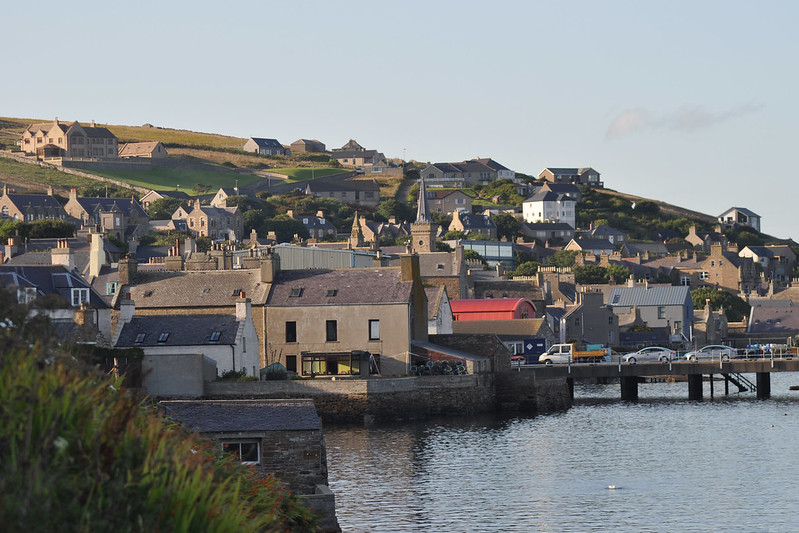
Stromness, Orkney. Photo by stevekeiretsu on Foter.com / CC BY-NC


The ‘immersive travelling’ phase for this novel involved a solo trip to Orkney, the birthplace of the main male character. To get there I took a train from Edinburgh to Inverness where I boarded a bus to John o’ Groats. I crossed the Pentland Firth by boat, docking at Stromness, a small town on the almost treeless Mainland where George Mackay Brown – memoirist, poet, and newspaper columnist – spent most of his life.

At the height of summer this far north, there is almost perpetual daylight, so I spent much of my four-day stay talking with locals and exploring the countryside. I left the island with a stronger sense of the history, culture, language and people than I had gained through my immersive reading, and felt better equipped to create a convincing Orcadian male character.

Conversations with a Chinese friend about the customs and culture of persons from the Pearl River Delta brought into being a young female Cantonese character living among opium pirates, a lucrative and hazardous trade. Women during that period were forbidden to travel, so I disguised Ming Yuet as a man to give her the anonymity she needed to travel safely to the Otago goldfields.


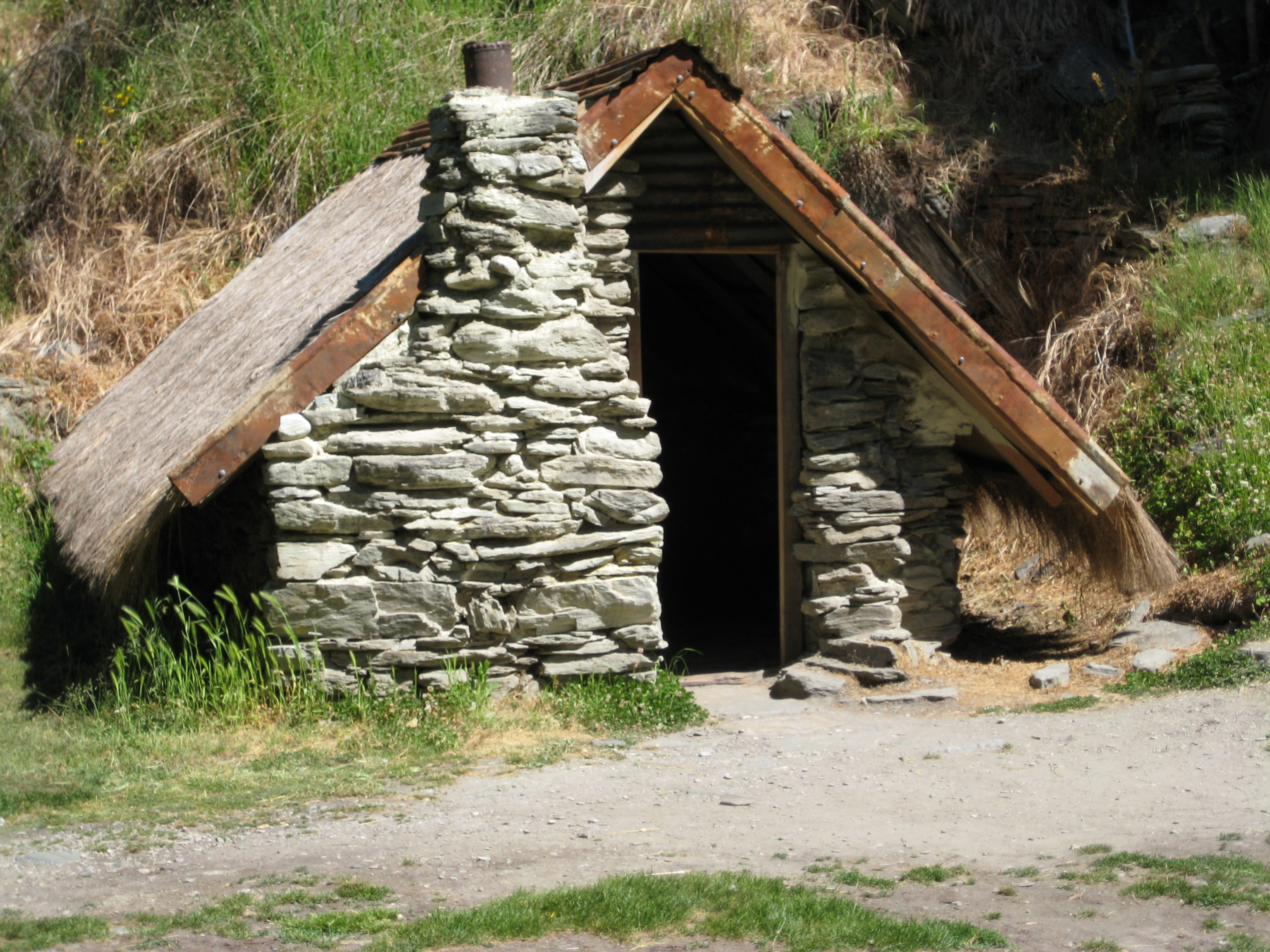
A Chinese hut in Arrowtown, New Zealand. Photo credit Maxine Alterio.


Travel is only one means of gathering information, and I pursued another option with my second novel, Lives We Leave Behind (Penguin 2012; Editions Prisma France, 2013). The novel was written as the creative component of a PhD, alongside a thesis called Memoirs of First World War Nurses: Making Meaning of Traumatic Experiences. I reduced my work hours so I could fly every six weeks to Wellington for supervision with Bill Manhire, and workshops with other PhD students. My work on the novel benefitted from thoughtful feedback – which led to including short male monologues between each chapter, for example – and useful, often unexpected reading recommendations.

In 2013 I was the recipient of the Seresin Landfall Otago University Press Residency, and given a six-week writing retreat alone in Waterfall Bay in the Marlborough Sounds. My proposal had been to work on a second short fiction collection. If I make a commitment, I like to stick to it. However, in the residency house I was intrigued by the black-and-white photographs hanging on the walls, taken in New Zealand in the 50s. In one, a boy stood behind a younger girl teaching her to shoot an arrow from a bow. The expressions on the faces of the children suggested to me a degree of vulnerability, a need to arm themselves.


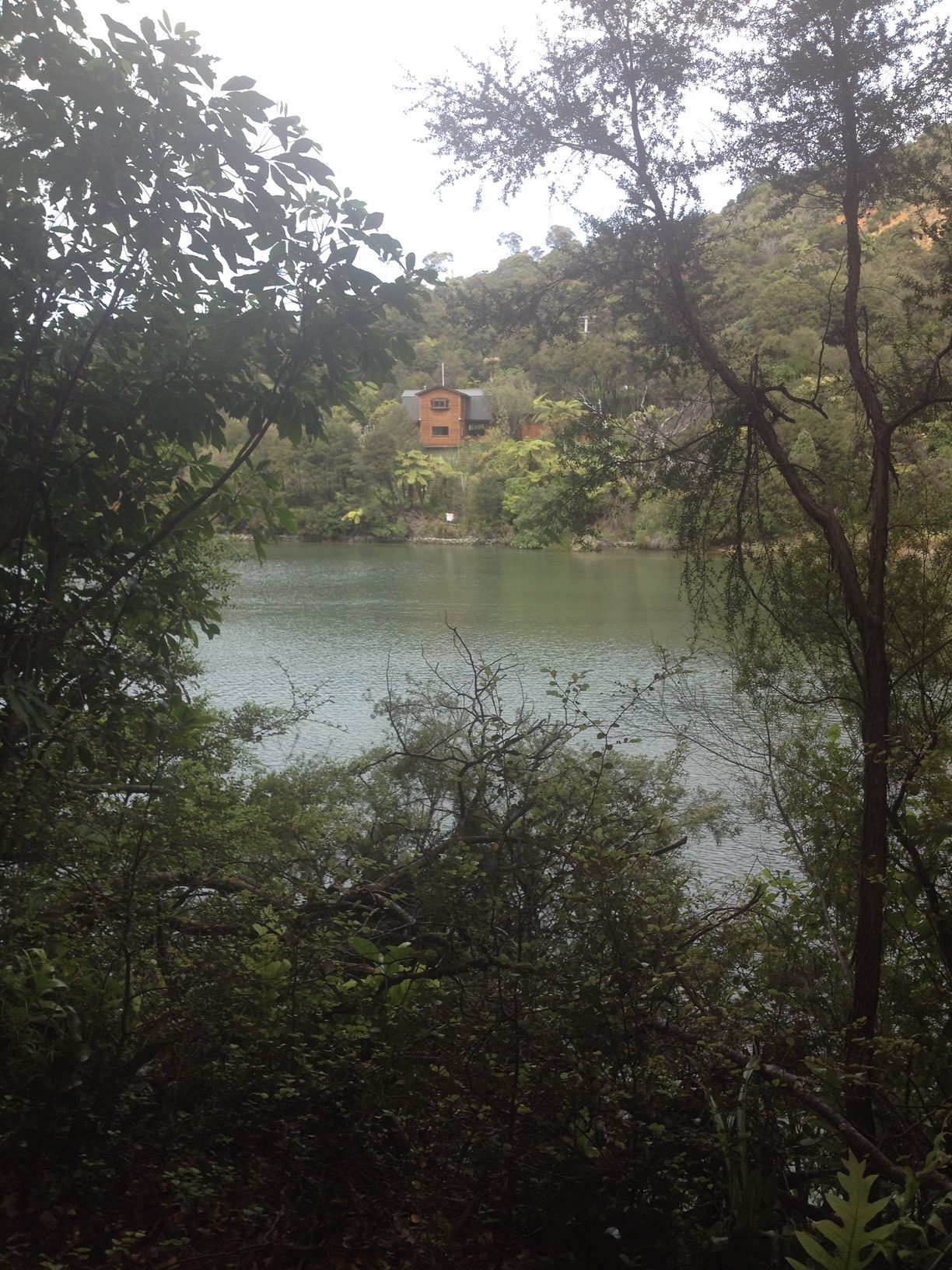
Waterfall Bay in the Marlborough Sounds. Photo credit Maxine Alterio.

.

On my third morning at Waterfall Bay I woke with a cast of characters living on the Vomero in Naples, a 1950s-1960s time-period and storylines for a new novel. I stopped working on a short story and began a novel-writing frenzy. One night a violent storm felled trees on the property and blew open a locked door downstairs. Another night, aftershocks from a Seddon earthquake jolted my castor-wheeled bed back and forth across the wooden floor. Both events drew my embryonic storylines down sinister alleyways.

That year I retired from my tenured tertiary position to concentrate on the novel, The Gulf Between (Penguin Random House 2019). Although I retained an academic mentoring role at work, for most of the year I could focus on writing. Bliss. Or so I thought. Settling into a productive new writing pattern took longer than I’d anticipated. More free time did not equal more words on the page. Immersive reading for pleasure had the stronger pull. Gradually, though, I established a consistent writing rhythm: six hours a day during the week, usually mornings through to early afternoon. My evening reading included books relevant to my project: Moravia by Alberto Moravia; An Italian Journey by Jean Giono; Woman Like Me by Curzio Malaparte; Days of Abandonment by Elena Ferrante; In the Shadow of Vesuvius: A Cultural History of Naples by Jordan Lancaster; and Fascist Italy by Chris Hinton & John Hite. Onto the wall in my writing den I pinned a detailed street map of Naples and a topographic map of the region of Campania.

Until my stay at Waterfall Bay, I had never intended writing a novel set in Naples, despite a twenty-three-year marriage to a man born and raised in the region. Nor had I accompanied my late former husband to visit his relatives. The reason was the promise my parents extracted from him before they gave us permission to marry: under no circumstances was he to take me, or any children we had, to Continental Europe. I was a seventeen-year-old bride and my husband a decade older, so my parents’ motives were understandable. They wanted to ensure that if the marriage floundered they were nearby to give me support.

I had forgotten all about this until, midway through a chapter of The Gulf Between, a similar scenario appeared on the page. I began to reflect on the complexities inherent in forgetting and remembering, and the notion that solitude, paired with creative receptivity, can resurrect aspects of the past. I also wondered about the consequences if my husband had not honored this agreement. Before long, I was considering what would happen if the fictional husband of my female protagonist made the same promise to her parents, and how their story might unfold if for some reason that promise wasn’t kept.


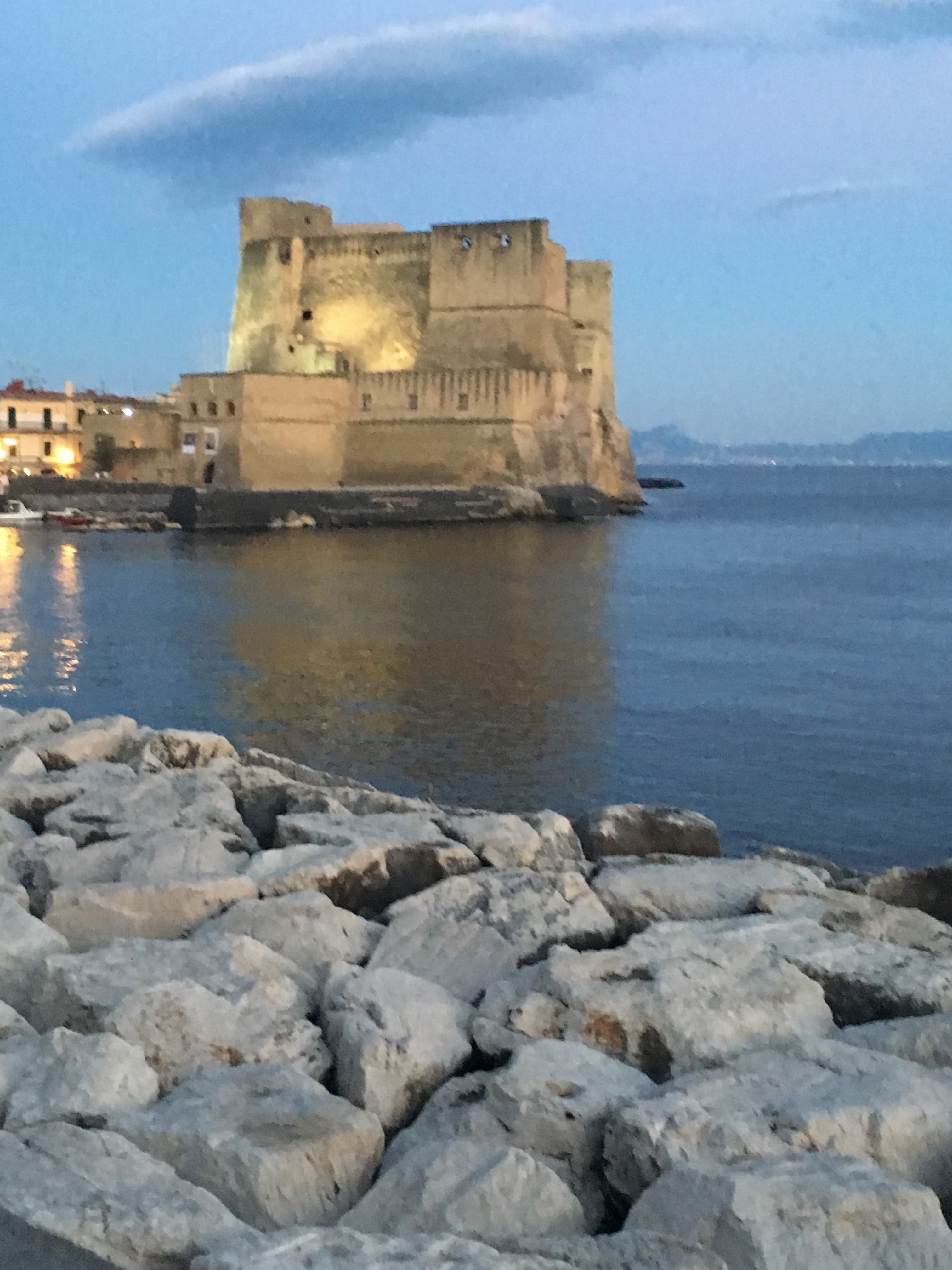
Naples waterfront. Photo credit Maxine Alterio.


A month after returning home from my residency I listened to a Writers & Company podcast in which Eleanor Wachtel interviews novelist Shirley Hazzard. As a young woman, Hazzard lived and worked in Naples for a year. Later she and her husband Francis Steegmuller owned a holiday home on Capri. After Steegmuller died, Hazzard maintained her ties with the island and made regular ferry trips to Naples. In the interview, Hazzard talked of sinking into despair when an earlier love affair had ended, saying: ‘It is incompleteness that haunts us.’

The phrase resonated with me. One of the reasons I write is to bring to completion in fiction what is left unfinished or unresolved in my life, though always through an imaginative lens and drawing on emotional memory rather than recounting direct experience. I felt compelled to continue working on the manuscript, yet the writing felt tentative, the characters detached, and the language flat and turgid. I wondered if I was trying too hard to distance myself from the text and set the manuscript aside, but the characters populated my dreams. Each morning I jotted down what I could recall of their mannerisms and comments, hoping these details would lift them into the realm of thinking, feeling characters with complex histories and perspectives.

In due course, I started writing again. After ten gruelling months, I had produced 90,000 words but I was too close to gauge their worth. It was time to bring this rough draft into the light. Harriet Allen, fiction publisher at Penguin Random House, made invaluable suggestions to improve the pace. She also proposed a structure that overcame the issue of multiple flashbacks interrupting the narrative flow. Three generous friends from a writing group I have belonged to for over twenty-five years also gave me feedback. One, a novelist skilled at suspenseful writing, encouraged me to ramp up the disturbing elements. Another recommended that I write a version entirely for myself, a tactic that allowed me to stop censoring the work and to cease worrying that a reader might take the author for the first-person narrator. The third friend addressed my tendency to overwrite and indicated where I could pull back. Other members of the group made useful comments on sections and chapters.

Somewhere in the reworking of the manuscript, I lost the fear of revealing aspects of my own life, as all writers do when we expose our preoccupations though the recurring themes in our work, and began to write freely, developing and deepening the storylines. Even so, multiple drafts later, I remained dissatisfied with my main characters. When I read Elena Ferrante’s superb Neapolitan quartet, I grew uneasy, since I was writing about Naples as an outsider.

To calm my nerves I entered a second immersive reading phase, delving into Ferrante’s other books and those of Anna Maria Ortese, Primo Levi, Alberto Moravia, Curzio Malaparte, Antonio Tabucchi, Rosetta Loy, Paola Capriolo, Marina Mizzau, Susanna Tamaro and Sandra Petrignani. I also read the works of outsiders such as Norman Lewis, David Leavitt and Mark Mitchell, Jess Walter and Dianne Hales.

These writers’ observations of Italians from the south reassured me, although for months I lacked the confidence to write. Looking back, I think due to my association through marriage I wanted the story to feel authentic to Neapolitans as well as to outsiders. I also wanted to better understand the impact of the war on my late husband who was born in 1939. During the occupation of Naples, citizens suffered relentless bombings and gnawing hunger. Orphaned children fended for themselves in the rubble. Retreating soldiers tossed sticks of dynamite into sewage and water systems; citizens died of treatable conditions because basic medicines were unavailable, and Resistance members were hanged in public squares for their involvement in the September 1943 uprising against German forces.


Maxine’s hotel in Chiaia. Photo credit Maxine Alterio.


In May 2017 I set off for Naples, somewhat apprehensive after my reading about endemic crime and corruption, pickpockets plaguing tourists, and the strong presence of the Camorra. A writer’s imagination can easily inflate the dangers of five weeks in Italy.

I flew into Milan and taxied to an inner-city hotel where I met an Irish friend; this time I did not want to travel solo. She and I bused north to the lakes, then headed through Tuscany and Umbria down to Campania and its capital, Naples.

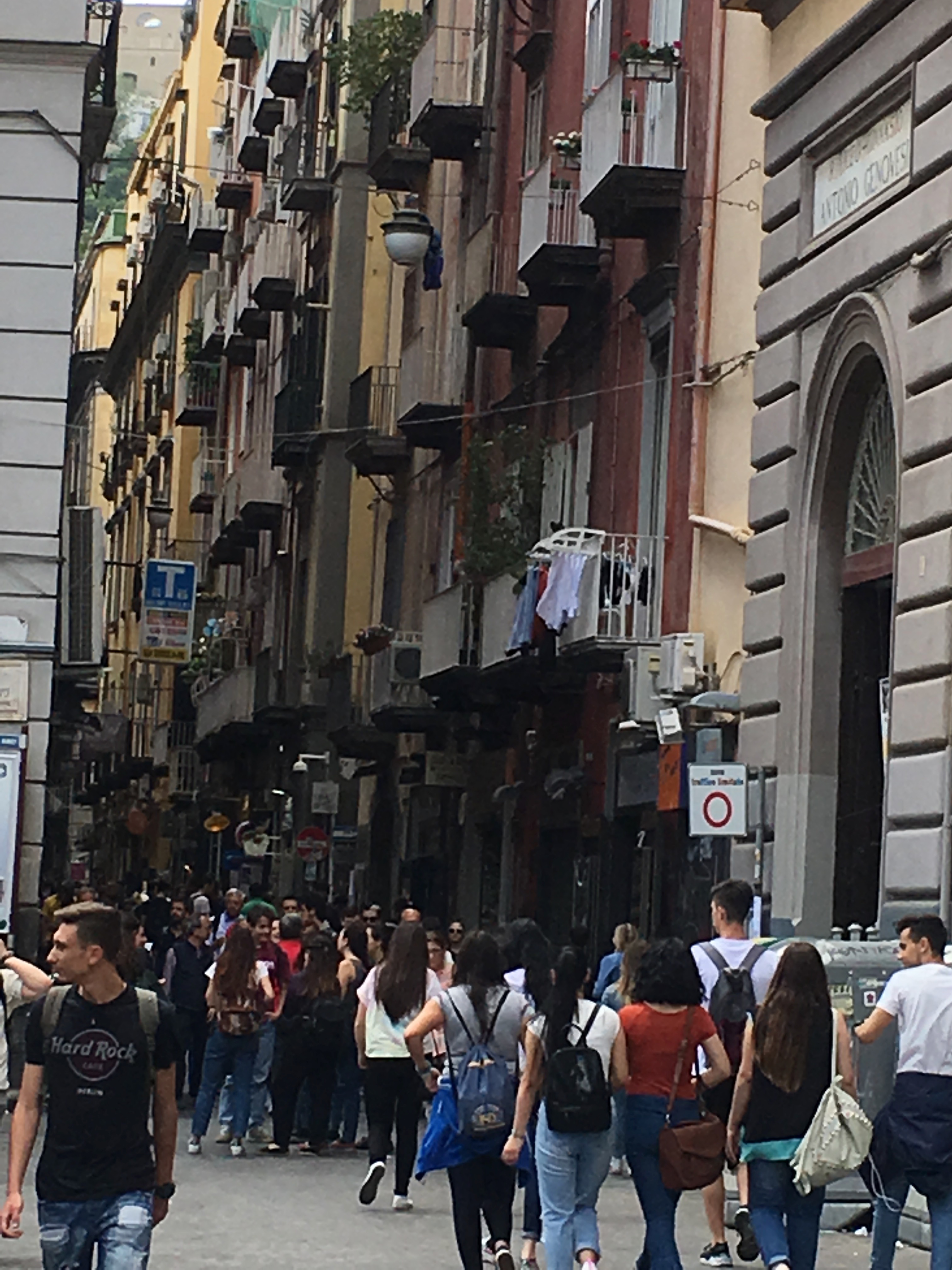
In many neighbourhoods of this city, wealth and poverty rub shoulders. Most have congested streets and pavements, elevated noise levels, traffic snarl-ups, flirting to the extreme, lots of chatter and laughter, and, in central sites, bollarded squares and a significant police presence. A short distance from our hotel in Chiaia, throngs of unemployed local youths shared pavements with North African migrants touting spinners along the waterfront.

On the second day, we joined a walking tour through historical sections of the metropolis. When it ended, I asked Monica, the pleasant young guide, if she was available to accompany us to places featured in a novel I was working on. She agreed and off we set. After a while, given the distances between key locations in The Gulf Between and the prospect of an uphill trek in the heat, Monica approached a taxi driver and haggled over a price.


San Guiseppe, Naples. Photo credit Maxine Alterio.

.

Salvatore turned out to be an asset, inserting himself into the novel with Neapolitan zeal. On our way up to the Vomero, a leafy residential district, as we conversed in gestures, Italian, English and Neapolitan, and Salvatore jammed on his brakes whenever he spotted a photo opportunity, I looked for the best spot to place the villa of my fictional family. None of my suggestions appealed to Salvatore, who took it upon himself to decide where the Morettis would live. He settled on a street that in the past had expensive villas on both sides, with spectacular views of the Gulf of Naples. In recent years, the villas had been replaced by apartment buildings. From there, we traced the route Julia and Ben Moretti would take to Floridiana Park where a significant scene unfolds. We had a lively discussion about which of the two entrances the couple was likely to use.

Once the decision had been made we hurtled down a crowded, narrow and winding street towards Posillipo. Based on my background reading I assumed that a fictional fisherman would live in this residential quarter where the city meets the gulf’s northern arm. Salvatore disagreed and proposed the poorer St Lucia as the authentic option, demonstrating again the value of local knowledge.

Monica and Salvatore’s affable company and familiarity with the city enriched my novel research. Their insider perspectives also proved valuable when I viewed the austere buildings from the Fascist era alongside the ornate architecture from ancient times. As Monica had remarked during the walking tour: ‘Everywhere you go in Naples there is Roman and Greek history beneath your feet.’ Above ground, there remained ample evidence of Mussolini’s rule.

Late afternoon I learned Salvatore had two football-mad young boys who, like Julia and Ben’s son in The Gulf Between, played at junior level for a local team. As Salvatore answered questions about the game, his enthusiasm for the novel — set in his birthplace and featuring his favourite sport — grew. When he and Monica dropped us back at our hotel, Salvatore emerged from the taxi, took my hands in his and pleaded for a cameo role. I agreed, although it meant rewriting a chapter and creating additional spaces for him to appear in the story.

On subsequent days, Monica directed questions outside her experience and knowledge to her Nonna who had lived in Naples all her life. Another family member provided useful information about schooling in the early 1960s. Monica also supplied me with Neapolitan phrases such as Si pazz – you’re crazy – to weave through the book.


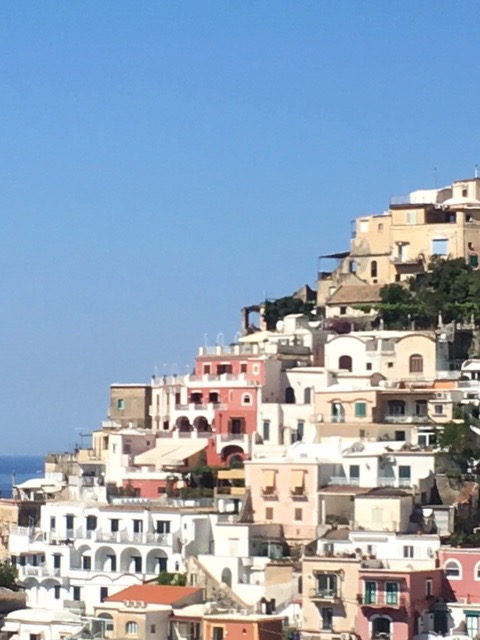
Positano, Amalfi Coast. Photo credit Maxine Alterio.

.

Another morning, as a local bus driver maneuvered his vehicle around a tight bend on the chaotic Amalfi Coast road, I spotted an ideal place to set a distressing incident. Photos that passengers on the bus took of Positano and airdropped to me provided the necessary details for another chapter. When we explored on foot the southern side of the Gulf, impressions gleaned from books were overlaid by the more vibrant reality.

To date, The Gulf Between has been my most challenging novel to write, but personally the most rewarding. Combining fiction writing with immersive reading and immersive travelling enabled me to better appreciate and understand — as much as an outsider can — the impact in the south of the rise of Fascism from the early 1920s on, and the traumatic legacies of World War II on civilians, including my late former husband and his relatives. Gaining these insights allowed me to bridge the gap between what I knew and what remained unknown.

Back home, I drew on my first-hand experiences in Italy to create multi-dimensional characters. Visiting the streets where my fictional family walked, admiring the same sights, going to the same places, smelling calzone fritto, and mixing with a cross-section of Neapolitans enabled me to go deeper into the psyches of my characters. A last creative push and they finally appeared fully formed on the page. The story ceased to be mine. It was theirs.


Maxine Alterio is a novelist, short fiction writer and academic mentor who has published three novels: Ribbons of GraceLives We Leave Behind and most recently The Gulf Between.


Header Photo by photomontuoro on Foter.com / CC BY-NC-SA

'Novels stand outside time, with their narrative structure of beginning, middle and end. They outlast politics, which are by nature ephemeral, swift and changeable and can quickly become invisible, detectable only to the skilled eye. ' - Fiona Farrell

Read more

Author C. K. Stead in London

The Interview – C.K. Stead

Mark Broatch writes:

It is strange,’ Vladimir Nabokov once wrote in a study of Nikolai Gogol, ‘the morbid inclination we have to derive satisfaction from the fact (generally false and always irrelevant) that a work of art is traceable to a ‘true story’.’

Yet satisfaction we do seek, particularly from some authors, who seem to draw deeply on autobiographical elements in their work. CK Stead is one of those.

Christian Karlson Stead is a novelist, poet and literary critic. An emeritus professor of English, he has gathered in his 86 years an Order of New Zealand honour and a CBE, is one of only two New Zealanders to be appointed a Fellow of the Royal Society of Literature, has been our Poet Laureate, and has received a swag of critical awards and accolades, not least the Prime Minister’s Award for fiction and the Katherine Mansfield Menton Fellowship.

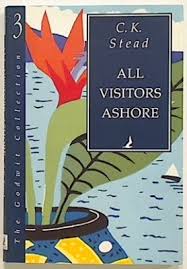
His bestselling 1964 work The New Poetic: Yeats to Eliot, a survey of modernist English poetry, established his critical reputation, but he is perhaps best known here for his novels. These include the 1971 dystopia Smith’s Dream, made into the breakout film Sleeping Dogs with national treasure Sam Neill, All Visitors Ashore from 1984 and The Singing Whakapapa, both of which won the fiction section of the NZ Book Awards. In 2009 he released Collected Poems: 1951-2006.

Often positively reviewed overseas, Stead has sometimes been more coolly received in his home country. While the work is always up for (re)appraisal, it is not difficult to suspect that his frequently unvarnished and refusing-to-toe-the-line criticism, both literary and of the wider cultural and social world, often put him offside with his peers. A 1990 article in Metro was headlined ‘Blaspheming against the Pieties: why the literati hate CK Stead’.

Subsequent public squabbles and the perception that the fictional work sometimes echoed the motifs of real life only reinforce this idea. Many of his novels, such as All Visitors Ashore and The Death of the Body, are accused by critics of containing central characters not too dissimilar from Stead himself, or of peddling the author’s preoccupations and irritations. His fiction has been called sensuously lucid, metafictional, yet fundamentally realist and confessional. Says The Oxford Companion to New Zealand Literature: ‘Stead’s early friendship with Frank Sargeson, his academic career, his marriage, an apparent extra-marital affair which recurs in various poems and two novels, and difficulties surrounding women and their claims: all these matters are presented to us under a veil of fiction that is at times alarmingly diaphanous.’

But as Stead himself says, ‘Stories are stories and create their own reality’. And ‘with fiction the border between what really happened and what is invented is always open, and if the writer doesn’t put it on record, there’s no way of knowing when and where it is crossed’.

Conducted over the course of several weeks by way of emails, our interview traversed many of these questions: autobiography in his fiction and ‘literary revenge’, the role of the novelist and critic in NZ, his not being ‘particularly inventive’, his favourite works, the state of his health, and whether he’s mellowed with age.


Mark Broatch:

How is your health now – still feeling ‘a box of birds’, as you’ve said, despite the diffuse heart disease? Still swimming?

Karl Stead:

I feel my age – 86 – and I’m told (and Kay is warned) I may have a serious, likely lethal, heart attack at any moment; but the heart is still pumping strongly. So I have heart disease, not heart failure, and am consequently quite fit – don’t pant going up hills, and am still swimming almost daily to the yellow buoy. I was offered heart by-pass surgery but decided against it. The medication has been adjusted and I carry on.

MB: I’d like to start on the perceived duality. Your 2007 poem ‘C.K.’ contrasts C.K. Stead with Karl. The literary biography Plume of Bees (2009) says the first is the man he is reputed to be, the second the person he believes himself to be. It starts:

There’s a Stead I / recognise only by / his picture // in the papers’

The voice in the poem suggests the poet is modest, not unsmiling or difficult, but ends with Karl promising to introduce himself to C.K., ‘ ‘Hullo, C.K. / I’m Karl. We haven’t / met’ – ‘Let’s / keep it like that’,’ / he says, unfriendly, / and turns away.’

Who is the real CK Stead? Or are you both ‘the brusque, prickly intellectual’ – sometimes – and the ‘the quietly spoken, personable fellow’ mostly?

KS: I don’t think the voice in the poem suggests ‘Karl’ is modest – but rather that he’s affable, good humoured, whereas ‘C.K.’ is unsmiling – ‘brusque, prickly’ as you say, and even dangerous. I think there must be a bit of both in me; but the smiling, affable person is (I’m pretty sure) the predominant one. I’m basically cheerful. Capable of stringent criticism, however, and fairly stern in arguing I’m right.
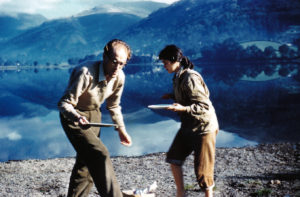
 

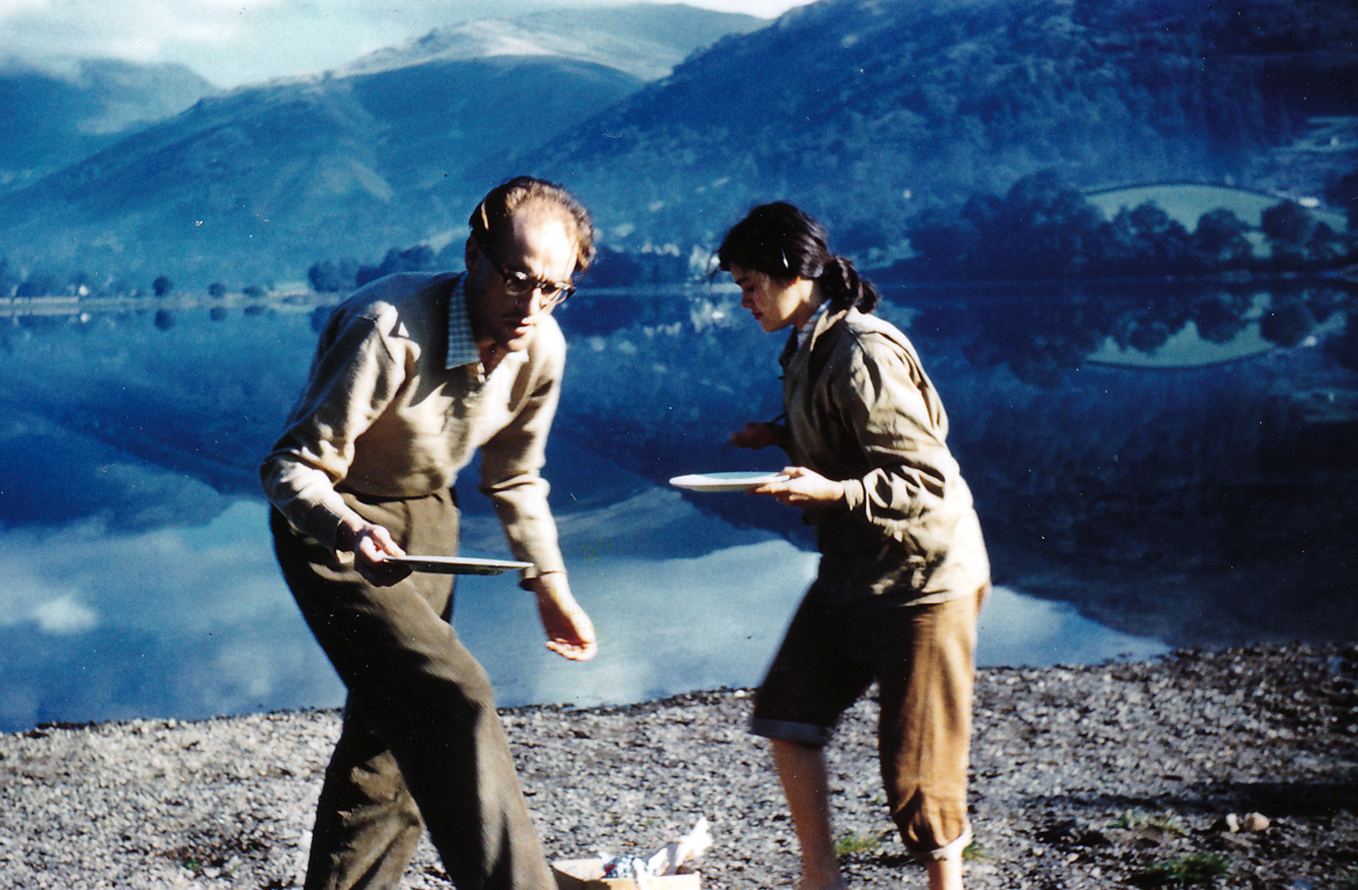
Karl and Kay Stead camping in the Lake District in 1958.


MB: Plume of Bees suggests your reception in NZ has also had contrasting extremes. It suggests your lack of a covert approach in fiction, not hiding behind allegory, parody or personae, and being forthright in criticism may have contributed to it. Kevin Ireland has said, ‘I think he’s wrong quite often, but he’s never unprincipled.’ Not many fiction writers and poets are critics – is this part of it? James McNeish said: ‘I’ve always been an outsider, and I’m quite comfortable with that. To retain your critical sense in a small society like New Zealand, you have to stand apart’. True, and true for you?

KS: This is more than one question, I think.

The best critics in English language literary history, the only ones who are still read, have all been poets. All writing, poetry or prose, is the exercise of practical criticism. It involves making continuous critical choices.

My ‘lack of a covert approach in fiction’ is a different matter – if it’s true. I think my writing often has an immediacy which makes readers feel as if they know me – so they assume they are reading scarcely disguised autobiography, even when it’s not.

Jim McNeish’s comment is right.

MB: You have said about your own writing, ‘Why have I annoyed people here? Partly because I don’t have many brakes … If I see something I feel inclined to criticise, I tend not to think very carefully about who is going to be offended’. Has this inclination dissipated over time? Have you become more mellow, more forgiving, in recent decades, as some who know you perceive, and if so, it is just age, or something else? Has it changed the work?

KS: I came to intellectual maturity (like Martin Amis, who says the same about himself) at a time when literary criticism was taken immensely seriously. It was a moral and intellectual duty to say what you thought honestly. Of course you learn slowly that tact is often necessary – and that one’s opinions change, so it’s not good to be too confident about them. I have learned to be less frank, or to avoid taking on tasks that might involve unwelcome judgements. This is partly age, partly ‘wisdom’, partly a mellowing, not always for the best.

MB: Do you think you are generally reviewed more harshly in NZ than elsewhere? Do you think critics here find it harder to separate the man from the work? How often have you thought the criticism justified?

KS: I haven’t had much of my work discussed at any length by serious literary critics here, though there was a very good one about The Death of the Body by Reginald Berry in Landfall 163, September 1987. I’ve more often felt ignored – overlooked – than given close and searching attention. And so much reviewing is amateurish. In the UK and Ireland there have been critical analyses at a level I seldom get here – see for example the LRB review by Frank Kermode cited below [in the ‘lucidity’ question]. Or these quotes from overseas reviews – for books, incidentally, which I don’t think even made the short-lists for New Zealand fiction prizes:

Talking about O’Dwyer (1999)

Talking about O’Dwyer’s intellectual force is inseparable from its narrative force: the drive towards the core event is gripping … Ranking writers is an invidious enterprise but, fresh from my binge [of his novels], it seems incontestable to me that C.K. Stead is among the very best contemporary novelists.

John de Falbe, The Spectator, 27/5/2000

I don’t know why everyone isn’t talking about Talking about O’Dwyer, C.K. Stead’s intricately worked and compelling novel which, most creatively, links middle-class New Zealand with contemporary Oxford and Croatia, and all of these with Crete during the Second World War. Extremely moving, and burning with a fierce charity for the inarticulate and marginalised, Stead’s achievement is also, through its central consciousness, a plea for uncompromising use of the intelligence.

Paul Binding, Times Literary Supplement, 1/12/2000

The Secret History of Modernism (2001)

Engrossing yet delicately understated, this is fiction of the highest order: gracefully intelligent, emotionally probing, politically sharp. While it lacks some of the narrative compulsion of its immediate predecessor, Talking about O’Dwyer, it is an even subtler, more reflective work, whose antipodean perspective is a healthy and at times astonishing corrective to the European self-centredness of so much historical evaluation.

Rosemary Goring, Sunday Tribune (Dublin), 13/1/2002

With deft, sure touch, Stead interweaves three strands of narrative: the reflections and peregrinations of middle-aged Lazlo; the mildly comic adventures of young Lazlo and friends; and the harrowing story of the Goldsteins … Much of the poignancy of this novel resides in the contrast between the leisurely, cultivated lives of Lazlo and his friends and the brutal, unthinkable realities that the equally cultivated Goldsteins were forced to confront just one generation earlier. Like Lazlo, Stead recognises that his ability to comprehend the century’s history is limited by the sheltered life he’s been lucky enough to lead. But in this novel, he has found a way to elucidate those aspects of the story he knows best.

Merle Rubin, Los Angeles Times, 1/9/2002

His characters are believable as well as likable. Stead’s handling of this student life of uncertainty and confused sexuality is far more graceful and humane than V.S. Naipaul’s sour handling of similar material in his recent novel Half a LifeThe Secret History of Modernism is as subtle as Jane Austen and as fatalistic as Thomas Hardy. Life is largely improvisation. Stead appears to have made the need for answers redundant in this minor miracle of a novel that studies life, love and the long regret caused by a moment’s hesitation. There are no questions either, just a profound sense of understanding, and many truths.

Eileen Battersby, The Irish Times, 10/2/2002

Mansfield (2004)

C.K. Stead has served us the most delicious, exquisitely prepared, delicately spiced Katherine Mansfield one could ever wish for, and the gourmet in me is immensely grateful… After finishing Mansfield I went back through its 246 pages trying to see ‘how it is done’ and, I must confess, I have no idea. A dearth of adjectives, an extraordinary accuracy of description merely through the use of verbs and nouns, the right intuition of when to comment and when to leave good enough alone, a taste for the right anecdote and a certain Mansfieldean humour that permeates the entire story from choice beginning to measured end: all these things no doubt contribute to build the moving truthful core of this novel, but they hardly explain its perfect workings.

Alberto Manguel, The Spectator, 5/6/2004

And then there’s a strange New Zealand phenomenon whereby certain writers become revered and others marked with a cross on the brow, and these predetermine the tone in which the writer is reviewed.
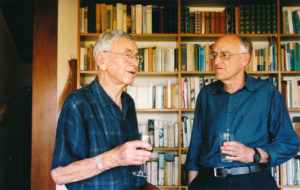
 

Stead with Allen Curnow at the launch of his last book in 2001.


MB: You have said, ‘Being the Britain of the South Seas was the NZ identity I’d grown up with … the writers, artists and intellectuals stood apart from that, criticised it, and so making common cause with them for me was temperamentally acceptable and desirable’. You’ve also said you have shifted on your concept of New Zealand’s literary culture as fundamentally Western with a dash of local atmosphere. How has that changed the work? You have long been in the thick of New Zealand literary history and life – did you ever wish to have been born in the British one?

KS: The basis of literary nationalism when I was young was in large part an effort to detach ourselves from the old Empire – hence the importance of Curnow. I was always a loyal New Zealander and never wanted to be anything else, but I did think we were unfortunately placed, inheriting European culture and so far from its centres.  The world has shrunk astonishingly in my lifetime – not just jet travel (we used to go by sea) but instant communication and the internet. And we have begun to recognise and accommodate as never before our indigenous culture. This has involved some inauthentic behaviour, but on the whole it has been necessary and beneficial.

MB: You have an Order of NZ honour and a CBE, are a Fellow of the Royal Society of Literature, you’ve been Poet Laureate, have had all number of medals and awards including the Prime Minister’s and Katherine Mansfield Menton Fellowship. It’s a softball question, but what do you consider your greatest achievement?

KS: The awards are not achievements in themselves, though I suppose they are signals of, or rewards for, achievements. I don’t know how to answer the question. I guess the big Collected Poems taken as a single work representing a large part of a lifetime’s work gives me a very considerable sense of satisfaction.

MB: Your publications now take up an entire page in the front of your books in 6-point type. If it’s not the same question, do you have a favourite? Any you’d like to do over again?

KS: Apart from the Collected Poems, I like All Visitors Ashore. I think The Death of the Body is probably my cleverest novel. And My Name was Judas probably my most original – I mean the idea of it, and the execution – a complete revision of the meaning of the Story Western Civilisation has tried to live by for centuries. The best of my Lit Crit is pretty good for those interested and intellectually up for it.

MB: When you were younger, your head was ‘full of novels’. In 2010 in your memoir, South-West of Eden, you said you lacked a compelling idea for a new novel. Yet you have since written two more, and two collections of poetry. How is the ideas well now?

KS: Now I’m trying to write a further autobiography, an entirely literary one, going from the end of South West of Eden to 1986 when I left the university and became a full-time writer. I can’t imagine writing another novel – but I tinker with poems constantly.

MB: The novelist ‘must become the whole of boredom’, you quote Auden as saying, while poets ‘dash forward like hussars’. Damien Wilkins argues that, for you, ‘to poetry’s angel, prose is the necessary donkey … Look at how much envy this novel [The End of the Century at the End of the World] displays for poetry’. Think that’s true in any sense? Clive James has said the critical essay and the poem are closely related forms. Craig Raine says (in My Grandmother’s Glass Eye) that the best poetry and prose share ‘brilliant accuracies and intensity’. How do the three forms relate and inform each other for you?

KS: Damien Wilkins’ review was very clever, and not altogether damning. He was right I’m sometimes impatient with the business which Virginia Woolf says makes fiction so hard – of getting your characters out of one room and into another. But every kind of writing stands or falls by being visibly alive. Too many sentences, or paragraphs, or pages without some spark, some shock or surprise, means whatever it is you’re writing is unwell and may soon die. This goes for literary criticism quite as much as for fiction or poetry. My collections of literary essays are published and sell because people find them readable, enjoyable. Critics are not remembered for being right but for being intellectually lively and for writing well!
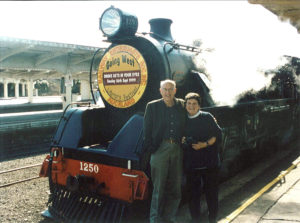
 

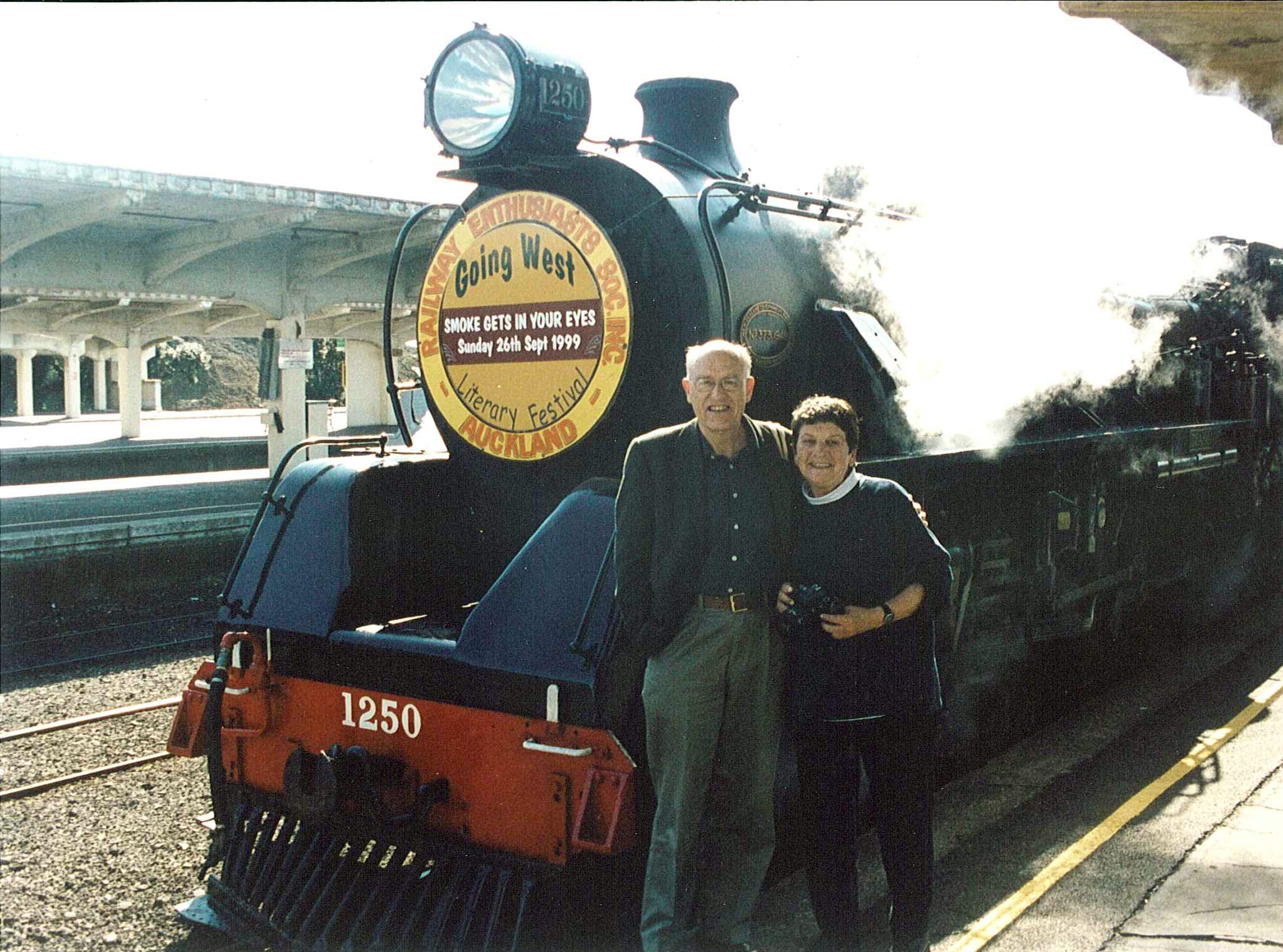
Stead with Marti Friedlander at the 1999 Going West Festival.


MB: Damien Wilkins has said your fictional work has ‘a surfeit of lucidity’, suggesting it has a lack of depth. Have you responded other than through the poem ‘By the back door’ (Derrida) – ‘no regrets’ rather than the ‘opaque – and delay’ approach? Does this lucidity and not infrequent autobiographical plot similarities make more problematic claims such as fictional revenge? (Harris says about All Visitors Ashore: ‘Biographical details are hard to exclude from an assessment of what Stead is doing with the novel.’) How do you interpret Wilkins’ charges of ‘self-loathing’ in your novels?

KS: Revenge for what, against whom? Wilkins? I didn’t mind his review at all. It was so much more interesting than most. I didn’t think the ‘surfeit of lucidity’ suggested lack of depth. I thought it suggested lack of mystery – ie that, however ‘deep’, all was made clear – and sometimes too clear too soon, so the fiction did not force you to work hard, and you could glide through it effortlessly. Also that I’m slightly bored by the necessary mechanics of fiction.

Wilkins doesn’t accuse me of ‘self loathing’ but my novels (or rather the one he was reviewing) of loathing itself for not being a poem. I don’t mind that. It’s an interesting idea, though it would not be difficult to mount a strong critical rebuttal. A.S. Byatt says I write a poet’s novels which probably means much the same thing.

Certainly I have no ambition to write the kind of George Eliot-ish fiction she writes (though admire it and enjoy reading it). Frank Kermode says in an LRB review ‘The end of the century at the end of the world is an interesting novel, not only because of the skill and honesty of its half-open half-closed structure, but because it is well-written enough to remind one that Stead is a poet. This is apparent not only in momentary flashing phrases but much evidence that he has what poets need if they are to be novelists, the ability to ‘do’ New Zealanders, or whatever community is selected, in different voices. If the book can also offer some laconic, possibly apocalyptic opacity, so much the better.’

I think this review in part answers Wilkins’ objections (if that’s what they are). These reviews, Wilkins’ no less than Kermode’s, seem to me ways of defining, or describing, rather than condemning, my fiction.

MB: If you had been allowed by the Czar of the Arts to write only one thing, namely poetry, novels or criticism, which would you have chosen?

KS: Probably whatever the Czar least wanted from me.

MB: You have said, in Landfall, ‘I would say since [about 13] poetry has really been the centre of my intellectual life.’ Can you explain what you mean by poetry being ‘my second-best art’ in the poem ‘Crossing the bar’? Eugenio Montale said the poem was ‘a dream in the presence of reason’. What is a poem for you?

KS: In ‘Crossing the bar’, high jumping represents life, and living is one’s ‘first art’. Literature serves life but is not life itself – so poetry is ‘my second best art’. ‘Only the whole man / Jumps his own height.’ In that sense poetry has been the centre of my intellectual life – and not just my own poems, but poetry by others, including the history of poetry in the English language.

MB: How have you changed as a poet? What sorts of changes did you make to your early poems for the Collected? What are you obsessed about now that you weren’t then? How have your topics and classical touchpoints changed? Does your late line soften?

KS: I used to be much more dependent on ‘the Muse’, ‘inspiration’ – in other words, on elements from within or outside myself which were not in my control. Since my fifties I’ve been much more able to put myself deliberately into what I think of as ‘poetry mode’. I’ve been less interested in the idea of poetic movements and fashions, more self-governing. I think one has a certain brilliance in youth which is lost, but is replaced by other qualities almost equally important and valuable – wisdom, experience, cunning, knowledge, stamina. Youthful brilliance at its best short circuits them all of course, but it’s short of breath, short-sighted, and tends to be short-lived. But at its best it can’t be beaten. In putting together my   I didn’t allow myself (with just one exception) to significantly revise my earlier poems. I think that’s a mistake Yeats and Auden make – of trying to make rough youthful poems smooth older poems – which is replacing the authentic rough with the inauthentic smooth.

MB: Which poets do you go back to again and again? Which have most influenced you? Which poem(s) of anyone do you most wish you had written?

KS: Donne, Yeats (but critically), Pound (at widely spaced intervals, and always with mixed feelings), Shakespeare, Curnow, Baxter (picking among the debris), Eliot, Auden, Larkin, Raine, Muldoon, Paulin, Reading, Whitman … But this is pointless. I read poetry often – I have masses of it at hand, and read it constantly. Preferences keep shifting. All are important to me, though for a great variety of reasons.

MB: You’ve played with form, but seem not to have been tempted by surreal or outrageous style. I was thinking there were no prose poems in the Collected but there’s one in Derrida: ‘My contemporaries across the ditch’. A particular aversion or does the poem dictate the form? How do you compose a poem? Longhand? From notes? Over a period of time typically? Who is your ideal reader?

KS: One does what is a natural expression of one’s temperament. I guess there’s a bit of the surrealist in everyone, but in me the realist predominates.

‘My contemporaries across the ditch’ is almost verse – the blocks are shaped to appear matching; they are stanzas in effect, one for each person discussed – so somewhat formal. But yes, essentially prose. I guess I think poems need form – that’s what makes them poems, even though the ‘subject’, the occasion, the whatever it is that triggers it, is what determines the form, ie the poem very often discovers the form as it goes, but it doesn’t (for me) discover no form at all.

I always write poems first in long-hand and try not to type them too early in the process. On the other hand, prose for me is composed straight on to the computer.

My ideal reader is an intelligent person sensitive to language who reads a lot and so is experienced in whatever it is that’s being read. If poetry, then they should have read a lot of poetry. Fiction likewise.


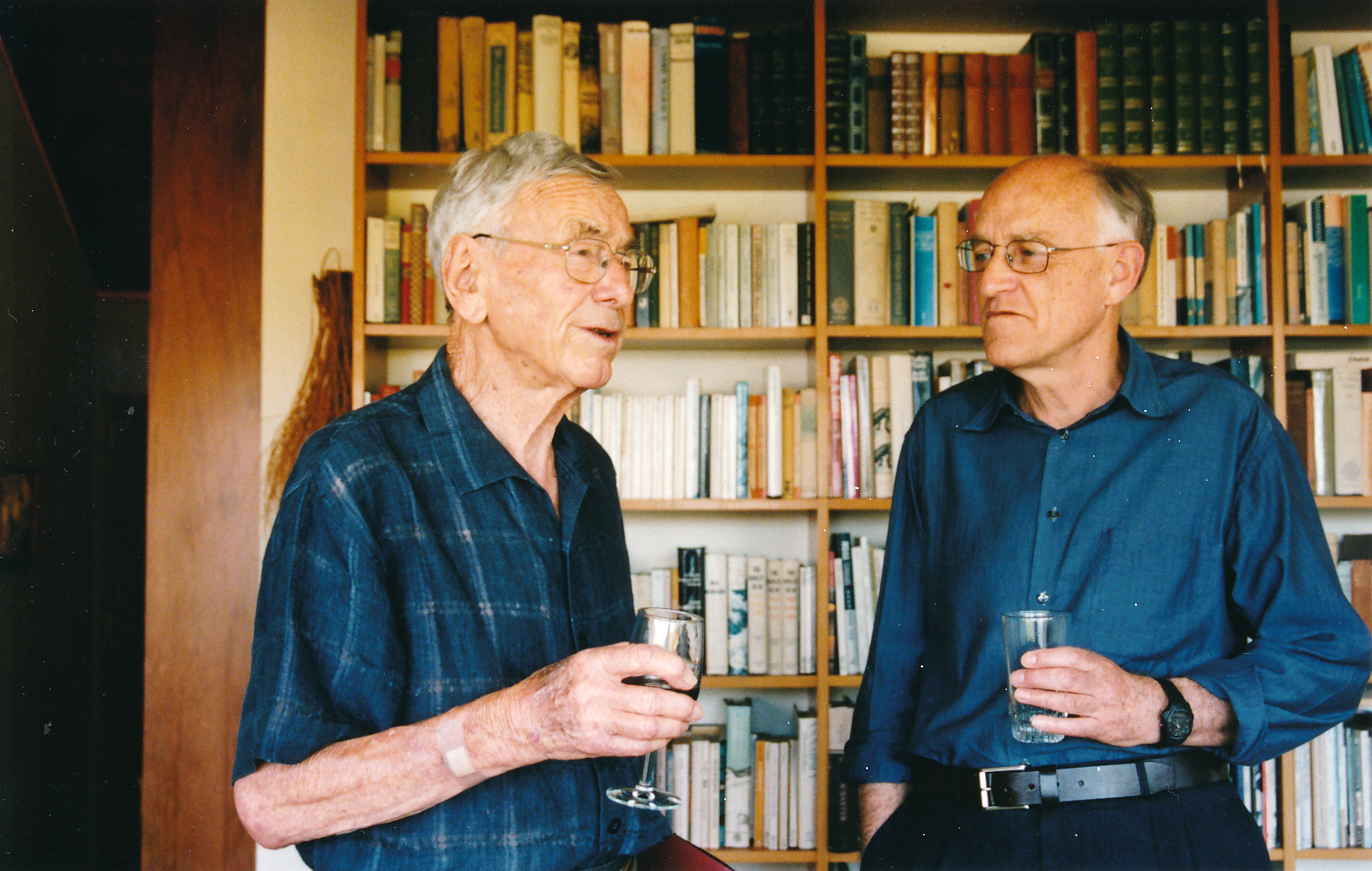
Stead with Kevin Ireland at a recent book launch.


MB: You say (in the Foreword to Collected Poems) that: ‘poetry is … more closely related to music than to anything else’. Fleur Adcock has written two librettos (for NZ composer Gillian Whitehead), Vincent O’Sullivan has done several works with NZ composer Ross Harris. Kevin Ireland has written a couple. You are musical – were you ever tempted? Or by plays, done by your contemporaries Maurice Shadbolt (Once on Chunuk Bair), O’Sullivan and James McNeish?

KS: I’ve always intended to write a play, and in fact as a student did a modern version in verse of Racine’s Andromaque. I’m sorry I haven’t done more because I enjoy writing dialogue. I wrote a screenplay for my novel Villa Vittoria when Roger Donaldson wanted to make it as a movie, but money was lacking and the project didn’t go forward. It was a good script – Roger liked it. And I did one for The Death of the Body.

I was asked once to write a libretto for an opera by Robin Maconie and feel very guilty that too much else intervened and I did nothing. I let him down. But my talent for music is present I hope in my sense of the music of poetry.

MB: When you were Poet Laureate you wrote that there may be too many poets and not enough readers of poetry. Do you agree with Vincent O’Sullivan, that maybe there should be Poets Anonymous, who will send someone around with a couple of bottles of wine till the urge to write poetry goes away?

KS: It’s a good joke, but of course poetry belongs to the human condition, as language does, and cannot be stopped. There will always be people writing it, most of them doing it very badly – but the appetite is there as long as language is there. It’s an attempt to reach into the language box and make it work for us, say things we feel must be said, speak beautifully or tersely, or brilliantly; invoke the gods and penetrate the mysteries of love and death.

But what the uneducated amateur doesn’t know, or can’t act upon, is that it’s an art, and thus a discipline, which means it has a history. The poets who matter make themselves aware of that history; they learn it, and ultimately become part of it. I’ve always said – You can’t do it on your own. You must put yourself into the stream to be part of it. Those early youthful brilliant poems (Keats died at 26) don’t come out of nothing. They are the moments when the young poet touches briefly the live wire of the tradition, and is made electric. The truly talented are conductors. They can make the electrical connection. Creative writing classes can’t do it for you. But once it has happened, then the work of lifetime begins.


Stead on the marae at Matahiwi as Poet Laureate with his tokotoko, Kay, son Oliver and daughter Margaret in shot.


MB: Do you feel your humour is underplayed by critics – in your novels and in poems like ‘The Advance of English – Lang and Lit?’

KS: It’s often overlooked, or not mentioned. But wit, which is humour with an intellectual edge, is part of the great poetic tradition. It’s also part of my temperament. I’ve made the point somewhere that the ability to be born, procreate and die we share with the animals. We are the only creatures that can laugh.

MB: You have said (to Matthew Harris for his PhD thesis) that autobiography and fiction are closer than most people admit. Jonathan Franzen wrote: ‘The most purely autobiographical fiction requires pure invention. Nobody ever wrote a more autobiographical story than The Metamorphosis.’ And in the foreword to South-West of Eden you say that ‘… I did not want to mark off areas that were fact in my life from those that might yet be invented. Fiction likes to move, disguised and without a passport, back and forth across that border, and prefers it should be unmarked and without check-points.’ I once asked the married Geoff Dyer about apparent longing and desire for others in what seemed to be essays – he said he knew exactly where the fictional line was drawn. You have poems like ‘Amsterdam: The movie’ (in That Derrida Whom I Derided Died), a seemingly autobiographical account of desire in Regensburg. That border remains open?

KS: Poems in the first person like ‘Amsterdam: The Movie’ appear to be autobiographical usually because they are. But with fiction the border between what really happened and what is invented is always open, and if the writer doesn’t put it on record, there’s no way of knowing when and where it is crossed. In All Visitors Ashore, for example, it’s usually assumed, and not without reason, that Melior Fabro is drawn partly from Frank Sargeson, and Cecelia Skyways partly from Janet Frame. Curl Skidmore is partly drawn from CKS – and people who knew the times and places I was writing about saw Nathan and Felice Stockman as versions of Felix and Hazel Miller (violinist and singer).

It contains an entirely invented, very juicy, and I think comic, sex scene (which, incidentally, shocked and embarrassed my mother-in-law). Years after the novel was published an elderly Hazel Miller rang me. She had read the novel and loved it – went on at great length about how vivid it was and how moving. I thanked her and said it was a novel people mostly do like. Hazel said, ‘But Karl …’ Long pause. ‘…Did we really do that?’ I thought if she wasn’t sure she must have had a very lively private life; but I thought it might be disappointing if I told her that I was rather timid in those days and, though sorely tempted by what seemed a clear invitation into her bed, I had scuttled off up the drive – ie that that scene was invented. So I evaded the question. But who would know the truth except the author? – and even Hazel wasn’t sure.

MB: Anyone in the NZ literary world knows it can be quite vicious, though revenge is often exacted behind closed doors. Because your work appears to have many autobiographical elements you’ve been accused of revenge, and even admitted to giving the odd ‘stiletto in the front’.

You have explained the parallels of a Nigel Cox Quote Unquote piece in the 1990s and a character in your winning EFG Sunday Times short story ‘Last Season’s Man’ as ‘a connection everyone has made. But I can’t and won’t affirm that’ and that you ‘did not accept any moral responsibility for mistakes that other people make in reading my work’. VUP publisher Fergus Barrowman, one of Cox’s literary executors – Cox died of cancer in 2006 – said it was a piece of ‘cold- hearted triumphalism’. You have suggested critics are sore losers, as it won £25,000. Do you have any literary regrets? Given the occasional acknowledged ‘frontal stiletto’, would you accept that revenge is a dish served cold?

KS: First let’s be precise. In an interview, Adam Dudding said my poem about Lauris Edmond was ‘a stiletto in the back’. I interrupted and said it was a stiletto in the front – because a stab in the back suggests something sneaky and surreptitious, whereas the poem about Lauris is quite frank and up front. She was often less than honest – as the poem says,

good company, wordy and witty,

but when backs were to the wall and guns blazing

truth was a stranger.

When her autobiography was praised for its ‘honesty’ two of her children wrote to the paper saying she was not honest at all. But I quite liked her, and that gets into the poem – triggered by my passing Grass Street and finding the phrase ‘intolerable Lauris’ coming into my head – so perfectly euphonious, and catching my mixed feelings about her. This focus on stilettos and revenge is crude journalism. Literature is full of subtleties, and needs careful, intelligent reading.

About the story ‘Last Season’s Man’: Fergus Barrowman’s description of it suggests he hasn’t really read it. Mario’s relations with the Virgin are comic; and the ending is wise, even-handed, generous – has no feel of revenge about it at all.

Explaining ‘where a fiction comes from’, even if it were possible to do that, is not the same as analysing what it means. As I’ve said more than once, just as there are people in New Zealand who think this story must be based on my relations with Nigel Cox, so there are people in the theatre world of Croatia who believe they know who it is based on there! Fortunately the distinguished panel of judges in London had no such distractions. They read it as fiction, which is what it is, and awarded it the world’s largest prize for the short story.

So regrets about this? No – none at all. Just impatience at idiocy and irrelevance.

MB: You ‘cruelly satirised’ Janet Frame as Cecilia Skyways in All Visitors Ashore, said Cox in the magazine Quote Unquote, though he allowed that she claimed no foul and liked the novel (Her quote of ‘A masterpiece’ is on the cover of some editions). Does the fact that she didn’t mind so much ease any guilt, leave you unaffected, or perhaps make you wonder if the portrayal was tough enough? How have your feelings changed on such matters? Matthew Harris notes that she created an unflattering, careeristic character resembling you years before in The Reservoir (1963). Yet your poem to her (‘Takapuna’) contains warmth and admiration, and also regret for ill-chosen words.

KS: The idea that Janet is ‘cruelly satirised as Cecelia Skyways’ is total misrepresentation – truly extraordinary! She’s represented as beautiful (which she was not) and brilliant and inventive (which she was). The whole novel is made up of characters who are almost like kindly caricatures (Curl’s mother has a Katzenjammer German accent) – but all lovable. Readers also find it moving. Allen Curnow reported catching his wife Jeny moved to tears at the end – and that has not been in the least unusual. It’s such an amiable novel. No one so far as I know (except, if what you say is true, Nigel Cox) has seen it as an act of malice, or revenge.

Incidentally I proposed to Janet that we write this novel together, taking turn and turn about to write 20 pages. She agreed enthusiastically. But when I’d done the first 20 pages I went on to the second – and so on; so she never got her turn. Janet called it ‘a masterpiece of creative writing’, which seemed a way of saying it wasn’t to be taken as ‘what happened really’. By that time she was guilty about the malicious story she’d written during her darkest time in London, which seemed to be about Karl and Kay Stead. Sargeson was appalled – and felt she’d ‘had a go at him’ too in Daughter Buffalo.

She seemed puzzled by her own motives when challenged about these fictions. There must have been wells of burning resentment under the brilliance. But she probably hoped that these fictions too would be read as ‘masterpieces of creative writing’. She later of course wrote lovingly about us in An Angel at My Table, which she dedicated to Karl and Kay and to Frank.
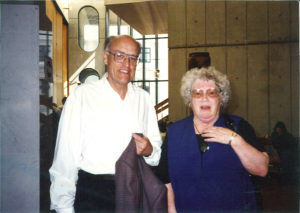
 

Stead with Janet Frame at the Wellington Writers Festival ,1985.


MB: I didn’t find it cruel at all, though Cecelia does come across as bonkers. Clearly you still don’t mind having the odd swipe at people, it seems. In ‘2013 New Year cartoons’: Prince Harry’s ‘small royal brain’; and Hilary Mantel, ‘whose / body clearly wasn’t [designed by committee] / but whose novels / might have been’. You have suggested that if the work – poem or novel – is good, a scathing or brutally honest approach can be worth it. Is that the price of being an honest artist/writer? Can I ask what has been the response of your wife and family to your artistic honesty?

KS: These are cartoons. What does the cartoonist do? He exaggerates what he considers to be, and others recognise as, the foibles and failings of his subjects.

Kay has always been totally loyal and supportive. My children have given me great support too, though Charlotte rebuked me publicly, once, for something that contravened her idea of propriety. I didn’t agree but I didn’t argue. On the other hand, you should read the lovely piece she wrote about my inauguration as Laureate at the Matahiwi marae. But I shouldn’t speak for my family.

MB: In The Death of the Body philandering philosophy professor Harry Butler is assailed by his department’s Women’s Collective for his affairs. This, points out Harris, was around the same time as your fellow lecturer Mervyn Thompson ‘was kidnapped and tortured by masked women after unsubstantiated claims of rape and sexual harassment’. Did you ever fear you might be next on the list?

KS: The case of Mervyn Thompson has often been cited as connected with The Death of the Body. I had a lot of sympathy for Mervyn who was judged without trial by the theatre community and treated very badly. But in my mind there’s not much connection with my novel, except that it does represent something of the atmosphere of the time – a curious mix of sexual liberalism (the professor’s relations with a post-graduate student are unabashed) and the sexual Puritanism that was beginning and became dominant as the AIDS scare developed. I suppose it could be seen as the period of transition from the sunshine of ‘the Sixties’ to the shadow of ‘the Eighties’. No, I never had any reason to fear that I might be next on the list. In a way Mervyn brought the whole thing on himself by keeping company with some really tough radical feminists. He wanted to be their friend, ally and supporter and of course they turned on him as a male.

The Professor of Philosophy in Auckland by the time I was writing the novel was a very proper Swede, Krister Segerberg, but I probably had in mind the one who preceded him from 1964 to 1970, Ray Bradley, militant atheist, driver of fast cars, and champion skier. Ray told me he saw a good deal of himself in the character of Harry Butler and seemed to be quite flattered. Michael Gifkins, reviewing it in the Listener, complained that university professors did not drive Porsches, but Ray did.

MB: You left university life in 1986. What do you make of university life now? Could you survive and thrive in the identity politics/#metoo/trigger warnings/microaggressions era?

KS: I very much dislike the current flavour of the university which seems given over to calculating the profits to be earned by the number of students enrolled. This in turn discourages rigorous academic standards. Also the managers, who used to be minor functionaries, now seem senior in status to the academics, and make many important decisions which should not be their business. At the age of 86 that world is alien to me. Of course if I had been born into it I would have coped with it and made my way through it, as young people have to do now. Every ‘world’ has its imperfections. The young learn to cope with it (or fail trying) and the old grow beyond it and look back with horror.

MB: You’re a scholar of a number of writers, including Ezra Pound, who held fascist and anti-Semitic views. Do you have a view on separating the work from the thoughts and deeds of flawed artists?

KS: This is a subject I’ve written a lot about, especially in the case of Pound, who is a serious challenge – but my other two ‘specialities’, Yeats and Eliot, are not a lot better. It’s very important first to acknowledge what one deplores about a poet like Pound. I have an ongoing dispute with Craig Raine (otherwise we are friends) about Eliot, whom Raine won’t concede was anti-Semitic.

There’s no dispute with anyone about how deplorable Pound was – he supported Mussolini and made anti-Semitic and pro-Fascist broadcasts from Radio Roma during the War. He was also a Social Credit freak. But once that is acknowledged there is still gold to be found in Pound’s work. He’s a poet of genius, but spasmodic and desperately flawed – a fascinating challenge for that reason.
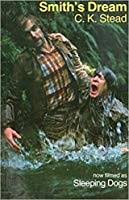


MB: You protested Vietnam and were thrown in a cell during the Springbok tour (and wrote poems about this and Bastion Point and the Rainbow Warrior, and novels that include the 1951 waterfront dispute – All Visitors Ashore – and totalitarian governments – Smith’s Dream). How liberal do you consider yourself in this era of the rise of identity politics and the populist far-right? Do you still feel clear in your criticism and poetry and life about political friends and foes?

KS: Politically I’m still what I have always been, a supporter of the Left, a Labour voter – but that’s an allegiance that throws up challenges from time to time – Roger Douglas, for example, or Tony Blair. At present we need prison reform and it’s clear Labour is held up by the populist Winston – but without Winston they wouldn’t be in government, so they have to proceed pragmatically. We also need higher wages and lower salaries to CEOs and their type. And maybe it’s time to ask whether medical specialists and dental surgeons and top lawyers should be able to earn millions – ie whether the tax system needs to be reformed. I still prefer the old Welfare State, but how do we get back to it after the dismantling and privatisations of the past 50 years? I have faith in Jacinda, Grant Robertson, David Parker, Andrew Little and the team. One would love a more radical programme, but for the moment democracy says no to that, alas.

If by ‘identity politics’ you mean letting your own identity (as woman, gay, trans, Catholic, Protestant, gun-enthusiast) determine who I support politically – no I’m not affected by that at all. I think the political issues that matter most are broad and should affect everyone, whatever their ‘identity’ in that narrower sense.

MB: ‘A flash in the pan’ (in Derrida) begins ‘The occasionally / mad writer’ and is a recognisable figure. The poem concerns life and legacy, his concern that he had 10 years only to achieve something brilliant, but also is returning serve on a bad review he gave your Collected, saying all your books had failed since your first. It does seem to leave the possibility hanging, as if the voice is considering it, yes? Do you recognise the need among some writers, probably a few poets, to move on quickly, to be focused on the next book?

KS: I’m not sure I understand this question. I don’t think I’m anxious to move on to the next book because I think there’s something wrong with the previous one. If I feel there’s something wrong I don’t want to move on – I want to fix it. But probably you mean something else?

MB: In Derrida there’s ‘The angels of science and compassion’, in which an older patient has unspoken thoughts about his female doctor. Not your present GP, you say in the notes. What do you make of Craig Raine’s 2015 poem ‘Gatwick’, which ‘is a fantasy about a young official at passport control’, says the Guardian, and which spawned a Twitter storm and mocking parodies? ‘She is maybe 22 / like a snake in a zoo,’ … ‘I want / to give her a kiss / But I can’t… I want to say I like your big bust. Which you try to disguise with a scarf.’… ‘I can say these things, I say, because I’m a poet and getting old. / But of course, I can’t / and I won’t. I’ll be silent. / Nothing said, but thought and told.’

KS: I caught a whiff of the fuss about Raine’s poem and I’m sure the Twitter storm must have been full of silliness. But I didn’t much like his poem and don’t think it’s much like mine about the rectal examination for prostate. Mine is more comic than his and has a lighter touch. I suppose it’s like his in that both are about not doing or saying what you may not do or say. But I thought his lines about the mother were needless and gross.

MB: Quite apart from their other virtues, your novels have zip. You have said, ‘In writing fiction I’m certain only of two things – that I want to keep the story moving, and that I want to generalise a society’; Professor Mac Jackson has said, ‘Stead is a master at maintaining the reader’s curiosity in ‘what happens next’ ‘; and in The Necessary Angel you write (in the context of Martin Amis): ‘The big question was always the same: What happens next? And how does it end?’ How do you do it, and why?

KS: Telling stories is a skill some people have and some don’t. Listen to an anecdote around the dinner table and you know at once whether the teller has that required basic skill or not. It’s not enough alone to make a novelist – and some writers who gain considerable reputations as fiction writers don’t have it. Norman Mailer has it in spades; I’m not sure that James Joyce does. Henry James is a natural storyteller even though his prose can be an undergrowth you have to fight your way through. Critics have puzzled over the success of Wordsworth’s The Lyrical Ballads, when they are such banal rhymes. But you read on because each is a human story, cleverly told, with the information released in the right order and the punch-line withheld until the end.

Why does one do it? Because it’s such a fundamental human activity, it brings satisfaction, and I suppose even a sense of power. You tell and they listen.

MB: Did you ever suffer what James Wood calls ‘the ordeal of choice’ – the fact that the author of a novel can do anything and is thus agonised by all the possible paths?

KS: No, I don’t remember being afflicted by this problem of excess of possibilities – maybe because I’m not all that inventive; but I think more because I’m temperamentally a realist, and so many things that present themselves as possible directions a human situation might take, when explored imaginatively, seem unlikely – difficult to make plausible. Plausibility is a major test for me, both as reader and as writer. I wonder whether Wood (an excellent critic) writes novels. [MB: He does.] I don’t think I would be likely to admire a novel by a writer who thought there were just so many possibilities it was difficult to decide which to take. At any one moment in a typical human situation the viable possibilities are few – though a choice between two, equally attractive, is very common. Two is not a lot.

MB: What’s it like having a child who is a novelist, Charlotte Grimshaw? Do you read each other and/or offer feedback?

KS: A source of great pride, of course, and interest to see where her talent will take her next. I think it’s true to say that a few decades back I used to have three regular readers – Kay, Charlotte and Margaret. All three would read and comment on my fiction before it went to publisher. Now I have only one – Kay. Kay and I used to read Charlotte’s fiction before it was offered, but not in recent years – though Charlotte still often sends us reviews or articles before they’re offered. Of course we all comment on and discuss one another’s work after publication. On the whole we have a been a close literary family (Margaret is in publishing in London, and Oliver writes on art history subjects and is a curator at the Turnbull Library) with a lot of interchange of ideas and opinions – but less so now our children are middle aged and Kay and I are almost beyond our use-by date.
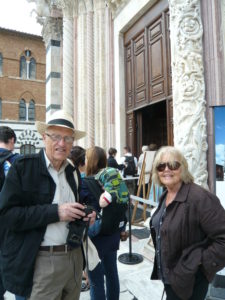
 

Karl and Kay in Florence, Italy.


MB: You had a stroke in 2005 – ‘how i love the world / and will be sad / to see it go’ (from ‘S-T-R-O-K-E’). How how does a thought like that gel with your saying you have no fear of death. Did your style or focus or attitude to life change after the stroke?

KS: I’m more than 10 years older now, and feel I have reached, or am very close to reaching, my ‘use by’ date. I don’t want to hang around losing cognitive and physical function just for the sake of staying alive.

MB: To return to the duality, you do share some similarity with Michael Frayn (‘Really’ in Derrida): ‘ ‘Mr Stead, I do admire your novels,’ / or even, ‘Karl, you cock’ … No – / we’re worlds apart really. Let’s keep it so.’ It’s flattering to be taken for someone else famous, but also suggests at heart you have no desire to be confused with anyone else?

KS: This is not something I feel strongly about, either way. The likeness, and being mistaken for Frayn, is just an amusing fact, serving an (I hope) amusing poem. The story about the Hay-on-Wye conversation and Frayn’s reaction is entirely truthful.

MB: You asked about this Q&A: ‘What will happen to it? Where does it go?’ You are working on a sequel to South-West, but it will only reach 1986, when you left university. Surely there will be a full biography. How much do you care about your legacy?

KS: I suppose there might be a biography, but/and unfortunately/fortunately I won’t be around to read it.
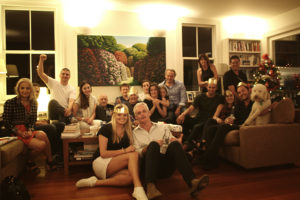
 

Karl Stead (seated left of centre) surrounded by family and friends.


Mark Broatch is an author, a journalist, a writer of fiction and poetry who has been the recipient of Buddle Findlay Sargeson and Michael King Writers Centre fellowships, and a stay-at-home father to a preschooler who gets the rest of his undivided attention. His fourth book, Word to the Wise, a guide to misused and misunderstood language, was published last year.

'One of writing’s greatest magics is to allow us – to use Kiri Piahana-Wong’s phrase – to slide outside the trap of time.' - David Taylor

Read more

Display It Like You Stole It: Letter from London


London, November, Guy Fawkes Day, 8 a.m. I was on the Heathrow to Paddington express train (‘fifteen minutes to the centre of London’) and feeling somewhat disorientated: back where I had come from, it was the middle of the night. I had arrived in London from Honolulu to take part in the Literature Programme organised by Creative New Zealand in association with the Oceania Exhibition at the Royal Academy of the Arts (27 September – 10 December 2018). This exhibition marked the 250th anniversary of the Royal Academy, which was founded in 1768 — the same year Captain Cook set sail on his first expedition on the Endeavour. The exhibition (‘five years in the making’) also marked the first-ever show of the arts of Polynesia, Melanesia and Micronesia held in London. (Oceania will open at the Musée du quai Branly-Jacques Chirac in Paris on March 12, 2019.)

The previous week, I had been on the big island known as Hawai’i — the largest island in the Hawai’ian group of islands — exploring the Kīlauea caldera, a highly active volcanic region, and inhaling the breath of Pele, the Kanaka Maoli goddess of  volcanoes, steaming up from vents in the lush vegetation and making the air tingle. The Big Island is a place at once primal, fierce, metamorphic. Part of the road in the Volcanic Park remained ruptured and impassable from the most recent earthquake just a few months earlier; and a lake of molten magma brimming in the crater had vanished around the same time as the earthquake, flowing away down lava tubes to emerge spectacularly aflame and pouring into the sea further along the coast. Two hours drive further on, across the stupendous volcanic slopes, was Kealakekua Bay, where on February 14, 1779, Captain Cook, had met his end.

In Hawai’i, the Kumupilo is a creation legend surrounded by ‘kapu’ or tapu, and associated with the festival of Makahiki and with the god Lono. It is paralleled on Aotearoa by the festival of Matariki and the god Rongo. Lono was an expert riddler, and according to his high priests practised at the art of ‘kaona’ or hidden menaings. Kapene Kuke, or Captain Cook, in his aloofness was mistaken for Lono when he arrived in the middle of Makahiki in 1779. The indigenous Kanaka Maoli people were chanting the Kumupilo as he came ashore at Kealakekua Bay. Cook enjoyed the attention but, long story short, when he failed to live up to the role he was speared to death: he was not the god Lono after all.


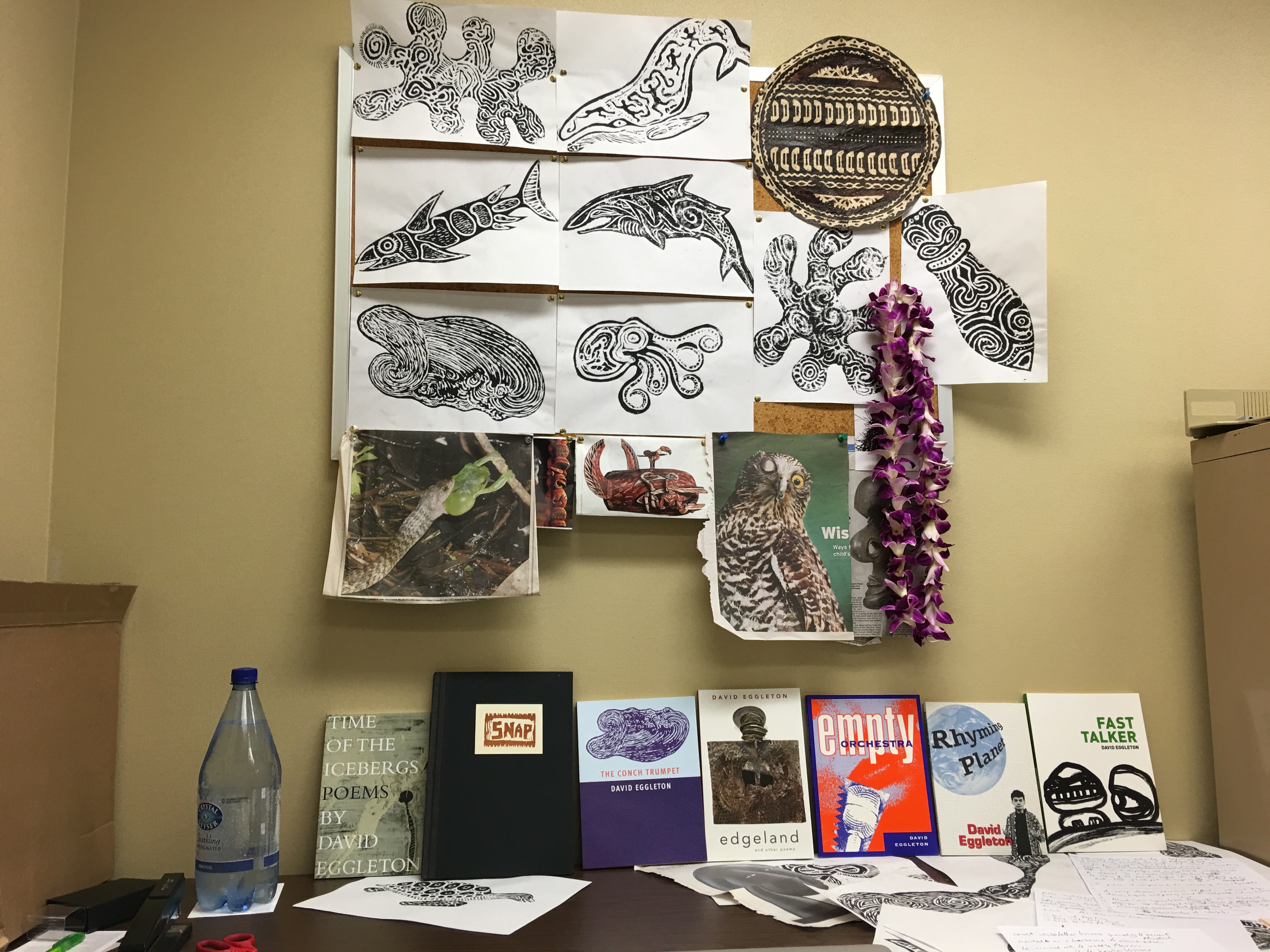
David’s workspace at the University of Hawai’i.


I had already spent nearly three months in the Hawai’ian archipelago, on a Fulbright-Creative New Zealand Writer’s Residency, based at the University of Hawai’i’s campus on the island of Oahu. I was researching my own Pasifika heritage, and also talking poetry and story with university students and others in concert with fellow Kiwi Fulbrighter, poet Coco Solid. At the University’s Hilo campus on the Big Island, we had been introduced to renditions of the vibrato chant known as the olioli’i’i, and to the accompanying ancient art of string-figure-making, the hei. These served to prove customary art forms were alive and well and part of an inspiring atmosphere. The whole island, made up of  six or seven active volcanoes, felt strangely bouyant, as if the island itself was on the move. The island climbs to the snowy summit of Mauna Kea, which, measured from the seabed floor, bulks up as the world’s highest mountain. Below Mauna Kea are rainforests, black lava deserts, gulches of giant ferns, waterfall cataracts, ocean rains, and smoky surf. And at Hilo, fresh from full immersion in Moana-nui, in the Pacific Ocean, and swimming with the endangered green sea turtles, I was walking on sunshine.


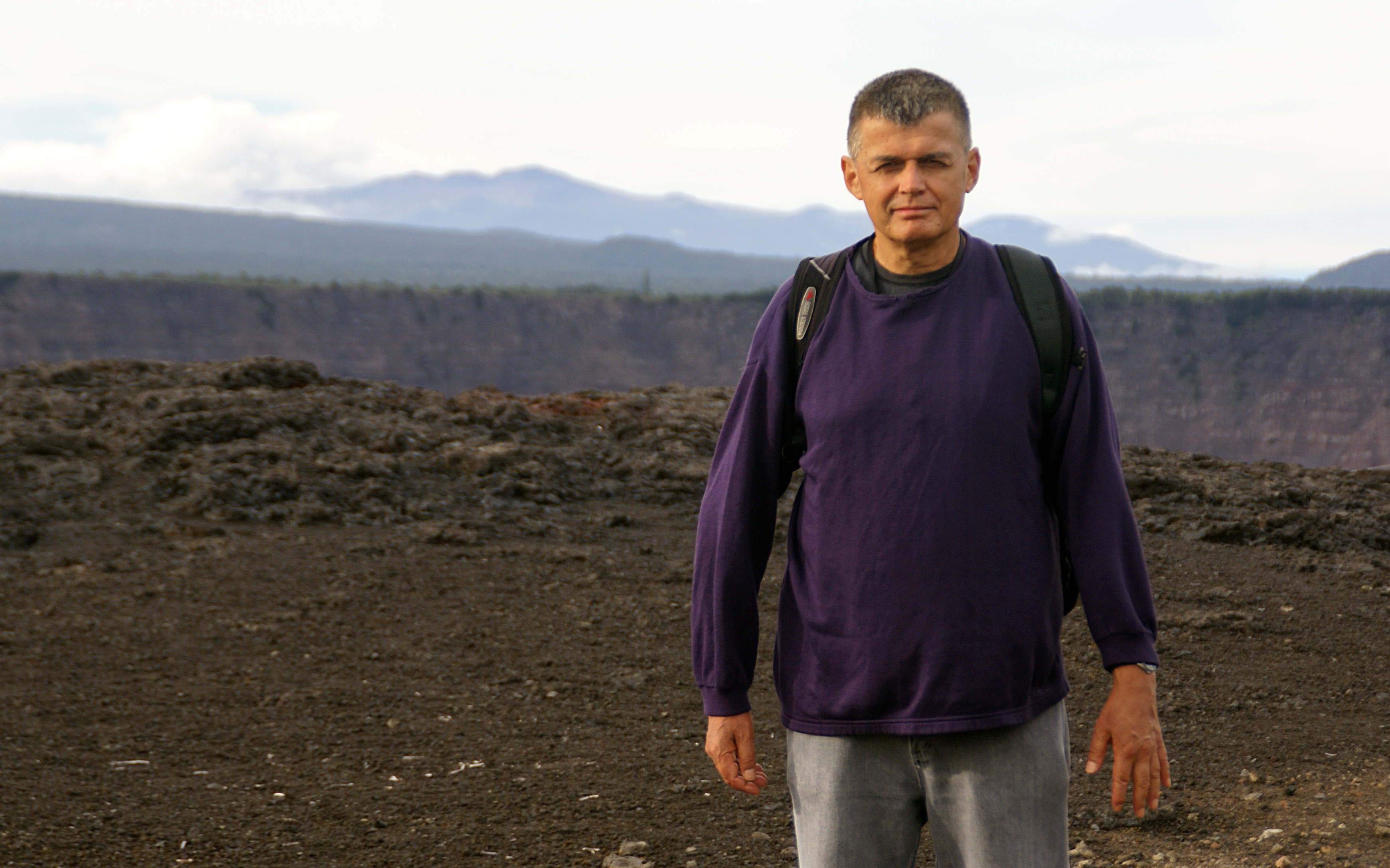
David at the Kilauea Crater with Mauna Kea in the background.


Next minute, like a sobering intervention, I was aboard a late-night Air Canada jet airliner, wallowing out of Honolulu into the north-east trade winds and bound for the capital of the old British Empire.

Passengers poured off the planes at Heathrow like footsoldiers in capitalism’s struggle to assert world-wide commodification: where every hair on your head has been numbered and priced, and the information digitally transferred to a database. I arrived, then, as a plugged-in hybrid, a part-electric afakasi, a Polynesian airborne like a mythological deity but also irrevocably tainted by globalisation’s gasoline alley, snuffing up the fumes of its greenhouse gases and ruefully acknowledging my role in creating the great carbon footprint in the sky.

The Tongan philosopher and writer Epeli Hau’ofa, whose satirical saga of South Pacific colonialism, Tales of the Tikongs, I had in my carry-on luggage as a well-thumbed talisman, remarks in an essay that Oceania originally ‘was a sea of islands … a world in which peoples and cultures moved and mingled unhindered by barriers of the kind erected much later by imperial powers.’ Now I was at the centre of one of those imperial powers, from whence the divide-and-rule cartographer had laid his heavy hand on the map of Oceania, restricting the routes of ocean-going vaka. This was jolly old England, with its grand dungeons and castle keeps, its raven-black clothing, its shadowy past and shady legacies. Emerging from the Underground’s Bakerloo Line at Charing Cross Station, and caught up in the urban dance of expressionless Londoners around their labyrinthine city, their swirl of pumping arms and legs as they marched urgently up and down escalators and stairs, I made my way blearily to our hotel accommodation on Northumberland Avenue. It was to be a flying visit; I was in the UK for six nights, having spent three days en route. Later in the week, somewhere out in the damp afternoon of autumnal London, the All Blacks, with the help of the rub of the green, would be defeating England at Twickenham yet again.

But at this point I was only eager to catch up with another group of cultural ambassadors, my fellow writers from Aotearoa taking part in the Oceania Literature junket: Witi Ihimaera, Paula Morris, Karlo Mila — and Tina Makereti, who would be arriving the following day. We were scheduled to gather in the hotel foyer at morning coffee time, 10.30 am, with our organiser Eleanor Congreve, a Senior Advisor (Kaiwhakahaere Matua) at Creative New Zealand-Toi Aotearoa, to run through events, protocols and waiata, and to synchronise our watches. After that, I knew, jet lag would claim me.


Beside the Oceania V&A sculpture. From left to right: Karlo Mila, Tina Makereti, Paula Morris, David Eggleton, Witi Ihimaera.


Entering London felt a lot like going down a coal mine, with its subterranean villages, its black seams and greasy caulks, its interconnecting tunnels and closed-in high streets. Even the assorted quixotic skyscraper shapes on the skyline, darkly hulking in the perpeptual twilight, resembled great coal outcrops: mine the Shard and keep Britain burning brightly for a year. From my hotel room window, a stone’s throw from Trafalgar Square, I looked out onto a mass of venerable grey stone buildings that I knew — because Google had told me — had been hollowed out and refurbished as luxury hotels. Directly opposite were the massive wooden doors of the fortress-like Embassy of Nigeria, curving round a side-street. The hotel we were staying at had been built in 1934 as the Royal Empire Society Building, before becoming the Royal Commonwealth Society Building after World War Two. Its rooms had been converted into quirky nooks and crannies. On the hotel’s exterior stonework remained the carved emblems of the colonies of the British Empire: Oceania was represented by the Southern Cross, the silver fern, sea shells and by outrigger canoes with lateen sails. I felt anonymised by these ponderous buildings surrounding me; they were pressing on me with the weight of their stone entablatures. George Orwell’s bleak Oceania in his dystopian novel 1984 might have been inspired by just such surroundings, and maybe even John Keat’s poem about the serene Pacific stared at with wild surmise: stout Cortez followed by even stouter whaling ship captains.
But if to travel from the Hawai’ian islands where the ocean is an open book, pages green and blue by turns, to a place where the cityscape bristled with imperial history, and to leave our hotel felt a bit like fighting the Battle of Trafalgar Square daily, with tootling black cabs, swarming pedestrians and cavalcades of bright red London double-decker buses launching volleys of exhaust, London was also a place that seemed to transform before my astonished eyes.

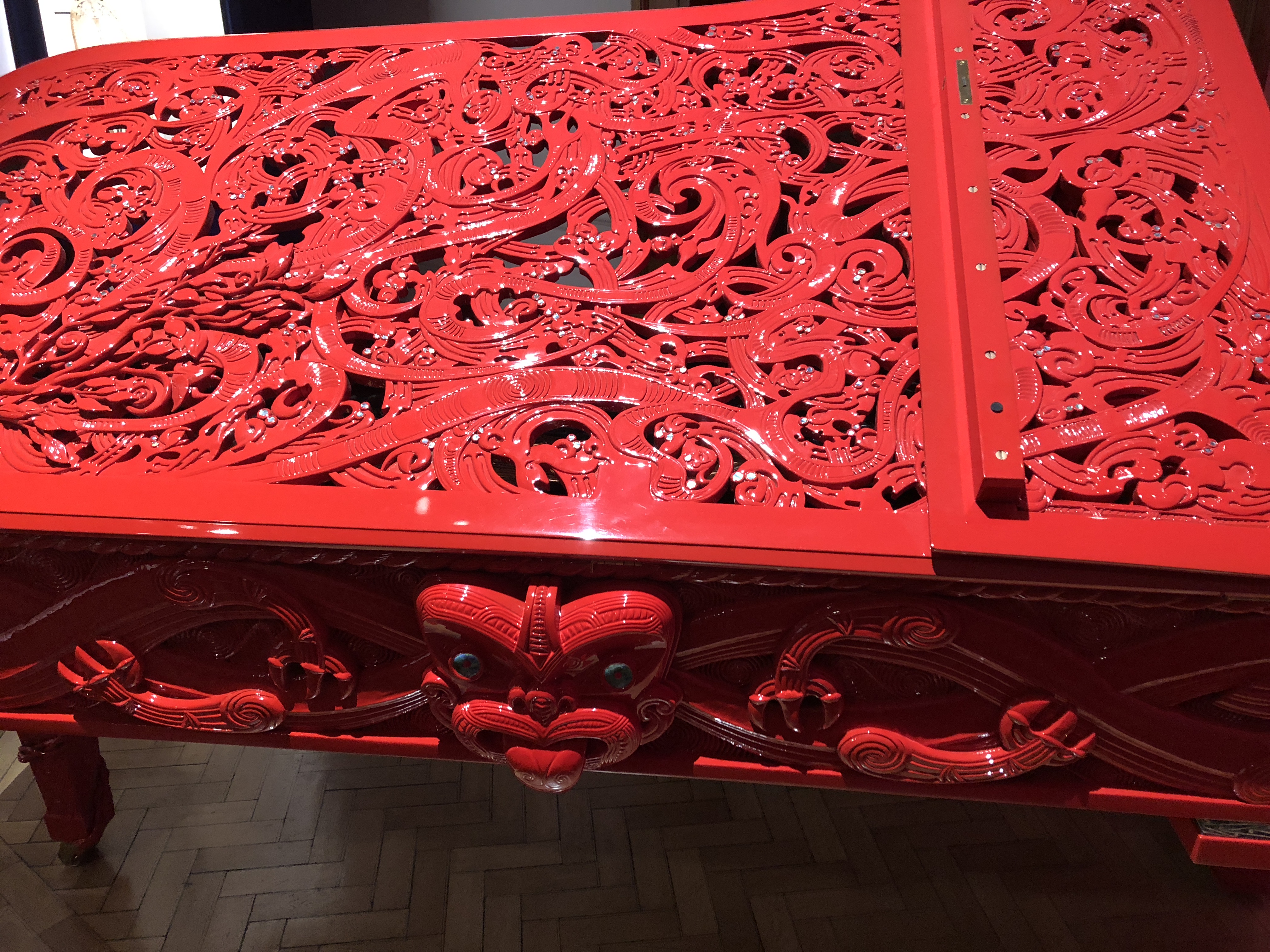
The 100th Anniversary of the Signing of the Armistice that ended World War One loomed on the Sunday, the eleventh day of the eleventh month; and New Zealand’s Governor-General, Dame Patsy Reddy, was in town to attend wreath-laying ceremonies, and also to view the Oceania Exhibition, which was partly sponsored by New Zealand’s Ministry of Foreign Affairs and Trade. All at once, central London itself seemed wreathed in poppies. Whether paper, plastic, ceramic or the real thing, poppies sprouted from hats, from coat lapels, shirts, jerseys and blouses. They were sprinkled on the front pages of newspapers, on posters, on billboards, and in shopwindows. Bright dabs of red petals burgeoned as a motif: the autumn drizzle was pinkish; traffic lights glowed red; here and there were notes of cherry and rhubarb and paprika — and rubescent teapots, and pools of crimson neon; even the darkness had a blood pudding texture to it. It was the season of roseate river mists, of mellow-lit pubs painted black and scarlet, and of russet leaves falling in public gardens. London, ruddily suffused and a bit rusty, had become a rosy city half as old as Time. And then, in the Oceania Exhibition, there was Michael Parekowhai’s glossy red piano, He Kōrero Pūrākau mō te Awanui o te Motu, carved like a wakahuia, carved like a bridge over troubled waters, and acting as a cultural beacon.


Michael Parekowhai’s He Kōrero Pūrākau mō te Awanui o te Motu

****

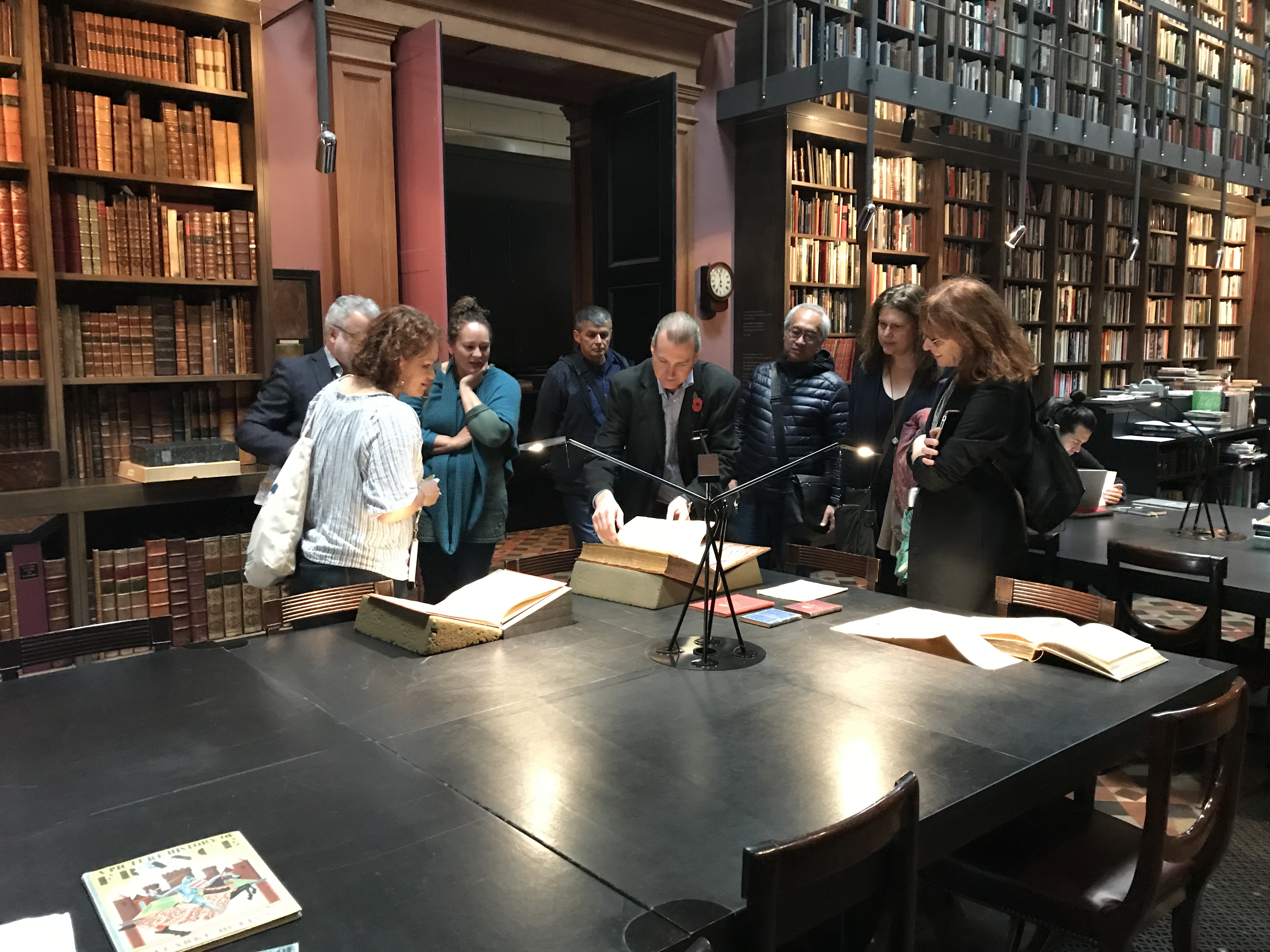
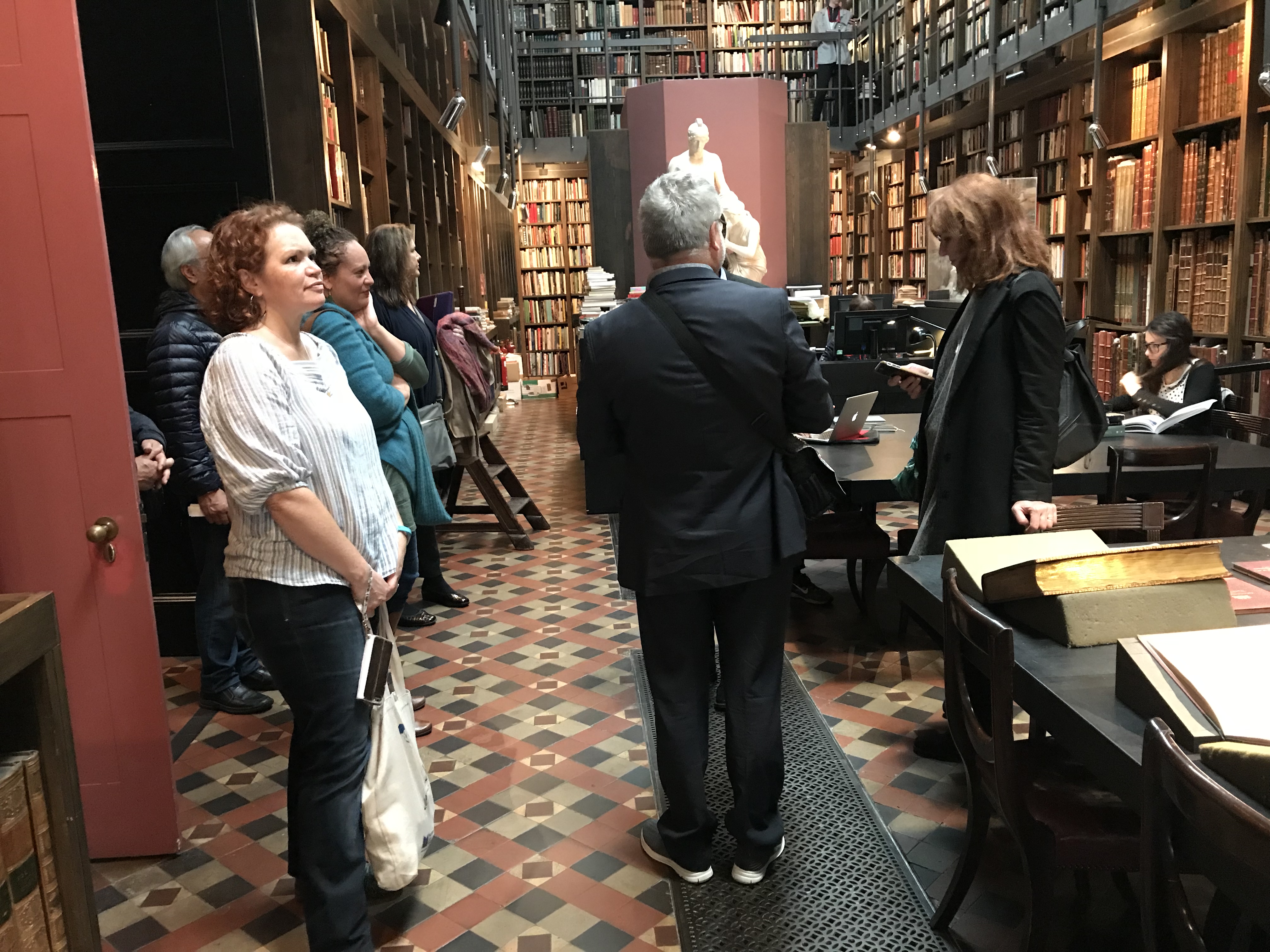
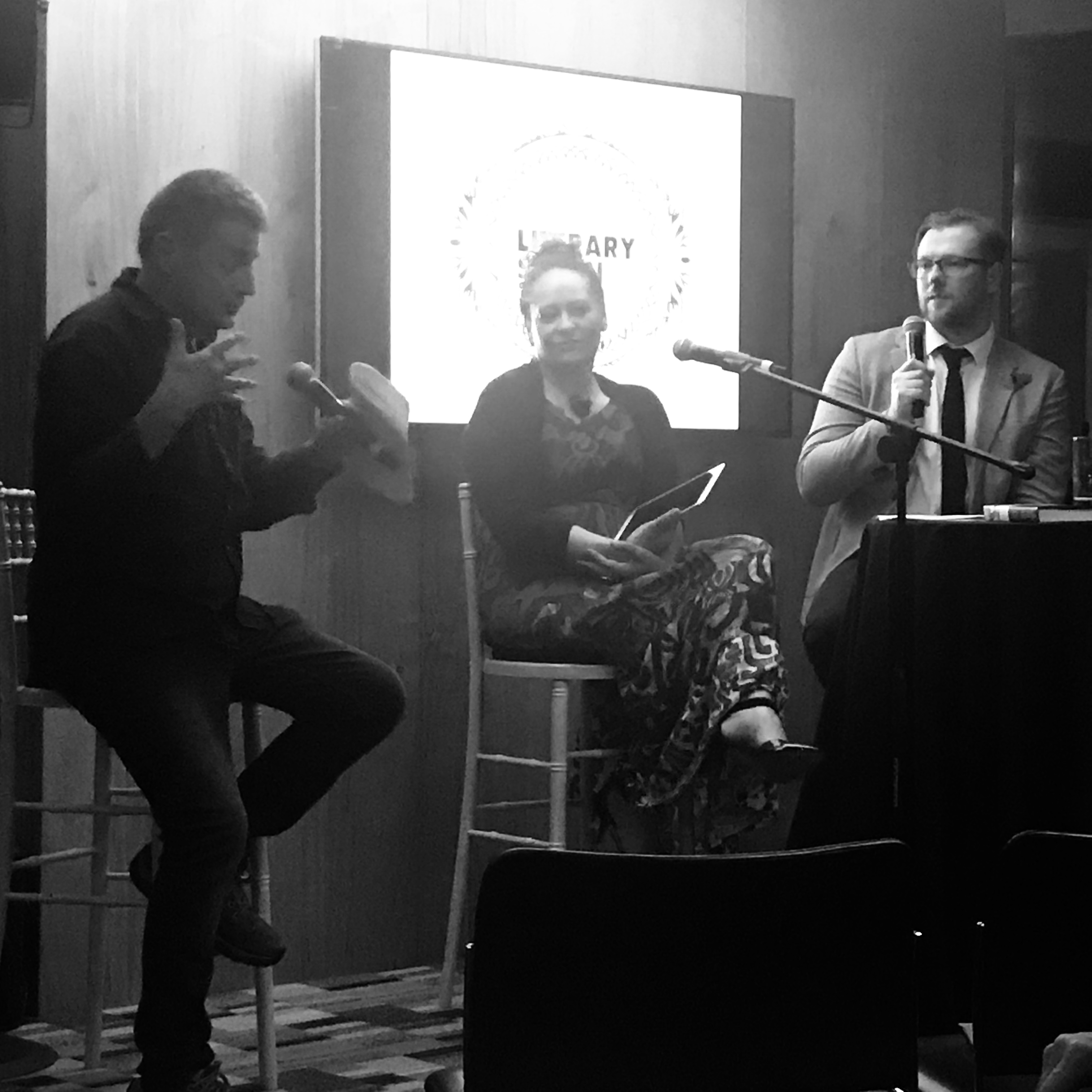
As part of our preparations while in London for the three public events that made up the Oceania Literature Programme, we five writers visited a variety of museums. The city itself is one big museum really, or maybe a theme park of museums that collectively contain a condensed summary of world history. And the myriad museum artefacts, sourced from all round the world, constitute almost an embarrassment of riches, now that notions of decolonisation are front and centre. But while identity art activists protest about provenance — ‘Display it like you stole it’ — today’s museum curators are mostly woke to the need to treat the extraordinary objects they hold from former colonies, not only with scholarly respect and preservational diligence, but also with the acknowledgement that moral, if not legal, ownership lies in places of origin and original context.


Above images courtesy of Creative New Zealand.


One morning we paddled our waka to the Victoria and Albert Museum in South Kensington. There, we met up with Eleanor and our guide, New Zealand-born curator Heather Harris. We trekked past the Rapid Response Collecting Unit, past a gigantic plaster cast of Trajan’s Column (the original still stands in Rome), past an actual-size replica of Michelangelo’s David, past many cabinets of curiosities, and into a cavernous hall devoted to seven of Raphael’s enormous painted designs for tapestries commissioned for the Sistine Chapel. Then, we headed into the Frida Kahlo: Making Herself Up exhibition, in its final weeks. What this solo artist show had more-or-less in common with Oceania was the ability to hold the reverential gaze of gallery-goers with a sense of spectacle. Laid out as a shrine-like evocation of the adobe-style La Caza Azul, Kahlo’s lifelong home in the Mexico City, where she was born and where she died, it was an undeniably vital and intense display of objects and artworks. But almost unbearably poignant, too, as it charted the effects of the artist’s traumatic bus accident when she was 18 that crippled her. Close, crowded and deliberately underlit, Making Herself Up took us from her childhood, to marriage to Diego Riviera, to ‘Gringolandia’ (the United States), to ‘the arms of Morpheus’ (her use of powerful painkillers). It fetished as relics her medical corsets and orthopedic devices; there was a glass display case of twenty mannequins wearing her favourite Mexican peasant dresses; and a glass display case containing her favourite lipstick: Revlon’s ‘Everything’s Rosy’.

Another exhibition some of us went to was at Tate Britain on the Thames Embankment: Edward Burne-Jones — Pre-Raphelite Visionary. The relevance of this High Victorian artist to Oceania was partly in the mystery and intricacy of his flowing designs, partly in his tributes to the anonymous makers of medieval cathedral artefacts, but mostly in his use of myths and legends and in his stylised veneration of ancestor figures. In the Perseus narrative cycle of paintings, his quest-hero Perseus was a figure very like Maui, while his Medusa was an unforgiving earth-mother like Papatuanuku, and the dragon or serpent Perseus sought to slay, a mighty taniwha. There was something funereal and otherworldly about the glowering knights and brooding damsels painted by Burne-Jones, too, that paralled the aesthetic abilities of the anonymous artists of Oceania to render powerful human emotions in the faces and in body language of the effigies they carved hundred of years ago.

****


Above images courtesy of Creative New Zealand.


On Wednesday evening, our first public event was held at New Zealand House: Damian Barr’s Literary Salon — a talanoa on the theme of ‘Oceania’. Through strict security, and up past a 15 and half metre tall, darkly-varnished pouihi, carved from a totara tree log by Inia Te Wiata back in the 1960s, to the big, glass-walled penthouse at the top, with its panorama of the high-rise pink and white terraces of city lights, icy against the black backdrop of the night sky. Damian, too, was riding high, after hosting the celebration for the tenth anniversary of his Literary Salon at the Savoy Hotel the previous week. The Scottish novelist and humourist held the University of Otago Scottish Writers Fellowship in Dunedin earlier in 2018, and is perhaps famous or notorious in New Zealand for his tweet describing the taste of feijoa as: ‘the love child of a highly scented candle with the texture of congealed intimacy.’

The venue was crowded with excited chatterers and bloggers, expatriate New Zealanders, arts administrators, PR people, literary agents and journalists — but if they were the salonistas, we were the tokenistas. It was never going to be more than samplings and tart soundbites from us, about as nourishing and substantial as the finger food that accompanied the generous dollops of fine New Zealand wine served up. Nevertheless, Damian was urbane and charming and welcoming; listening respectfully, asking light-hearted questions, and generally jollying us along.

For our mihi, Paula Morris delivered a rousing karanga, her hands quivering in the whākapakapa; Witi followed with a speech in te reo; then we all chanted a short karakia, by turns, each throwing out a sentence in a rhythmic affirmation of our unity as a writerly delegation, the audience responding warmly and enthusiastically to this exotic Polynesian theatricality. For our mahi, Tina Maketeri read an extract from her new novel, The Imaginary Lives of James Pōneke; Karlo Mila and myself recited poems; Witi discussed an episode from his memoir Māori Boy, which was about his grandmother’s acerbic response to the British nursery rhymes Witi brought home from his first day at primary school. And Paula Morris, after reading out a new short story, made the salient point that New Zealand writing in the metropolitan centres of London and New York still exists with a colonial publishing paradigm; that is, it is mostly invisible.

Her observation chimed with the nature of the Salon presentation, the fleeting impressions of us as individual writers the audience would have had, along with a concomitant sense of us as a group as being on a cultural mission, representing something larger than ourselves, namely literature from the South Pacific seeking, in Witi’s words, ‘to throw off the shackles, straitjackets, stereotypes and legacies of European romanticism and euphemism’.


****


From left to right: Damien Barr, Paula Morris, Karlo Mila, David Eggleton, Tina Makereti, Witi Ihimaera. Photo courtesy of Creative New Zealand.


On the Thursday evening, we took to the stage at Marlborough House, a former Royal Palace and now home to the Commonwealth Foundation, for a panel discussion entitled, Speaking Sideways Or Talking Back: Contemporary Perspectives from South Pacific Writers, chaired by Paula Morris. Once again, the venue was full, but this time most of the audience seemed to have a vested interest in the politics of Oceania — ‘in the activation of the Va and the weaving of the Moana back together’, as one of the attendees, Jo Walsh, put it in the question and answer session afterwards. Albert Wendt first proposed the need for a new way of writing about Oceania back in 1976, one that took stock of emerging independence movements and post-colonialism. He produced two landmark anthologies of the literature of Oceania in the years that followed, Lali (1980) and Nuanua (1995), and now here in 2018 our keynote book for the panel discussion was the latest anthology of the new literature of Oceania, Black Marks on the White Page, published by Penguin Random House, and edited by Witi Ihimaera and Tina Makereti. In it, writers ranging from Selina Tusitala Marsh to Tusiata Avia to Gina Cole to Courtney Sina Meredith are all speaking sideways or talking back to the dominant narrative with their own subversive fictions.

Paula and Tina have both written novels about nineteenth century Māori travelling from the colonial periphery to Victorian London — Rangitira and The Imaginary Lives of James Pōneke, respectively — and Witi’s novel The Rope of Man spirals outwards from the East Cape to contemporary London and back with the sway and stamp of a kapa haka song.

But at this event it was Karlo Mila at the podium who talked back most urgently and most pertinently to the panel topic, by questioning the meaning of the term ‘commonwealth’ in relation to Oceania today in her long poem, ‘For the Commonwealth’.  ‘— It does not feel like we have inherited commonwealth but rather common problems … and if the ocean could speak in that choked, overheated throat gagged with plastic bags in the way she once spoke to us … she would say enough … If ever we needed to wake from our sleep and hear the call of the commonwealth it is now …’

In Karlo’s cry to the blue continent, we have gone beyond picturesque archipelagoes and antic exuberance to what is actually happening, to today’s realpolitik. To the arc of instability and to sea-bed mining; to backyard paternalism and unscrupulous social engineering; to nuclear weapons testing and suppressed sovereignty movements; to the very high incarceration rates for young Māori and Pacific Islanders in Aotearoa; to the unfulfilled repatriation of the plundered moai statue Hoa Hakananai’a (‘Stolen Friend’) back to Rapa Nui. After World War Two, Oceania was claimed as part of the ‘American Lake’, and in the twenty-first century is being inexorably drawn into the territorial aggrandizement and debt-loading of China’s maritime Silk Road. And still environmental destruction continues, and still sea levels continue to rise unchecked.

****


At the Bishop Museum


Earlier in the week, ahead of our final public event, Writing Oceania, at the Royal Academy of Arts on the Friday night, we were provided with copies of the hefty catalogue of the exhibition, and this turned out to be essential reading.

Exhibitions on such a globe-girdling scale require careful negotiations with a variety of institutions, guardians and kiatiaki, and need nuanced contextualisation through essays and documentation when they are presented.

Some talk of London, or Ranana, as a place where world-eating culture vultures have traditionally come home to roost and feast on their pirated gains; and of Captain Cook and the curio-gatherers who followed him as the very emblem of unrepentant colonial overreach in the Pacific. But since those early encounters between the radically different societies of Europe and Oceania, both geopolitical entites have not existed in a vacuum or in self-enclosed bubbles; they have gone on interacting, trading, and examining one another’s cultures for mutual benefit. Twentieth century art, psychoanalysis, and a host of other contemporary cultural developments have been inspired by the arts of Oceania: the arts of Oceania in short are a major contributor to how we think about civilisation now. At least, this is the thesis advanced by Oceania. As an amelioration of  the destruction wreaked by European conquest this view is clearly inadequate; however, as a means of making sense of cultural transformation in the South Pacific by assembling aesthetically beautiful objects into a meaningful unity, it does useful work in allowing us to see Oceania’s treasures holistically.

If Oceania is a continent, then it is a continent as complex as Europe. Oceania is actually a fragmentary and muddled show. The meaning and mana of many of the more than two hundred items included is only partly addressed. The selection of items is partly haphazard or fortuitous. The totalising narrative it tries to embrace is manifestly incomplete: the twentieth century story — Maori Modernism, for example — is conspicuous by its absence. This is blockbuster as totemic monolith, freighted with historical significance, but also suffering from partial amnesia. In Oceania, the whole of the twentieth century has more or less been reduced to a cartoon head of the Phantom, the ghost-who-walks, painted on a wooden battleshield recovered from a battlefield in the Papua New Guinea Highlands.

Obviously, the curators are aware of these omissions, most of which if rectified would only serve to complicate the exhibition for a mass audience. What they have provided instead is a show that emphasises the politics of identity, of belonging, of place. On the Wednesday morning, we were given a guided tour of the exhibition by Adrian Locke, one of the curators of Oceania. I asked some simple factual questions of him as our group wended its way around, but to have interrogated the aimiable but wary Adrian about issues such as colonial plunder and repatriation would have been like asking questions of the Sphinx. I would have heard muffled echoes of my own voice, and a reeling away of desert birds cawing into the distance, and a great silence as from a locked vault deep beneath London itself.

In the end, we were there as faith-based writers, as believers in the mana of Oceania, and we saw the spectacle as it was intended to be seen, as a presentation of the exceptionalism and essentialism of the sea of islands that is Oceania, reflected in its taonga, its pantheon of archetypes. This was Oceania as a kind of dreamscape, a distillation, a resurrection of fallen idols from their legendary, fecund, humid haunts into the air-conditioned present, tightly-grouped and placed up on pedestals, the display cases lit by a kind of underwater or submarine light. This was the bottled ocean; a logjam of rainforest beings, adrift on global currents. This gathering of artefacts was also a kind of dispersal, a diaspora: proof positive that otherworldly argonauts sawn out or dug out of their places of origin, their temples, and were normally housed deep inside dozens of different museums. Sighting the god A’a in the flesh, as it were, was a time-standing-still moment; the figure holds you as if it is surrounded by a magnetic force-field. This statue is from the island of Rurutu, in what is now French Polynesia. A father-deity, its carved wooden skin is fertile, exuding other smaller gods in perpetuity, although it has also been neutered by some overzealous missionary with a hacksaw. Brought to England by the London Missionary society 150 years ago, A’a lives in the British Museum, as a celebrity, the world’s most celebrated Polynesian carving. In front of all these massed effigies, necklaces, cloaks and headdresses, Witi raised the question, shouldn’t this show itself tour to Oceania? Something for museums to muse on.


****


At the Reynolds Room. Photo courtesy of Creative New Zealand.


Our final gig, chaired by Adrian Locke in the Reynolds Room at Burlington House, Piccadilly, was packed, somewhat to the consternation of the Royal Academy staff who had to hurry around and find more seating. Late arrivals ended up standing, jammed in at the back. Each of us spoke to and about specific taonga in the exhibition; while the whole evening had an atmosphere of ritual, an affirmation of the currents and energies animating Oceania. We concluded our korero to a standing ovation. The waiata we ended on was ‘Pōkarekare ana’, and Witi invited all the New Zealanders present in the room to sing and sway along with us. Sir Peter Buck (Te Rangihiroa), in his 1958 history of the great Polynesian navigators, Vikings of the Sunrise, asking the question where is Hawaiki, suggested any of the islands of Oceania might well be Hawaiki. The islands are organically connected, as if by the tentacles of an octopus, but where does the head, where does Hawaiki lie? Some say at Savai’i in Samoa, some say at the island of Hawai’i, some say at Oheavie in the Tahitian group of islands, as in a map drawn by Tupaia, the Tahitian navigator who guided Captain Cook. But for now a gigantic banner draping the facade of Burlington House bearing the word Oceania and an image of a female ancestor figure painted with traditional tattoo designs from the island of Aitutaki in the Cook Islands group suggested that the spirit-world of Hawaiki might have gathered here, to represent and to be acknowledged.


David Eggleton received the 2016 Prime Minister’s Award for Literary Achievement in Poetry. His most recent collection of poetry Edgeland and other poems, published in 2018 by Otago University Press, was longlisted for the 2019 NZ Ockham Poetry Award.


*****   The Oceania literature programme was supported by Creative New Zealand *****

'The thirty-five of us were in the country of dream-merchants, and strange things were bound to happen.' - Anne Kennedy

Read more

Why Aren’t You Reading Queer?

To celebrate the fourth Same Same But Different festival – the only LGBTQI writers festival in New Zealand, held every year in February as part of Auckland Pride – we suggest some contemporary NZ reads: twenty-plus books either by queer writers, with queer content, or both.


.

1              Peter Wells: Boy Overboard (2014, Penguin Random House)

Wells, the founder of SSBD, is a visionary mover and shaker in NZ lit. A regional finalist for the 1998 Commonwealth Prize, Boy Overboard is the story of eleven-year-old Jamie, staying with family friends in a place called Hungry Creek and trying to work out who he is and where he fits in the world. A poignant novel about self-discovery, sexuality and coming of age.


2          Witi Ihimaera: Nights in the Gardens of Spain (1995, Penguin)

Which life should you follow? Ihimaera’s semi-autobiographical book is the story of David Munroe, a man who confronts his double life and the impact that his coming out has on wife, children, friends and career. Now in its fourth edition (and adapted for TV in 2010), Nights in the Gardens of Spain explores points of conflict between sexuality and social mores, and within contemporary gay culture.

.

.

3              Gina Cole : Black Ice Matter (2016, Huia)

Cole’s-award winning stories transport you to unlikely places, from Suva to Auckland, up Fox Glacier to inside a toxic sweatshop. Whether it’s exploring lesbian dating dynamics or coup politics, this story collection stuns. It won best first work of fiction at the Ockham NZ Book Awards 2016: the judges called Cole ‘a new, assured and vibrant voice’ and said the stories ‘burn you down, freeze you in your tracks, comfort or cool you’.

4              Georgina Beyer: A Change for the Better – the Story of Georgina Beyer (1999, 2002, 2010, Random House)

Sex worker, famed actor, entertainer, politician and the world’s first openly transgender mayor in 1995, Georgina Beyer became a household name as the first openly transgender Member of Parliament in 2000. A long-standing human rights advocate, Beyer’s legacy includes a long and powerful list of legislative reform, but it hasn’t been easy. A Change for the Better documents Beyer’s turbulent life and times.

.


.

5              Chris Tse: He’s so MASC (2018, AUP)     

After reckoning with the dead in the award-winning How to be Dead in a Year of Snakes, Tse has turned to issues of identity and how to live today in his powerful second collection. Enter a world of self-loathing poets and compulsive liars, of youth and sexual identity, and of the author as character — pop star, actor, hitman, and much more. These are poems that delve into hyper-masculine romanticism and dancing alone in night clubs. Acerbic, acid-bright, yet unapologetically sentimental, this collection reflects on what it means to perform and dissect identity, as a poet and a person.

.


6              Peter Wells and Rex Pilgrim, editors: Best Mates: Gay Writing in Aotearoa New Zealand (1997, Reed)

This rich collection of a century of gay writing in New Zealand includes work by Stevan Eldred-Grigg, John MacDonald, James Allen, Sir Toss Woolaston, Witi Ihimaera, Samuel Butler and Frank Sargeson. The collection includes Bill Pearson’s story ‘Purge’, a small masterpiece, but no Charles Brasch, thanks to an over-sensitive estate. It’s a scandal that this book is out of print, but you can find it at most libraries.

.


7              John Huria, editor: Huia Short Stories 3 (2007, Huia)

This outstanding collection of thirty-five of the best short stories from the 1999 Huia Short Story Awards for Maori writers includes Anton Blank’s story ‘Queen’ about a young rural queer Maori man, super confident in himself, who leaves his nurturing whanau to experience the Auckland city gay scene, the drag queens, and a life that is ‘fabulous’.


8              Courtney Sina Meredith: Brown Girls in Bright Red Lipstick (2012, Beatnik)

CSM’s first book introduced a bold, charismatic new voice of Urbanesia. Her first-ever published poem, ‘Jam Sandwich on the Lawn’, was – she’s said – a way of getting her queer experience out there. Edgy, sensual and provocative, these poems went viral: read it and you’ll see why.

.


.

9              Hinemoana BakerWaha | Mouth  (2014, VUP)

Baker is a writer with an eye for the comedic and – as a singer/songwriter – and ear for the musical. But she’s also prepared in this, her third collection of poetry, to delve deep into dark times of grief and loss. Her work is spare but rich, managing to be both smart and playful with language.

.

.

10           Annaleese Jochems: Baby (2017, VUP)

Another best first book of fiction winner at the Ockham NZ Book Awards, Jochems’ debut is a novel about a flawed and spoiled young bisexual woman who steals from her family, lounges on a yacht called Baby and fantasises about an older female fitness instructor. Sparse, tense and jam-packed with dark humour and tension.


11           Hannah Mettner: Fully Clothed and So Forgetful (2017, VUP)

Mettner’s debut poetry collection hit the ground running, winning the Jessie Mackay Prize for best first book at the 2018 Ockham Awards. Relationships with women, both family and female friendships, are central to the collection, along with themes of coming out and sexuality, and nods to Gertrude Stein, Janet Paul, Adrienne Rich, and Katherine Mansfield.

.


.

12           Chris Brickell : Mates and Lovers: A History of Gay New Zealand (2008, Godwit)

From shearing sheds to pubs, movie theatres and public toilets, the landscape of this book spans the country, and 175 years of male-male love and sex in NZ. Includes interviews with recognised members of the queer community such as Samuel Butler, Norman Gibson, Frank Sargeson, Chris Carter, Witi Ihimaera, Ngahuia Te Awekotuku, Noel Virtue, Carmen, Fran Wilde, and Peter Wells, and other men with fascinating tales to tell – plus hundreds of photographs, court records, diaries, and newspaper archives.

.


.

13           Graeme Aitken: 50 Ways of Saying Fabulous – 20th Anniversary Edition (2015, Random House [Australia])

Billy-Boy prefers culture to cows, but when you’re the only son of a rugby-loving Kiwi farmer, you buckle down and do your chores – and escape into a fantasy world of cross-dressing and theatricals. This coming of age book set in rural New Zealand was adapted into a feature film and was an official selection for the 2005 Toronto International Film Festival. It also became a popular hit on the queer film festival circuit.


.

14           Hera Lindsay Bird: Hera Lindsay Bird (2016, VUP)                            

Bird’s eponymous poetry collection became such an instant global success that it required a re-print the morning after its launch. The collection includes dead poets, birds, sex, raunchy lines and poetry Bird wrote when she was in her first queer relationship and was ‘trying to figure the whole thing out’.


.

15           David Lyndon-Brown: Skin Hunger (2009, Titus Books)

The late and much-loved Lyndon-Brown was the author of a story collection, Calling the Fish, and novel, Market Men, set – like this poetry collection – in a seedy bohemian Auckland of vulnerable outsiders and transgressors.


16           Joanne Drayton: The Search for Anne Perry  (2012, HarperCollins)

We’ve all seen the Peter Jackson film ‘Heavenly Creatures’ but what happened to Juliet Hulme, the teenager involved in what was perceived as an ‘unnatural’ friendship, who committed matricide in New Zealand? She grew up to become Anne Perry, international bestselling crime writer with 25 million books sold worldwide, published in 15 different languages. Acclaimed literary biographer Drayton draws parallels between Perry’s own experiences and her characters and explores the adult she became, her compulsion to write, and her view of the world in the context of her past.

.


17           Annamarie Jagose : Slow Water (2003, VUP)

Tragedy, vanity and moral hypocrisy abound in this based-on-a-true story novel about a famous gay scandal. In 1836 English evangelist William Yate fell in love with third mate Edwin Denison during a four-month ship voyage to New Zealand. Yate was eventually turned upon by fellow voyagers, betrayed to church and civic authorities, and came within inches of hanging. Told from both Pākehā and Māori perspectives, this 2004 Montana NZ Book Awards winner is meticulously researched and presented.

.


18           Mark Beehre: Men Alone – Men Together (2010, Steele Roberts)

Workmates, neighbours, gardeners, jewellers, priests and more: the immense diversity of the gay world is explored through documentary photography and oral histories. Beehre examines the lives of 45 gay men — couples, singles and one trio — and their takes on contemporary relationships.

.


19           Elizabeth Knox: The Vintner’s Luck (1999, VUP)

This celebrated novel follows Sobran Jodeau, a handsome young vineyard heir in 19th-century France, who meets a beautiful male angel named Xas. Their annual midsummer rendezvous — interwoven with Sobran’s marriage, village life with its affairs and mysteries, the horror of the Napoleonic wars, scientific progress, fatherhood, and wine-making success — turn inexorably sexual, as Xas and Sobran fall in love, even while Xas’ ‘fallen’ nature is revealed. Daringly exploring the spiritual worth of sensual pleasure, The Vinter’s Luck won a tall stack of awards in NZ and overseas.

.


.

20           Renée: These Two Hands – a memoir (2017, Makaro Press)

Dramatist and fiction writer Renée thought she would die at forty-two, but instead, at fifty, started to write plays and novels, all featuring queer protagonists. With wit, intelligence and honesty, in These Two Hands Renée writes her story, spanning the Great Depression until now, and told in patches, like a quilt, one for every year of the life she’s lived so far. Renée has received the Playmarket Award (2017) and Prime Minister’s Award for Literary Achievement (2018) in recognition of her significant contributions to writing in New Zealand.


21           Marilyn Waring: 1 Way 2 C The World: Writings 1984-2006 (2009, University of Toronto Press)

Public intellectual, politician, leading feminist thinker, environmentalist and social justice activist Waring assembles some of her most provocative work in this stimulating collection of essays and reflections. With typically lucid clarity, Waring examines issues around gay marriage, human rights, globalization, the environment, and international relations and development.

.


22        . Tina Makereti: The Imaginery Lives of James Pōneke (2018, Penguin Random House)

Sixteen-year-old James (Hemi) Poneke is a ‘live exhibit’ in Victorian London, gazed upon and examined by day. But by night James turns his gaze on the great city and its inhabitants, wandering the streets and learning about its hidden places and disguises. This dark and beautiful novel – just  longlisted for this year’s Acorn Foundation Fiction Prize at the Ockham NZ Book Awards – explores both past and present ideas of equality, LGBTQ, colonialism and the savagery and nobility of nineteenth-century London.


23           Sharon Mazer – with foreword by Witi Ihimaera: I Have Loved Me a Man (2018, AUP)

The true story of a queer brown boy in a big white world is no ordinary biography. From the Old Mill Disco in Timaru to San Francisco’s ACT UP protests, through Jazzercise and drag, AIDS and homosexual law reform, I Have Loved Me a Man  explores a social revolution in NZ through the prism of Māori performance artist Mika.

.

'...we were there as faith-based writers, as believers in the mana of Oceania...' - David Eggleton

Read more

Letter from Europe

Fiona Kidman on a ‘split personality’ in London and Paris.


When I walk down the road from my hotel in Queen’s Gate Gardens to my publisher’s rooms in Ebury Street I pass Eccleston Square. Like all those Kensington Squares it’s closed off from the public with thick hedges behind the railings that protect its abundant plant life and the tennis court from prying eyes, though sometimes you can hear the thwack of balls and tennis scores being called. There was a time more than thirty years ago when I could look down from above and see into that Square. I was staying in a mean bed sit, and could see right in.  I wrote about that experience in a story called ‘The Tennis Player’, and the character is called Ellen:

In London she lugged her huge suitcase up five flights of stairs and found herself in a bedsit under the eaves of a building that looked elegant from the outside and was a dump inside.  There was a fire escape out to the roof just like in The Girls of Slender Means.
Only Ellen was forty-five and the war was over.

Those days remain with me. I drank German wine and ate imported avocadoes and fish and chips out of paper bundles alone in that room. I was using the bedsit as a base while I researched my novel The Book of Secrets, making journeys to and from Scotland. I was dreaming that some day my work might be discovered further afield than New Zealand, but that seemed improbable because I am a writer who has stubbornly written about New Zealand. Somewhere in my heart I hoped that the reading public might discover New Zealand, the way they ‘discovered’ Australia through its literature in the 1980s.

But I still haven’t got to Ebury Street. The publishing house of Aardvark/ Gallic is nestled behind the shop front of Belgravia Books, a compact modern store selling gorgeous books; the shop is owned by the publishers too. Gallic Books was founded by Jane Aitken and Pilar Webb in 2007 with the aim of bringing French fiction to an English-speaking audience. They burst into the publishing scene when they picked up Muriel Barbery’s The Elegance of the Hedgehog, and went on to sell 400,000 copies. Aardvark is an off shoot of that company and publishes writers from around the globe, including New Zealand writers like me, and Tracy Farr, and Damien Wilkins. Tracy’s novel The Hope Fault is due for release next month. My own novel All day at the movies has just come out. All these years later, the world has discovered us.


With a staff of five it’s a tiny operation on the surface but it punches way above its weight. I’m here to promote the new release. (Well, let’s be honest, I’ve gone AWOL for five weeks, seeing family and friends along the way, but my publishers both here and in France have picked up on my journey and suggested we work together to get some mileage for the books out of my trip). So first up, it’s a trip to the BBC where I am to be interviewed by Mariella Frostrup for BBC4’s Open Book programme. I’m accompanied by Jimena Gorraez-Connolly, my PR person who has become a firm friend since my first books were released by Aardvark. Jimena is from Mexico, married to an Irishman.

I’m not too nervous about the interview because I worked as a radio talks producer for years and more or less know what to do. At least I think I do. But the glamorous entrance and strict security at Broadcasting House rattles me. When I get to the control room, everything is rapid fire. I am quickly ushered into the presence of Mariella. Should I say ‘the Presence’. She sits on the far side of a very large blonde wood table. It is to be a half hour interview, a pre-record but there is not a moment to waste as the next interview will be coming down the line right on the dot of the next half hour. It’s straight into it without the preliminaries, and written questions are being relayed to her from the control room, something I find unnerving. And I’m having trouble with my hearing aids. Well, at least I do know it’s a pre-record and that things can be fixed. I put up my hand and say STOP, this isn’t going very well, and we have a discussion about whether I will use cans or not. When things are more or less sorted we begin again and I do my best. At the end of it, I say firmly, now let’s re-do the first question so that I can come in on a positive note. I can see I’ve upset the apple cart, but we do it anyway and I think Mariella is relieved; its miles better and later people will tell me I sounded confident. Here is some totally unasked for advice, but for what it is worth, if you are doing a pre-record don’t forget that it can be spliced and tidied up and you can ask to correct things. In this digital age these splices are simple and take the operator just seconds. If it’s live, then no matter what you say make sure that the entry into the interview is as forceful as you can make it.


Fiona at Belgravia Books with Jimena Gorraez-Connolly


The reading in Belgravia Books goes much better that night. It’s a full house and there are a lot of familiar faces, friends whose lives began down under, and a dear grandson who has forsaken New Zealand, and a team of his mates, so there are young people there too. Writers arrive: Kirsty Gunn, Hugh Lauder, Janet Wilson. Later there is a publisher’s dinner and what was meant to be a small occasion grows because nobody wants to go home. We take a room above the restaurant rather than the table that has been booked and the extras offer to pay their way. My publishers get firsthand experience of how a Kiwi party keeps on growing. Later the young people suggest clubbing and invite me along but I know when I’ve had enough of a good thing. My bed at the Grange Strathmore lies in wait. The days of the garret in London are over. All the same, I take another walk past Eccleston Square in the morning.

Paris lies ahead, but in between there is the south of France for a week. In Nice I spend an evening with Carl Nixon, current Katherine Mansfield Fellow in Menton, and his family, at a dinner hosted by William and Mimosa Rubenstein. William has ‘looked after’ KM Fellows for many years.


Rebecca Nixon, Carl Nixon (standing), current Katherine Mansfield Fellow in Menton, William Rubenstein, long time mentor of Katherine Mansfield Fellows, centre seated Fiona Kidman, Mimosa Rubenstein on right.


I am beginning to feel like a split personality. I’ve been doing Skype interviews with New Zealand journalists from my hotel bedroom about my forthcoming novel This Mortal Boy, promoting Movies in London, and now I’m about to promote The Infinite Air in Paris. The book has come out recently as Fille de l’Air, translated by the Shakespearean scholar and translator, Dominique Goy-Blanquet, who has just had her own new book out with Bloomsbury.

The taxi delivers me to what I thought was the hotel I had booked in St Germain, a place I’ve stayed before. Only it’s not. It’s a building site, a disaster scene. ‘It’s not a hotel,’ I say.

The driver says it is and dumps my bags on the street anyway. It is a hotel. It is Hotel l’Odéon, undergoing renovations. The manager comes to the door, his face anxious. The breakfast room will be ready in the morning he tells me. Three burly builders muscle him aside. I put my bags at the reception desk, a table surrounded by tools and machinery, filing cabinets stacked one and top of another behind it.

‘I’m just going out for a walk,’ I say. I set off at a brisk trot to the other hotel, my real beloved hotel beside the Odéon Théâtre. Its name is Hôtel Michelet- Odéon. I feel like a total fool. So much for my clever online booking. When I ask if I might book in for eight nights, the receptionist smiles sadly.  They are fully booked.

‘What shall I do?’ I wail with childish frustration.

She smiles. ‘If I were you madam, I’d make the best of it, and have a nice time in Paris.’

It pulls me up short. Yes, that’s what I must do.

In fact, I will get to like the friendly brave staff battling to host their guests at Hotel l’Odeon, and yes, the breakfast room is finished the next day and it’s nice, even if a battalion of tradesmen continue to bang and thump in other parts of the hotel for the rest of my stay.


Sabine Wespieser Éditeur with books.


The publisher, Sabine Wespieser Éditeur, is to be found just around the corner in the heart of the Latin Quarter. Sabine’s rooms are situated in a 13thcentury building, the steps worn into grooves, the walls thick and heavy, the huge beams of wood above the winding stair low and dark. But, as always, the door opens on rooms that are full of filtered light, and simple, stylish décor. That’s Sabine through and through, the quintessential Frenchwoman. The books lining her walls are all cream. Only the lettering is a different shade and each title she produces has different variations on colour themes. She started her publishing house in 2004 and has produced 170 titles since, from 70 writers. Her modus operandi: she publishes twelve books a year, just that and no more. Each one achieves maximum publicity. The range of her contacts is extraordinary, and nowadays she is a publisher who is written about in her own right. Among her authors she has Edna O’Brien, Tariq Ali and a host of others with illustrious names. Her loyalty to me over twelve years and five books never fails to humble me.

This trip is not about talking to media, it’s about talking in Paris bookshops. Sabine cultivates bookshops assiduously and this is a major factor in her sales success. We are going to au Livre écarlate in the 14th, and L’Attrape-cœur, in Montmartre. They are little shops by comparison with New Zealand but crammed with titles and, on the nights that we visit, with people too. And this is the thing that struck me – these shops are not on the high street, nor are they surrounded by other shops. They are tucked away in quiet places but they are a destination for their local communities. In Montmartre, the crowd stretches into the street and clap and cheer when we arrive, waving glasses of champagne in the air. The questions go on for a long time, rapidly translated as we go. On the first night the conversation ran for two hours and they are deep questions exploring every nook and cranny of the characters’ psyches.

That night in Montmartre, Sabine takes me up to SacréCœur Basilica to see the lights of the city beneath us. On the way down we get lost in the back streets and go the wrong way down a one-way street; the oncoming driver is aggressive forcing a fast reverse up a winding hill.

‘I think it’s time to go home, Sabine,’ I say.

‘But that is what I am trying to do dear Fiona,’ she says, and suddenly we are laughing until we cry all the way back into the city centre.

There is a big dinner at her house the next night, ten of us, a splendid cold zucchini soup to begin with, a fish dish, a cheese course, and clafoutis to follow – it’s the cherry season. Cooking relaxes her, Sabine says.

In the wind down of those Paris days there are still friends to see, including former Randell Cottage residents, Pierre Furlan and Thanh-van Tran-Nhut. They both long to come back to New Zealand.

I am beginning to, also. Back in London for a few days, my grandsons and I drive down through the Kent countryside to Sissinghurst, and I peer into Vita Sackville-West’ darkened writing room in her tower, and the scent of roses, the roses in the white garden, drift up to meet me. It’s perfect, all perfect. It reminds me that I, too, have a room of my own.


Dinner with the Gallic/Aardvark team, and friends. Managing director Jane Aitken is on my right, Jimena sits in front, Maddy Allen behind her. Other friends include Professor Janet Wilson (seated left), Professor Hugh Lauder (standing right). Grandson Tobias Kidman (standing behind me) and his friends make up the rest of the group.


ANZL Fellow Dame Fiona Kidman’s numerous accolades include the New Zealand Order of Merit for services to Literature and the Prime Minister’s Award for Literary Achievement in Fiction. Her most recent novel is This Mortal Boy (Vintage, 2018).

'Novels stand outside time, with their narrative structure of beginning, middle and end. They outlast politics, which are by nature ephemeral, swift and changeable and can quickly become invisible, detectable only to the skilled eye. ' - Fiona Farrell

Read more

The Pony Club

Owen Marshall’s 2017 New Zealand Book Council Lecture


We live in an age of reduced attention spans, of sound bites and ten-second news items: a browsing age with an itch for novelty. People are pressed for time, we’re told, with all manner of stimuli competing for their attention. Surely an age for the short story, yet doorstop novels are as popular as ever. On occasion, I have pondered on the reasons for this disjunction. Perhaps part of the explanation is that once the world of the novel is entered and has become familiar, it can be left and re-joined without further demand, whereas each story in a collection requires a fresh intellectual effort to come to terms with its characters, intentions and mood.

Indisputably, short fiction in general is less commercially successful than long narratives, and no doubt publishers sigh when the unsolicited collections continue to arrive. In other respects too, the short story is seen by some as the lesser creation, as being the apprentice work for aspiring novices before they can move on to the serious task of writing novels, and indeed for many writers it has been a natural progression from the former to the latter. Those authors who have remained focused on the short story may well feel at times that they are members of the Pony Club, while novelists enjoy the status of the Equestrian Society.

However, in my opinion those attitudes are more prevalent among casual readers and observers than among writers themselves. A novel requires a greater commitment of time, but is no more technically challenging than a short story. Indeed, there are those who see the short story as the preserve of the literary purist and the Grail of the most knowledgeable aficionados and discerning readers. The story is short, but its range in intention and mode is wide: from the remorseless poignancy of Anton Chekhov’s ‘The Lady with the Dog’ and Katherine Mansfield’s ‘The Doll’s House’, to the bleak humour of Bette Pesetsky’s ‘The Hobbyist’. From the stripped and throbbing dialogue of ‘Hills Like White Elephants’ by Ernest Hemingway, to the brilliant, postmodernist effrontery of Donald Barthelme’s ‘Rebecca’.

Novelist JG Ballard, who began as a writer of short stories, became pessimistic about their future. In the Literary Review in 2001 he said, ‘the short story seems, sadly, to be heading for extinction’.[i] Such predictions have been made for most literary genres, often with cogent supporting evidence, but somehow the literatures themselves will not so readily give up the ghost. The short story is resilient and continues to reach out to discerning readers, receive recognition and provide challenge for writers.

The short story has been with us a long time: the Biblical fables, Chaucer’s The Canterbury Tales, Boccaccio’s Decameron and the stories of The Arabian Nights. Yet what a slippery customer it is to define and contain, to assign a distinct role. Academic criticism has struggled to provide any attribute, except length, which decisively sets it apart from the novella and novel. Though even shortness is an unreliable property, being gauged only relative to something else.

So, what is a short story? Most editors are too circumspect, or shrewd, to attempt an answer. They press on briskly to methods of selection, social context, delineation of literary trends and discussion of individual stories. But the question is a good one and, even if not answered convincingly, by wrestling with it we enlarge our appreciation of the form and of individual stories. In the end, we are likely to favour definitions that agree with our own responses for, as Proust said, we read only what is within ourselves.

John Hadfield, in his introduction to Modern Short Stories, was dismissively pragmatic and unhelpful:

A short story is a story that is not long; that would seem to be a sufficient, if inexact, rule of thumb by which to work.[ii]

But how long is a piece of string? Robert Louis Stevenson and his contemporaries often wrote stories of 30 or 40 pages, while many competitions and publications today have limits of 5,000 words, or less. Present day trends are not in agreement: on the one hand the increasing popularity of very short pieces known as flash fiction, on the other something of a revival of the longer story in the hands of those such as Annie Proulx. Edgar Allan Poe, as part of his definition of the short story, said it should be able to be read ‘at one sitting’,[iii] but even that is unsatisfactory in its vagueness.

And besides, surely prescriptive length is a distraction, and there is something unique in the short story; some characteristic or sum of characteristics that, quite apart from word count, makes it a species within literature. But if so, what is the gene that determines the genre?

What a difficult question that has proved to be. This is partly because, as soon as we move from an individual story to generalisations about literary form, there is a lack of precision. The genre falls to pieces in our hands: yarn, fantasy, fable, metafiction, romance, psychological realism – the short story, like the molecule, breaks down into smaller and smaller entities when under pressure.

Many qualities apart from brevity are put forward in attempts to define the short story. They are varied, often contradictory, and in all cases we can think of short fictions that will not fit the prescription, and often long works that do. The difference between the short story and the novel seems to be one not of kind, but of degree. In terms of what may be conveniently and clumsily termed the literary short story, however, there are views expressed that are both stimulating and helpful, and I would like to briefly mention two acclaimed practitioners – HE Bates and Frank O’Connor. Bates wrote:

‘The short story is to fiction what the lyric is to poetry. In its finest mould the short story is, in fact, a prose poem’.[iv]

American writer William Gass agreed, saying: ‘It is a poem grafted on to sturdier stock.’ [v] It does seem that the economy of the short story inclines its practitioners to use poetic techniques of compression and figurative association. Think of such leading writers of short fiction as Anton Chekhov, James Joyce, John Cheever, Grace Paley and Katherine Mansfield.

O’Connor, in his book The Lonely Voice, identifies an ideological difference between the short story and the novel. For him, the short story arises from ‘an attitude of mind that is attracted by submerged population groups’,[vi] by which he means those disenfranchised within their societies. It is easy to make a case that the short story has operated in this way within New Zealand fiction: we need look no further than Frank Sargeson and Janet Frame. The notion is intellectually beguiling, but again in the genre as a whole there are many exceptions, and among novels many that fit the bill. Yet I was interested to see in his introduction to the collected stories of Alistair MacLeod, that John McGahern supports O’Connor’s view:

I think of the novel as the most social of all the art forms, the most closely linked to an idea of society, a shared leisure, and a system of manners. The short story does not generally flourish in such a society but comes into its own like song or prayer or superstition in poorer more fragmented communities where individualism and tradition and family and localities and chance or luck are dominant.[vii]

Poetry and disenfranchisement; perhaps in such ideas we see something of the characteristic nature of the literary short story. However, the art is a living, changing one and there will be as varied a range of successful stories as there are writers of unique consciousness. I think also that the essential skills of fiction writing are the same for both short stories and novels, just adapted to the form selected and the specific intention of the task at hand.

So, my brief consideration of the nature of the short story ends as inconclusively as it began, but fortunately we do not need agreement about form to enjoy individual stories, or to appreciate the significance of short fiction in literature. Now, I will move on to sketch my own journey with the short story and praise my own heroes, while remaining aware of the subjective and selective nature of my views.

˜

We tend to impose order and direction retrospectively on life’s experiences, and so it is with our reading. In our recollection, we are prone to group those books that go naturally together, even though the reading of them was scattered over the years. Also, books that should have been read earlier tend to retreat to that appropriate place in our memory without conscious deceit. I’m aware of this, nevertheless I’m sure that the literary short story is a genre that attracted me quite early, and in which I read widely, if indiscriminately, in my late teens and in my twenties.

My interest wasn’t the result of university study. I don’t remember any noted short story writer being discussed in lectures at Canterbury; indeed Virginia Woolf is the only writer I can recall becoming interested in through lectures. My father’s infectious enthusiasm for Arthur Conan Doyle and Rudyard Kipling was perhaps more of an influence, but the European and American writers who attracted me were not favourites of his. Mansfield and Sargeson were not where I began, though I came willingly to them in time. Also, despite the Kiwi vernacular, the comedic yarns of Barry Crump had little appeal for me.

I remember as a seventh form student, and later at university, going to libraries for the work of overseas writers – Chekhov, Hemingway, VS Pritchett, AE Coppard, Elizabeth Bowen, James Joyce, Isaac Babel, Sherwood Anderson, Flannery O’Connor, Guy de Maupassant, William Saroyan and especially HE Bates and TF Powys. It wasn’t that I was deliberately seeking out short stories: I read novels just as enthusiastically and never thought to make a distinction between the two. Nor was I consciously searching for writing that gave attention to rural and provincial settings and characters, yet looking back on my early influences there seemed to be an element of this in my choices.

I imagine few people now read Bates, and even fewer, Powys. Theodore Powys knew intimately the countryside and his rural community. Considered old fashioned even in his own time, his writing is suffused with mysticism and delineated by allegory, but there is also a hard edge of violence and almost pagan fatalism. In Powys there is a majestic contempt for any attempt by an author to ingratiate himself with readers, or follow literary fashion. His characters never completely fade, but stand as ironic spectators in the wings. Lord Bullman and clergyman Hayhoe, Mrs Moggs walking to the beautiful sea, old Jar the tinker, in all his guises.

In Bates I felt warmth, sympathy and a determination to enjoy the hour at hand despite an awareness of life’s tribulations. He was a prolific writer and didn’t always maintain his highest standards, but his best writing is full of wonder and affection for the natural world, along with a realistic yet compassionate understanding of character. A visual writer of the highest order, unsurpassed in capturing landscape and setting, he was capable of an unforced lyricism that bore out his stated conviction that in its finest form the short story is a prose poem:

The engine itself stood between the cow barns and five stacks of wheat and barley, belching up clouds of black smoke into the tall poplar trees over-stooping the pond. The storm was spending itself furiously, driving dark flocks of clouds low over the farm, spitting cold gusts of rain and yellowing the air with showers of poplar leaves. The stacks were ruffled like birds, and straws in thousands sailed upwards in tufts like golden feathers and were borne away into the distance with a pale mist of chaff from the drum and the black smoke writhing and sweeping over the fields.[viii]

I moved on from Bates, but never completely away. Literature evolves and so do we. I came to appreciate very different modes, from Italo Calvino and Donald Barthelme to Grace Paley, Annie Proulx, Raymond Carver, David Malouf, John Irving and Bette Pesetsky.

Yet sometimes I return to Bates and, unlike is the case for much of my early reading, I’m seldom disappointed. Perhaps this reacquaintance is enhanced by a sense of my young self and the optimistic pleasure I found then in his work.

What an expansion and flowering of the literary short story there has been since my early reading, with magic realism, postmodernism, flash fiction, prose poetry, gay, ethnic and gender writing all reacting with each other and with traditional realism, fantasy and allegory to promote vigour and variety. New, powerful voices have arisen, and many established ones persist. I enjoy the adroitness, wit and intellectual sleight of hand evident in much of modern short story writing, yet if pushed to name my present favourites I find they are all realists – John Cheever, William Trevor and Alice Munro.

Despite his talent and ultimate success, Cheever was tormented by alcoholism, bisexuality, marriage difficulties and basic insecurity. Yet with unsentimental insight and a scrupulous language, he exposed the often trivial and empty lives of middle class Americans in graceful, unpretentious tales. Cheever said of himself, ‘Such merit as my work possesses is rooted in the fact that I have been unsuccessful in my search for love’.[ix]

He had a concession at the bowling alley. He called it the pro shop, sold equipment, and drilled and plugged bowling balls with some rented machinery. It was dark that afternoon, but you could see him in the darkness, talking into a wall telephone … He said he’d call back, hung up, and turned on a light. He was a tall, bulky man with a vast belly – proof of the fact that there is little connection between erotic sport and physical beauty. His thin hair was most neatly oiled and combed with the recognizable grooming of the lewd. On his little finger he wore a flashy diamond, flanked by two rubies. His voice was reedy, and when he turned his face into the light you saw the real thing, a prince of barroom and lunchcounter pickups, reigning over a demesne of motels, hotels, and back bedrooms – proud, stupid, and serene. His jaw was smooth, well shaven, and anointed, a piney fragrance came from his armpits, his breath smelled of chewing gum, and he had the eyes of an adder. He was the real thing.[x]

William Trevor is a subtle and elegant writer. His women characters are as finely drawn as the men, and the stories are carried by authenticity of setting as well as enduring themes. He is a master at creating characters who carry psychological injury, or susceptibility, of one sort or another. People with ‘a surface held in spite of an unhappiness’.[xi] He is especially interested in the influence of memory and the past, the constraints and lessons of experience and the effects of change. I am reminded of his manner when I read the fine stories of our own Vincent O’Sullivan. Trevor identified himself as a short fiction author ‘who writes novels when he can’t get them into short stories’.[xii]

He did not, he said, remember the occasion of his parents’ death, having been at the time only five months old. His first memory was of a black iron gate, of his own hand upon part of it, and of his uncle driving through the gateway in a Model-T Ford. These images, and that of his uncle’s bespectacled face perspiring, were all in sunshine. For him, so he said to Miss Ticher, the sunlight still glimmered on the dim black paint of the motor-car: his uncle, cross and uncomfortable on hot upholstery, did not smile.[xiii]

How well deserved is Alice Munro’s award of the Nobel Prize for Literature. She reads human nature as well as any writer has, and treats her characters with integrity, originality and a compassion free of sentimentality. Her stories are serious in the best and most engaging way. Ordinary, small town people become extraordinary as their inner hopes and fears are opened up, and in their vulnerability we recognise so much of ourselves:

In the old days when there was a movie theater in every town there was one in this town, too, in Maverley, and it was called the Capital, as such theaters often were. Morgan Holly was the owner and the projectionist. He didn’t like dealing with the public – he preferred to sit in his upstairs cubbyhole managing the story on the screen – so naturally he was annoyed when the girl who took the tickets told him that she was going to have to quit, because she was having a baby. He might have expected this – she had been married for half a year, and in those days you were supposed to get out of the public eye before you began to show – but he so disliked change and the idea of people having private lives that he was taken by surprise.[xiv]

Short stories have an especially honourable tradition in New Zealand writing. Our first internationally significant writers, Katherine Mansfield and Frank Sargeson, were both short story specialists. Short fiction continues to be written enthusiastically, given prominence by well-established national competitions, featured in school and university courses and gathered into collections. I would argue that for much of the twentieth century, the short story was more characteristic of New Zealand fiction than the novel and more fully developed; Maurice Duggan, Maurice Gee, Maurice Shadbolt, Dan Davin, CK Stead, Fiona Kidman, Janet Frame, Witi Ihimaera, Fiona Farrell, Bill Manhire, Patricia Grace and Vincent O’Sullivan are all noted short story writers. The situation has now changed, and the New Zealand novel has come of age through the cumulative authority of Frame, and the works of such writers as Gee, Keri Hulme, Alan Duff, Elizabeth Knox, Catherine Chidgey, Lloyd Jones and Eleanor Catton. That is to be celebrated. I do not see the short story and the novel in some sort of internecine conflict, and many of our authors continue to write both.

It was not until I left university and began writing short stories myself that I read many by fellow New Zealanders. Of these, Mansfield, Sargeson and Frame made the greatest impression on me. The characteristics that attracted me most in Mansfield’s stories were a sense of longing and a sense of both immediacy and transience. I suppose what we mean by ‘voice’ in fiction is the manifestation of personality through the writing, and her voice is brave, the sense of presence immediate. One of my favourites of her stories is ‘A Dill Pickle’, which well displays both her shimmering imagery and sensitivity to passing impression:

And she seemed at that moment to be sitting on the grass beside the mysterious Black Sea, black as velvet, and rippling against the banks in silent, velvet waves. She saw the carriage drawn up to one side of the road, and the little group on the grass, their faces and hands white in the moonlight. She saw the pale dress of the woman outspread and her folded parasol, lying on the grass like a huge pearl crochet hook. Apart from them, with his supper in a cloth on his knees, sat the coachman. “Have a dill pickle,” said he, and although she was not certain what a dill pickle was, she saw the greenish glass jar with a red chilli like a parrot’s beak glimmering through. She sucked in her cheeks; the dill pickle was terribly sour…[xv]

In Frank Sargeson’s work I admire the tautness, the astute eye for local character and his adaptation of Kiwi idiom for literary purposes. Sargeson proved the hard way that a writer could stay in New Zealand and succeed, using our own version of English. In a letter from 1980, he said,

I think I slowly drifted into devoting my life to writing. And I think what eventually drove me on and on was the wish to do my part in creating what might come to be recognised as a valid kind of Enzed language for the stories I had to tell.[xvi]

That battle has been won so completely that we tend to forget its importance and Sargeson’s role in it.

I met Sargeson only through his writing and fleetingly through correspondence, and regret that we never had the opportunity to talk. He was supportive of my work. There are many New Zealand authors who can say the same, for Frank’s generosity to fellow writers is well known, and one of the many attractive aspects of his character. In 1981, I was fortunate to be Writer in Residence at the University of Canterbury, the first substantial period of time I was able to devote to writing. Sargeson had given my first collection of stories a generous review in the literary journal Islands and I wrote to thank him and express admiration for his own stories. I had no idea then that his health was failing rapidly. I received two notes in reply: the first is lost, the second I have framed in my study. It is badly typed, clumsily corrected, the signature is shaky and I value it greatly. He wrote of his own experiences within universities, the $50 he had been paid for a contribution to a Japanese publication, ‘the horrid kind of special stroke’ [xvii] he had recently suffered and ended by wishing me well. Michael King later told me it was Sargeson’s last typed letter. With all he faced at the time, he could still send such a message to a little-known writer whom he had never met. How many of us would have bothered?

Although we never came face to face, I’ve learned since that Sargeson thought we had. In his local wine shop was a young Owen Marshall who served him Lemora wine and talked of Ronald Hugh Morrieson, and for some time Sargeson thought the salesman was me. What I should have done, of course, was write to him much earlier and say how much I admired his work, but I had that mixture of pride and shyness common enough in the young writer.

The Williams were grafters, everybody agreed about that. They never seemed to have any time for recreation, unless that was the name you could give to the time they put in on their flower beds and keeping the place tidy. They never went to socials or dances, they never even went to church, so nobody got to know them at all well. But they had people’s respect for being such hard workers. Occasionally it would be said they were a pair of money-grubbers, living only to rake in the cash, but I think that would usually be said by somebody who wouldn’t have minded being able to do the same thing. That is, if they were doing it. Nobody knew for certain.[xviii]

It is Janet Frame, however, whom I most admire among New Zealand short story writers; indeed, among all our authors. Her unerring personal sensitivity and symbolic view of the world constitute the closest thing to genius that we have in this country’s writing. I met her only twice, retain only a few brief notes from her, including a birthday greeting, and attended her Dunedin funeral. Though I do have a more substantial if indirect link with her through our mutual association with the South Island town of Oamaru, that ‘kingdom by the sea’.[xix] She lived there as a child and young woman, I taught there for twenty years. One of the last places I visited before leaving Oamaru in 1985 was the Frame home at Willowglen. The place was derelict, with birds roosting inside and a scatter of mildewed newspapers and torn books on the floor. Everything a snarl of desolation. From a small basin in the corner of one of the rooms, I tore off a grimy plug and chain as a memento. Michael King told me jokingly that he would swap it for Sargeson’s paper knife, but died before there was any chance to negotiate.

Frame’s stories often have a haunting sense of unease, even threat, despite their apparent simplicity; a sense of unknown things stirring just below the surface of life. They also possess the poetic language mentioned by Bates as typical of literary short fiction:

In the summer days when the lizards come out and the old ewes, a rare generation, a gift of the sun, gloat at us from the television screen, and the country, skull in hand, recites To kill or not to kill, and tomatoes and grapes ripen in places unused to such lingering light and warmth, then the people of Stratford, unlike the “too happy happy tree” of the poem, do remember the “drear-nighted” winter. They order coal and firewood, they mend leaks in the spouting and roof, they plant winter savoys, swedes, a last row of parsnips.

     The country is not as rich as it used to be. The furniture in the furniture store spills out on the footpath and stays unsold. The seven varieties of curtain rail with their seven matching fittings stay on display, useless extras in the new education of discernment and necessity.[xx]

Not all my favourite New Zealand stories are written by the best known of our authors. I think of Norman Bilbrough’s splendid ‘Dogman, Busman’ with its strangely alienated characters, Christine Johnston’s intriguing narrative technique in ‘They’ and the confiding, colloquial engagement of Frankie McMillan’s ‘Truthful Lies’. I experience pleasure in seeing younger writers taking up the banner of the short story and producing exciting examples of the form: Carl Nixon, Sue Orr, Gemma Bowker-Wright, Craig Cliff, Tracey Slaughter, Amy Head, Emily Perkins, Sarah Quigley, Courtney Sina Meredith, Sarah Laing and Charlotte Grimshaw among others.

While the ley lines of Mansfield and Sargeson are still discernible in our short fiction, all manner of new magnetism has been at work, and the effect of Pacific writing, feminist writing, post modernism and gay writing is obvious. Has this development resulted in a body of work that is more than superficially distinctive of New Zealand? Perhaps an overseas commentator is best placed to answer that question, but we would expect the response to be yes, and in my opinion it is. Our stories are shaped not only by individual psyches but by the creative tension between those forces that tend to create a uniquely local form and those that promote wider commonality. Among the former are a more assured sense of national identity, the acceptance, indeed validation, of a New Zealand vernacular, tertiary writing courses and the growing influence of Māori and Pacific writers such as Patricia Grace, Albert Wendt, Witi Ihimaera and Paula Morris. Among the latter forces are our embrace of international communications, our susceptibility to dominant cultures, our enduring Pākeha links to a literature that originated in Europe, the expansion of an arts festival scene that regularly brings us influential overseas writers and a brash, global hi-tech youth culture. Many of our best stories profit from a meeting of New Zealand and overseas influences, and are, as WH Auden hoped for his poetry, ‘like some valley cheese, local, but prized elsewhere’.[xxi]

I have had thirteen collections/selections of my short fiction published, as well as novels and poetry. As is obvious from my comments, I am naturally drawn to the challenges and artistic rewards of the short story form, but there is another significant reason, a practical one, for my concentration on short fiction for so much of my writing career. It suited my lifestyle at the time. Until the early 1990s I had a full-time job and a family: writing had to be fitted around those priorities. After one unsuccessful attempt, I didn’t have sufficient confidence that years spent on a novel would result in something worthy of publication. Since becoming a professional writer I have had the blocks of time necessary for writing novels and the encouragement of publishers to do so. My love of the short story is abiding, but I also welcome the test and variety of writing full length prose and poetry. Who would wish to restrict themselves to one genre as reader, or writer, when there is so much of value in literature as a whole? I consider the short story and the novel to be of equal value, each with its characteristic strengths and challenges. Size isn’t everything, and surely quality is more important as both a measure and a goal.

I think the Pony Club is alive and kicking, both here and overseas, and I hope all of you are members. Trot out a story with pride; garland it if you can. I finish with the final paragraph from James Joyce’s famous story, ‘The Dead’; the title certainly not an indication of the state of the genre in which it’s written:

A few light taps upon the pane made him turn to the window. It had begun to snow again. He watched sleepily the flakes, silver and dark, falling obliquely against the lamplight. The time had come for him to set out on his journey westward. Yes, the newspapers were right: snow was general all over Ireland. It was falling on every part of the dark central plain, on the treeless hills, falling softly upon the Bog of Allen and, further westward, softly falling into the dark mutinous Shannon waves. It was falling, too, upon every part of the lonely churchyard on the hill where Michael Furey lay buried. It lay thickly drifted on the crooked crosses and headstones, on the spears of the little gate, on the barren thorns. His soul swooned slowly as he heard the snow falling faintly through the universe and faintly falling, like the descent of their last end, upon all the living and the dead.[xxii]


ENDNOTES

[i] Interview with JG Ballard, ‘Pure imagination, the most potent hallucinogen of them all: JG Ballard Talks With Sebastian Shakespeare’, transcribed by Mike Holliday, The Literary Review, http://jgballard.ca/media/2001_ literary_review.html, 2001 (accessed 2 August 2017).

[ii] John Hadfield, Modern Short Stories, edited by John Hadfield (London: JM Dent, 1939), vii.

[iii] James Cooper Lawrence, ‘A Theory of the Short Story’, The North American Review 205, no. 735 (1917): 274–286.

[iv] ‘HE Bates, The Modern Short Story (London: Michael Joseph, 1972), 12.

[v] Chris Power, ‘Survival of the smallest: the contested history of the English short story’ in The New Statesman, 27 June 2017, http://www.newstatesman.com/culture/ books/2017/06/survival-smallest-contested-historyenglish-short-story (accessed 16 August 2017).

[vi] Frank O’Connor, The Lonely Voice (London: Macmillan, 1963), 20.

[vii] Alistair MacLeod, Island: Collected Stories (London: Jonathan Cape, 2001), xiii–xiv.

[viii] HE Bates, HE Bates, edited by Alan Cattell (London: Harrap, 1975), 113.

[ix] John Cheever, The Journals of John Cheever (New York: Alfred A Knopf, 1991), vii.

[x] John Cheever, ibid, 206–207.

[xi] William Trevor, Cheating at Canasta (New York: Viking, 2007), 65.

[xii] William Grimes, ‘William Trevor, Writer Who Evoked the Struggles of Ordinary Life, Is Dead at 88’ in The New York Times, 21 November 2016, https://www. nytimes.com/2016/11/21/books/william-trevor-dead. html (accessed 16 August, 2017).

[xiii] William Trevor, William Trevor: The Collected Stories (New York: Penguin, 1993), 46.

[xiv] Alice Munro, Dear Life (London: Chatto & Windus, 2012), 67.

[xv] Katherine Mansfield, The Best of Katherine Mansfield’s Short Stories (Auckland: Vintage, 1998), 171.

[xvi] Frank Sargeson, letter to Owen Marshall, 1981.

[xvii] Frank Sargeson, letter to Owen Marshall, circa 1981.

[xviii] Frank Sargeson, The Stories Of Frank Sargeson (Auckland: Penguin, 1982), 136.

[xix] Quoted in Michael King, Wrestling with the Angel: A Life of Janet Frame (Auckland: Viking, 2000), 40.

[xx] Janet Frame, Six by Six, edited by Bill Manhire (Wellington: Victoria University Press, 1991), 266.

[xxi] WH Auden, Epistle to a Godson & Other Poems (London: Faber & Faber, 1972), 32.

[xxii] James Joyce, The Essential James Joyce (London: Jonathan Cape, 1950), 174.


ACKNOWLEDGEMENTS

The Academy of New Zealand Literature would like to express our gratitude to Owen Marshall and the New Zealand Book Council for permission to republish the 2017 New Zealand Book Council Lecture. More information about this and previous Lectures can be found at http://www.bookcouncil.org.nz/advocacy/nzbc-lecture/ )

Please note the New Zealand Book Council still have printed copies of the Lecture which are available for free with a Book Council membership.


'I want you to think about what you would like to see at the heart of your national literature ' - Tina Makereti

Read more

Photo credit: Matt Bialostocki

Fiction and Factions: the Political Novel in New Zealand

Fiona Farrell delivered this year’s University of Auckland lecture to a packed house at the 2018 Auckland Writers Festival. For a PDF and podcast of the lecture, please follow this link.


The brief was broad: around 40 minutes, talk about anything, whatever is on your mind. Well, what’s been on my mind lately is politics. And fiction. Last year I published a novel, my seventh. It’s routinely introduced at talks and festivals as ‘political’. The only one to be so labeled.

Now, from my point of view, everything I have ever written has been political. The fact that I can write at all – descendant of Irish famine refugees and dispossessed Highland crofters – that I have been delivered the necessary health and education and readers with money, inclination and time for books – has all been over to politics.

But why this book? What makes a work of the imagination ‘political’? Is it because it occupies the junction between fiction and journalism, fact and fantasy? Is it because references to political events or politicians are embedded in the narrative like hokey pokey in ice cream? Does it depend upon some notion of authorial intention, not simply to entertain but to critique the workings of power? Is it because the text suggests factional allegiance, to left or right? And can fiction that professes to be ‘not political’ drift free above the muddle of ideas, decisions, actions that we bundle together and label ‘Politics’? Or is the personal political, as Carol Hanisch and the 70s feminists insisted and is every novel, every one of our imaginings inescapably ‘political’? And as a novelist, is there something distinctive about writing  ‘political fiction’?

New Zealand novels begin with politics. With Anno Domini 2000, or Woman’s Destiny, published in 1889 – the work of a politician, Julius Vogel, 24 years in government, three as Premier.

It’s still in print and its author’s name is attached to a New Zealand literary prize, the Vogel, awarded each year for Science Fiction, and not to be confused with the Australian Vogels which are awarded to young writers and named for one of the sponsors’ products, the Vogel loaf. Those Vogels are named for Alfred Vogel, a Swiss naturopath who according to the company website, ‘won the trust’ when visiting a Sioux reservation near Wounded Knee in South Dakota, of a medicine man, Black Elk, who gave him a handful of prized Echinacea seeds as a farewell gift.

Back in Switzerland, Alfred set to analysis, processing, and the creation of a multimillion dollar industry. The site does not mention what happened to Black Elk, but elsewhere it is recorded that he remained on the reservation, revered as a survivor of the Battle of Little Bighorn, and a devout Catholic who is currently being proposed for canonization. His tribe meanwhile remain embroiled in the battle to reclaim their lands in the Black Hills.

I am with Carol. You can’t escape politics, not even when you are buttering your toast. Nor when you are writing a novel.

Our Vogel, Julius, is remembered now for the public works schemes he initiated, draining, bridging, roading – and for the first women’s suffrage bill which was defeated in his term, but paved the way for the bill of 1893. By then, Vogel was back in England, the epitome of the colonial success story, spending a gouty retirement penning a novel.

It’s set in 2000. The central character is Hilda Richmond Fitzherbert, 23, and Undersecretary of State in the cabinet of Mrs Hardinge, prime minister of the Empire of Britain, and the most powerful politician on earth.

Her seat of government is Melbourne, now a city of two million, where we discover Hilda attempting to avoid the attentions of a nefarious local nobleman, Lord Reginald Parramatta. His secret ambition is to destroy the Empire by declaring Australia an independent empire with him, naturally, as emperor. But in the novel’s climactic scene, Hilda foils the plot, captures 2000 Australians, and heads off to visit New Zealand where her father has invested wisely in a plan to divert the entire Clutha River to expose the gold reefs in its bed. She travels to view the moment of diversion with other dignitaries in a private aluminium air cruiser that bobs along at 100 miles an hour, 50 feet above the Tasman.

She finds true love at last in the Emperor himself, Albert, fresh from victory over the Americans. They’d been upset that he had refused to wed the daughter of their president so decided to invade Canada, but fleets of armed imperial air cruisers have put paid to that. The empire is peaceful at last, even problematic Ireland, and Lord Reginald Paramatta dies an edifying death from wounds sustained in the American war, nursed in his final hours by the saintly Hilda.

‘Reginald,’ she faltered, ‘I fully, freely forgive you all your wrongs to me’ …
She sank upon her knees before the couch, and in low tones prayed … and as
she prayed a faint smile irradiated the face of the dying man, and with an
effort to say, ‘Amen’, he drew his last breath.


It’s fairly safe, I think, to call this tosh. Not to be mentioned alongside contemporaries like Tess of the d’Urbervilles or Portrait of a Lady. Its closest cousin would be Verne’s The Purchase of the North Pole, also published in 1889, in which scientist entrepreneurs attempt to melt the Arctic ice cap to reveal coal deposits by detonating a huge cannon concealed beneath Mt Kilimanjaro. The explosion will tilt the earth’s axis and change the climate. But Vogel lacks Verne’s wild inventiveness. A few air cruisers can’t really compete with a giant cannon and a plan to achieve what we’ve achieved with so much less effort by hopping into our cars in our millions to pop down to the mall.

What has kept Vogel’s book in print isn’t science fiction, but politics, the digressions where the politician emerges from the narrative to outline a new tax system or the necessity for global confederation. We see the man and we see his era. This is a novel of extraction, the fantasy fuelling all that manic engineering, burning, draining. The same mood expressed in the heroic demeanour of the loggers standing in grainy print beside the fallen kauri. Their pride seems misplaced to modern eyes, but then, we have been exposed to another kind of imagining: a world devoid of trees, the extinction of species, the political dystopias of our own creation.

The speculative futuristic frame of Anno Domini 2000 is shared by other titles that always turn up on the Google lists of political novels, along with that characteristic of being anchored in contemporary preoccupations. 1984, for example, where Orwell’s Everyman, Winston Smith, and his beloved Julia exist in a future of mass surveillance. It has taken on new currency in our era of Five Eyes and digital snooping while remaining unmistakably a post-war fantasy, written during the months when at Nuremberg ordinary men were giving their testimonies, just following orders, inflicting unspeakable horror, so appallingly banal. The Two Minute Hate, the Thought Police, required little imagining.

The other title that usually features on the lists, Margaret Atwood’s The Handmaid’s Tale, was begun in 1984 as an act of homage to Orwell, and intended, in that era of heady feminism, as a counterpoint, to be ‘the world’, as she put it, ‘according to Julia.’ It depicts a future, where women are herded and valued for their fertility, a preoccupation that belongs unmistakably to 1984, the year when Rita Arditti published her bestselling Test Tube Women, describing the new science of in vitro fertilization, the harvesting of ovaries, sexual selection. Other species (cows, hens, sheep) were being exploited as never before for their femininity – their eggs, their mammary glands with their valuable secretions, their wombs for the production of two, three or more profitable offspring – so why not women? Recently Atwood’s novel has taken on further political resonance as the West identifies its shadow enemy in Islam and its signature brand, the veiled woman. It’s always interesting to watch how the politics of a novel are reframed by the preoccupations of a new era.

In New Zealand, the futuristic political novel has been best expressed in Karl Stead’s Smith’s Dream, published in 1971 when it felt as if Keith Holyoake had been in power for ever – since 1960 – and the factional lines were fiercely drawn over Vietnam. Now novel and movie adaptation are more likely perceived as action story, another repeat of that timeless male fantasy in which the hero must struggle against a man who is older, dominant and murderous.  But in 1971, a future where the country is governed by a bland totalitarian populist, with the assistance of American-linked armed forces, seemed a mere breath away.

It’s not fictional territory I have ventured into often myself, but I remember how it felt to write the future. My first novel back in 1992 ended with New Zealand as a sun-scorched wilderness after global environmental collapse. Small groups huddle round the few remaining fiercely defended water sources, and at intervals they cull their population, by forcing some out beyond the barricades. One woman has survived the cull and lives alone, a wizened incontinent old crone, on a tiny island off the west coast, that in all this desolation is miraculously lush and green. She has reverted to a primate state, covered in fur.

And one day her peace is interrupted. Three strangers discover the island, they come ashore, there’s a quarrel amongst themselves, murder, the island withers overnight and the old woman compels the survivor to carry her on his back across the mainland, where they stop from time to time. When they stop and she pees, springs are reborn, creek beds fill, rivers grow to torrents, and finally in the ruins of the Oamaru Post Office she is reunited with another ancient creature who is her sister. And as they curl around each other, rain begins at last to fall.

I remember the crazy freedom in imagining such a narrative. It felt close to writing poetry, loose, associative, with a strange logic, like dreaming. I also remember how when the two sisters came together in the Post Office it felt as if I had solved some psychological disjunction in myself and was free to become a proper adult at last. It’s hard to explain this precisely, but I think there is always in writing fiction the external narrative – plot, character – visible to the public, and the private narrative the writer is telling her or himself, invisible, possibly unacknowledged, but the force nevertheless that is driving the story.

The political dimension to a writer’s work is not always as evident as in Vogel, Orwell, Atwood, Stead. Jane Austen, for instance?
.


.
In the 2000s, she’s white muslin, wet shirts and simpering sex. But in one of the most interesting books I’ve read this year by a New Zealand writer, the Otago academic Jocelyn Harris strips away the muslin. In Satire, Celebrity and Politics in Jane Austen, Harris exposes a writer who was far being the cloistered aunt insisted upon by her nephew and first biographer, but keenly interested in politics, from her earliest scribblings to her final work. It’s a poem written just three days before her death, her skin already richly marbled black and white with decay. It’s a poem, a jaunty little ditty, about the cancellation of the Winchester races.

They were an institution on the aristocratic calendar, like Ascot, but in 1817, a volcano in distant Indonesia had exploded, the ash cloud hung heavily over Europe bringing storms, disastrous crop failure, starvation, riot.  In Winchester, the ‘Lords and the Ladies [all] sattin’d and ermin’d’, were assembled, writes Austen, but their revels are ended when the city’s Saint Swithin sends torrential rain as a rebuke to their dissolution: ‘By vice you’re enslaved. You have sinn’d and must suffer!’

Chief among the dissolute was the Prince Regent, charged in his father’s madness with ruling the country, and a man Austen privately confessed to ‘hate’ – and that was not a word she used often or lightly.

She was not alone. He was widely loathed, lampooned in a new and popular print medium, the satirical cartoon, as an extravagant, grotesquely bloated libertine. Austen had access to these, along with that other dramatic new post-revolutionary medium, the newspaper, with its apparatus of editors and journalists and its columns of print critiquing the events of ‘le jour’, the day, in that blissful dawn when the three old estates, clergy, nobility and commons, were being shoved aside by that crude arriviste, the fourth estate.

She lived in a turbulent era, of revolution, regicide, war, riot, famine, pervasive poverty. Laws were passed to curb dissent, rendering it a capital offence to ‘stir up dislike of His Majesty, his heirs or successors’ in speech or print, and the law was enforced. When the poet and journalist Leigh Hunt described the Prince Regent in his paper, The Examiner as ‘a corpulent man of 50… a libertine over head and ears in debt and disgrace… who has just closed half a century without a single claim on the gratitude of his country or the respect of posterity,’ he was sentenced to two years imprisonment and a fine of L1500.

His wife Marianne moved into gaol with him, along with three of their children, a four-year-old, a one-year-old and a newborn baby, and they painted the ceiling of their cell blue to look like the sky, but making fun of power was clearly not to be done lightly.

Harris’s meticulous book shows how Austen made her fun, encoding political comment in plot, setting, characters, sometimes in a single word. Just one example: when Sir Walter Eliot in Persuasion, fool and extravagant fop, cries, ‘Can we retrench?’, in that one word, ‘retrench’ contemporary readers would have heard the widely satirised cry of the Prince Regent when asked by parliament to reign in his borrowings from the public purse. ‘Must I then retrench?’ It’s as if I were to write a character of the past ten years who repeatedly uses the word ‘opportunity’ or ‘excellence’ – words politically loaded with a right-wing resonance that will, in a few years’ time, please god, be inaudible.

Novels stand outside time, with their narrative structure of beginning, middle and end. They outlast politics, which are by nature ephemeral, swift and changeable and can quickly become invisible, detectable only to the skilled eye.

So – novels can imagine the politics of the future, but what of novels whose subject is not the future but the past? The historical novel, as much an imagining and as unmistakably of its era as those Hollywood epics where it’s supposed to be Ancient Egypt, but it still looks like 1934 and Claudette Colbert is wearing the wig, or 1963 and it’s Liz with a lot of eyeliner.

New Zealand fiction visits the events of our history, but selectively. Sometimes a kind of courtesy seems at work. There is no novel set on Flight 901 to view Erebus, for example, nor on the Wahine as it drifts toward the reef. Perhaps in a small country we feel too close, we know people for whom this was not in the least imaginary; perhaps it is some understanding that fiction is sometimes eclipsed by reality and stands exposed as an act of ego, a mere display of technical competence.

Perhaps this is why the novels of the greatest trauma in our country’s history, the First World War, were written so long after the armistice. Memorials to that event are pinned to the heart of every settlement with their long lists of dead. Less obvious is that war’s other dimension, the massive resistance, the protest meetings that erupted when that new political entity, the National Government which later morphed into the National Party, introduced conscription in 1916. No memorial to the four MPs representing that other new political entity, the Labour Party – Fraser, Semple, and the rest, sentenced for sedition, imprisoned for twelve months with hard labour – for arguing against military involvement.

I had no idea until very recently just how large this opposition was: that of 187,593 men who were registered as eligible for service overseas, 77,811 stated they did not wish to fight. Not just Archibald Baxter and a few mates. Not just religious objectors, but thousands of socialists who saw no fight with their brother workers in Germany, New Zealand Irish objectors who did not want to fight for Britain while Ireland was not free. Māori objectors, principally Tainui, who refused to fight for a government that had recently seized their lands.

The contemporary public narrative of this contentious period was left to journalists, though their version seems as fictional today, now that we have been able to read the private diaries, the letters, the memoirs, as any novel. What strikes most in reading the reportage is its tone: the determined jauntiness of dispatches from the front, the ‘Prussian hearted Hun’ of it all, the chilling cruelty of a report, for example, in the Manawatu Standard in 1915, of the man ‘of German origin’ who hid overnight in Collinson and Cunningham’s department store in Palmerston North, tore the shop’s Union Jack in strips and wove a noose from which he hung himself over the stair rail. ‘He was of the grey rat family,’ wrote the editor by way of obituary, ’widely known but not highly respected.’

Fiction had to wait. It is the wash of colour backgrounding Mansfield’s great stories of childhood, those stories written in the 1920s for the brother who had died in Flanders, the darkness behind the luminous beauty of the children gathered to play snap in the wash house at the bay. It’s 20 years before John A. Lee could turn first-hand experience – he lost his left arm in France – to fiction in Civilian into Soldier,  before Robyn Hyde could imagine her Passport to Hell, decades more before Shadbolt’s play Once on Chunuk Bair, or Elizabeth Knox’s haunting After Z Hour. As for the savage struggle between warmonger and conscientious objector, it’s 70 years before Maurice Gee’s Plumb enters the debating chamber, seeing the old socialists: ‘So much left undone, so much that will never be done. I knew these important men must feel the same when they were out of this chamber, when they stood alone, facing their young selves.’

And those fictions, those imaginings, are probably closer to the truth of that terrible war than the politically charged journalism of its era, with its omissions, editing, and emotive style.


This corrective function is present in this country’s great historical imaginings: in Paula Morris’s Rangatira, for example, where Lindauer’s portrait of Paratene Te Manu, is given his voice. His conversation with the artist, is, as Morris writes in the end notes, ‘conjecture and invention’, and what brilliant conjecture it is, that dignified first person account of the voyage – in steerage – to England, the publicity tour led by a grandstanding, egocentric missionary who grabs centre stage along with the profits, sickness, breakdown, longing for home. The voice draws us into that shapeshifting act of empathy that lies at the heart of fiction.

And when the voice becomes silent, there is the end note, recorded by James Cowan in 1895 where the old man receives his notice of eviction from his home on Hauturu as it is turned by government edict to Little Barrier and a bird sanctuary, cleared of pests, of people. ‘The ancient warrior, bent with age, would not touch his summons so it was laid on the ground at his feet. He picked up a manuka stick and danced feebly round the obnoxious paper, making digs at it as though he were spearing an enemy.’ Morris’s fiction lends its truth to current treaty negotiations and the contemporary playing out of this country’s ongoing narrative of colonial invasion and appropriation.

As a writer, I have ventured into the past more often than the future, and what remains with me of that experience is its curiosity: the strangeness even of my own lifetime. I read newspaper reports from the 70s with a mix of recognition and total disbelief. I have used the past to write about the present: a story about Richard Seddon proposing that he was actually female with a genetic disorder that turned him male in adulthood, because I was sick of hearing and reading in the 80s about the need for ‘strong’ leaders. Or a romantic Victorian style novel about the introduction of mustelids into this country in Mr Allbones’ Ferrets because I was caught up in the debate over the introduction of genetically engineered organisms into these vulnerable islands. The past is always available to us, like that ancient cabin trunk that can be retrieved from the back of the garage, reworked and given new purpose as a coffee table.

And then there is the writing that addresses the politics of the present, the fractious fault lines that run the length and breadth of this country. The politics of gender and race and class.

When fiction writers step out into such contentious territory, it’s sometimes possible to hear the sharp intake of breath. It’s there in one of Patricia Grace’s early stories, for example, ‘A Way of Talking’, published in 1975 and the one she chose to open her Selected Stories in 1991. The story concerns two sisters: Hera, the narrator, older, cautious, still at home, about to be married; and Rohe, sometimes Rose, younger, back from the city and university for the wedding. They go for a dress fitting to a Pākehā neighbour. They are all sitting have a cup of coffee after the fitting when they hear:

a truck turn in at the bottom of Frazers’ drive. Jane said, ‘That’s Alan. He’s
been down the road getting the Maoris for scrub cutting.’ And Rose takes a
big pull on her cigarette, blows the smoke out gently and says, ‘Don’t they
have names?’

And there it is: fiction doing what no other medium does as well, placing its finger on the instant so tiny it could easily go unnoticed. There follows the older sister’s embarrassment and anger, and later, back home, the shift in understanding that is the whole point of fiction, why we tell stories at all. Hera makes a silent promise to her sister:

I’ll find some way of letting Rose know that I understand … I’m not as clever
the way she is. I can’t say things the same and I’ve never learned to stick up
for myself. But my sister won’t have to be alone again. I’ll let her know that.

And that is what Patricia Grace has done, is doing, fiction by fiction, year by year.
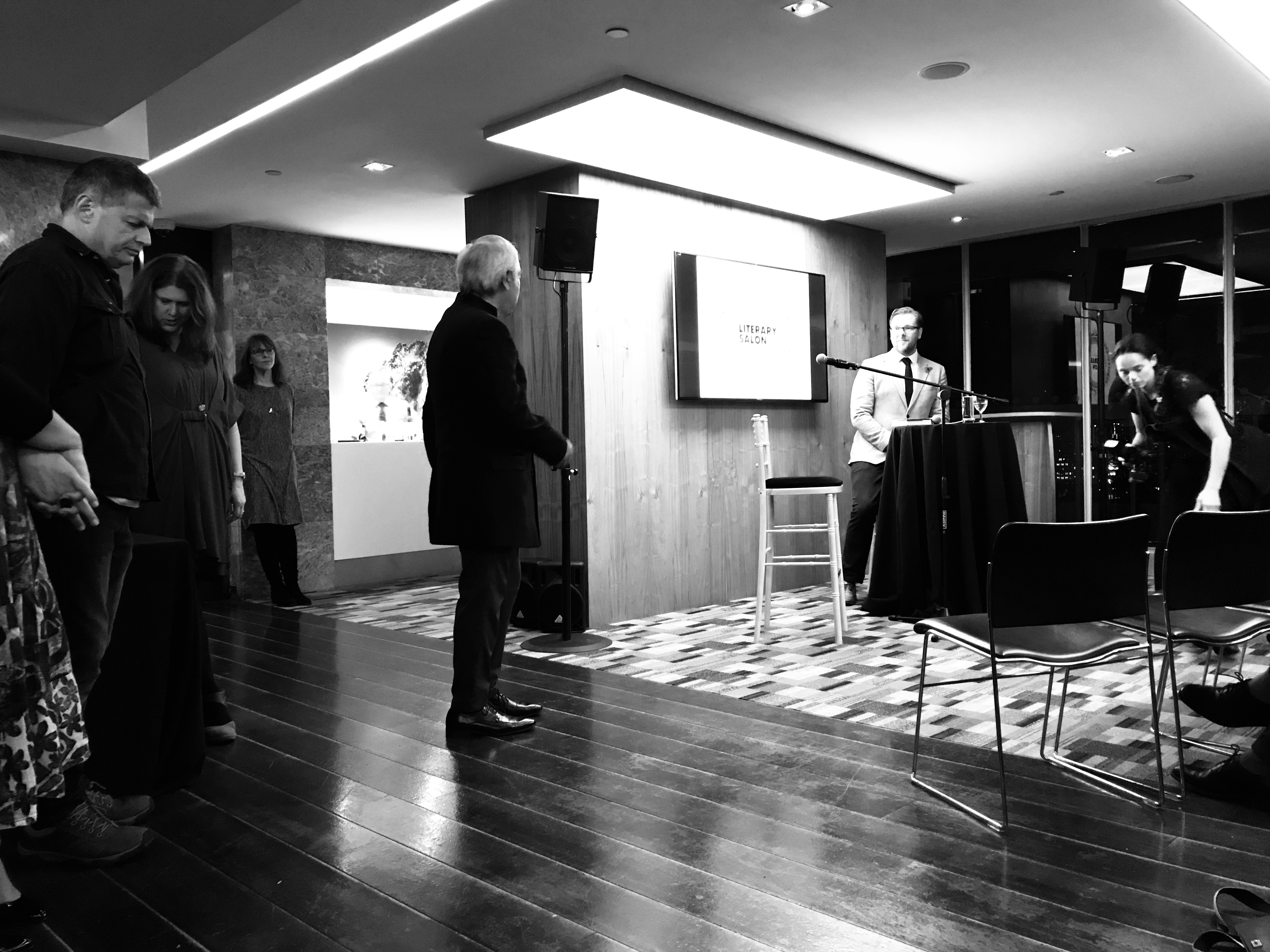
.


You can hear the same intake of breath in Fiona Kidman’s ground breaking A Breed of Women, published in 1979, which opens with a woman waking on an autumn morning.

This is the day, Harriet told herself. Today I shall lose weight, be better
understood by my lover and my husband. Today I shall make something new
and significant in my life.

What she makes is the novel itself, tracing her life from small town childhood to adult independence, sexual freedom and professional engagement up to the point where she loses her job, which could be construed as failure, as anti-climax, but no. In the concluding paragraph, Harriet decides:

She had reached a watershed, but it was a timely break for her … Time to be
herself … to write down what it had all been like, and how she had arrived at
the present in preparation for the future …

Which also sounds like the resolution Kidman has followed through a long career, writing down what it has been like to lead a woman’s life in this country in this era.

Then there is that major political fault line, the Main Divide: the one where left is set against right.

Factional politics in New Zealand are fierce and visceral, though we tend to conceal this unless it’s an election year when political story telling shifts up a gear. It’s The Story of Metiria Turei: she’s done wrong, she’s got that fatal tragic flaw in her past. Like Oedipus accidentally stabbing his dad at the crossroads then sleeping with his mum, she’s fibbed to the welfare and she must be punished, so she’s being pursued through a city airport and a journalist friend of our family says he found himself in the middle of the pack, wondering as he ran, ‘What the hell am I doing?’ A good question. Was it that good old playground perennial, chasing a kid till they cry? Was he the shining agent of moral retribution? Was he just doing his job? Was he taking part in another orchestrated grubby campaign to weaken the opposition? Was he embarked on some journalistic mission to cleanse the corridors of power, like Woodward, like Bernstein, or closer to home, like Duncan Garner, dedicating heart and soul to, as he expressed it so eloquently, ‘fucking destroy’ Chris Carter? The sorts of questions Giovanni Tiso also raised in a thoughtful online assessment of New Zealand journalism’s role in the Turei narrative and the ready acceptance that ‘once the blood was in the water, the sharks must do as nature commands them.’

Then Metiria’s gone, The End, and Winston Peters is on the ropes, he’s done for, then he’s not, he’s bouncing back mid-ring, fists raised and the crowd is on its feet…

For the most part, the factional fault line is unremarked, its presence signalled in the mud pool bubble and plop of the words we use on the surface. Eleanor Catton voices some mild criticism of New Zealand’s ‘neoliberal, profit-obsessed, shallow’ politicians and is called a traitor and a hua on Radio Live, and the broadcaster doesn’t lose his job but in a few months later is appointed by the Minister to the Broadcasting Standards Authority.

And below the surface seethes the memory of the crowd baying for blood at Hamilton and the headlocks and batons and further back there’s Vietnam and the argument at pub or kitchen table, National Mum and Labour Dad slugging it out, year after year, behind the roses on the trellis at Calvary Street. I doubt that in many of those arguments, the basis for that divide is addressed: the concept of a free market, the social contract, Klein versus Friedman, any more than I doubt that the theoretical basis for the factional divide in Northern Ireland leads to animated debate in the local pub over the precise nature of the eucharist: does the bread truly transubstantiate at the moment of communion to the body of Christ, the wine to his blood? Theory plays a small part. History, family tales, experience, the batons and the baying – these are the things that nudge us to one side of the divide or the other.

Left versus Right. The great 50/50 divide.

In this country we are not threatened by deportation or imprisonment in a cell, however nicely decorated, for political expression, though our laws of sedition have been applied in the past with great force – to silence Te Whiti, for example, or Harry Holland, while those defamation suits place some restraint on any impulse to publish that which might discredit or cause others to shun and avoid.

What restrains us is not so much the law but something more subtle: supermarket syndrome, that certainty in a small country that having dashed off your damning attack you will bump into the object of your fury considering the relative merits of the baby peas in the frozen goods section. Or the chance that careless political expression might affect your chances of promotion, your ability to pay the mortgage. It’s not so long ago that letters to the editor were routinely signed with a pseudonym: Outraged of Outram or Mother of Four took good care not to give overt offence. Or there’s that terrible affliction, good manners, that included politics among the list of topics to avoid at the dinner table among people one did not know well, along with vulgar speculation about how much someone earned, and religion, both now consigned to the irrelevance bin. But I think there might still be some hesitancy in coming out to total strangers that you vote Labour, Act, or feel strangely attracted to Colin Craig.

Maybe this reticence accounts for the fact that our novelists have rarely followed Plumb into the debating chamber: New Zealand has no equivalent to the American political blockbuster, no fictionalized Muldoon figure to equate with Willie Stark in All the King’s Men. No Holyoake or Bill Sutch equivalent to the figures in Advise and Consent, or to shift the fiction-making to television, no Helen Clarke/ Birgitte Nyborg figure working her way through the labyrinth, no adaptation of Hager’s Dirty Politics to equal a West Wing imagining of power.

We have largely left the narrative of factional politics to the writers of non-fiction: to the journalists and those super-journalists, the Political Commentators – Soper, Watkins, Young, Garner, Hoskings – who shape the story and deliver it to us, serial fashion, day by day, creating the honeymoon, the fairy tale. The Story of the Poor Boy, who makes his way in the world by the exercise of his wits, like the Clever Little Tailor, and becomes very rich and the leader of his people, yet kind, shown at the moment of his accession cuddling a kitten – Picton the Kitten – on the steps of Parliament and he’s international, he’s flying to Afghanistan on a private air cruiser along with a handpicked selection of journalists and Political Commentators, the fourth estate off to the war zone, a glass of bubbles in one hand and a canapé in the other. And his country is prosperous, it’s world class, rocks tar, and then he tires of being leader goes into the board room and shuts the door. The End.

Now the regime has changed and the journalists’ tale has gone into reverse. They have been handed the fairy tale – the gifted, beautiful young woman who emerges from obscurity to walk the corridors of power in her feather cloak, her handsome husband at her side, and it could be Kate and William, only better because she’s ours – but now the journalists reject the story, they are filled with doubt, with dread, they must blow away the fairy dust, toss the acid.

We leave politicians to the earnest hagiographers and the hardcover bio, and the critical analysis to Bridget William Books, or Hager’s steady steely scrutiny or the cynical eye of Steve Braunias and the columns that morph into ‘non-fiction novels’ like Madmen, that 2011  ‘campaign diary like no other’, with its multiple plots and cast of peculiar characters that could not be improved upon by the most fertile of imaginations.


Novels featuring politicians like Charlotte Grimshaw’s brilliant satirical Soon are a rarity here. The summer court is assembled about the Prime Minister, the immensely right, immensely charming David Hallright. His ministers and acolytes, the political wives recline about the swimming pool like so many neoliberal lizards round a waterhole, observed by an outsider, Simon, and his lumpen left-wing brother. Seduction, betrayal, accidental murder and moral failure has politics at its icy, beating heart.

Mark Broach in a Listener interview with Grimshaw following publication of this novel, wrote that ‘in the absence of public intellectuals and given the sputtering light of local journalism, we increasingly look to our novelists and poets to show us things we can’t always see.’

Or don’t wish to see. Or are being persuaded, like those readers of the Herald or the Manawatu Standard in 1918, to see through a very partisan pair of glasses.

We may rarely venture onto the sunny patios of power, or into the debating chamber, but politics, the way we choose to organize ourselves within these islands and the ideas over which we have fought so bitterly, are always present.

Decisions made decade after decade form the turbulent background to Jake the Muss or the Deniston Rose or Kahu astride the whale or the men Walter Moody discovers assembled in the hotel in Hokitika. Politics are the stage on which Marshall’s Larnach reaches for the gun and the dangerous territory where Wells’s Lemmy and Jamie are forced to negotiate sexual attraction and where Johnston’s Howard Shag meets his nemesis. It’s the wash of colour behind those other groups of children – Emily Perkins’ Forrests caught in the turmoil that will last in the heart forever, the children in Owls Do Cry scavenging at the tip but blessed with that acute sense of beauty that eclipses small town conformity.

The exact nature of those politics can depend upon the reader. Lloyd Jones’s Mr Pip for example, was greeted by an English reviewer in the Guardian as ‘a delicate fable that never shies away from the realities of daily life shadowed by violence.’ Matilda, the 13 year old Bougainvillean narrator, lives in a settlement under siege. ‘Apart from the presence of pidgin Bibles,’ writes the reviewer, ‘civilisation might never have touched the village.’ Only ‘one white man remains’ and through him the children discover in Great Expectations  ‘a bigger piece of the world … In the fertile soil of Bougainville, Mr Watt’s cultural seed has taken root and flourished’, instilling in Matilda ‘a moral code’. By ‘hybridising the narratives of black and white races,’ the author has created ‘a new and resonant fable … a story that unites.’

Closer to home, however, Selina Tusitala Marsh reviewing the book for the Dominion in October 2007, was less enchanted. In place of a delicate fable, she reads a novel saturated in the politics of colonial appropriation. Instead of something ‘new’ she reads ‘a very old, very played-out story’ and ‘the continuing canonisation of white male voices speaking for/over/through indigenous female voices.’

The voice, moreover, repeatedly gets it wrong. ‘Would Matilda, born and bred in Bougainville, really label her environment as the “tropics” rather than the bush? ‘Would she refer to a class mate ‘as “the boy with the big woolly head”. Has she seen wool?’ And what of the women who hide from the soldiers in the bush ‘[sticking] their teats into the mouths of their babies to shut them up.’ ‘“Teats?” As in cows?’ queries Tusitala Marsh. ‘Why not breasts or nipples?’

And why is it that once the school closes, the children of this village have nothing to do all day – no food to gather, no chores – and most astonishingly, no alternative sources of knowledge. ‘Wouldn’t these children already know … [as] an island people dependent on the land for thousands of years, the many uses of the coconut?’

We can choose or not to detect the politics.

Sometimes, however, they simply rise up and smack you in the face.

In 2010, one spring morning, I was flung into the air. The tectonic plates had made a minor adjustment. It’s something that happens here. Right now, we’re only 93 kilometres or so above the lava, sometime it will bubble up. In 45 seconds, Wellington could tumble or the entire West Coast could split from the South Island or Taupo could erupt and there’ll be cloud and crop failure across the planet. It’s how it is.

An earthquake is a seismic wonder, an awe inspiring few seconds of energy-release that renders all human artifice – our buildings, our social structures, our egos – insignificant. We’re reduced to infantile surrender, tossed by gigantic hands and for a few seconds, we are united in a visceral experience, devoid of politics. But the moment we return to earth, politics kick in.

The Christchurch quakes have been a political event. They immediately altered the course of an election. Until the quakes, the mayor, Bob Parker was presumed finished, and his replacement by Jim Anderton a near certainty. But voters switched their allegiance as Parker appeared night after night on television, calm amid the chaos, purposeful, articulate, clad in the hard hat and high vis vest that were immediately seized upon by politicians running for national office in this country, and, marketed by the same PR company, conservative politicians in the UK: the currency trader, the Old Etonian, togged up in the camouflage of the working man.

The institutions put in place to rebuild the city and the manner of their governance, the way in which the centre came under the direct autocratic control of a central government which had already overturned a democratic regional election, while in the suburbs it was, as Brownlee famously said, ‘All over to the insurers’, by a government devoted to turning this country into a place where it is ‘good to do business’.

The manner of the recovery, the abrupt demolition of the old, whether repairable or not, the priorities for reconstruction, the anchor projects with their focus on the profitable tourist, the introduction of an entirely new kind of public education with its modern learning environments barn-raising 70 or more children, so cheap, so efficient, the very style of the new architecture – all this expressed a particular political mindset, disaster capitalism in action.

At first amid the chaos, fiction fell back. Non-fiction, journalism especially the work of the remarkable John McCrone, took centre stage. And poetry. Lots of poetry as writers reached for the art form that best expresses raw emotion. But gradually fiction sidled back: Joe Bennett’s King Rich took up residence in the abandoned hotel in the Red Zone, Jane Higgins’s teenagers in The Bridge, travel to war in a taxi through an imaginary city in chaos, a novel she calls her ‘quake book’.

And my novel. The political one, written because I had been talking to a man struggling with recalcitrant insurers, an exhausting pinpricking battle over details too small to be of any interest whatever to the journalists of this country who were so very eager, with the honourable exception of John Campbell, to insist upon a story of boom and profit and progress in a place where it was so good to do business. I spoke to this man – married, young family, house a wreck of botched repair, flooding in heavy rain, and I asked him how he’d sum up how he felt about it all.  He said, ‘Impotent.’ And I thought: yes. That’s the place where fiction can get to: the tiny intimate pain where all politics has its origin, its end.

Over the past months I have been watching the new library take shape on the corner of the Square, just behind the ruins of the cathedral. It’s a big rectangle, but in another year or so it will be completely dwarfed, as will the new cathedral, by one of those anchor projects that are the legacy of Brownlee and the Key regime: the new convention centre. $475 million dollars worth of auditoria and breakout rooms. The library is a more modest affair of $95 million, but its exterior looks beautiful in the architect’s drawings. Curiously the words ‘library’ or ‘whare pukapuka’ don’t actually appear on the hoardings.

Instead the planners promise a ‘community arena/events/whanau performances/ interactivity/ makerspace,/stories, gaming,/ study/meetings/non-fiction’. The drawings show people strolling through a foyer that could be a hospital or airport, the only hint of library a small bookshelf in the background. The planners promise café and retail space at street level, to ‘draw people in’ for books it seems will no longer be enough. And nowhere any mention whatever of fiction. No children’s books. No novels for the grownups. I’ve stood in the Square looking at the hoardings, feeling a bit like one of the last remaining reel to reel tape recorders, a slide projector, curling tongs.

I’ve asked a librarian who has assured me there will be novels in the library, up on the fourth floor. But it’s strange, this public dismissal of fiction. It feels like part of some more general diminution of the arts and humanities in our universities, part of the culture that focuses on the body, on sport, rather than the imagination, part of some vast movement of the zeitgeist under our feet, that mistrusts the imagination and what it might be capable of conceiving.  Part of a new global politics.

But in the meantime, here we go, the writers of fiction, in our air machines, bobbing along, fifty feet above our country, looking down, seeing how it might have been, how it yet might be, making things up. Imagining.


Photo on Foter.com


'My readers turn up...and I meet them as human beings, not sales statistics on a royalty statement.' Fleur Adcock

Read more

Vision Test

David Taylor assesses the 20/20 Poetry Collection, and what we’re exploring – and avoiding – in our literature of unease.


The 20/20 poetry project was devised in 2017 to celebrate 20 years of National Poetry Day in New Zealand. Twenty ‘acclaimed Kiwi poets’ were asked ‘to choose one of their own poems – a work that spoke to New Zealand now’.  Those poets included Bill Manhire, Selina Tusitala Marsh, Kevin Ireland, Elizabeth Smither, Paula Green, Apirana Taylor and Cilla McQueen.

That group of poets were ‘also asked to select a poem by another poet they saw as essential reading’.  Many of the selected ‘second twenty’ were young, new, or underrated voices who’d published a collection or had poems included in an anthology or journal – including Chris Tse, Lynley Edmeades, Gregory Kan, Johanna Emeney, Michael Steven, John Dennison and Simone Kaho.

The resulting forty poems offer an interesting cross-section sample of the current ideas, voices and concerns in contemporary Aotearoa New Zealand poetry. Many of the poets had their selected poems pasted around the country by Phantom Billstickers, current sponsors of National Poetry Day.

To comment on what these poems suggest about the subjects current in our poetry right now, and on why these poems may have been chosen, it’s necessary to make some generalisations – drawing observations from ‘repeated sightings of’ rather than from an exhaustive scientific survey. With so much diversity in our poetic voices the commonalities are not necessarily topics, themes and styles, as they once would have been. But there are definitely patterns here which are hard to ignore.

One is to do with the timeframe of these poems – in particular that many of them have very long temporal settings. The second is to do with a sense that many of these poems have an underlying sense of uncertainty – culminating in a collective sense of existential searching.

Three themes which I expected to be more prominent were very modestly represented and so some consideration is given to their absence – landscapes, cultural identity and relationships.

As a sample on which to run some quick tests, these poems suggest that we might be moving away from some more traditional areas of exploration but are not yet sure where to look or what we might be looking for, or what we are trying to avoid.


I slid outside the trap of time: the poems as temporal Thinking Putty

One of writing’s greatest magics is to allow us – to use Kiri Piahana-Wong’s phrase – to slide outside the trap of time. In writing, the here and now can give way to ponderings as broad as the infinite scale of time – from before the creation of the universe to beyond its destruction – or to the monumental turning point of a fraction of a second – lives made, ruined, obliterated while you were changing channel. From Nano-second to eons, the timescale is critical: it establishes the boundaries within which some kind of worthwhile knowledge has been cornered by the writer – some snippet of wisdom, important observation, or necessary truth.

Does this sample of forty poems reveal any patterns in the ways poets might be thinking about time, exploring time and using time to frame their work? In general, most of have long time scales. Apirana Taylor’s ‘haka’ is notable for being the only poem dealing with a very brief moment of time. His visceral description of the haka felt ‘in my bones/ and in my wairua, ‘flash[ing] like lightening/ up and down my spine’, and compulsively making his ‘eyes roll/ and my tongue flick’, slows down time to consider a range of sensations happening simultaneously in a short moment. That moment ultimately evaporates into the moment of first breath: ‘eeeee aaa ha haaa’.  Tihei mauri ora.

A handful of poems occur around a particular event, employing a tableau style to set up a scene and then zoom in on particular details.  In this way we see Josephine wearing ‘her Time Out guide as a hat and then… as a fan/ and then… as a hat again’ in Paula Green’s ‘Josephine Waits in a Queue’. We can observe the ‘black and white dog,/ her snappy tail on fast forward’ and ‘Mother at the upstairs/ open window’ just as a young boy is about to be killed by a car in Michael Harlow’s ‘The Late News’. In ‘This Paper Boat’, Gregory Kan shows a more mundane domestic moment with a ‘mother walking into the dining room’ while son and husband ‘both/ blow our noses’.

Like ‘haka’ these poems have a narrow temporal scope that gives an intensity to specific moments. But by encompassing a few hours in their ambit they have a more ponderous approach – we are observers of the scene with the speaker, whereas ‘haka’ tries to place us as a participant in the action.


A significant majority of the 20/20 poems place themselves over much greater expanses of time, to the point where time itself is arguably a significant player in the poem. The idea of ‘searching’ will be discussed later in this essay, but it’s worth noting that the majority of these poems have large scale temporal parameters in which to look for their ‘truth’. The timeframes give context and boundaries: if I look inside here I’m bound to find what I’m looking for. In ‘Miscarriage’, Ish Doney sets a scene over two seasons to describe the cruel relationship between hope and despair. In ‘Hinerangi’, Kiri Piahana-Wong gives us a woman reflecting on ‘the end of my/ days’.  Across the last lunar months of life she comes to an understanding of, and desire for, moving on from earthly life, to ‘let the world-song/ swallow me’.

Many of the poems here go much broader.  ‘Whānau’ by Robert Sullivan, ‘Almost a Buddhist’ by Rob Hack, ‘Pukeroa’ by Ngahuia Te Awekotuku, ‘At Frankton Supermarket, Queenstown’ by Richard Reeve and ‘I Cannot Write a Poem About Gaza’ by Tusiata Avia all have generational questions sitting in the background.  With Sullivan, ‘Today we are following// the river, tracing the paths of our people,/ the great names and the previously unknown’.  Hack considers the potential continuity or rupture of ideas over time by juxtaposing a biographer’s description of the imminent publication of Dr Zhivago with his own killing of an ant walking over the biography. He then declares he has lost ‘interest in history’.

For Te Awekotuku, the poem’s persona sits ‘against/ a tree’ while the ‘road before me stretches/ far into the cool twilight’ considering how ‘the white man… replaced our glorious heritage/ with muskets, fire and bricks’. Contemplating the rampant development of the Queenstown Lakes area, Reeve suggests ‘we have become the presiding custodians of perspective,/ paradisal grubs awaiting the gulp of a new long century’. Avia tries to confront the difficulties of writing about the multi-generation horrors of Palestine.

In each of the poems the validity of the main premise is heightened by the timeframe: Sullivan’s journey is more significant because of the many who have made it before; the killing of Hack’s ant somehow more significant for its links to Pasternak’s atheism decades earlier; the disenfranchisement in ‘Pukeroa’ for its historical origins in colonisation; the Frankton supermarket for the questions it asks about how we have commercialised ‘historic’ places; and the impossibly sad situation in Gaza is amplified if we multiply current suffering by the decades of occupation. In these ways referencing the distance of time enables the poems to claim an intensity for their positions.

In a slightly different way other poems here use the scope of a human lifetime: what wisdom can one life be distilled into?  Indeed, ‘[t]here are times… when your whole life seems/ an open book’, as Karl Stead observes in ‘Into Extra Time’. The poem considers both what might be found in that book and, through reference to Captain Oates, what may be remembered of it by history. In this instance the uncomfortable truth that surfaces is a thought prompted by another poem that ‘what you really want is death’.  In the first part of the poem this is enough to make the poet ‘say the time has come to stop this scribbling./ It’s late.’

‘Contained’, by Lynley Edmeades, follows a similar theme. Identifying that now ‘[w]inter has grown on us’ the years which ‘felt so long as a child’ are now ‘a mere tilt// of the head’, she concludes with allusions to failure like Stead’s: ‘what will be will never be contained’. Both of these poems are concerned with a failure of language to do justice to that life. One ends with a lack of containment for what ‘will be’, the other with Oates hearing ‘nothing – / nothing at all but the wind…’.

Some poems here take in a more cosmic sense of time. In ‘Frost’ by Cilla McQueen the subject is not just from history but ‘he is history, gone/ from this round world, he is starlight’: kua wheturangitia ia.  This looking beyond – rather than within – our lives is also used by Diana Bridge in ‘Big Bang’. This poem reaches a long way back to when ‘God/ hovered over the waters before He let the light in’ to suggest our need for narrative – and in particular explanations of how we got to this moment: ‘long before/ we knew to write it down our race has liked a prologue’.  Though these poems are set against a vast temporal background, they are still looking to interpret some mystery and provide some important observation. In this way the poet is Bridge’s ‘hierophant’, the poems are the ‘cells unfold[ing] like flights of living thoughts’. Importantly here, she finds a link between the large and small scale through the effect each can have: ‘[m]icroscopic, macroscopic, the reach is the same’.

This linking of the micro and the macro is achieved with precision in ‘There’s Always Things to Come Back to the Kitchen For’, by Alison Wong, where in seven short lines we move from the minutiae of everyday domesticity – ‘a bowl of plain steamed rice/ a piece of bitter dark chocolate’ to children ‘on long elliptical orbits’ who can be like ‘comets’ or ‘moons’. Here it is the suggestion that those ‘long elliptical orbits’ will continue to lengthen even as they provide a link between the here and now and the passing of time.

Overall, nearly three-quarters of the poems grouped here set themselves against a background of time which is well beyond a passing moment, afternoon or even a couple of days. As an indicator of patterns these poems suggest that contemporary poets are concerned more with compressing time than stretching it. They are explorations of Big Time. Like conclusions drawn from Big Data, this seems like the noticeable insight from a great expanse. Perhaps because of the role time plays in these poems, there is a strong sense of something being searched for – a looking for understandings that ultimately elude.  We might have escaped ‘the trap of time’, but what have we escaped with?


If I could speak/all you’d hear is an echo/ over here/ – no, over here: the poems as a loss of certainty

All writing, it could be argued, is some kind of evidence of a chase – the writer, having pursued an idea or set of ideas, holds up the words as evidence of the remains of the pursuit.  So it’s unsurprising that the idea of searching for some kind of useful observation or knowledge emerges strongly in these poems as a group. Many seem to struggle with having any certainty about what they find.

This is not a criticism – a poem doesn’t need to find definitive and robust answers to the questions it asks. Indeed, the asking is much more important in many ways than the answering. But it’s interesting that so many of these poems seem to reach a position of uncertainty.

Earlier I talked about knowledge being ‘cornered’ by the writer. When a poem gives itself the length of a whole life, or longer, to explore and find its wisdom, it’s not merely a case of cornering but sending in the hounds to flush it out.  A number of these poems are able to hold the quarry up – to give us some certainty or conclusion.  Chris Tse, in ‘In which the Author Interviews Light’, asserts that ‘[e]ach event that punctuates/ the arc carries its own intention,/ as does each storyteller’s/ tongue laced with favour and prejudice’.  Alison Wong is convinced that ‘There is Always Something to Come Back to the Kitchen For’. Kiri Piahana-Wong’s kuia tells us from the grave that not only did she not meet back up with the husband she pined away for, but that ‘[t]he truth is,/ I did not care’ and that in death she ‘was more than myself now’.

The truth from Ngahuia Te Awakotuku’s scanning of history is that ‘the white man/ – has come, and has conquered/ wiped from beneath us/ that base we knew so well’. Tusiata Avia reveals that that she can indeed write about Gaza.  As noted earlier, Diana Bridge decides that the ‘reach’ of microscopic and macroscopic is the same. Stead declares that ‘[t]he songs of/ your youth have forgotten you’. We find out from Leilani Tamu that ‘Avaiki Rain’ would ‘take my muted grief/ and grant it the right// to echo’. In ‘Children’, Bill Manhire tells us that ‘[t]he likelihood is/ the children will die/ without you to help them do it’. Each of these poems, of course, is trying to ‘get at’ something and many, as in these examples, are able to hang it up for us to see.

But perhaps the most notable commonality in the wisdom-finding of these poems is the uncertainty or elusiveness of broader connections. So many of them struggle to come away with a definitive sense of understanding – there are a few small offerings, as seen above, but the big connections are missing or equivocal. While ‘Flying Across Australia’, Kevin Ireland discovers that understanding the immensity of the Australian landscape requires ‘some sort of theory/ to tidy up everything’ but ‘I didn’t feel it was down to me to figure it out’. In ‘Knowing What It’s About’, Vincent O’Sullivan reveals that bees have ‘a life ‘more direct than ours’’ and that they know ‘what it’s about’. By implication then, the certainty of life-knowledge of the bee has escaped us.

Many other poems are similarly inconclusive – the hunt completed, all agree there was something there, something important, but it somehow got away. In ‘Poi Girls’, Louise Wallace’s child narrator never gets to the bottom of the antipathy and antagonism between herself and the Poi Girls. In the end we get silence rather than enlightenment. Explanations, like the movement of the Poi Girls’ poi, are absent.  They ‘hang still/ from their hands/ and today say nothing at all’.  Similarly, ‘Almost a Buddhist’ can’t give us a definitive resolution but gives us just that – almosts. Pasternak is ‘almost an atheist’, the dead ant becomes a question mark in a history book. Stead leaves us outside the tent with Oates wondering if he paused to listen for voices calling him back. Another question mark in history.

‘The Whys and Zs’ by Bill Nelson starts by telling us that ‘[h]is last four years have nothing to say,/ not because they don’t want to// but because there are no real words/ to choose from’.  This failure is echoed in ‘Whānau’ when Robert Sullivan, asking many questions about his eponymous ancestor, tells us that ‘[t]hese questions remain to date’.  At least some of the whānau from the title are mysteries.  All this leads us back to Edmeades’ observation: ‘the point remains the same:/ what will be will never be contained’.  Collectively we have, then, uncertainty and impermanence.

Many of these poems set out large grounds to search for certainties and though they don’t come back entirely empty handed, there is a sense that many, in the face of the mysteries of time and history, are resigned to not coming away with the answers.

It’s interesting that when asked to pick works which ‘spoke to New Zealand now’ and poems deemed ‘essential reading in 2017’, this is what turns up. It’s beyond the scope of this survey to assess whether this is new, or sustained, or widespread in our writing at the moment or what the impulse behind it might be, but given that we find ourselves inhabiting a world where the extent of poverty, ecological degradation, housing shortages, suicide rates and sexual violence have removed any agency from words like ‘crisis’ and ‘critical’ and ‘urgent’, it may not be surprising many people, including poets, are searching for answers to how we got to this point and are struggling to find answers – or experiencing a general sense of unease and uncertainty which is reflected in their writing.

If that seems like drawing a long bow based on this selection of poems, I would direct you to the person sitting at the marae, looking at the cars going past and being angry about colonisation in ‘Pukeroa’. To the ‘two thousand/ one hundred and sixty-eight dead Palestinians’ in ‘I Cannot Write a Poem About Palestine’. To the absurd ‘Atlantic lobster’ for sale in the Queenstown supermarket. To the sky that ‘would be stricken,/ inconsolable’, in Brian Turner’s words, by ‘what we’re doing/ down here’. To Jillian Sullivan’s goat milker ‘sneak[ing] to the edge/ of a ruined life and look[ing]/ down at how far I will fall’. To the ‘truth’ in James Norcliffe’s ‘Questions With Which to Interogate a Witch’, a truth which ‘will come// as it always comes: terrible/ in an iron helmet with spikes/ on the inside’. To Selina Tusitala Marsh’s imperative to ‘[l]ead when you want to end all injustice’. To the loss of sleep in ‘Into Extra Time’ – ‘behind closed eyes/ the words, like rats, are working’.To ‘let[ting] the world-song/ swallow me’ in ‘Hinerangi’. To Josephine ‘taking of her shoes and belt and surrendering her bags… after three/ hours’ in her queue. To needing the light left on in at night in Simone Kaho’s ‘Prey’. And on.

It’s difficult to look at these poems and not get a sense of them balancing an uncertainty or even a whiff of existential angst – a grasping for meaning and response to something much bigger, and much more historically rooted.  There may be a reason to look across increasing larger spans of time for some explanations and organising principles.


each angled rock face spawns waterfalls: the poems as freedom campers

Perhaps one aspect of the myth-making attendant on the Great New Zealand Landscape is that it features prominently in our writing. The presence of the landscape (in a Department of Conservation sense) in Aotearoa New Zealand writing has been well documented in the past, as has the role of bush and wilderness areas on collective national identity myths.  As John Newton has observed, ‘The Romantic inheritance may be poison, but it seems to be all we have.’

Exploring the physical landscape, however, is not particularly common in these poems. In terms of establishing temporal and spatial boundaries in which to look for observations of note, very few of these poems go to the ‘great outdoors’ for answers. They are far more domestic in situation.

The poem with the clearest focus on the wildness of nature is ‘Rakaia’ by David Eggleton.  His description of the river’s descent from the mountains and on to the sea is vibrant and has a visual intensity. The ‘ridges ripple with snow melt’, becoming ‘a youthful stampede of spring creeks’ before the river ‘springs out of the mountains’.  There are glimpses of landscape in other poems but they are more glimpses seen in passing than major elements.  ‘Hinerangi’ and ‘Whānau’ find great significance in their locations – the first with Hinerangi ‘[a]nchoring/ myself deep in the earth’ and then being laid ‘in te urupa’; the second with the search for tupuna starting with ‘[t]he grass at Te Kaaretu… renowned/ for its softness’ which the ancestors would use for their bedding before heading downriver ‘tracing the paths of our people’.

Richard Reeve still gives us a sense of deep respect for the land in ‘At Frankton Supermarket, Queenstown’ but juxtaposes the sublime mountainous landscape of the Queenstown area with SUVs, subdivisions, selfies, and that Atlantic lobster. The poem doesn’t necessarily criticise the people in this landscape but it raises questions about the commercialisation of such places. ‘Milking’ by Jillian Sullivan is notable for being the only poem set in a rural landscape, but with the ‘daunted kitchen,/ with the cupboards nailed/ shut against the rates’ it is definitely more in the tradition of the pastoral dystopia.


Today we are following/ the river, tracing the paths of our people: the poems as cultural terms of reference

Questions of culture and identity (individual and national) are something we’re often told is ‘happening’ in our writing; apparently it’s all about telling our stories.  Again, this was not all that evident in these poems, chosen as exemplars of work speaking to New Zealand now.

A few of the poems deal explicitly with cultural identity, dislocation and colonisation.  ‘Whānau’ by Robert Sullivan and ‘Pukeroa’ by Ngahuia Te Awakotuku are both trying to understand or establish a connection between past and present. For one that means following tracks that tūpuna would have walked and seeking to answer questions about whom they were. For the other it is sitting at the marae, watching traffic go past and trying to understand the painful impact of colonisation on her people.

‘Hinerangi’ is a retelling of a story that implicitly looks for wisdom that may be applicable in the modern world.  What ‘haka’ says about the importance of culture is hopefully self-evident. Interestingly, this small group are actually pairs within this project: Robert Sullivan chose Te Awakotuku’s poem; Apirana Taylor chose Piahana-Wong’s. Among non-Māori writers there is very little evidence here that similar questions need asking, or a sense of te ao Māori as part of their own world. The notable exception is Louise Wallace’s ‘The Poi Girls’.  This poem bravely takes as a starting point a Pākehā feeling a resentment and antipathy towards a group of Māori girls that deepens over the course of the poem and never resolves.  This ‘gap’ in cultural understanding between children encapsulates the same gap – antipathy, resentment, poor understanding, lack of willingness to learn – played out over and over in relationships between Treaty partners at all levels.

Among the poems by Pasifika writers, ‘Avaiki Rain’ by Lailani Tamu is an emotive take on the dislocation that migration can bring. The loss of the Aviaki rain which would ‘take my muted grief/ and grant it the right// to echo’ and the loss of ‘the solace she gave me/ when all that was left/ was the rain’ expresses a sense of sorrow common to many with a history of migration.


I must turn you/ to the third person: the poems as relationship and grief counselling

Despite the long and persistent history of love poetry in all its manifestations and relationship stages, this collection offers little about intimate relationships. Paul Schimmel’s ‘With Words’ explicitly addresses seduction and intimacy: ‘I would touch your skin/ everywhere, between all/ the different parts of you/ with the word love’.  But this level of overt physicality is unusual in this collection of poems.  In ‘Your Being’, David Kārena Holmes gives us a cosmic declaration of love. The object of the desire ‘is/ a blazing star/ that turns and burns/ like Achenar… towards that light/ I set my face’. ‘In the Bonds’ by Marisa Cappetta is a more domestic poem of devotion, a portrait in which we learn ‘[m]y wife is a massed display of devotion,/ a crackle of kindling on a frosted morning’ as well as being ‘the aroma of cardamom, cinnamon and cloves’. All three of these poems play with the balance between tenderness and intensity.

A different angle is taken by Johanna Emeney in ‘Subtext’, a break-up poem in which the tenderness turns to bruises and the intensity turns to disappointment, and the poem struggled to find the right words. One other poem in the 20/20 Collection deals with the end of a relationship but this time through death. Cilla McQueen finds an extraordinary way to express this loss in ‘Frost’, acknowledging that ‘[t]ime comes when my compass/ trembles to your true absence// and I must turn you/ to the third person’. It is a short poem but one which does the heavy and heart-breaking job of admitting that ‘he is history, gone/ from this round world, he is starlight’.  In this we again get the association of love with cosmic bodies but this time to acknowledge loss.

Writing in New Zealand, as elsewhere, has always had a diverse range of interests and modes of expression, some ideas persisting over time where others fade. Arguably, there is a greater diversity of voices now than ever before. For these reasons it is problematic to make pronouncements about ‘the overall state’ of any aspect of writing. As explored above, three themes which I was expecting to see in 20/20 – where are we, who are we, how do we love each other – are in short supply. So why are the ideas of ‘time’ and ‘a lack of certainty’ noteworthy enough to dwell on?

I find it intriguing just how strong the sense of ‘searching’ is in these poems. Earlier I suggested that it might seem far-fetched to claim some relationship between the large time scale and lack of certainty, and wider social and political problems but whether consciously or not (I suspect often unconsciously) these poems are struggling to be definitive. Indeed, several poems actually leave us with a failure of language to ‘speak’ altogether – and there are many silences.

In so many ways we are living in ever more uncertain times. There are many ways in which the world is in flux and the outer wave lengths of that flux seem ever more extreme. The issues we face today are complex. Decisions in the past as to whether one should support the Vietnam War, the Springbok Tour or nuclear armament came down to really quite simple arguments on each side and people’s moral compass would fall one way or the other. But many of the big issues these days require a specialist knowledge which puts certainty beyond most people. So many points of contention have scientific, legal, economic or policy experts arguing with one another. You can’t end child poverty the way you can end a rugby tour. You can’t ban climate change the way you would a nuclear warship.  It’s not always obvious that a trade agreement might damage both countries in the way that a war does. So it’s not a big step to think the uncertainty and anxiety of contemporary life – nor wondering how the past might explain how we got to this position – may somehow have woven themselves into the collective question-asking of our literary work.

If our art is a reflection of our society this may be a very accurate reflection on where we find ourselves at the moment. Rights we have long considered to be a part of everyday life – food, shelter, freedom from violence – are no longer experienced by all in an increasingly unequal society. We have world leaders promoting nationalism, individualism, racism and violence as guiding principles. I’m not suggesting that it is up to poets to address these issues or even to write specifically about them – though Tusiata Avia’s offering shows just how powerful language can be when it comes to these discussions.  Rather, I’m suggesting that the increasingly precarious state of the world – environmentally, politically and economically – as well as the realisation that we have persistently ignored serious issues domestically, make for a sense of unease. It is no surprise if this is reflected in what we write about, and how we write.


David Taylor is Assistant Head of English at Northcote College, and wrote the Teachers’ Notes for National Poetry Day’s 20/20 Collection. In 2015 he received a Fulbright Distinguished Award in Teaching to study in the US, and in 2017 he was one of only four teachers to be awarded the prestigious Woolf Fisher Fellowship, which he used to study school literacy strategies around Australia.

(Phantom Billstickers National Poetry Day 2018 will be held on Friday 24 August.)


*Original feature photo on <a href=”https://foter.com/re/7c1e7a”>Foter.com</a>

‘Inspiration is the name for a privileged kind of listening’ - David Howard

Read more

Writing in Disguise


Stephanie Johnson on definitions and disguises, and the risks of writing under a pseudonym.

 .
 .
In August 2012 I began work on a novel set mostly in Australia and a little in New Zealand, with the working title Small Life. It is a phrase that has always interested me, being a description of the prey of various carnivorous animals. In the outback and bush, firehawks are known to drop burning twigs into grassland and then hover in the air above, waiting for small life to escape incineration, whereupon they would swoop in for the kill. It is a powerful metaphor.
From the beginning I knew I would not publish the novel (if indeed it was accepted for publication!) under my own name. I wanted to attempt a commercial novel, a saga of the kind I had enjoyed reading as a child and teenager before my palate was ‘educated’ by university degrees and an acquired idea of the superiority of literary fiction. After a long career of some twenty books as well as plays and screenplays, it was a kind of experiment. It had its genesis in a number of sources, none of which are more important than the other. It was kind of confluence of all of them that led me to this highly personal semi-crisis.
.
Firstly, I suppose, it was to do with a hope for financial recompense for the enormous amount of work that goes into a novel. Many years ago, while bemoaning my insolvency to a publisher, she responded ‘But you don’t do it for the money.’ She seemed almost shocked when I replied, ‘Of course I do.’ I don’t remember how our conversation progressed from there but it was probably along the lines of so many conversations between New Zealand writers and their publishers/book sellers/ agents/friends and supporters. The same tropes are wheeled out, i.e. it is impossible to make a living as a writer in this country, (with the subtext: either leave or don’t bother trying); the only hope is to sell the film rights; you need to sell a book in England/America to get yourself established; you need an agent/shark. But possibly, just possibly, I thought, a novel rich in story and presented under a different name might sell.
.
Another influence was my dear friend, writer and filmmaker Peter Wells. A long time ago he suggested I do this, write under a pseudonym, with the reasoning that many writers like me, with a long backlist, do write under pseudonyms. It affords a kind of freedom, a rebirth.
 .
A third influence came from another conversation, this one with a powerful arts bureaucrat. I suppose I was behaving badly when I asked her, ‘Why have I never had an [Arts] Laureate [Award]?’ It seemed to me that I would have been at least a candidate, having written for every medium possible, published here and overseas, having co-founded and directed the Auckland Writers’ Festival, mentored younger writers and taught in many universities as well as Auckland Prison. The bureaucrat answered me reluctantly. She said, ‘In Wellington your work is regarded as lowbrow.’
.
Lowbrow?? I thought of the complex plots and heavy research that went into my six historical novels and fumed. Is that where my work belongs, in the lowbrow section? Right, I thought. I’ll give you fucking lowbrow.


A fourth influence, not that I thought of doing it myself at the time, is a plot line in The Writers’ Festival. This is my eleventh novel, and a sequel to The Writing Class. Both are novels about writing and writers. Merle Carbury, a central character, decides to send a novel away under a pseudonym. She however goes one step further than I was to. She attaches a photograph of a young and beautiful friend, presenting the pretty visage as her pseudonym’s own. Young and beautiful writers, as we all know, have an advantage. Early in my career a fax was mistakenly sent to me, intended to be sent in-house by an overseas publisher. It contained the memorable words ‘She photographs well.’ I was outraged because I wanted to be taken seriously, not valued on my appearance. Since then I have observed many instances of aesthetically pleasing writers not only blazing through the media but receiving enormous advances. A gorgeous young Australian set a record in the early 2000s with an advance of a million US dollars for a fairly average novel – an advance that never earned out. At the Adelaide Festival a female literary agent said to me, as we stood a distance off a scrum that had formed around the poor girl, ‘Don’t you wish you had tits like that?’

Well, no, not really. And even if I did, tits generally aren’t very good at holding a pen.

Scroll forward about fifteen years. Small Life is now titled Jarulan and sent away to my agent in Sydney. Jarulan is an Aboriginal name for the type of fire started by hunting birds, as described above. I was worried, perhaps unnecessarily, that publishers would not look at the book if they knew the author was a New Zealander resident in her homeland. So I came up with a bio: ‘Born in Broken Hill, Lily Woodhouse is married to a New Zealander and lives on the Gold Coast where she and her husband manage a hotel. Jarulan is her first novel.’ The New Zealand husband was necessary to explain Lily’s apparent familiarity with tikanga Māori and Rotorua in the 1930s. I didn’t give Lily an age, but I hoped publishers would assume she was young. (And beautiful).

All went along very well for a while, until my clever editor smelled a rat. She already suspected it was a pseudonym perhaps, but the ‘first novel’ was a mistake. She didn’t believe it was a first novel and put pressure on my agent – who is she? At first, my agent held back and wouldn’t divulge. She knew how keenly I wanted to remain anonymous. Other writers manage it, most famously Elena Ferrante. Nickki Gemmell, an Australian, managed to maintain her anonymity for months following the publication of The Bride Stripped Bare in 2003.

Publishers don’t like pseudonyms because it makes it hard for them to get any traction in an already difficult market. When New Zealand writer Greg McGee published his crime novels using the pen name Alix Bosco, he was protected by his agent, Michael Gifkins, and only came out of hiding when he won the inaugural Ngaio Marsh Award. A watertight pseudonym makes it very difficult for the publicists to do their work. Any media has to spin out from the book itself. They call this ‘book-led publicity’ as opposed to ‘author-led’ and it’s a fairly rare beast. Reviewers read the books they review – or at least we hope they do. A journalist, trying to provide copy for whatever publication or site, may not have the time or the inclination to read a novel. Much easier to interview the writers, or get them to answer set questions about their influences, their daily routine, their inspiration, bra-size, or whatever.


Photo on Foter.com


I started to feel very guilty, as though I’d perpetrated a crime, a rort, even though the taking of pen names is a fine literary tradition. The idea was floated that the publishers would not go ahead with the book unless they knew Lily’s true identity. My agent caved. I was distraught when she told me she’d let the cat out of the bag, even though the response was good. The publishers knew of my work under my real name. It wasn’t that they thought little of it. Negotiations ensued – publicity would be book-led, I wouldn’t have to do interviews, and the secret would be kept between only those who needed to know.

But it wasn’t to be. An article for The Australian needed a photograph. I found an ancient one. No one will recognise me, I thought. I was panicky a lot of the time, not sleeping. I couldn’t understand why it had to be this way. I had chosen ‘Woodhouse’ as Lily’s second name: this is my husband’s name and he had his chest puffed out a million miles. It now struck me as a very stupid choice. I tried to change the surname, but the publishers wouldn’t allow me to. They liked the ring of Lily Woodhouse. I had to re-think it all and convince myself that it didn’t matter if I was uncovered. It would only be in New Zealand that it made any difference. In early July, a week or so after the book was published the telephone rang. It was David Herkt, asking to speak to Lily Woodhouse. I’ve known David for years. He wanted to write an article for The Sunday Star-Times. I pleaded with him not to write it, just to let me enjoy this for a bit longer. He persuaded me by saying that if he didn’t write the article someone else would, and that he had loved the book. We did the interview and he wrote the article, which was very kind and generous, but still I felt sad that this intoxicating sense of starting all over again was at an end.

Jarulan by the River – the novel’s final title – is the story of a rural family in northern New South Wales. It begins in 1917 and finishes now, as the family’s fortunes wax and wane. In 1917 a son, Eddie, has been sent as a remittance man to New Zealand and has married a Māori woman. In the 1930s, a son from that union, Irving, comes to Australia to take over the farm. He falls in love with Rufina, his grandfather’s much younger German widow. So the novel is a love story. It’s also a story about race and class, sex, music and inheritance. It’s a big book. It starts at the beginning and finishes at the end. It is, as I’ve said, an attempt to write a commercial novel. It’s full of ghosts, babies, wonderful Australian animals and beautiful frocks. It unashamedly aims for a female readership.


But what, exactly, is a commercial novel? I think it’s a novel that makes few demands on the reader in terms of structure, or keeping up with the writer’s conceits. In an interview (yes, I did them, plenty, and mostly with an Australian accent) I used an architectural metaphor. If a very literary novel is an architecturally designed house with astonishing angles and expansive, cold surfaces, a house where you can’t find the loo or a cosy corner, a commercial novel is a comfortable, welcoming house where the reader sits by the fire, sips Scotch and puts on slippers. Here, says the author, who is well concealed behind a screen, sit down. Make yourself comfortable. I’m going to tell you a story. In  literary novels the author is often too close for comfort, displaying so many clever tricks so that you find yourself marvelling at their language and inventiveness even while you’re getting out of their way while they perform cartwheels on the polished concrete floor. Literary novels win literary prizes. Commercial novels generally do not. Readers give literary novels a lot of largesse. A very smart woman I know once told me that it took her over a hundred boring pages to get into a certain Man Booker Prize-winning tome. I asked her – why did you persist for that long? She said – because it won the Booker. It was if she expected to be bored and irritated. A literary novel is not afraid of boring you to tears. A commercial novel won’t take that risk.

Many novels, of course, occupy the middle ground. They can be well regarded by critics and also sell in satisfying numbers. These days, as many writers in the ANZL know, the only novels that are really selling are tie-ins with film and television. In Australia the big sellers are Liane Moriarty (Big Little Lies her most famous) and Jane Harper. The latter is a new, exciting crime writer, who recently published her second novel. I’m sure she will sell the film or television rights any day now, if she hasn’t already.

So – I suppose the question remains – was it worth it all for Jarulan  by the River? Did it catch fire? Well, yes and no. It was everywhere in Australia, with major window displays in over thirty independent bookshops. There were piles of it in the airports. It was well reviewed. In New Zealand it sold badly. On my agent’s urging I went to some Auckland bookshops around Christmas time to introduce myself and ask how the book was selling. In one famous independent bookshop the bookseller, with whom I have had a long, albeit distant association, said ‘But it’s an Australian book.’ Eh??? She knew very well who had written it. I am not Australian.

Writers my age and older will have had the experience, as younger writers, of being asked, ‘How much money do you make?’ or the question’s ugly twin, ‘Do you make any money?’ ie at all? And we may well have answered, just as the publisher said, ‘We don’t do it for money.’ We are our own worst enemy.

Now, as mostly mediocre self-publishing proliferates and clogs up the libraries (anyone wondering why their public lending right recompense is diminishing steadily?) the opportunity for real income seems to have lessened even further.

The thing is, I enjoy reading good commercial fiction. And Lily likes trying to write it. I’ve just sent away her second novel, Thistle. Fingers crossed my publishers will take the punt. Meantime, Lily has left the building and I’ve started work on a novel under my own name. At least I think it is. Lily might get impatient, barge into my study and take over.


Stephanie Johnson will appear at the Auckland Writers Festival on 18 May, in conversation with Terese Svoboda and in the ‘Call On O’Connell’ street event.


'...we were there as faith-based writers, as believers in the mana of Oceania...' - David Eggleton

Read more

Essay from Iowa

Anne Kennedy finds a place to think in the country of dream-merchants.

There was only one way to frame a trip to Iowa in 2017, even a trip for literary purposes – especially a trip for literary purposes; it was a visit to the land of Trump.

Iowa is a swing state, and it had swung. As I packed my bags in Auckland, I had in my head not so much the image of the canary-down-the mine as the dead parrot in the Monty Python skit. I half-expected clashes, raging in the streets, riot gear. But when I arrived in Iowa City, where the University of Iowa is situated and where I was to stay for two-and-a-half months, it seemed clear there would be no such thing. The town is about the size of Palmerston North, and as sleepy, surrounded by miles and miles of corn fields. (The university itself has over 34,000 students, almost half the city’s population.) Although I saw a couple of Trump caps, and on the last night a woman who sits on the board of a bank told me ‘Hilary is a criminal’, you wouldn’t have known a fascist regime had taken over the country. As long as Trump didn’t declare war on North Korea in 140 characters, life, at least for now, looked to be going on eerily the same in this part of middle America.
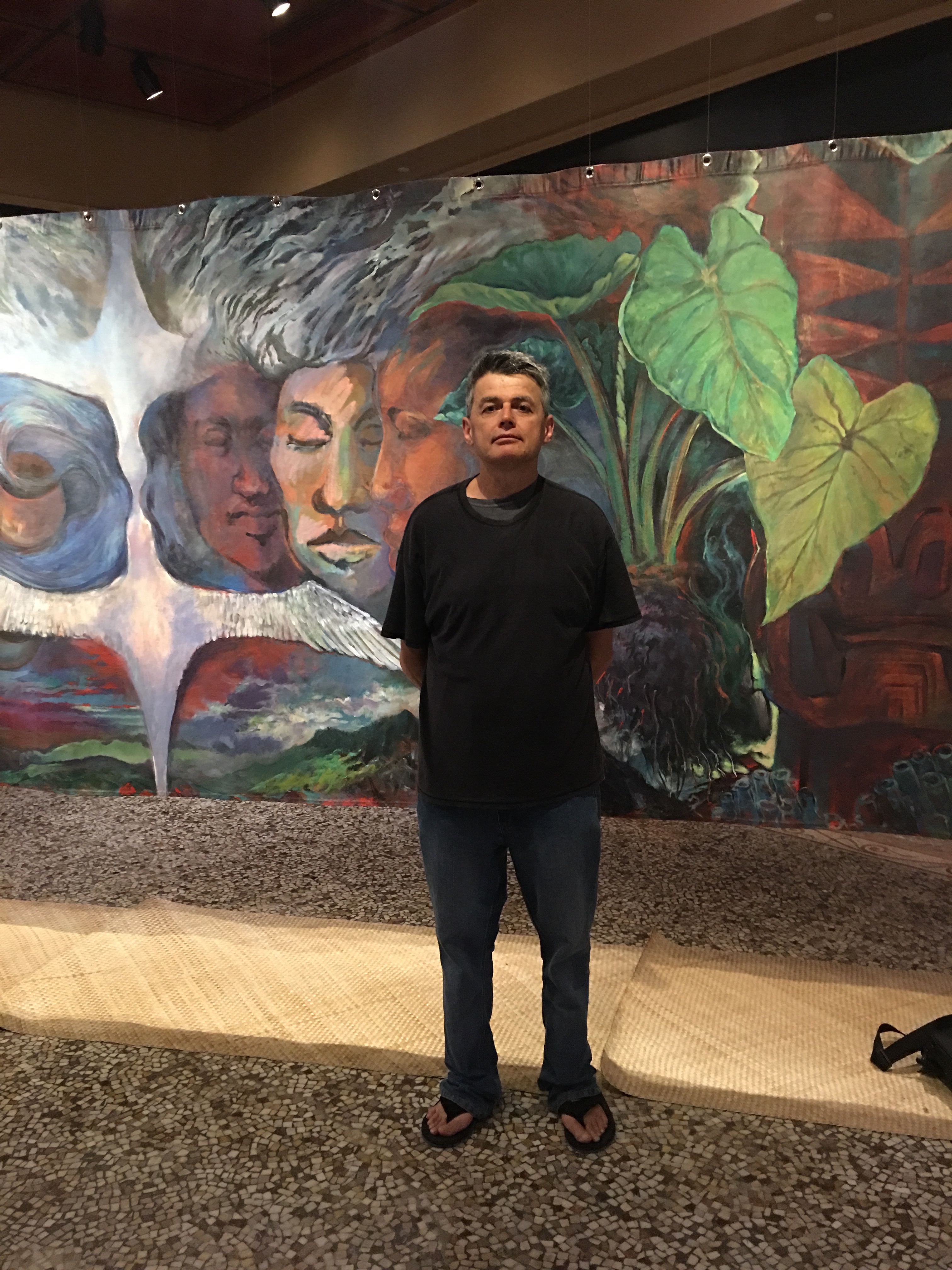
But while I was there, I saw something quietly powerful: people spontaneously protesting Trump – to my knowledge the only successful protest to date – in the name of diversity and education.

I was in Iowa to join thirty-four other writers from around world at the 2017 Fall Residency of the International Writers Program in Iowa City (also a UNESCO City of Literature). The State Department annually funds many of the writers from certain countries, but most of the rest of us were sponsored by our own countries. Creative New Zealand paid my way, and I’m grateful for New Zealand’s support for the arts, because going to Iowa was important to me – as a New Zealand citizen, as a teacher, and as a writer. In Iowa, we wrote, read, discussed, and visited other educational institutions. I saw the academy upholding its value as an institution, its right to be, and to be for everyone.
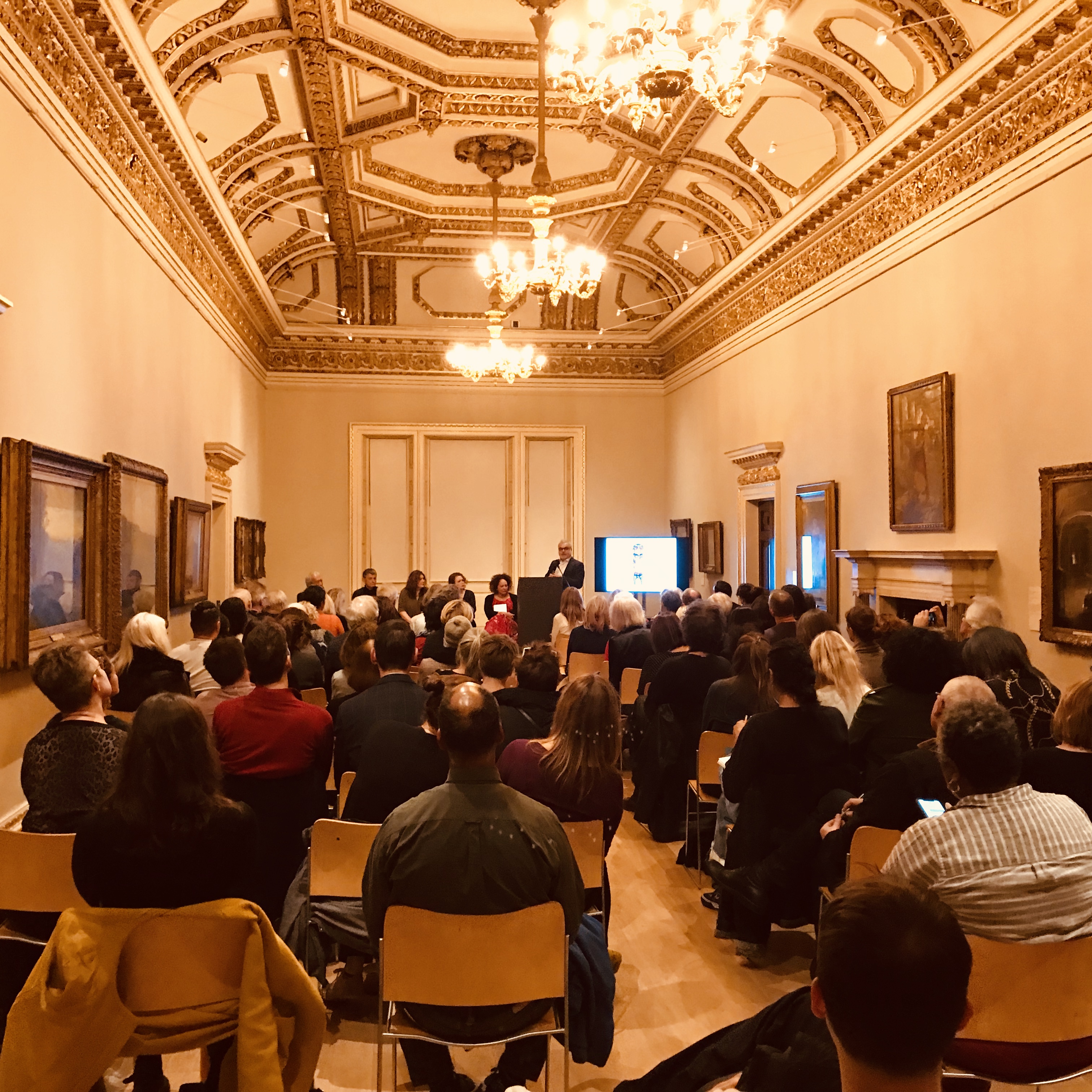
I knew about the Iowa Writers’ Workshop, of course: the seat of the ‘Iowa Method’, the workshopping system I and many other creative writing teachers have been using since forever; and the programme associated with writers like Flannery O’Connor, Raymond Carver, Denis Johnson, Alice Notley, and Ann Patchett, to name a few. (Our own Eleanor Catton and Paula Morris are Workshop graduates.) On the International Program, I followed a line-up of remarkable New Zealander writers, including Courtney Sina Meredith, Daren Kamali, Joanna Aitcheson and Vivienne Plumb.

That 2017 was the 50th anniversary of the program added to the excitement. There were festivities, visiting alumni; the story of how the IWP came into existence was told over and over (how stories get remembered; that’s why we write in the first place). Legend has it that the idea to invite a group of international writers to Iowa on a yearly basis was suggested by Hualing Nieh Engle, novelist and wife of the late Paul Engle – Director of the Iowa Writers’ Workshop from 1941–65 – one day while they were rowing on the lake. Paul said, ‘That’s a crazy idea’, but by the time they’d rowed ashore, IWP was a thing. Fifty years later the program, having hosted over 14,000 writers, is still going strong.

The current director Christopher Merrill is America’s Bill Manhire – not-in-your-face, witty, formidable, a great writer. A poet and memoirist, Merrill is a former war correspondent, whose gift to the program is diplomacy, and if the US ever needed diplomacy, they need it now. It seemed to me that Merrill and the wonderful staff of IWP – who are all writers; they are there because they are writers – found themselves in a hall of mirrors this year. Their stock in trade is discourse. They reach out (as if across a lake) across borders, across culture and language. And remember, the IWP is part-funded by the State Department. At any IWP gathering, the Americans lamented Trump in some way – sometimes by allusion, sometimes overtly, sometimes simply with an enormous sigh. More than once, the hair stood up on the back of neck to see the intolerable nature of their situation. In 2017, the university was no longer the undisputed critical, free-thinking arm of society, but the resistance.

This is the university being universal. Along with a manuscript, that was the impression I brought home.


Shambaugh-House, Iowa


A morning’s Tweet-season is a long time in politics these days, let alone ten weeks, and a heck of a lot happened while I was in Iowa. Like most people, I approached the morning news the way Dorothy Parker opened her front door: ‘What fresh hell is this?’

First was the DACA debacle, and I want to talk about it because it has been one of the most dramatic sequences of events in the administration so far, and it says something about what is still possible in the US, and anywhere.
But before that, I need to show my hand – because part of my heart is in the US. My family and I lived in Honolulu from 2003–13. For some of that time, I taught at the University of Hawai`i. I have extended family on the both coasts and have travelled there often. So I know Americans are just people, like you and me. Its history is diabolical, its size is mind-boggling, it’s a place of extremes, socially, politically and in every other way. When you look at it on paper, it shouldn’t function, but it does. (Imagine if New Zealand was 70 times its size and ran the planet. Well, there’d be a lot of methane. And homelessness. And 70 Destiny Churches.)

The Deferred Action for Childhood Arrivals (DACA) bill that Obama passed in 2012 enabled young adults brought to the US as children by their parents (some illegally, some on visas that expired) to get temporary immigration status while they sorted out their next step. This meant that 800,000 people (they call them ‘Dreamers’ after the American Dream) could now legally get a job, drive a car, and enrol in an educational institution for the first time. It wasn’t carte blanche to stay, but it was a start.

On September 5th, Trump, in a kind of Twitter Kristallnacht, tweeted that he would carry out one of his election promises and scrap DACA. The 800,000 Dreamers who had grown up in the US, who perhaps spoke only English, would be sent back to the country of their birth, a country they couldn’t possibly know because they had not been free to travel in and out of the US.

There was an outcry. It seemed that, ten months into the administration, the reality of Trump had finally come close to home. The Dreamers were people’s next-door neighbours, their school-friends, their colleagues – and their family; this was going to break up families. For the first time, people recognized that this was Fascism, and all across America, they rallied, mostly on university campuses.

I was at the rally at the University of Iowa. It wasn’t huge – maybe 500 people – but it was impassioned. Dreamers spoke about how before DACA they had lived in secret. Now they could work, healthcare and a driver’s license. Most important, they could study. People listened, cheered, and cried. Around me, people were weeping.
A few days later, in response to the rallies, Trump airily announced he hadn’t really meant it: DACA would stay. It was as if smashed windows were boarded up – not mended, because no one could forget the damage to the Dreamers and their families who had spent a week thinking the only country they knew was going to deport them. But amid the nuttiness and instability, hope flared. Then it was gone again.

For a moment there, amongst the unspeakable ugliness that is going on in the US, the power of protest, which is the power of democracy, had asserted itself in the university; the university had spoken for the people.


DACA protest University of Iowa, Sept 2017


The thirty-five of us were in the country of dream-merchants, and strange things were bound to happen.
We were from, respectively: Algeria, Argentina, Australia, Basque, Belgium via Palestine, Belgium via Somalia/Italy, Egypt, Germany, Guyana, Hong Kong, Hungary, India, Indonesia, Iraq, Israel, Japan, Kazakhstan, Kenya, Macedonia, Mexico, Myanmar, New Zealand, Niger, Nigeria, Pakistan, The Philippines, Singapore (two), Slovenia, South Africa/Zimbabwe, South Korea, Spain, Taiwan, Thailand, Uganda, and Venezuela. (Three of these countries are on the travel ban list that has been enacted despite oppositional proceedings in the Supreme Court. Ostensibly, next year there will not be participants from Iraq, Somali, or Venezuela at IWP. In 2017, I met three extraordinary writers and thinkers from those countries, and the loss of that kind of interaction, even on a purely personal level, is staggering.)

The IWP put us up in the Iowa House, a plain but nice university hotel – a college dorm for grown-ups. Some people had a view of the stunningly beautiful Iowa River. Others looked out on a brick wall. On the first day, one of the staff, our house mother, Mary, kindly told the brick-wall people not to feel hard-done by. Historically, those writers had got the most done; they did more dreaming without a real river to distract them. I guess that’s the point about walls; you can only imagine what’s behind them.

I had a brick wall for six weeks and the river for six weeks. I was also the person who had travelled furthest to be there, but what I realised, as I got to know the others – because one of the wonderful, border-dissolving aspects was that we got to know each other really well – was that all of us, while in the US, looked back down a long telescope at our own existence.

In the early evening, like many, I walked along the banks of the Iowa River. In the summer heat it was flat calm like polished steel; flocks of birds flew up, and the sun turned everything gold then rose-coloured. Iowa was a place to think.

After a few weeks, we began to compare notes on how it was being away from home for this length of time – away from our normal lives, not on holiday, but not having emigrated either. I’d thought it was just New Zealanders travelling overseas who feel as though we’ve been hiding in the jungle since 1945, not knowing the war was over. But no, everybody, it seemed, felt some degree of that. Over time, it became clear that it was true not just because we were away from home, but because we were in the US, and we all knew the place on some level whether we had lived there before, or never set foot in it until now. We had gone behind some kind of wall to a place we always knew was there. The common impression was of living in a surreal world: Did I die, and this is afterwards? Am I in a dream? I couldn’t count the number of times I heard the participants say they felt like they were in The Truman Show. That phase passed, but for a while, it cast me, at least, half behind ‘Plato’s wall’ in the state where writing comes from.

But not only were we in the place we already knew, we were aware of the necessity of that place to make The Truman Show. In the land where capitalism had run amok in an unprecedented way, we could locate an artistic metaphor there to describe our sense of dislocation. Every time we saw a corn field, someone joked about The Children of the Corn. Left and right, we used America’s Gothic version of itself as a lens on America.

Then, as if this wasn’t complicated enough – Harvey Weinstein.

It’s impossible to underestimate how potent this development was at a time when the American Dream was being rudely shaken awake. One of the major dream-merchants, a purveyor of dreams, a prince of dreams, had been toppled like a statue of General Lee – yes, that was going on concurrently. Except Weinstein wasn’t like General Lee; no one was calling for his reinstatement ‘because it’s history’. Hell no, we were going Me Too, Me Too all over our Facebook pages.

When I say we, I mean anybody who has ever fallen under the spell of a Hollywood movie. That’s the thing about mass culture, it enculturates. The strange power of America – why we were at the IWP, even – is not just the dream which turns out to be myth (so the DACA Dreamers found out) but that the critique of the dream is also a mirage. The layers are all simply degrees of impossible in which we are complicit. In the end, no one can take anything at face value, and that inability to read has produced Trump.

The book project I worked on in Iowa is set in New Zealand around the time of the counterculture movement in the US, which of course had huge influence in New Zealand, on Pāhekā culture in particular. As I researched the roots of the movement in the US, I marvelled afresh at how such a seismic cultural shift could have been so subsumed, in both countries. I blame the dream mentality; it grew out of a dream and went the way of dreams.
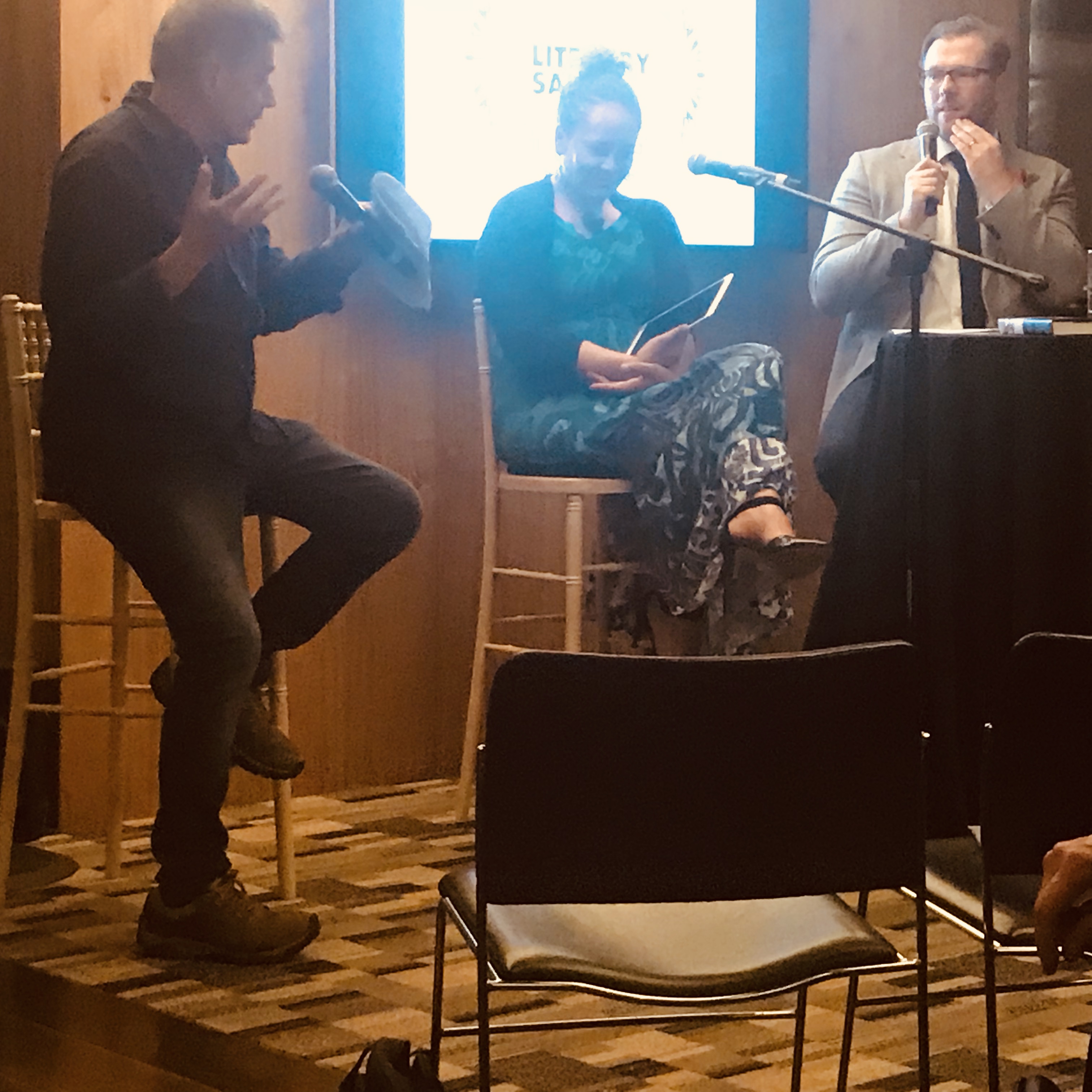
But dreaming is complicated. All of us need to dream on some level – whether it’s the dream of getting your job back in a coal mine, watching a film that critiques its own industry, or looking at a brick wall or a river in Iowa – and something very deep in America knows that.


IWP 50th Gala, Iowa, Oct 2017


Staggering off the plane to a Labour-Green-and-the-other-lot coalition reminded me of once, years ago, returning home from a trip to find our neighbours-from-hell had moved out – a sense of elation and possibility. But perhaps spending time in Trump’s America has made me allergic, because I’m still very worried. We have a long way to go.

I have come from the land of Trump with my hand up like a protestor at a DACA rally: Education for All. And that means education across all fields because we are all different, and our society is layered.

The journey home, for me, has been to go from an academic programme whose purpose is to promote diversity and discourse in arts and creativity – despite everything – to the one I teach in which, well, isn’t doing that. From my vantage point, our failings in education look stark. We are standing by while the Humanities sink, while Arts are taught as a tool for commerce, where we mistake entrepreneurship in the art for art itself.

Our educational institutions are being managed like chain stores. Instead of standing up to government and being the resistance on behalf of education, ‘managers’ in education are complicit in its corporatisation. There is nothing more Trumpy. Trump is only Trump because of the people around him who carry out his deeds.

Anne Salmond puts our desperate need in a nutshell: ‘More than a change of government, what is needed is a change of heart. We must demand of our leaders – and ourselves – that at the very least, the land, the sea and our young people are cared for. Without them, there is no future.’

We think we’re okay, but like the US, we are dreaming.


Anne on her birthday wishing for Trump to be impeached.


Anne Kennedy is a poet, novelist, screenwriter and editor who has received numerous awards and residencies. Her most recent works are a novel The Last Days of the National Costume (Allen & Unwin), and The Darling North (AUP).

'There’s a kind of heaven that comes from hearing another writer interpret the mysteries of process' - Tracey Slaughter

Read more