.
.
.

Far-Flung
by Rhian Gallagher

Auckland University Press
.

$24.99

.
ISBN: 9781869409111
Publisher: Auckland University Press
Published: August 2020
Pages: 96
Format: Paperback, E-book
.


.

How to Be Happy Though Human
by Kate Camp


$30.00


ISBN: 9781776564064
Publisher: Victoria University Press
Published: August 2020
Pages: 160
Format: Paperback
.
.

Reviewed by David Eggleton


Rhian Gallagher’s third collection of poems, Far-Flung, is a book of two halves: the first half is a distillation of specific landscapes into lyrical poems; the second part is a process of uncovering the mysterious hinterland we call the past through researching the writings of others. Her focus is on North Otago, and South Canterbury: where she lives lives now, and where she grew up. The title of the book invokes notions of movement, of distance, and ultimately a suggestion of a stone catapulted from a shanghai – or perhaps the world, the planet, hurtling through space, orbiting the sun. ‘Far-flung’, too, brings us to the notion of settler culture and migration, those topics of endless navel-gazing absorption for our national literature.

Displacement, unsettlement, exploration, if these are the themes brought to mind by the book’s title, what makes the collection lively are the shifting, subtle registers of the poems themselves. Summoning up her childhood environment on a farm near Timaru, Gallagher conveys plenitude of place, recollected Wordsworth-like in memory, as textures, feelings, the taste of dust swirling on the wind.

For Gallagher, the landscape is refracted autobiography, or a kind of self-portrait, registering states of mind. Living in Dunedin and exploring bush walks north of the city, a keen tramper and amateur botanist, she renders physicality through a kind of deftly woven verbal musical brocade. Her poems are chamber pieces, as in ‘Salt Marsh’:

            past crab burrow to ghost shrimp and worm


            sparkling in the wet

            catacombs of vitality, so busy down there,

            small mouths on which this world leans …


or as in ‘Normanby’:


                                                – and a dust cloud

            rolls in the wake and the gulls agitate

            and the small birds follow in the flung seed-spree.


A New Zealand nature poet, perhaps even nature mystic poet, she is in the tradition of Ursula Bethell, Peter Hooper, Ruth Dallas and Cilla McQueen. Gallagher interprets the world by walking over it; her ears register the vibrations of bird calls, her eyes the play of light, her hands the touch of bark and leaf. The end result is a kind of elation, a lyricism seeking after enlightenment, illumination, understanding. The titipounamu (rifleman) is observed busily tapping trees ‘as if she will find the key one day … all of the secrets of the beech forest/ bursting free.’ (‘Titipounamu Tapping the Beech Forest’). At the same time, the poet is alert to environmental changes and damage: ‘the river slips from the fish/ perishing’ (‘Mackenzie Country’).

Formerly self-exiled, and then returned as an expatriate, something she wrote about in her previous collection Shift, Gallagher explores landscape with a kind of double perception, an understanding of cultural relativism:

            leaving home long enough to be a stranger

            sets a yearning in motion

            while those who stay

            never think of home.

                        (‘The Roost Trees’)

When you travel, you are constantly translating. Returning, she writes as one keenly aware of the dialect of the tribe. She is not alienated from the vernacular, but distanced. In ‘Country Hall’ she remembers the communal spirit of her childhood:

            the hall

            lit up like a liner

            in a sea of paddocks, the country dark

            turning stars into an anthem

            warbling and symphonic.

One can perhaps trace the origins of Gallagher’s full-bodied immersion in nature, her sensuous prostration at the altar of landscape, in her Roman Catholic upbringing. Certainly, her poems convey a sense of her early childhood as a time of innocence, prelapsarian, striving after a state of grace, and subject therefore to a kind of spiritual dread:

            Mixed with the spirit and drunk

            in a toast, mixed with the air

            made a mist and that was the face

            of the Holy Ghost …

                                    (‘What You Knew About Water’).

The stormy weather described in her poem about the time of the Wahine ferry disaster. ’10th April 1969′ is positively demonic: ‘the waves breaking into my dreams’.

The first section of Far-Flung is titled The Speed of God, while the second section is called Seacliff Epistles, and this is centred on the early years of the Seacliff Lunatic Asylum (later Seacliff Mental Hospital, eventually closed because of ground subsidence) in North Otago. Gallagher also writes a bit about this locale in the first part of the book, with the hills of ‘the Kilmog slumping seaward … the highway/ doesn’t want to lie still’, and the old Seacliff school building where she lived for a time ‘pretending to be a writer’.

A number of poets have lived in and written about the small coastal settlement of Seacliff, including Joanna Paul, Peter Olds and Michael O’Leary, having found its psychogeography fascinating. In Seacliff Epistles, Gallagher’s strategy is to ventriloquise the voices of some of the incarcerated inmates of the old asylum, to acknowledge and commemorate them as particular individuals by recasting diaries, letters and the reports in historical texts into poems. Beyond this, she channels their sense of despair, or their spirited defiance, or their stoic resignation, as a way of exploring the early settler mindset, the repressions and strictures of Victorian morality, the power structures of a transplanted class consciousness, and in particular the fragile, persecuted status of poor Irish migrants: ‘immigrants from lowly backgrounds’, as they were described.

There are fleeting references, too, to the great panjandrums of the time, including Truby King, who recruited domestic servants from those who had been detained as ‘insane’. Struggling against straitjackets both figurative and literal, inmates such as ‘Maeve (‘them church ladies praisin me efforts’) and Agnes (‘shipped/ from the workhouse, wretched’) are given voice, ‘not heroine pioneers//  but perplexed, peripheral, raging//  the wild Irish workhouse girls.’

Imagining the musty, mouldy air of locked rooms and attics of the gigantic asylum, its atmosphere still alive in cultural memory and heritage, if also thoroughly razed several decades ago by bulldozers and demolition, Gallagher is rewarded for her creative scrutiny – ‘harvesting details like a detective’ – by poems of remarkable resonance. In ‘The Asylum Keys’, she asks: ‘What happened to the keys? More than a thousand keys … The thistledown knows more than I … the asylum/ locking me out … I listen.’

When God has vacated the building, we don’t necessarily have paganism and hedonism; we have, it seems, a duty of preservation and observance of hand-me-down pieties, albeit in secular form. After all, we are all eclectics now, cobbling together patchwork value systems and bricolages of convictions. If Rhian Gallagher is something of a solitary, a spiritualised, inward-turning poet in the Gerard Manley Hopkins mould, Kate Camp in How to be Happy Though Human: New and Selected Poems, with its numerous shout-outs, seems something of a salon writer, a coterie writer, associated with the clubbable and tribal Wellington school.

As with Rhian Gallagher’s book, the title of Kate Camp’s book is a signpost. As a collection, these poems are suffused by melancholy, a traditional property in poetry – witness ‘Ode to Melancholy’, by John Keats – but Camp’s is a melancholy tempered by comedy, or droll comic effects. Kate Camp is a poet both enchanted and disenchanted by human foibles and behaviours, and her poems are able to expertly skewer or dissect our everyday shibboleths and most cherished clichés, deriving, as so many of our aspirations do nowadays, from consumerism’s coaxings and blandishments:

                        The ordinary can be miraculous

                         if it happens often enough.

                                                (‘Don’t get me started’)

Like any good sceptic, Kate Camp questions everything:

                         Why preserve one’s childhood memories?

                          So, like the Egyptians they might be packed into the grave?

                          …

                          Everything is small enough already

                          and there is too much too much of everyone.

                          To understand your life you need another whole life.

                                                   (‘Snow White’s Coffin’)

Camp’s poems, then, are aphoristic, dialectical, knowing. They nod to irony, anomie, solipsism, as if to close friends. They stop to flirt with New Age psychobabble, clinical psychology jargon and Zen koans, before moving on to obliquely quote New York School poets and lowbrow TV sitcoms:

                          The law is, that those who love you

                           will not help you get better

                                                (‘The Law of Expressed Emotion’)

and:

                           This would be cherry blossom time

                            if there were any cherry trees here

                            if there were any blossoms

                                                (‘Cherry Blossom Time’)

and:

                            On the mower’s handle the white shapes of two animals

                            the tortoise and the hare

                            that one might know how fast to travel

                            using fables as a guide

                                                (‘Lawns’).

Camp’s poems are sometimes chatty and companionable, offering confidences over the teacups, as it were:

                          A childhood friend lived there

                          in that sad apartment

                          facing south, her baby coughing,

                          she was not a good person, but still.

                                                (‘Walking up the zig zag’)

And sometimes they are confessional, especially about the tragicomedy of the body, never quite measuring up to the Ideal, instead a constant source of vexations and ruefulness:

                           Standing on the field while other people’s daughters

                           play sport, their limbs and tragic just-appearing breasts

                           little lumps of fat on their chests.

                                                (‘Female Family Annihilators’)

Dysmorphia, boundary issues, stress, domestic order and disorder, Camp is a clever crafter of telling or telltale vignettes moments, plucked spasmodically from the great quotidian mundane, with a special interest in the grotesque and the macabre. At times, it’s as if she’s talking for victory, talking to win the match point, but also not afraid of the epic fail, for that too will provide an excellent miserabilist comedy routine, expertly rerouting a transgressive or aggressive stance with the skilful feints and cape twirls of a mock-matador.

Recycling observations from multiple philosophies, from the smorgasbord of globalism and its promiscuous minglings and mirage-like promises, Camp becomes the wry laureate of the entropic, apostrophising the stuffing of our over-determined twenty-first century existences:

                          I am my own daughter, my own son

                          remembering with a shock how beautiful I was …

                                                (‘Autumn with your rare MN‘)

In these poems, selected from her six previous volumes with the addition of sixteen new poems, tone is everything: bemused, ruminative, wistful, wise – and always I hear my malaise hurrying near. The smouldering slow burn, the curdled idealism, the salvation army assembly of humorous perceptions: a virtuoso display. Each poem’s like a bumper ride in a fairground, crashing into obstacles, at once jarring and exhilarating; leaving you dizzy but adrenalised, and, in a manner of speaking, woke, by poems pleasant and unpleasant.


David Eggleton is a Dunedin-based poet and writer, and the current New Zealand Poet Laureate. A Selected Poems is forthcoming.   

'I started to feel very guilty, as though I’d perpetrated a crime, a rort' - Stephanie Johnson

Read more

.

.

.

Searching for Charlie: In Pursuit of the Real Charles Upham VC & Bar
by Tom Scott

Upstart Press

.

$49.99
.

ISBN: 9781988516608
Publisher: Upstart Press
Published: August 2020
Pages: 368
Format: Hardback


Reviewed by Nicholas Reid


Nearly ninety years ago, the British author A.J.A. Symons did something which may or may not have been to the benefit of later writers. With his The Quest For Corvo, he wrote the first biography to place the biographer at the centre of the story, piecing together how he came to research his subject. This was long before anybody had heard of postmodernism, but The Quest for Corvo is now often called the ‘first postmodernist biography’. Trouble is, Symons’ daring innovation has become a cliché. The world is now awash with non-fiction called ‘In Quest of This Person’ or ‘The Search for That Person’ or even ‘Finding So-and-So’. And the come-on is always the same. The author claims to be investigating the nature of his subject in new ways, which nobody else has considered. The author claims to have found new information, hitherto hidden, about his subject. And always the author invites us on his own journey, which can overwhelm the biography part.

This is very much the genre of Tom Scott’s Searching for Charlie, subtitled In Pursuit of the Real Charles Upham VC & Bar. Often Scott is in conversation with Kenneth Sandford’s straightforwardly heroic biography of Upham, Mark of the Lion, published in 1962 and read by all Kiwi schoolboys of my (and Scott’s) generation. Scott says he carried Mark of the Lion wherever he went on his journey. Sometimes he quotes from it. Sometimes he corrects its minor errors (such as Sandford’s claim that Upham won a knighthood) and he tells a few salty stories that Sandford didn’t include (such as a mildly cruel prank Upham played on a POW to persuade him to be a blood donor).  Most important, having convinced us that Charles Hazlitt Upham was not a psychopath, and having told us that he was essentially a modest, if determined, Kiwi bloke, Scott says that he is in quest of the source of Upham’s extraordinary courage.

Of this courage there is no doubt, well attested by official records and many witnesses. Upham was the only soldier to win the Victoria Cross twice. Scott gives credible evidence that his superiors would have awarded him more VCs if they had not been overruled. If you’re going to have a war at all, Charlie Upham was the type of soldier you wanted in the front line. He really did knock out, single-handedly, enemy machine-gun posts and strong points in the counter-attack on Maleme airfield in Crete. He really did organise defences against Rommel’s tanks on the Minqar Qaim escarpment in North Africa, and led the breakout once the Kiwis were surrounded. With all the gusto of an old Boys Own Paper yarn, Scott depicts Captain Upham rallying his men and charging forward throwing hand grenades at anything that looked like an enemy. It helps to know, as the book often emphasises, that Upham was a taciturn guy who never boasted and had a ‘defiant, bewildered, almost pathological modesty’. Better still, Upham wasn’t up himself. ‘Fiercely egalitarian, he was better than no bastard and no bastard was better than him.’ As a bonus, he could swear a blue streak, so he really is one of us regular jokers, right?

But there are big problems in the telling. Scott travelled to many sites of Upham’s war experience – Greece, Crete, North Africa, Italy, Germany. But while he tells us the sights he saw, and the scant surviving evidence of a long-ago war, little of the travelogue illuminates anything new about Upham himself. The narrative shows us that Scott interviewed many old-timers (family and fellow-soldiers of Upham) and some military historians in his research. But Searching for Charlie has only a very modest bibliography and absolutely no footnotes or endnotes to verify sources.  This becomes problematical when we meet passages that read like fiction. Was Charlie Upham really sitting in a long drop in 1935, and reading a page of newspaper supplied as toilet paper, when he first became aware of Hitler’s persecution of Jews? And did he immediately jump up and shout ‘Bastards! Filthy bigoted sons of bitches!’? Maybe he did, but I’d like to see the source of the story. Elsewhere, Scott admits that some scenes are simply as he imagines they should have been, like Upham’s response when turning down a knighthood.

Scott tries hard to mitigate the fact that Charlie had a privileged childhood before he morphed into a rugged, backblocks farmer and soldier. He was the son of a wealthy barrister, resident of Christchurch, and attended Christ’s College. So we get accounts of the jolly wheezes he pulled at school, which, we are told, later allowed him to rag German guards when he was a POW. Then there is the jokey-blokey tone Scott often adopts. We are told that the words of the Horst-Wessel Lied really translate as ‘All we are saying… is give war a chance.’ I think a laugh track was meant to be inserted there.

It’s true that Scott doesn’t deny the darker side of Charlie Upham, showing that, post-war, he could be a grumpy and even threatening man. Reasonably enough, Scott suggests this could have been one effect of long-term PTSD. Even so, the sum of this book is simply to reinforce the iconic image we already had of the great New Zealand warrior. I find no new explanation of the source of Upham’s extraordinary courage, despite the declared rationale of Searching for Charlie. I’m sure it will have a wide readership and be enjoyed by many (especially males). But maybe some historians and keen readers of history who want and expect more will grit their teeth.


Nicholas Reid is an Auckland historian and poet. He writes the fortnightly book blog Reid’s Reader.

'I felt energised by the freedom of 'making things up’' - Maxine Alterio

Read more

.

.

.

The Tally Stick
by Carl Nixon

.
Vintage
.

$30.00


ISBN: 9780143774761
Pblished: RHNZ Vintage
Published: August 2020
Pages: 288
Format: Paperback


Reviewed by Philip Matthews


‘The car containing the four sleeping children left the earth.’ That is a perfect opening sentence, conveying both mystery and dread, an almost fairy-tale dimension (dreaming children) existing alongside the brutal image of a serious car crash on a remote road on the West Coast of the South Island in the distant 1970s.

The five pages that follow are a heart-in-mouth account of what happens when a car slides off a wet road in the dark, and falls, slowly, into the river below. What would you say in those last moments, if you had time? ‘John wished there were time to apologise to his wife.’ Everything slows down. John doesn’t survive, nor does his wife, Julia, and nor does their baby, Emma. But the three older children, Maurice, Katherine and Tommy, all make it and scramble out of the car to safety. And then what?

The Chamberlain family had only just emigrated from England and were taking a South Island road trip before John was to start his new job in Wellington. No one knows where they are, and weeks pass before anyone realises they are lost. This is the 1970s, when it was still possible to go to the other side of the world and just disappear. Their sense of the New Zealand bush (they want to say forest) is as malevolent as it would have been for British immigrants arriving a century earlier. It’s primeval and impenetrable: ‘The forest here was vast and tangled. Trees, ferns, creepers and moss grew next to, on, over and through each other. It frightened her.’

The surviving children tell themselves there are no predatory mammals in these dark woods, but there is a kind of bird-man glimpsed at times. There are sandflies and there are eels that feast on dead bodies. After a few days, the children are rescued by a hunter and taken to a cottage, where a woman healer lives. Does that sound Grimm? There are further fairy-tale resonances, but Nixon, who always sticks close to realism, doesn’t push them too far.

You sometimes hear people say Nixon is overlooked as a contemporary New Zealand writer. I doubt that’s true: he wins prizes, he’s been picked to represent New Zealand in international markets and he sells books both here and overseas. But like Owen Marshall, and perhaps Maurice Gee, who are both obvious influences, he is occasionally written off as a regionalist concerned with his own fenced-off section of the country. That isn’t a strictly accurate description either, but it is fair to say that Nixon has never been fashionable. Yet he is an enormously competent, highly skilled and accessible writer who successfully straddles the gulf between literary and commercial worlds.

The Tally Stick​ (my only real complaint is with the ungainly title, which refers to an obscure object that barely features) is an efficient, gripping story, a Kiwi Gothic thriller that is confidently and economically told. It is probably his strongest novel. It would also make a hell of a movie, or better yet, a TV series. Nixon has things to say about adaptation and identity, about family and home, about colonialism and the new rituals and beliefs we might adopt or invent in a new land (the author has a religious studies qualification), but he lets these and other themes glide under the surface like one of his giant eels. The imagery of falling returns at the end, but there is a contrary movement, a floating above things, almost birdlike, which imparts a sense of hope and a belief in some kind of greater balance, just as Nixon balances his hard realism with a spiritual dimension.


.


Philip Matthews is a Christchurch journalist. He is writing a book about post-punk band The Birthday Party.


'I started to feel very guilty, as though I’d perpetrated a crime, a rort' - Stephanie Johnson

Read more

.

.

.

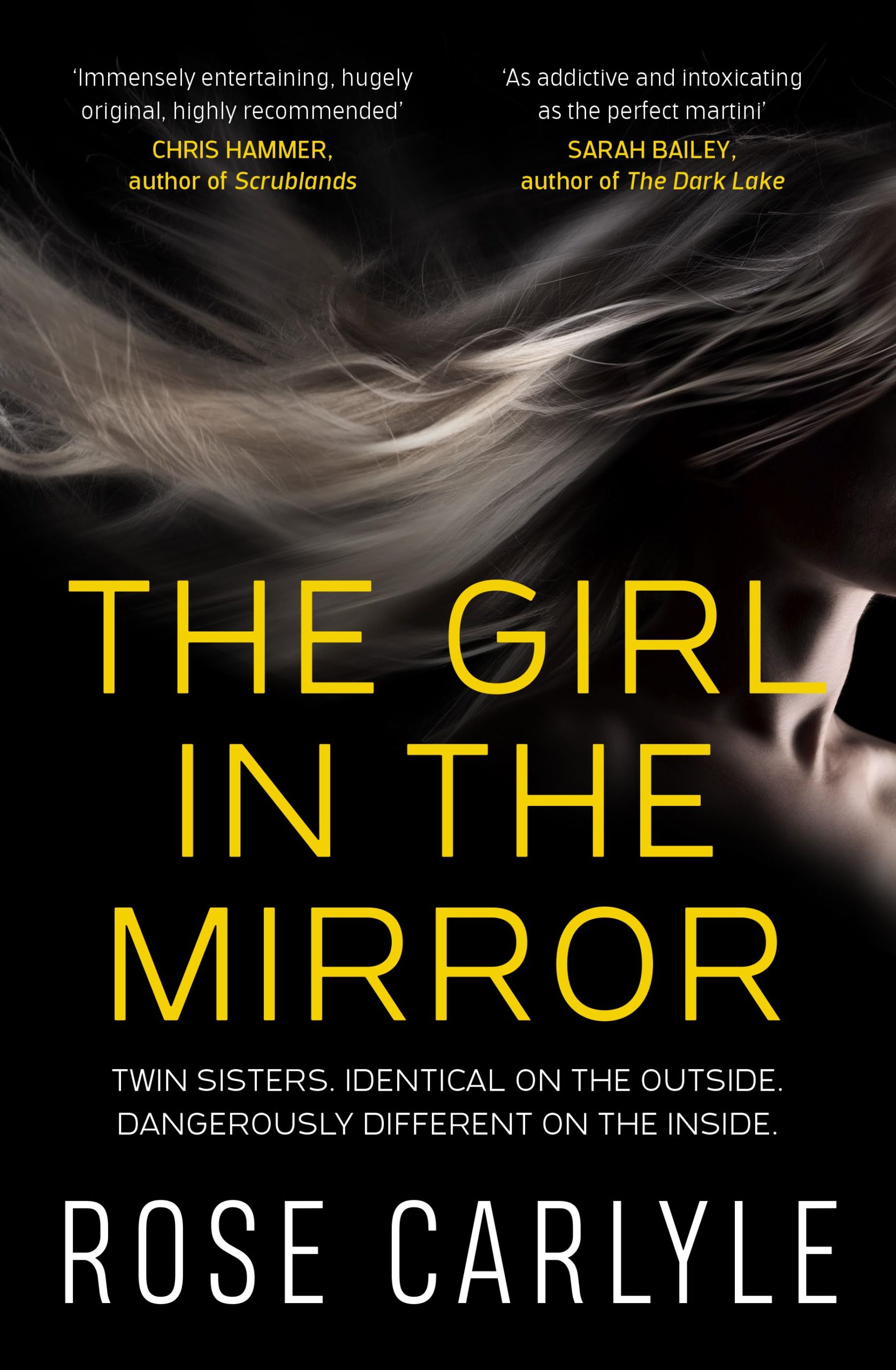
The Girl in the Mirror

by Rose Carlyle

Allen & Unwin


$32.99

.

ISBN 978-1-76087-673-9
Publisher: Allen & Unwin
Publication date: August 2020
Pages: 362
Format: Paperback

.

Reviewed by Sally Blundell


It’s a twin thing. The sort of thing non-twins do not understand but rather suspect: the knowing looks, the shared impulses, the empathy, the uncanny ability ­- in identical twins anyway – to pass themselves off as the other. It’s the stuff of holiday time movies, classroom antics, pub braggadocio and family legends. It’s also easy fodder for darker tales of rivalry and psychological game-playing.

In The Girl in the Mirror we meet twins Summer Rose and Iris. As Iris tells us, ‘For the first twelve days of our life, we were one person. Our father’s brains and our mother’s beauty swirled into one blessed embryo, the sole heir to the Carmichael fortune.’ The fortune is that of their father, the decidedly unbrainy Ridgeford Carmichael, owner of half of the beachside town of Wakefield in Australia. But then, on the thirteenth day, ‘we split.’ Here endeth the blessedness. The ‘rupture’, we are told, was imperfect, leaving not identical twins but mirror twins, each a literal reflection of the other. Summer’s higher right cheekbone is Iris’ higher left cheekbone; Summer’s right handedness is Iris’ left handedness, even Iris’ organs are on the ‘wrong side’ of her body (this is not unknown – in rare cases of situs inversus, a ‘mirror twin’ may have internal organs such as the heart, stomach or liver on the opposite side of their usual anatomical position). Summer is the ‘it’ girl, explains Iris, ‘a blonde bombshell. And I’m her mirror.’ This gnaws away at Iris’ confidence. Beautiful, sunny, sweet-natured, self-assured Summer is loving and loved perfection; beautiful but prickly Iris, the second and unexpected birth, ‘the surplus twin’, is left feeling insecure, unloved, obsessed with her sister.

Misery on misery, indignity on indignity. The just-too-awful kindness that prompts Summer to allow her sister to wear the golden sash of the inaugural Wakefield Beach Junior Beauty Pageant that she herself has won; the oh-so-handsome and romantic Adam who sweeps Summer off her feet; the inadequately disguised favouritism of mother Annabeth. Underlying this unwinnable contest is the will of their father. Rather than splitting his vast fortune among his seven children (by two different women), Ridge leaves it all in one eye-watering hit to the first child to give birth to a baby that will carry his name: ‘Like a medieval lord, he wanted it to stay together for as many generations as possible.’ The ugly race is on and, apart from gay brother Ben, no one comes out of this well. Iris gets a desperate call from her twin in Thailand. Summer and Adam have overstayed the import permit for the family yacht Bathsheba but Adam’s young son is in hospital and can’t be left – would Iris fly over to Phuket and sail the yacht, with Adam, south across the Equator to the Seychelles? Like, now?  Iris – ‘failed job, failed marriage and failed life’ – agrees, for the less than honourable promise of spending time with her rich and handsome brother-in-law. But once in Phuket, the plan changes. It is Summer who will accompany Iris on the two-week sea journey, just the two of them, all alone, in the big, wide, unseeing ocean.

First-time novelist Rose Carlyle is a lawyer and an able seafarer herself. She has crewed on two scientific yachting expeditions to the subantarctic islands; she and her young family lived on her own yacht in the Indian Ocean for a year. Her account of Iris’ deep love for the ocean and and the twins’ seagoing voyage is clearly steeped in a deep understanding of, and respect for, sailing. After completing a creative writing Masters course at University of Auckland, she ditched an earlier novel to work on this, her first published book. Already it’s been hailed as a publishing triumph. International rights have been bought by HarperCollins USA, the book has been sold into four different languages and a movie deal has been signed. As it should. With shades of Dead Ringers and The Talented My Ripley, the plot charges towards the dramatic denouement like a sloop on a trade wind as the true natures of Summer and Iris and the madness inspired by a cruel and unethical inheritance become apparent.

Building the required scaffolding for the story is not as smooth. Descriptions of Iris casually trying on her sister’s underwear ‘to see what Summer looks like in these’; Summer’s desperate description of Tarquin’s ‘pee pee’ swelling excruciatingly ‘and there’s something seeping out’; the deeply disturbing ‘sexyrape’ initiated by Adam; the blithe inattention of Annabeth; even the cast of relentlessly rich and beautiful characters (everybody, but everybody, is rich and handsome or beautiful, except for poor, pregnant Virginia with her double chin and ‘elephantine thighs’) – all make for a strained and often uncomfortable climb to the pivotal scene in the middle of the Indian Ocean. From here, however, the pace picks up, the suspense heightens, the tangled twists of the plot tighten until we are left, breathless, at the last, game-changing sentence.

.


Sally Blundell
 is a journalist, writer and reviewer based in Ōtautahi Christchurch.


'The thirty-five of us were in the country of dream-merchants, and strange things were bound to happen.' - Anne Kennedy

Read more

.

.

.

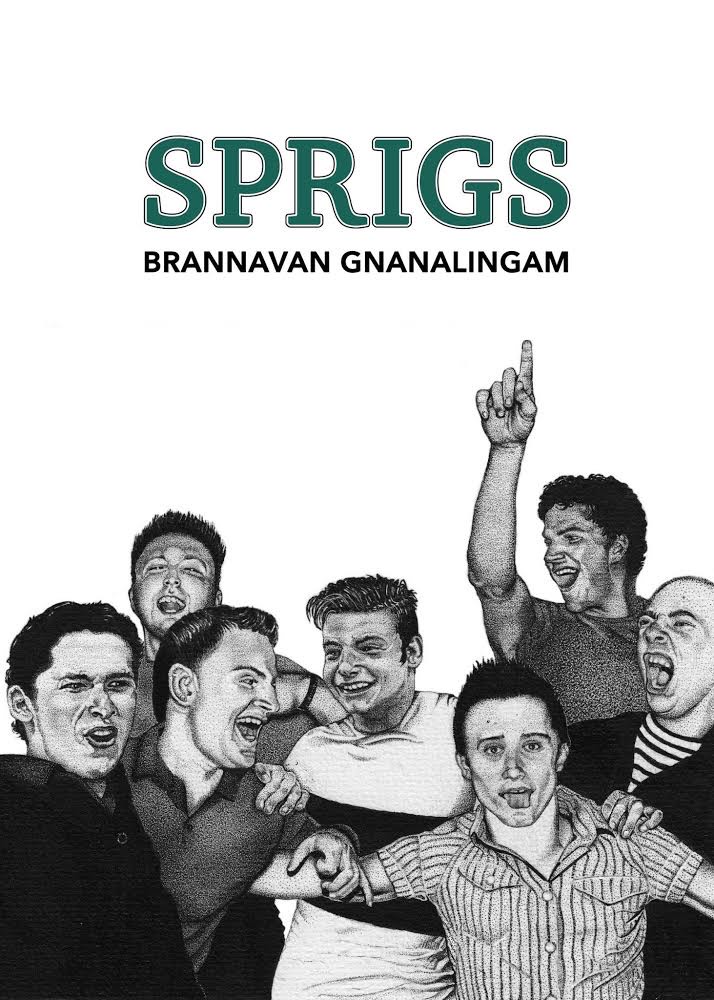
Sprigs
by Brannavan Gnanalingam

Lawrence & Gibson
.

$30.00
.

ISBN 9780473526382
Publisher: Lawrence & Gibson
Published: July 2020
Pages: 450
Format: Paperback
.

Reviewed by Angelique Kasmara


Brannavan Gnanalingam takes a scalpel to all that is rotten within a private boys’ school in his latest novel, Sprigs. In the aftermath of a brutal act of sexual violence, his aim may be precise, but it’s also sweeping. Everything from bullying, racism, toxic masculinity, to adults using their power and privilege to protect their own is eviscerated.

Sprigs is Gnanalingam’s fifth novel. His last, Sodden Downstream (2017), was a fiction finalist at the 2018 Ockham New Zealand Book Awards: its protagonist, Sita, is a Tamil refugee who makes a fraught journey during a storm from Lower Hutt to her cleaning job in Wellington. For Sita, the violence in her life lies in the past, in Sri Lanka. In Sprigs, the violence is local.

The novel’s central narrative – the story of a teenage girl who is gang-raped by several players in the First XV at a post-match party, and the events following – is split into four parts: The Game; The Party; The Meeting; and The Trial. The bland titles do little to hint at the structural brilliance within. In particular, the major turn in the final act comes as a slam in the gut.

The first three parts flick swiftly from one point of view to another. In The Game, this roaming perspective may recall the technical skill of players throwing a ball around a field. Like Hussein, the maths teacher, I am also bewildered by rugby. My fear of being unable to pick up on any sporting nuances appeared to be confirmed right from the opener, which launched with a discombobulating speech by the coach, Twyford, brimming with machismo: ‘For most of you, I’m delaying your Saturday shits. This is a game. This is the game. Win this, and you’ll go down in St Luke’s annals. Lose this, and you’ll go down in infamy … You don’t want to go out as losers do you?’

This is how they talk? Further down, it’s revealed that Twyford is playing a role, and that he’s also the English teacher. Suddenly, his flourishes make sense. But do the boys realise or care for his references to Waiting for Godot or pick up on the self-parody? Probably not. The First XV captain, Pritchard, signs off his own speech with, ‘We need to fuck those Grammar fags up. Bunch of losers.’

There’s a head-spinning number of characters, crowding in as though they’re tumbling into a getaway car. (The book includes a three-page list of characters.) Gnanalingam teases out tiny observations to add depth and detail. Gradually, a few key characters form solid shapes. Richie, potentially St Luke’s’ best player, is viewed as some kind of mascot of diversity: ‘St Luke’s’ first-five, Richie, their “token” as he was semi-affectionately known, had the worst spot next to the toilets’.

Although Richie is the only brown boy on the team, checking his actual whakapapa proves to be a task beyond the others: ‘Despite the barbs, the lads practised their “bro handshake” on him and expected Richie – although his Mum was Sāmoan – to lead their haka on the few occasions a year that the school haka was deemed culturally appropriate.’ Richie is afforded no such cruise control: the emotional labour he’s having to deploy to fit in is in perpetual overdrive:

‘Skux boi, how’d you make it out to the game? Did you walk from Poor Māori?’

Richie didn’t know how to respond. He had no choice but to laugh. Be the good-humoured fellow in the face of such comments. If he reacted, Tafty’d be harder to tolerate. So he gave an involuntary grin, flashing his unmanicured teeth in the face of kids whose parents spent thousands of dollars at the orthodontist. He tried to think of a joke because he worried about looking gormless. He couldn’t. ‘Nah bro, drove out.’

‘Shit bro, your car must have the best suspension to deal with all of the potholes around where you are.’

‘Nah, it can’t be too flash or it’d get nicked.’ Richie burned inside at stooping to Tafty’s level.

Another First XV player, Tim, may be gay, but who knows? Who is even there to listen? The Principal’s address at assembly – ‘As far as I know, we’ve never had a gay student at St Luke’s but we want to make sure you know that we see you’ – is about as good as it gets.

Also attempting to fit in is Priya. In the stifling atmosphere of Simeon College, sister school to St Luke’s, she’s used to dismissing her own feelings whenever her hesitant attempts get a ‘meh’ response from her friends.

She had to maintain a sense of coolness. Yet she found herself asking, ‘You ok to drive us Polly? Restricted and all?’

Polly and Jess and Liv laughed. Priya wanted to rewind time. She never could talk seamlessly.

Priya’s exchanges with her family demonstrate a similar stilted quality, the result of navigating between two cultures: her parents, she thinks, assume ‘I’d get married one day to a nice Sri Lankan boy’. But there are also some sublime moments of connection with her Amma – who she calls ‘Mum’ in front of her white friends – and with her Appamma, who flies in to share her own secrets with Priya.

The narrative is unrelenting in its depictions of a toxic culture, but Gnanalingam isn’t above giving us some comic relief, even if served up as a dry-nah-burnt side dish. ‘She turned off the TV and Hazel screamed as if she was being assassinated. Kelly thought, if she was, at least there’d be some silence.’ This is how a fumbling kiss is described: ‘she felt like she was at the dentist wishing for the dental nurse’s hose with the amount of saliva in her mouth.’ There’s a particularly LOL moment when a techie is sprung by cops needing to seize equipment from the computer lab.

Whenever the perspective switches to a different character, the rape somehow becomes all about them. Picking through these layers is a mammoth task, one which Gnanalingam takes on fearlessly. When news of the attack reaches the upper echelons of St Luke’s College, the self-serving principal and some equally vile parents and trustees immediately call in lawyers and take PR advice to minimise any damage to the reputation of the school.

Nothing is heard from the young woman herself in the aftermath until the final act, where the entire narrative is retold from her corner and in first-person. We aren’t given the easy option of having her story revealed as a singular act of evil, to be captured and contained. Rather, it’s death by tiny cuts, complicity and cover-up seeping up through the wounds. The details of the rape itself aren’t made explicit, but all else is slowly drawn out in her utterly compelling monologue. It runs for nearly a hundred pages, confronting us with just how much of her story has been erased in the preceding pages.

Given the subject matter, it may be presumed that Sprigs comes wrapped with a ‘message’. It doesn’t. What it does do, with a whole lot of insight, tenderness and fearlessness, is open up the conversation. By the end, my scribbled notes included a bunch of question marks. Where do we draw the line when it comes to allowing circumstance and culture to mitigate the agency of individuals? Is forgiveness a sliding scale between healing and erasure? How do we do better?

Gnanalingam stays clear of glib answers, offering instead the prospect of a different kind of solidarity, for those who have ‘to start all over again, slowly, painfully, and in full public view’ but who ‘know our stories are our own’.


Angelique Kasmara is a writer, editor, translator and reviewer from Auckland. Her novel Isobar Precinct, winner of the 2017 Sir James Wallace Prize for Creative Writing, and finalist for the 2019 Michael Gifkins Prize, will be published in 2020. Some of her work will be appearing in the upcoming anthology Ko Aotearoa Tātou | We Are New Zealand.

'Novels stand outside time, with their narrative structure of beginning, middle and end. They outlast politics, which are by nature ephemeral, swift and changeable and can quickly become invisible, detectable only to the skilled eye. ' - Fiona Farrell

Read more

.

.

.

Not That I’d Kiss a Girl
by Lil O’Brien
.

Allen & Unwin

.

$36.99

.

ISBN: 9781988547589
Publisher: Allen & Unwin New Zealand
Published: July 2020
Pages: 344
Format: Paperback 
.

Reviewed by Ruby Porter


Lil O’Brien’s memoir Not That I’d Kiss a Girl is billed as a ‘coming out and coming of age’ tale, yet it begins in the aftermath of a moment that feels less like coming out and more like being pushed: Lil’s parents overhear her, nineteen years old, saying she likes girls. They don’t take it well. It forms a rupture in her life, a split: before they knew, and after. She loses her family, and she’s told it’s her fault.

Lil doesn’t begin as the cliché: a shy, insecure girl-in-the-closet. From the start she is full and nuanced on the page. She spends a lot of time judging others, instead of the other way around. She judges the ‘First Ladies’ at her school, after becoming friends with them. She judges the women in her Otago University coming out group ‘Blossom’ (‘I felt much better about myself after meeting the others’). Even when she’s the most conflicted about her sexuality, she still has an innate confidence, an easy way of moving through the world.

O’Brien acknowledges this privilege, though sometimes this acknowledgement comes too late. Only after her parents kick her out, almost halfway through the memoir, does she explain that they paid her rent, her uni fees, and a weekly allowance for bills and food. She was armed with a taxi card, a petrol card, and a credit card, all courtesy of her father. (We learn, chapters later, of the Farmers charge card when she tries to buy undies.) Reading this, I was taken aback. As someone who’d never even heard of a petrol card, this felt like need-to-know information.

But nothing is withheld on purpose. More than anything, this is a very honest book. O’Brien describes things many people never would. The fatphobia she inherited from her parents, leading on a seventeen-year-old, judging a girlfriend for her white boots. Being bad at sex; passing out during sex; crying, often, mid-sex.

Everyone knows a Lil – gay, but somehow almost always attracted to straight women. She raised my bisexual heckles once when she lumped two women together: ‘my currency value was weak compared with men’s when it came to Kasey and Lacey’. Lacey is a bar-sexual, leading Lil on for the attention of men, but Kasey, who identifies as bi, just isn’t that interested in Lil, and ends up kissing her male flatmate.

It is hard to tell whether the intended audience is local or international. She explains where Dunedin is, and that New Zealand doesn’t have a tipping culture, but then describes the bottom of someone’s denim shorts as ‘daggy’.

Where O’Brien’s writing excels is in capturing the elusive, naming the unnameable: the intensity of young love, imperceptible shifts in power, what remains of memories which have been lost to shock: ‘What happened next survived in my memory as a series of sensory elements and emotions. It’s as though my brain has tried to block out the detail but hasn’t protected me from the feelings: dread, terror, nausea. It’s easy to bring back the ghosts of that memory, even today, sixteen years later. I remember the soft night-time lighting of the room and the TV murmuring in the background. I remember the shape of what they said.’ She describes friendships where the conversation doesn’t flow as ‘like a headwind: you have to lean in a little harder to keep your balance’ and the memory of a kiss as ‘never enough, like an image you put through the photocopier twenty times until it’s blurry and indistinct.’

The act of ‘coming out’, as a singular big event, is (I hope) one that’s becoming less and less necessary. So the memoir’s central focus – on this alienating and confusing process – timestamps the story as much as the ‘hologram orange’ ball dresses, the all-caps all-contractions text speak and Nelly’s ‘Ride wit Me’. And, as you would hope, the early 2000s gay content is all there: message boards with online lovers, Tumblr feeds of kissing girls, The L Word. Lil attempts to download the first episode with her Dunedin flat’s 56kbps dial-up: ‘After a week of stops and starts and the agony of waiting, I had just over a minute and a half’. ‘Outstanding’, she calls it, this minute and a half of Bette and Tina in their pyjamas getting ready for work. ‘Neither of them looked like they were going to be killed off or go back to men.’ (Maybe this joke is intentional, or maybe O’Brien never made it to Season Three, because Tina does exactly that.)

‘Not That I’d Kiss a Girl’ is truly, deeply, hilarious. Lil dismisses the one out girl in her uni hall when she hears ‘that she’d bragged about having a double dildo. What an attention-seeker, I’d thought. Even though I couldn’t stop wondering what a double dildo was’. The humour is self-deprecating, open, and necessary. There’s a lot of pain in this memoir. But even in the darkest places, O’Brien still manages to find the light.

O’Brien spent two years sharing this story in high schools as part of Rainbow Youth’s education programme, and this shows. It reads, at times, like how you’d tell this story to a friend. A chattiness seeps in the edges: ‘We’d talked about gay stuff and lesbians and just, like… gay stuff!’ There are colloquial turns of phrase, which feel tired and overused. Floodgates open, white knights appear, weights are lifted, stomachs twist in knots, and drop. There are kicks up bums, lovers gathered in arms, turning points marked. Her friend Jack is described (twice) as ‘the son [her parents] never had’. People get their acts together, or don’t. Lil does a lot of standing on her ‘own two feet’.

O’Brien is repetitive, too, in documenting her inner monologue. She tells us again and again how, at first, she couldn’t even think about her sexuality, then she couldn’t name it, then she couldn’t ‘confront it head on’.  She reiterates, right up until the end, that her family finding out so early ‘hadn’t been part of the plan’. This kind of metanarrative felt, in most places, unnecessary. She tends to overexplain the significance of events. For example, she describes the electricity between herself and her high school not-girlfriend, then she describes feeling absolutely nothing with her university not-boyfriend, and then she says, ‘The two experiences couldn’t have been more different.’ She even reintroduces characters who need no introduction (Harry, her first boyfriend, and Bridget, her ex-best friend.) O’Brien needs to trust her story – and her reader – and let go of our hands. I got the sense that this stemmed from a need to be understood. Similarly, I felt a need to ‘get everything out’, to make a record of what happened, that at times meant the cataloguing of unnecessary events and exes.

But you can see why O’Brien might feel this way. Hers is an important story to tell. It spans the cultural shift that has taken place in the last couple decades, at least in Aotearoa, where it has become much less socially acceptable to be homophobic. Lil experiences that unsettling phenomenon, where people who once judged her now want to act as though everything is fine. She asks, ‘how do you get closure when the main perpetrator has never acknowledged what happened? How do you close the door on something that – in their eyes – never occurred?’

This book seems like a pretty good start.


Ruby Porter
was the inaugural winner of the Michael Gifkins Prize in 2018, with her debut novel Attraction. Attraction was written for her Masters of Creative Writing at the University of Auckland, and published in 2019 by Melbourne-based Text Publishing. Ruby is currently a tutor and PhD student at the University of Auckland.


'There’s a kind of heaven that comes from hearing another writer interpret the mysteries of process' - Tracey Slaughter

Read more
.
.
.

.

Funkhaus
by Hinemoana Baker

.

Victoria University Press

.

$25.00


ISBN: 9781776563142
Publisher: Victoria University Press
Published: June 2020
Pages: 72
Format: Paperback
.
Reviewed by Kiri Piahana-Wong 

.


Funkhaus is Hinemoana Baker’s fourth collection, her last being waha | mouth (2014), and with a gap of six years, is a book much anticipated by many. These intervening years have brought significant changes to Baker’s life, particularly her move to Berlin in 2015. Many Kiwi writers seem to end up in Berlin, and the themes of identity, home and belonging are perennial ones, but in Funkhaus Baker makes them feel fresh. The title draws on the German word funken, meaning to send a radio signal, and the poems within do indeed reach out, across borders, oceans, languages, vistas and the changing seasons. ‘My view is rooftops, winter-blue sky/and a chimney, she writes in ‘Bird Order’; contrasting with a later poem, ‘December’, where the invitation is to ‘Walk with me in summer mist under powerlines/where the loud tūī bells out over the valley.

The collection is anchored by two strong poems dedicated to damaged buildings. ‘Mother’, the first poem in the book, was written in tribute to Tapu Te Ranga marae, which was destroyed in a fire in 2019. The second poem in the collection, ‘If I Had to Sing’, was commissioned for the reopening of Christchurch Art Gallery Te Puna o Waiwhetū in 2015. The marae and gallery stand as poignant symbols of devastation and (at least in the latter case) rebirth. ‘If I had to sing’ begins with the lines:


I have no idea what to call this rebirth

and yet I’m here to name it

to feed the new flame


with wood from the old.


These lines serve to frame the whole collection. Throughout Funkhaus, the old and new intermingle, rising together, falling away and apart, creating new ways of living and being in the world.

Some poetry collections tell a single story, while others coalesce around themes and the poet’s stylistic approach. Funkhaus falls firmly into this latter category, being only loosely and tangentially tied together. In this kind of collection, it’s the poet’s style that matters, and here Baker is at the top of her game.

Stylistically, Funkhaus is lyrical and musical; its lyricism, however, is punctuated by sudden shocking revelations and moments of searing dislocation. Many of the poems give the appearance of being on solid ground, but partway through a lurch in your stomach and the feeling of the ground suddenly falling away signal the poem is moving to a different place. For example, ‘Fox’ begins with a sighting of the animal in the snow, so the line ‘the dying in your arms of your own child’ simultaneously jumps out, but is then almost subsumed into the poem as a whole – the depiction of the fox, a plant growing from a cobblestone, a sandwich board with pictures of fruit. The poem ‘Aunties’ also moves quickly from colourful description to gut-wrenching (if matter-of-fact) harder truths.

Funkhaus is a significant achievement in that it manages to capture both the loveliness and awfulness of human existence. The language and backdrops are beautiful, but the realities the poet describes are difficult, including pain that is often unspoken. The collection packs a punch: a fist wrapped in delicate spiderwebs. From ‘December’: ‘I am a dark bird opening and closing its beak.’


Kiri Piahana-Wong (Ngāti Ranginui) is a poet and editor. She is the author of the poetry collection Night Swimming and is the publisher at Anahera Press.

'...we were there as faith-based writers, as believers in the mana of Oceania...' - David Eggleton

Read more

.

.

.

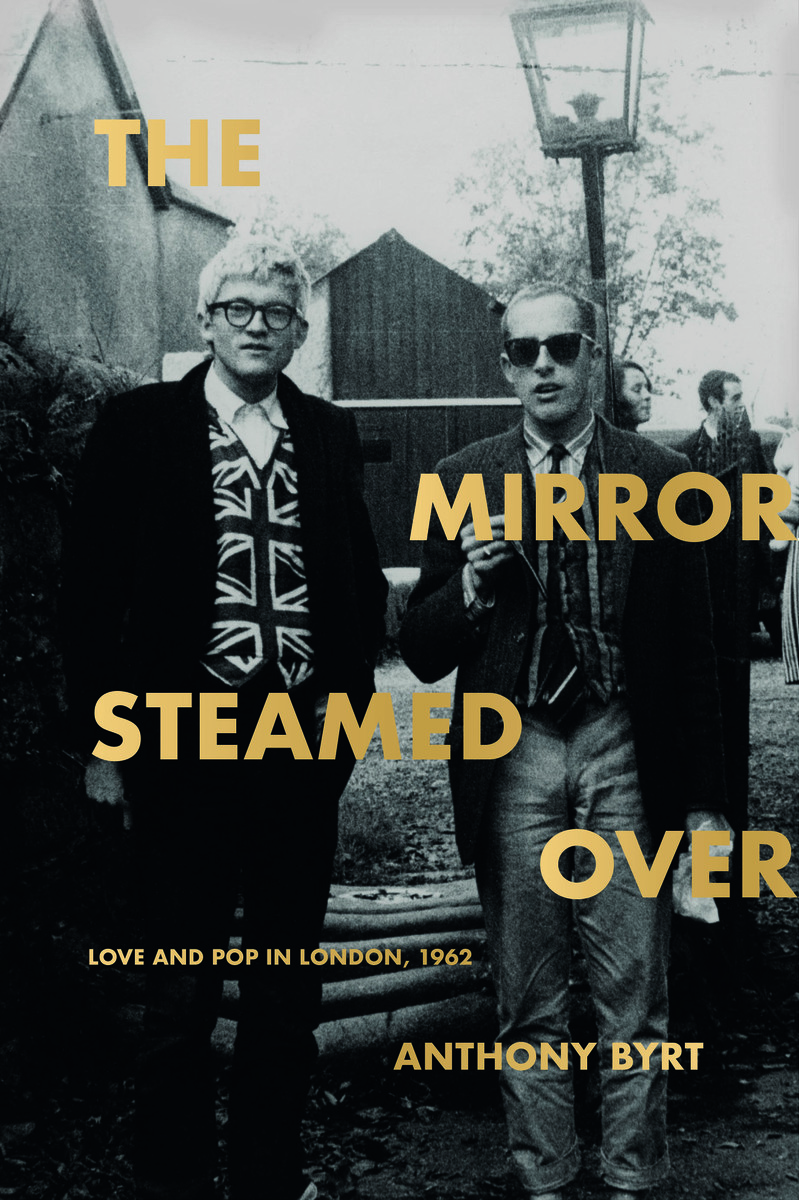
The Mirror Steamed Over Love and Pop in London, 1962
by Anthony Byrt

Auckland University Press

.

$45.00

.
ISBN: 9781869409104
Publisher: Auckland University Press
Published: June 2020
Pages: 312
Format: Paperback with flaps, Ebook
.

Reviewed by Ian Wedde


‘Byrt articulates the wisdoms of historical distance while transporting the reader into the local texture of time and place.’ So reads a section of the blurb text by Matt Saunders, Harris K. Weston Associate Professor of the Humanities, Harvard University. It’s a neat if also diplomatic capture of what makes Byrt’s account of the art moment, represented in part by the British ‘Young Contemporaries’ exhibitions of 1961 and 1962 in London, at once critically disenchanted and sympathetic. The book’s three main protagonists, New Zealander Barrie Bates (who self-transformed and -produced as Billy Apple on 22 November 1962), English artist David Hockney and English novelist Ann Quin (Bates’ sometime lover), are often represented in their own words and by implication social attitudes and self-beliefs or self-doubts. An example is Bates’ adoption of a Black American hipster persona and jargon, inspired in large measure by Norman Mailer’s ‘American existentialist’ in turn inspired, as Byrt writes, ‘by black culture and the radical object-ness of jazz’. Much of this material, the product of extended research, reads as anachronistic and often sexist (the ‘wisdoms of historical distance’ – or hindsight – bit). At  the same time, however, it provides a forensic and unjudgemental narrative of ‘time and place’. Crucially, and as foreshadowed in the book’s title, this rigorously maintained binocular view opens up a fascinating account of the identity issues, the mirror-images and personas that were critical factors in the lives and practices of the book’s core cast.

The book’s adroitly chosen title derives from an extraordinary moment in Ann Quin’s 1964 novel Berg, her third, but the first she published. In it, as Byrt summarises the novel’s core identity scenario, the eponymous lead character, Aly Berg, ‘knowingly wants to kill his father, knowingly wants to fuck his father’s lover, and eventually does’. This is a variation on the classic Oedipus story that preoccupied Wilhelm Reich (The Sexual Revolution) and R.D. Laing (The Divided Self), both of whom were de rigeur theorists of social change during the 1960s. Berg reverses his name to Greb with the intention of disguising his identity from his father and in doing so creates a mirror reflection of himself. At one critical moment when Berg/Greb encounters his father having a bath, ‘The mirror steamed over.’

Following this lead in Quin’s novel, Byrt quotes a passage in Laing’s The Divided Self in which the ontologically insecure person ‘is open to the possibility of experiencing oneself as an object of his experience and thereby of feeling one’s own subjectivity drained away.’ Quin had ghostwritten Bates’ RCA dissertation ‘Pop Corn’; in one way or another, she had assisted his development of what Byrt calls ‘a framework of existentialism and Hip’, and had contributed significantly to the moment when Bates would be ready for a radical transformation. This of course would be the moment when Barrie Bates ceased to exist and Billy Apple was created, at once conceptually an art work and a person, and a repudiation of both personal history and of an art history unable to leave the past (including its provincial New Zealand location in Bates’ case) behind.

Crucially, this severing transformation also deliberately complicated and reconceptualised the distinction between the advertising/branding domains of Madison Avenue that the artist Billy Apple would work in, and those of the art world. The person now known as Billy Apple would continue to game this tension in the US with conceptually acute works that stared down his mixed successes in London, to begin with in Ben Birillo’s exhibition ‘The American Supermarket’ that opened in the Bianchini Gallery in New York in October 1964. Here, Apple shared gallery and review space with a distinguished cadre that would define what Byrt calls ‘a seminal moment in the story of American Pop’. Its members included Warhol, Tom Wesselmann and Jasper Johns, in an exhibition space designed as a functioning supermarket and an artwork in itself by the artist Richard Artschwager.

The pre-Apple, Barrie Bates companion of London RCA years, the painter David Hockney, had also constructed a public brand, in his case outing his identity as a gay man. He had also looked for ways to step away from the legacies of both academic English art history and the huge, suffocating post-war presence of American Abstract Expressionism; and, like Apple, had found the place to do that in the US, though in California rather than New York. Here, in the sunny world of swimming pools, he marked his distance from Bradford and London with paintings such as The Splash (1966). Unlike Apple, however, Hockney continued to work comfortably and very successfully within the borders of the art world – Byrt records a hint of aggrieved ambivalence in Apple’s response to his youthful RCA friend’s success. But they are still in touch, says Apple, as recorded in Byrt’s excellent Prologue, which does an essential job of civility by setting out some basic rules of conduct in establishing ‘historical distance while transporting the reading into the local texture of time and place.’

This is at best a succinct account of core themes in The Mirror Steamed Over – its richness as an account of the 1960s transformations contributed to by Barrie Bates/Billy Apple, David Hockney and Ann Quin involves a wider cast of players. For me, much of the pleasure given by the book involves its scrupulously researched and sympathetically presented profiles of other key individuals, including one of my favourite poets, Frank O’Hara, whose work as a curator and art writer was central to the emergent New York art world post-Pollock and Rothko; of another poet, John Ashbery, and artists including, in particular, Larry Rivers. Byrt’s attention to these individuals adds detail and complexity to the intertwined stories of Hockney, Bates and Quin.

Only Hockney and Bates are depicted on the book’s cover – Hockney in what became his 1960s trademark Union Jack waistcoat and peroxided hair, Bates in a hip pair of shades. But for me the book’s unexpected surprise presence – a gift – was Ann Quin, whom I hadn’t heard of before reading this book. She probably committed suicide in 1973 at the age of thirty-seven, failing to return from a swim out from Brighton’s Palace Pier. A photograph of her by Oswald Jones, taken around 1964, appears in the image section. The photograph is of a moment of intense social pleasure and engagement, in which Quin is talking with a half-smile shaping her words, a cigarette between the fingers of her left hand, her presence emerging with warmth and vivacity from the page. I now plan to read her novel Berg as soon as I can. It is no coincidence, I’m sure, that on the page facing the photograph of Ann Quin is one of Barrie Bates, the axis of his animated speech across rather than out from the picture, Quin’s cigarette mirrored by the pencil between the fingers of his right hand. This photograph was taken in 1961, at the Royal College of Art, and but for the anachronism involved the twinned images might almost be of an exchange between the two of them. Even more than the several photographs of Bates and Hockney being laddish together, the Bates/Quin double-fold captures something of the energy of that decade of mirror images and identity transformations that constitute much of the fascination of Byrt’s remarkable book.


Ian Wedde is a poet, fiction writer, critic, and art curator, and the recipient of well over 30 major awards, including New Zealand Poet Laureate and  Officer of the New Zealand Order of Merit. His latest novel The Reed Warbler was published in May 2020, through Victoria University Press.

‘Inspiration is the name for a privileged kind of listening’ - David Howard

Read more

.

.

.

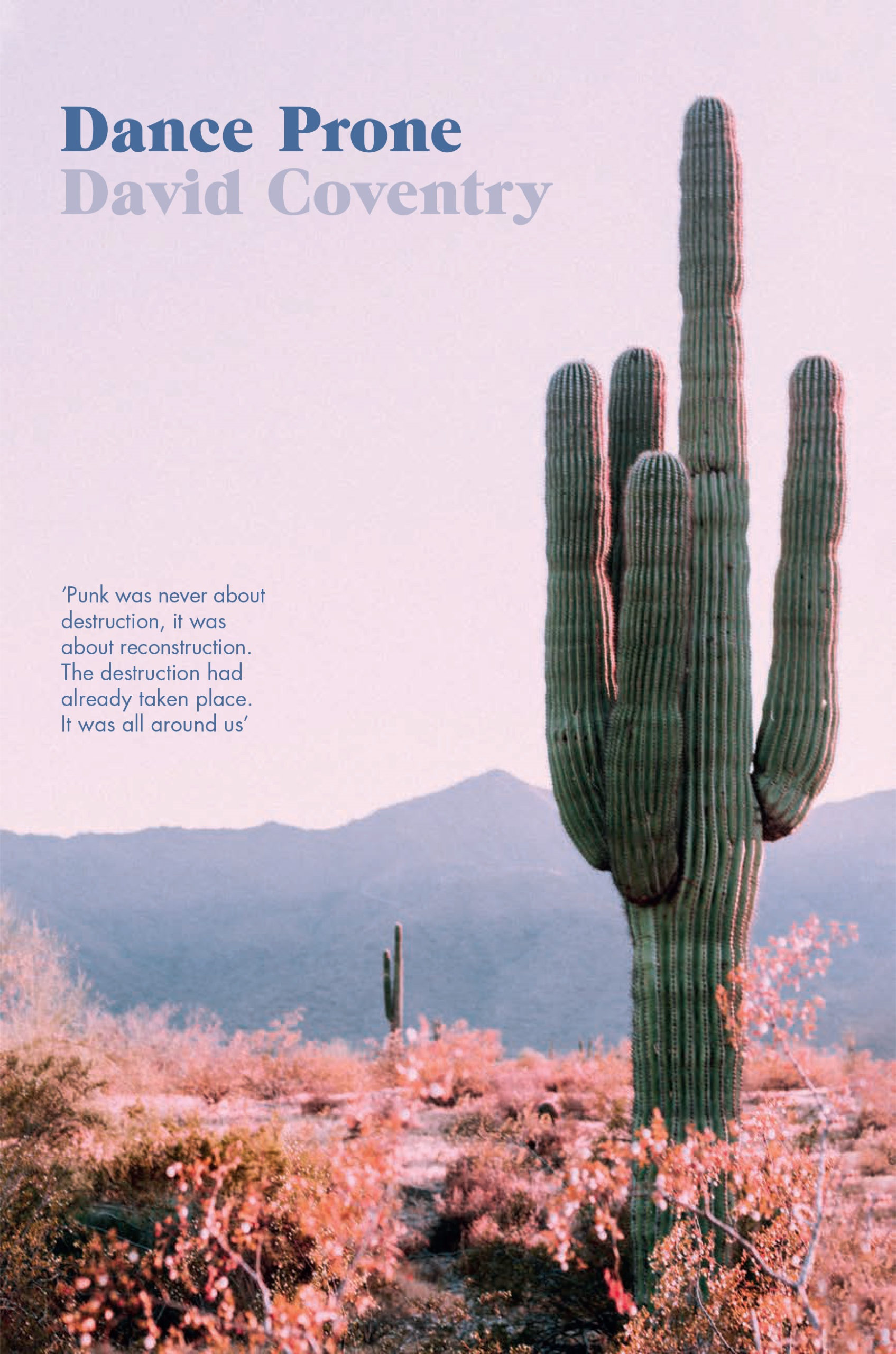
Dance Prone
by David Coventry

Victoria University Press


$35.00


ISBN 978 177656 3098
Publisher:Victoria University Press
Published: July 2020
Pages: 400
Format: Paperback


Reviewed by Philip Matthews


‘Punk, to my mind, differs from heavy metal by both its sly humour and its irony,’ Darcey Steinke wrote in her recent essay on Nick Cave, ‘God is in the House’. ‘Also its nuanced theological engagement. While much metal takes on the mask of destroyer, punk is the wailing of the destroyed.’ Punk, in various forms that began in the 1970s, was broken music for broken people. It was protest music that gave shape and voice to dissent, resistance and nay saying. It was about resistance to the oppression of boredom and the world’s moral corruption and offered the self-obliterating power of noise. Or as Wellington writer David Coventry puts it in his second novel, Dance Prone: “At seventeen we craved velocity. Volume and haste. Massive, thickening waves of decibel and speed.”

The broken people in Dance Prone are Neues Bauen, a post-hardcore four-piece from the fictional college town of Burstyn, Illinois. Frontman Conrad Wells narrates the story as the band tour through the south-west of the United States during the closing weeks of 1985, playing halls, bars and house parties, where gigs frequently devolve into violence, and friendships and rivalries develop with other bands across a pre-internet underground network formed by venues, labels and fanzines (Wells is supposedly writing a tour diary for scene bible, Maximum Rocknroll). Coventry clearly knows what he is talking about, not just as a student of the era but as a musician who played in bands around Wellington in the 1990s. The book is crammed with cult band names, from Big Star to Mission of Burma to Christchurch’s Scorched Earth Policy – at times, it risks becoming a guided tour of Coventry’s record collection, complete with annotations. He is very good on the urgent, kinetic action of a band on stage, the unsteady sense of making something that could soar or collapse at any moment:

The beauteous arrangement, this shriek amidst the rhythm and throb. The fellow running the monitors pulled me up and reset the mics and I was back across the other side choking the neck of the guitar. Queues of army jackets arguing to leap the stage first. One stood arms out on the monitor, Blair Potaski with his mouth bleeding.

There is a lot of blood and the violence doesn’t just happen on stage. Conrad is raped in the back of the band’s van and the plot becomes a mystery, spanning decades and continents, to find out who did it. On the day of the rape, guitar player Tony Seburg shoots himself in the face and, to bookend the tour’s violence, a death mirrors that of Minutemen singer and guitarist D.Boon in a van crash in Arizona near the end of 1985. A dense story is rendered even trickier by Coventry’s frequent impersonations of Don DeLillo’s unique prose style. Coventry has said that his life was changed at 21 by reading DeLillo’s White Noise, and it’s clear that the influence has been a deep and lasting one for him (The Names is namechecked here). There are sentences throughout this book that could almost be mistaken for DeLillo’s brilliant sentences – ‘Water and whatever bursting in the lights’ is one picked at random. The same could be said of cryptic dialogue such as this:

‘She invoices. She sends samples. These are the things of ordinary lives.’

‘Ordinary lives.’

‘It’s this thing I’m doing.’

At its best, DeLillo’s prose can get at something transcendent beyond the page, an impression of knowledge passed on in some extrasensory way. That might be why DeLillo refers to art and cinema so often, as they do the things that language can’t do. DeLillo’s individual sentences can also convey an epigrammatic wisdom (‘the future belongs to crowds’ in Mao II) that Coventry’s writing never quite approaches. ‘Within all great cities time and space are compressed, extended; the only calculables are food and its smell,’ Conrad muses. Or later: ‘Secrets make the world alert and constantly awakening.’ That sounds good but some readers will pause at sentences like that to wonder if they’re true.

Like DeLillo, Coventry brings art and cinema into the picture. Conrad visits a site in north Africa that he knows was a location for an Orson Welles production; old film of the band is found online in 2019 and scrutinised as though it is mysterious footage of Hitler or JFK in a DeLillo novel. There are large, environmental, cultish art projects that also have an air of DeLillo about them. But one man’s trauma is really at the heart of this travelogue guided by violence or excavation through the painful layers and gaps of memory. It can be a murky and challenging experience. Even when Conrad finds himself in the bright deserts of the US or North Africa, he and his story remain enshrouded in a darkness he just can’t shake.


Philip Matthews is a Christchurch journalist. He is writing a book about post-punk band The Birthday Party.

'I felt energised by the freedom of 'making things up’' - Maxine Alterio

Read more

.

.

.

Second Person
by Rata Gordon

Victoria University Press

$25.00

ISBN: 9781776563067
Publisher: Victoria University Press
Published: June 2020
Pages: 94
Format: Paperback

———

Sinking Lessons
by Philip Armstrong

Otago University Press

$27.50

ISBN 978-1-98-859241-1
Publisher: Otago University Press
Published: July 2020
Pages: 54
Format: Paperback


Reviewed by Anne Kennedy


Two first collections both grapple ambitiously with big topics, identity and the strangeness of being. Each pursues its own map – the nature of these issues – but in distinct ways. As such, these debut poets declare themselves, their voice and vision, their influences and affiliations. In Sinking Lessons (winner of Otago University Press’s Kathleen Grattan Poetry Award for 2019) Philip Armstrong’s human/animal motif (among other things) simultaneously dismantles and asserts the nature of ‘us’. When his dog’s ‘fetch and whistle’ dreams nudge his own dreams into being in the night, the poet wonders, ‘I can’t imagine where it leaves my claims / to being human’ (‘Die Traumdeutung’). Rata Gordon’s Second Person likewise second guesses the entitlements we take for granted, but using collisions of states and substances: ‘It is not about coming home / or how calm and tender / is the meat of my heart’ (‘Not seagulls’). The respective book titles alone evoke clouds of association and unknowing, more than is on the label (what else can poetry do?). Sinking Lessons’ double-edged pun – ‘that sinking feeling’ in a time of rising sea levels – goes for gallows humour: laugh or you’d cry. And the ‘you’ in Second Person is ‘me’, isn’t it? Or ‘they’, or the reader second guessing, or all of the above. These days, it is perhaps impossible to view anything without a post-Covid gaze peering over our mask, but in a time when we can’t rely on much, these two new poets’ words, published in early 2020, seem eerily to be just what we were waiting for.

Philip Armstrong is a literature professor at Canterbury University with a focus on human-animal studies (he wrote a cultural history of sheep called Sheep), and while animals, beasts, creatures, fish and fowl – tautly examined Ted Hughes-style physically and emotionally – scamper through Sinking Lessons there is much more, a non-linear dive into the metaphysical unaccounted for. These 50-odd pages in four sections are busy with intent.

Armstrong signposts a childhood with small, thumbnail stories which articulate a watery, Pacific world view, and a world of questions. In ‘Sinker’, a ghoulish family fishing story, the boy’s freshly caught sprat has the hook reinserted by the father: ‘back in behind the eye and out the mouth / and drops the fish into the layered green’. Memories of the practical and emotional sit cheek by jowl; it’s not comfortable. In these poems, there’s the earthiness of Janet Newman, the delicacy of Dinah Hawken.

These are small narratives, and also metanarratives. The child’s emerging consciousness is joined by a growing cast of characters, both literary and legendary, with references from Marlowe to Melville, Shakespeare to Mary Shelley, Hemingway and Orpheus. The gorgeous ‘Swimming Lessons’ channels Moby Dick (quotation in italics):

.

Which makes me think about the time

I tumbled overboard at Shark Bay, Pōnui,

four years old, no swimmer, and my eyes

opened the first time under water taking in’

strange shapes of the unwarped primal world.


The place where the Classical and contemporary inform each suggests Helen Rickerby’s How to Live. But these resemblances are just that; Armstrong is original in sound, idea, form.

Linguistically, these poems achieve that rare thing – economical yet conversational. Armstrong joshes about, code-switching with subtle entendre reflecting the collisions of character, place and time frame that are the meat of these poems. In ‘Call Sign’, the mundane opens up meaning: ‘the marine forecast… calling up tomorrow’, and, ‘dying in the afternoon’. In ‘Longitude’, coordinates highlight our banal attempts at locating ourselves: ‘That was east one seven five point eight’, but resound finally with, ‘I wake. It’s night. I hear the rain / like someone moving round the room’. Line breaks are as natural as breath.

Emblems and narrative threads twist and turn; nothing is wasted. In ‘A Visit to Hell’, it is noted that there are no animals, only ‘everybody who / believes in it: Hell is their Hall of Fame’. In the tender ‘Going to a Funeral’, the speaker travels with his father on a plane with their respective reading material, a kind of literary transaction, the father with his breviary, the poet with Doctor Faustus. The father ‘goes ahead’ as if into Hades. In the midpoint ‘Creature Effects’, a longish, sometimes-rhyming story about a headache, every line trembles with the mind-body equation: ‘Don’t go thinking’ and later, ‘The meltwater was thick as syrup where / I bathed my livid feet’.

And always, the question of boundaries of being, as in ‘Self Introduced’:

.

                        some kind of colt-legged greyhound-

                        bodied cat-like swept-back-long-haired

                        speed freak shifting shape …


Late in the collection comes ‘Song of the Orpheus’, a sequence about the ship of the same name that was wrecked in the Manukau Harbour in 1863, a rather strange flight of colonial history, tightly composed of five rhyming poems that hopefully signal another book.

Sinking Lessons has at its heart a humility about our place here on a physical level, alongside a deep questioning: did the poet/speaker (and you, reader) live this or just think it? Is it just a myth? Armstrong’s brilliant clashes of the small moment and the momentous keep the story alive.

The four sections of Rata Gordon’s Second Person constitute a grand tour of ‘you’ as mother/child, traveller, inhabitant of a body, inhabitant of the Earth. The tone, however, is the opposite of grand, as a deep engagement with image offsets any big ideas. The opening lines, ‘I’m dressed in yellow leaking / gorse seeds out my pockets like… (‘The pregnant pioneer looks over her shoulder’), sets up the persona who orienteers in a landscape of memories, images, ideas.

Like Armstrong, Gordon selects specific, defined childhood events – real or imagined, who knows, and does it matter? – to impart intense universal pictures of feeling. That’s the trick of poetry, where the unique reaches out to the reader. In ‘Small Town’, the lost aching moments of childhood seem to be finally captured by the poem – and by us: ‘dogs in pain / on freshly cut grass’ and ‘a bottle top has lost its mother’. Likewise, catastrophes are refound by the second-person/mother/child/you/me/reader: ‘A red streak / in our dog’s fur where / the neighbour shot her’.

Gordon’s linguistic modus operandi is sense-heavy streams, a smorgasbord of images and ideas in a kind of exuberant New York-school freefall.

.

Smear clay on the wall. Or cake mixture.

Pop coloured bubbles on the wall. Dip your whole body in

In like a Chinese fish and slap yourself against it. (‘Wall’)


Formally, there are a variety of shapes, from free verse to couplets to prose-y-type poem. But there seems to be a central organizing idea – that of the list, either overt lists (‘lists’!), or implied lists, that is, free verse in which assortments of ideas and things are juxtaposed. These arrangements are woven into the substance of the book. Bill Manhire writing on Walt Whitman’s lists in Doubtful Sounds observes that what this method achieves in a poem is to do away with ‘class’. The items in the list come ‘one after the other, each equally there, each with equal rights in the poem’. This equality is at play in Second Person. The governing idea of equality means entities – cake mixture, hearts, bodies, desires, laments – are allotted their fair share.

But what is the effect of this democracy of ideas? It seems that situating the ordinary or banal or absurd next to the heightened throws the latter into deeply emotional relief:

.

So flies will spell your name on the window

So you’ll never have to wear a concrete dressing gown

So you’ll feel snug like a stitch in a cardigan (‘Why’)


And so, in the end, the comparisons do poetic work to make us feel.

The travel poems section (India, San Francisco), which might at first seem like a detour from the business of this book, in fact develops the notion of the ‘second person’, much as travel broadens the mind:

.

You walk through the streets

in second person as if

watching yourself from behind

your backpack and your hands

are limp but your heart is

beating (‘Mango’)


Thus, the ‘person’ is poised to enter the impactful and complex third section of the book, which is where things really take off. It is here that the self wrestles with, among other things, an unromantic settlerdom (a kind of inverse The Piano) in the knock-out poem, ‘How I arrived’:

.

the bodice was made of used handkerchiefs and the lasting

impression was of a Victorian housewife washed up on the beach

nibbled and scratched and worn away by sand-hoppers and limpets

…..and the teeth

of sprats and yes I was wearing a great billowing skirt with fat

sanitary pads soaked with the blood of seals…


And gender identity in ‘Pacing’: ‘It so happens I am sick of being a woman’. This poem mirrors Armstrong’s ‘The Female Me’, with both reminiscent of Steph Burt’s Advice from the Light, poems that imagine growing up as a different gender. Gordon’s challenge of the binary is aching but funny: ‘Still, it would be wonderful / to frighten a barrister with a possum tail’.

One lovely image system to notice about this book is its ‘yellow’, from the yellow dress of the first line to a bee to the sun on wallpaper (which perhaps refers to ‘The Yellow Wallpaper’) to a yellow flower to a mango to eggs to grapefruit to a yellow plate to turmeric, all of which denote an offset kind of happiness.

Lastly, we return to the mother of the second-person equation, and to an imagist clarion cry which is the essence of this delightful book: ‘skin to skin / eye to eye / on Monday / on the red towel’ (‘Shoreline’).

Each of these poets – whose books have been beautifully produced by university presses – uses the precision of craft to express what is normally just beyond our reach, the subtle, vital concepts of simply being here.


Anne Kennedy is a poet, fiction writer, screenplay editor and teacher of creative writing. Her latest book is  Moth Hour (AUP), shortlisted in the 2020 Ockham Book Awards. The Ice Shelf (VUP), a novel, appeared in 2018. Awards and residencies include the NZ Post Book Award for Poetry, the Montana Book Award for Poetry, the University of Iowa International Writers’ Program, and the IIML Writers’ Residency. She lives in Auckland.


'...we were there as faith-based writers, as believers in the mana of Oceania...' - David Eggleton

Read more