.

.

.

.

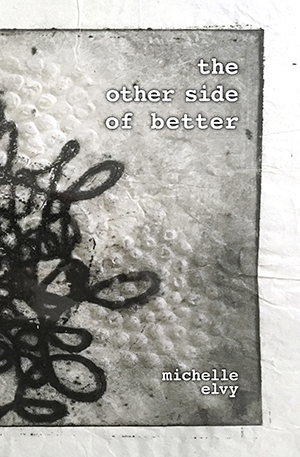
the other side of better
by Michelle Elvy


Ad Hoc Fiction


$30.00


ISBN: 978-1-912095-02-5
Publisher: Ad Hoc Fiction
Published: July 2021
Pages: 172
Format: Paperback


Reviewed by Jack Remiel Cottrell


the other side of better by Michelle Elvy is a fascinating hybrid of a book part flash fiction collection, part flash fiction novella. The difference between the two forms is subtle, and like much with flash fiction, they can easily blur and overlap. Add in a dash of poetry and playing around with forms, what Elvy has produced is something which has multiple layers depending on how the book is approached.

The first section in particular features repeated characters and situations, looping around the subjects and examining them from every angle. Themes of family and strained relationships (I’m not sure any of the couples who show up in the book could be considered happy together), childhood friendships and traumas, travel and the search for home permeate the book.

Those themes are even looked at from an intertextual point of view, as the character of the Fuddy-Duddy Editor pops up throughout the first part of the book offering a critique of the story we have just read. The FDE even goes so far to critique the subtitle of Ideas for a long documentary film ‘after Lydia Davis with a nod to the German film Manner’. The FDE is scathing about the author’s desire to write like Lydia Davis ‘You think that will get you published?’

It’s a delightfully meta take on the process of writing and trying to get published, and probably gives any writer a bit of a sting.

The second section, The Fuddy-Duddy Editor Intrudes, comes immediately after that. It eases back on the meta, and in doing so loses something of what had made the FDE a welcome visitor in the first section of the book.

There are some great moments where the FDE retells a story from the previous section, condensing seven pages into one, and possibly inviting comment on which version is better. The FDE admits she has never been a fan of Lydia Davis, followed straight away by a very Davis-eque dream story.

But the Intrusion also features more stories about childhood and falling out of love, which almost feels like a waste of the FDE’s charm. Did these stories really need to be given to the FDE? Or is it just a tactic to get them in when they’re so similar to what has come before?

In an example of how the layering of characters and stories produces something more complex than the sum of its parts, I even wondered if this was a commentary on the process of writing flash fiction. That while a writer might create eighty pocket worlds each with their own characters, there’s still only one author, and they will always end up writing like themselves.

As much as I love the writing in-jokes and layers of meta, The Fuddy-Duddy Editor Intrudes has a nudge-nudge wink-wink quality that does make me wonder if it’s written more for other writers than it is for general readers.

The other side of better is one of those books where even if you’re not enamoured of the subject matter, the language more than makes up for it. Elvy’s pieces have the hallmark of great flash fiction that every word feels deliberate without any sense that the stories were written with a pen in one hand and a thesaurus in the other. Some pieces are undoubtedly poems. Some feel like they once might have been poems. Others are very much stories, and it is part of Elvy’s skill that they all fit together. Love, Story plays with both parts of the title – a doomed affair between a man who doesn’t read fiction and a narrator who doesn’t use commas: ‘I’m living with insufficient punctuation and trying to break up with a man who doesn’t believe in truth in fiction’.

Section three offers a change of pace and tone. There’s a speculative slant to the section which feels completely congruous with what has come before. Again, it is evidence of the skilled wordsmith that it all fits together so well.

Animals both captive and wild offer their own stories in various ways. Caged zoo apes give humans a straightforward middle finger. A giraffe also gets fingers, so she can use a typewriter to send a letter. There are self-congratulatory hippos, and a whale shark who is dreaming she is a boy (or is it the other way around?)

And amongst the animals, and the speculative stories about the end of the world, some of the characters from the first section appear again, giving the whole book a sense of coming to a gentle conclusion.

Elvy’s stories slide between forms and subjects with an assured manner that is born of long practice and even longer hours editing. A reader might be able to dip in and out of the collection, ignoring the prescribed order, and find something that makes them re-examine how they have been reading.

But Elvy has clearly put thought into the arrangement of the pieces, as characters from one story show up again five or fifty pages later a tiny easter egg, in videogame terms, for those who read the whole thing in order. And by reading the whole thing in order they might get an idea of the repeated motifs which are examined, carefully and in different ways from every side. Which of these sides is the better one is left up to the reader.

.


Jack Remiel Cottrell is an itinerant flash fiction writer and rugby referee. His first book Ten Acceptable Acts of Arson and other very short stories came out in August 2021.


'The thirty-five of us were in the country of dream-merchants, and strange things were bound to happen.' - Anne Kennedy

Read more

.

.

.

.

Voices of Aotearoa: 25 Years of Going West Oratory
by The Going West Trust


Oratia Books


$49.99


ISBN: 978-0-947506-97-1
Publisher: Oratia Books
Published: 16 September 2021
Pages: 384
Format: Hardback


Reviewed by Philip Matthews


I’ve only been to the Going West festival once, and that was back in 2019, when Paul Horan and I took our comedy book, Funny As, on the road to Titirangi and spent an enormously enjoyable hour on stage with comedian Michele A’Court. We loved it; I hope that one or two people in the audience got something from it as well.

Two years seems like a millennium ago in a time of Covid-19, when festivals are threatened and getting together in groups has been either a luxury or a health risk. I remember that the Going West mood was relaxed and open, without the intensity, pressure, crowds and commercialism of the Auckland Writers Festival. We were half in the city, half in the forest. Roosters in the carpark were audible in the hall, but otherwise it was quiet. There was a communal lunch, which I think was vegetarian, and instant coffee. There was a very cool Witi Ihimaera session that had a soundtrack. It was a good time.

From Hokianga to Wanaka, Tauranga to Invercargill, there is hardly a town or city in New Zealand that hasn’t developed some kind of writers festival. Yet Going West stands out, not only for its vibe, and its longevity (it was founded in 1996), but also because it comes with a story, or perhaps a creation myth. It sprang from a big idea. Like Klaus Kinski in Fitzcarraldo, who longed to see an opera in the jungle, Murray Gray had a vision of Maurice Gee reading from Going West on a train to the west, and he wouldn’t rest until it became real. The visionary spirit of former Waitakere Mayor Bob Harvey is in the festival’s DNA too.

Twenty five years later, in the absence of in-person events, the festival team has packaged its opening night speeches into a substantial book that is both a historical record and a souvenir. Of course the speeches were written to be heard not read, and they can indeed be heard at the festival’s website. But the book, as an object, is still valuable as an artefact of a community created by literature, or dreamed up by a shared idea of literature, and what it can and should do.

In her 2015 oration, titled ‘Holding the Line’, novelist Stephanie Johnson talks about writers festivals as a kind of commons, ‘a place where people can come together to encounter new ideas and ways of thinking; a place where revolutions, big and small, can be fomented’. That feels true. At their best, as at Christchurch’s Word over the past decade, they can almost seem like autonomous zones.

Ideas about communities created by writing are a common theme in these 23 keynote speeches, plus the bonus insertion of Allen Curnow’s ‘Landfall in Unknown Seas’. Sometimes the speeches can be self-regarding and self-indulgent, and as they are written to be heard not read, they are mostly chattier and more anecdotal than if they were essays written for print.

Topicality is rare, which is probably a good thing. Ian Wedde’s jocular piece, ‘The Nation’s Narrative’, is very much of its time (1998) in its musings on TV advertising and national identity. Michael King pays attention to the horrors of September 11 before launching into his wonderful piece on family history, ‘Never Lost for Words’ (2001). The literary community’s loathing of John Key is evoked by Johnson in 2015 through her impersonation of fictional National Party Poet Amanda Tauiwi Reinhardt Carlton. The performance even involved a wig.

One complaint before we get to the good stuff, and that is about the titles, which are largely banal and generic. ‘Never Lost for Words’, ‘Getting a Word In’, ‘Fit to Print’, ‘Word of Mouth’, ‘Holding the Line’, ‘Between the Lines’, ‘Spread the Word’: these are almost interchangeable from one speech to the next, but I suppose they have the advantage of letting the invited speaker take the topic in any direction they like.

There are many highlights and what follows is only a sample. Nigel Cox (2005) has very witty things to say about returning to New Zealand from Berlin and being struck by the casualness of everything here. The Māori guy at Immigration says to him, ‘Great to have you back fella. Welcome home.’ He sees grown men wearing shorts and T-shirts in a Wellington southerly. But he has complaints about New Zealand too: the public transport, the obsession with violent crime and the state of the media, especially the shortage of books pages. You can imagine the Going West crowd nodding in agreement at that last one.

Ecologist and writer Geoff Park (2003) was a prescient thinker about the New Zealand natural world and its representation, and we could use some of his wisdom now: ‘The evolution of modern New Zealand culture from its colonial beginnings has been paralleled by nature’s relentless vanishing from sight and mind. And as we have become a culture poor in people who have been able to read country and feel it, we have been losing our capacity to know the life forces that sustain nature and to intuit with them. Yet no piece of New Zealand has been colonised so long that its native spirit is a reality no more.’ How apt to have heard that on the border between the sprawling suburban edge of Auckland and the very green Waitakeres.

Park and Cox are no longer with us. Nor are King, Peter Wells, Maurice Shadbolt and Christine Cole Catley, whose 2004 piece was a tribute to King, who was ‘in love with life, in love with this country, courageous, laughing’. Nor is photographer Marti Friedlander who breezed in and bossed writers around, as Going West chair Naomi McCleary puts it.

Charlotte Grimshaw’s 2013 piece, ‘In Conversation on Conversation’ is another highlight, and it’s fascinating to see her work through some of her ongoing interests in this forum. Surveillance is one of them, in the wake of Edward Snowden’s whistleblowing, as is the anti-intellectual culture in New Zealand politics. She makes some of the same points Cox and Johnson make, but in a more rigorous and sustained way, and one has to admire the bravery of her saying that she sees an analogue of the relationship between her fictional doctor Simon Lampton and her fictional prime minister David Hallwright in the relationship between Nazi architect Albert Speer and Adolf Hitler.

How are otherwise intelligent people so easily seduced by the powerful, she asks. Why does our conscience fail us? What should artists do? It’s very easy to see how this speech set the scene for the radical self-examination that led to this year’s sensation, The Mirror Book.


Philip Matthews is a Christchurch journalist. He co-wrote Funny As: The Story of New Zealand Comedy(Auckland University Press, 2019), which was longlisted in the 2020 Ockham New Zealand Book Awards.

'The thirty-five of us were in the country of dream-merchants, and strange things were bound to happen.' - Anne Kennedy

Read more

.

.

.

.

The Pink Jumpsuit
by Emma Neale


Quentin Wilson Publishing


$35.00


ISBN: 978-0-9951329-9-3
Publisher: Quentin Wilson Publishing
Published: July 2021
Pages: 133
Format: Paperback


Reviewed by Josie Shapiro


Poet, novelist, and until recently, editor of the esteemed literary journal Landfall, Emma Neale’s latest book The Pink Jumpsuit is a collection of ‘short fictions, tall truths.’ Full of the emotional potency and the heavily embroidered prose of her poetry, the collection is a contemplation of family fault lines and varieties of love. Told in tiny fragmented flash fictions and several slightly longer pieces, this collection often takes flight into the fantastical and the peculiar, to great effect.

There’s a comforting sense of balance in this collection. A feeling of sweetness even in the sadness, a grittiness to combat the saccharine, and a pillowed landing when the rug is pulled out from under you. The titular story, ‘The Pink Jumpsuit’, feels essayistic, and might be the tallest truth in the book. Placed near the end of the collection, it appears to be the skeleton key that unlocks the rest of the stories. In ‘The Pink Jumpsuit’ Neale’s preoccupations become clear we understand her interest in fathers, broken families, heartbreak and the magic that can be found in science.

Through the father character, Neale navigates the multifaceted dynamic between parents and children. One character reimagined, the father of these stories is a workaholic, often toiling in laboratories. He’s emotionally unavailable as well as physically absent, and he haunts the characters while alive and dead. In ‘Spirit Child’, the father, with his ‘footsore, wrung-out heart’, dies suddenly, leaving behind two grown sons and a relatively new girlfriend. A year after his death, the girlfriend claims to be pregnant with his ‘spirit child’. The eldest son appreciates the absurdity of this idea; yet, heavy with regret, he feels also an outrage at the potential for losing his father once again: ‘“he’s our dad,” some small voice in me wants to say. “Ours.”’

Another version of this father appears in the story ‘In confidence’, where the daughter meets a young man at a party. Their innocent banter soon proves unnerving: the man claims to be her half-brother, his birth the result of the father’s sperm donated for scientific research. Later, the daughter understands the young man is a con man, and yet she’s uncertain who is telling the truth, and who is guilty of deceit and betrayal. The father she’s known all her life, or a young man she feels instantly connected to? Each story dissects the unknowability of the father in a new way, and examines the impact of this formative relationship throughout their lives. The children are all searching for love, acceptance, truth. However, their inheritance is often something else entirely.

The inheritance in ‘My salamander’ is perhaps the most outlandish. The workaholic father appears again, and his scientific research comes home with him, leading to an odd genetic modification in future generations. With echoes of Ted Chiang, this story expertly slides from the straight into the strange. Neale juxtaposes the simple reflective voice with the odd dreamlike twist so that the story is both believable and fanciful. It’s one of the standouts in the collection.

Another highlight is the story, ‘Old, new, borrowed, blue’, a short fiction broken into four meditations. The final one, the brilliant part IV, steals the thunder from the first three by sheer weight of emotive power. A brief look at the relationship between Jake and Ed, this story felt like a glance into a much deeper love story, one with the same tensions and emotional depth as Annie Proulx’s Brokeback Mountain. This short piece left my mouth dry with a grief much larger than the word count would suggest is possible. Neale’s ability to create whole worlds dense with their own histories and conflicts with merely a simple turn of phrase is displayed to perfection in pieces like this.

Other flash fictions are whiplash quick and dirty: ‘I’ve never much liked choker necklaces’ is more of a punch to the stomach. ‘Courtship’ and ‘Mothian’ dance with words and evoke fleeting visions. Neale’s inner poet roams free in the shorter work, while in the longer stories her natural inclination for wordplay and subtle rhyme tends to be more hidden, like gems awaiting excavation. Every story has a final line that swirls and slides, drifting to new ideas, though the ending to the short fictionette ‘Freestyle’ is one of the best: ‘Yet or do I mean what’s more? at the end of every lap, each accurate, turtling turn, each small splash she gave was gorgeously private, inward, and self-contained.’

Many of the stories in the collection are ruminations about love and the consequences of broken love. ‘Worn once’ delves into the humiliating dread of the jilted bride.  In ‘Stray’, the protagonist learns new truths: ‘She hadn’t understood that a person can swiftly feel sympathy, but then just as swiftly move on; that attraction can be like light passing through a prism: suddenly, exquisitely there, and then for obscure reasons, just as quickly absent.’

Neale studies love like a scientist, intent on discovering its every detail. First love, long-lost love, paternal love; her characters learn that love is far more nuanced than we initially believe. In ‘Apocalypse shelves’, a young boy discovers his grandmother’s dehydrated lover packed away for the end of the world, and realises his naivety: ‘I thought how love was somehow like pair, pare, see, sea, or even match, match. Long, long. A sound people made, and you thought you understood. But did they mean another thing altogether?’ All the characters are walking on such uneven ground, working through misunderstandings, or sometimes, in the case of one ex-boyfriend in ‘Deep liking’, the lies those closest to us might tell.

Hovering around the edges of the collection are the mystical and fantastical stories: faeries and fylgja, little men in jars and children undergoing metamorphosis. Throughout the stories, no matter how realist or surreal, there’s a biting sensation that Neale’s mining the human experience, recording it in her notebook, taking heed of the finest of details to augment her fictions. A line in ‘Trypanophobia’ sums it up best, as though Neale were talking about herself ‘She had seen that hot, turbulent magma deep in the secret earth of every human.’ The Pink Jumpsuit opens up the human, exposing the extraordinary in our lives, our imaginations, our failures, and the ever-present potential for wonder.

.


Josie Shapiro is a writer from Auckland. Her short fiction has been published in takahē, Newsroom, The Three Lamps and Ko Aotearoa Tātou / We Are New Zealand (OUP, 2020).

'Character to some extent is much a construction of the reader as it is of the writer.' - Lloyd Jones

Read more

..


.

.

The Forgotten Coast
by Richard Shaw


Massey University Press


$35.00


ISBN: 978-0-9951431-4-2
Publisher: Massey University Press
Published: November 2021
Pages: 256
Format: Paperback


Reviewed by Stephanie Johnson


Family histories are having a moment in the sun. Charlotte Grimshaw’s The Mirror Book gave us an account of a privileged midlate twentieth century childhood amidst perceived neglect. Alexander McKinnon’s Come Back to Mona Vale records three generations of a wealthy Christchurch family and the damage done along the way. Both books are exquisitely written and told from expansive yet intimate viewpoints.

Richard Shaw takes a two-pronged approach to his account of another Pākehā family, this time in the Taranaki. First to arrive was Andrew Gilhooly, a farmer from County Limerick, Ireland, in 1874. He was tall for the era, almost six foot, and strongly built. The mostly Anglo Protestant officialdom had difficulty with his name, and Shaw’s attempts to trace the patriarch’s movements are occasionally made difficult by erroneous spelling. However, it seems certain that Gilhooly became part of the Armed Constabulary that helped build the military road between Okato and Opunake, a road that later enabled the invasion and sacking of Parihaka in 1881. The early part of the book details the appalling treatment of Māori in the Taranaki, not only the brute violence meted out by the colonial government, but also the convoluted red tape that bound their land into long, forever renewable leases.

He writes too of leading Māori of the time, Te Whiti, Tohu and Titokowaru, all of whom endured imprisonment, the rape of their women and the loss of their homes, farms and communities. All Pākehā, especially those of us whose families arrived that long ago, cannot read of Parihaka without nauseating guilt and remorse. Shaw feels particularly burdened by it, since he can track back to an ancestor who was actually involved. After the land grab, Gilhooly ended up in possession of a substantial farm and other blocks of land in the Taranaki, which set his family up for generations.

Shaw’s evocation of this shameful chapter in our history is clear-eyed. There are statements that suggest he has an overseas readership in mind, or perhaps an ignorant one. Why else mention, for example, that the Māori Land Court was not actually Māori, or to debate the difference between ‘settling and stealing’?

The second prong of the book is Shaw’s meditations on his father and Uncle Dick. Of his father he writes that he had a ‘language built on silences’, and later that he, ‘… offered me a particular way of being a man.’ The man Shaw shows us was not made terse or unkind by his silences. Bob, whose real name was Keith, was a beloved father. His own childhood was hard, his mother dying early, and Bob and his siblings deposited in an orphanage, the Methodist Home in Masterton.

Uncle Dick was a scholarly, intelligent man who trained as a priest, becoming a Doctor of Divinity in the early 1930’s at the tender age of twenty-two. He went to Rome to achieve this, and Shaw writes a little too exhaustively of the process.

Chiming throughout these accounts are nostalgic notes of the lost community networks in Taranaki, those that spun around farming families the dances, competitions, parades and those that emanated from the Church. There is the sense that Shaw mourns the passing of these close-knit communities almost as much as he mourns his ancestor’s part in the pillaging of Parihaka. Almost in passing, he remarks on the changes in the New Zealand priesthood no longer do they come from Ireland, but Sri Lanka, India and the Philippines. There is also a degree of reluctant nostalgia, for this reviewer at least, that in neither environment the orphanage or the Church are there details of the child abuse we have latterly come to closely associate with those institutions.

One of the delights of The Forgotten Coast is the reference to writers here and abroad. Ursula Le Guin, Tom Stoppard, Owen Marshall, W.H. Auden, Aldous Harding, Tim Winton, Cormac McCarthy, Emma Espiner, Hilary Mantel and Dick Scott, among others, are mentioned in context. However, the writer who is heralded more than any other is Rachel Buchanan, and, in particular, her seminal The Parihaka Album: Lest We Forget. Shaw owns that her book was enormously influential, and that he is grateful also for the guidance he received from Māori friends and colleagues.

Towards the end of his life Shaw’s father, Bob, wrote a two-hundred page family memoir that perhaps assisted and supported Shaw during the two years it took him to write The Forgotten Coast. Bob’s memoir could be treasured by his descendants, whereas Shaw’s book may offend some of them, especially those who prefer to remain in what Buchanan dubs the ‘dementia wing’, i.e. a state of amnesia with regard to Parihaka. It is likely though that most will enjoy the book, especially the more recent material about their clever priest. A broader readership may find much of the family detail tedious.

Ultimately, no cure is offered for the ongoing white guilt that plagues many thinking New Zealanders. The bald fact is that Parihaka happened, and that we must go on wrestling not only with the historical fact, but also its legacy.


Stephanie Johnson’s most recent books are the novel Everything Changes (Penguin Random House 2021) and the biography/social history West Island: Five Twentieth Century New Zealanders in Australia (Otago University Press 2019).


'...we were there as faith-based writers, as believers in the mana of Oceania...' - David Eggleton

Read more

.

.

.

.

Sleeping with Stones
by Serie Barford


Anahera Press


$25.00


ISBN: 978-0-4735761-8-9
Published: July 2021
Pages: 77
Format: Paperback


_________________


Burst Kisses on the Actual Wind
by Courtney Sina Meredith


Beatnik Press


$30.00


ISBN: 978-0-9951180-9-6
Published: April 2021
Pages: 72
Format: Paperback


Reviewed by David Eggleton


We sweat and cry salt water so we know that the ocean is really in our blood, wrote Pasifika poet Teresa Teaiwa. These two slim volumes by Pasifika poets Serie Barford and Courtney Sina Meredith affirm the same aphoristic insight. To battle with waves waves of emotion, waves of climate change, the buffeting metaphorical waves of daily life in lyrical, charged, crafted language is what both books offer, but they do so in different ways with different aims.

For Serie Barford in Sleeping with Stones, the poet is a shamanistic dancer, channelling voices of ancestors and planetary energies. She celebrates the body electric in all its common humanity; she is accepting of its corporeal flaws, its humbling imperfections and ultimately its inevitable mortality. Yet at the same time her poems emphasise a certain solitariness, an alert self-awareness, where she faces up to destiny and to the fickleness of fate in her own terms and under her own cognizance.

Her poems have the immediacy of spells or chants, and are intended to evoke the animism and the holistic world view of pre-Christian culture as much as the quotidian materialism and interconnectedness of our own globalised era, where the flutter of a bat’s wings in Wuhan can send ripples of chaos and uncertainty to girdle the earth.

Sleeping with Stones is a sequence of urgent, driven writing about the fleetingness of the moment, the slings and arrows of outrageous fortune. Barford’s book is dedicated to ‘Alain’, her long-term partner who ‘went over the edge’ that is, dramatically slipped from a waterfall in Latin America and was drowned. Poem after elegiac poem is about the metaphorical resonances of their relationship. The first poem in the book recalls how they first met on the island of Upolu in Sāmoa decades ago:


I want to return to Piula

swim through the lava tunnel …

make garlands from laughter
siva with the sun …


These poems draw their energy and power from the poet’s skill and power in mingling tones of voice by turns euphoric, assertive, yearning, fatalistic. Mourning her lost lover, she reaches out addictively to memories of his presence, because alive he was immediate, unpredictable, even dangerous. She writes in ‘Under siege’:


you slept alert
hands ready to strangle …

I hid the knifeblock …

you switched plates at dinner

and made me taste
your food

for poison


Summoning up his ghost, she is a gazer into the distance, her eyes are turned seawards and skywards, as if face to face with the whole sweep of a life:


our favourite coastal walk
took us over rivers
past grazing horses

on to a track of expansive views
marked by orange stakes
pegging headlands to the surf

                                                            ‘Te Ara Kanohi (The Pathway of the Eye)’


Barford’s poems are always dynamic, alway engaged with physical sensation; they are hymns to vitalism. In ‘I wish’, the poet states: ‘I wish I’d anchored you with rocks/ in a lagoon fenced by coral …’ Poetry creates an emotional truth beyond the prosaic through charged language: the poet becomes seer and soothsayer, able to enact reunion, forgiveness, reconciliation.  The poem ‘Into the world of light’ declares:


I resolutely lanced my heart
a swollen fist about to burst
with a shark tooth plucked from a dream…


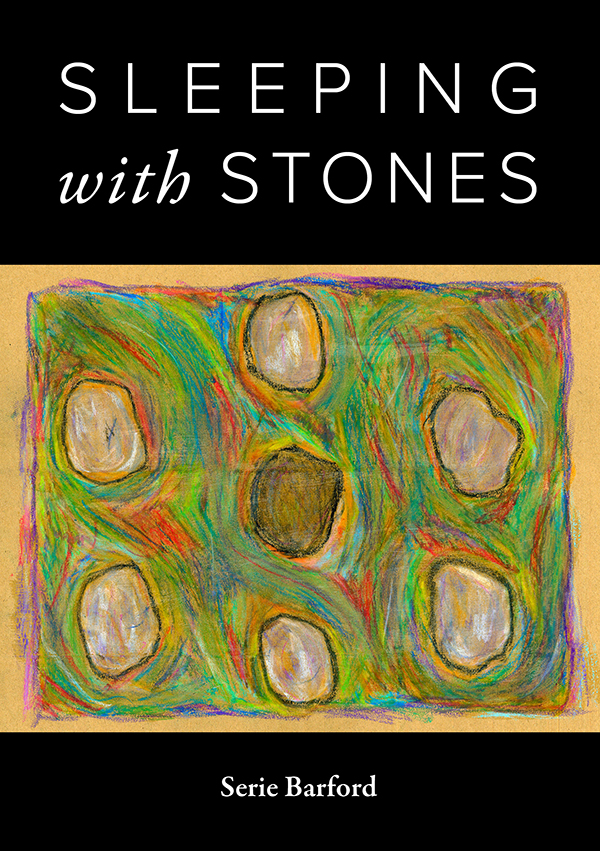
Her lyricism gives what she writes a textured, haptic quality: ‘I’m scribing banana leaves with permanent ink/ stick figures and pithy messages for you’ (‘Summer equinox’). Her keening phrases are a stamping, staccato, challenging dance one thinks of the traditional pounding of tree-bark to make ceremonial tapa cloth, or of the tap-tap rhythms of a carver working with chisel and mallet on the toppled trunk of a tree. Sleeping with Stones has a cover image done by the poet in pastels and crayons that suggests turbulence: a tide rapidly coursing over boulders or else stones as ritual markers embedded in the ground, a ceremonial fire pit, elemental flames and smoke. The poem ‘My graffitied heart’ bears witness:


I have …

excavated air pockets
struck bedrock
melted into this planet’s core
run with lava to the sea

toasted your birthday
danced to Django Reinhardt

survived a parabolic fall

regained my footing

kept walking


Her poems, then, offer first-hand testimonies to trials and endurance. Life’s journey is her subject in all its mutability, with its joys, revelations, disappointments, stoic acceptances. Serie Barford lives close to the wild ocean beaches of Auckland’s West Coast, and there is throughout these poems a strong impression of dramatic weatherfronts moving through and over, bringing mercurial atmospheres: gusts of rain, big surf, zig-zag bushpaths, thunder and lightning. Sleeping with Stones, imbued with grief, anger, hope, love, comedic thrills and spills, brings us poems that are exclamations drawn from crucibles of smelted-down, quicksilvery emotions wonderfully crafted filigrees and traceries that seek to catch the ocean wind and soar away.

Courtney Sina Meredith, in her new collection Burst Kisses on the Actual Wind, also writes the music of the everyday, but her mood music is a shimmering, jazz-like complexity of tones. This is a poet ever alert to the ambivalences of shifting contexts, as in the poem ‘Could you connect me to a diverse community’, or the poem ‘November in New York’:


I hear the term ‘liberal elite’ and the bird in my chest
stops singing…


Her poems resemble collages of speech emerging from background noise at a literary conference, or at a rowdy party, or out on the street driving along. The indeterminacy is resolved, as in hip-hop music, slam poetry or improv theatre, through craft devices. Her poetry works by sampling, or through feedback loops of language, referencing cultures past and present. Sometimes there’s a stuttery rhythmic rap-like listing that attempts to define or pin down a situation or relationship, as in the title poem:


Burst-kisses-on the-actual-wind
Lose-my-shit-the-closest-to-God
Mean-to-tell-you-I-want-you-bad
Mention-instead-something-dumb
An-irrelevant-random-acquaintance
Tell-the-girl-nothing-act-cool
Date-regularly-forget-their-names
Smile-talk-about-the-mahi-sweet
Give-my-body-permission-to-fall …


Meredith, in this latest book, is partly a global nomad moving between airports, hotel rooms, writers’ residencies, and delineating the contemporary lifestyles of the young and artistic. Her narratives, fragmentary and elliptical, are attuned to speech vibrations, sonic associations. Her ambition is to create exquisite turns and twists of perception, and glancing insights. She has a knack, a gift, an intuition for synaesthesia, a blending of intensely felt impressions conveyed through her choice and arrangement of painterly or sensuous phrasing:


There is no cure
but aromatic flowers high in a tree
you need a limber boy
to pick them with his teeth
………….      ‘Household Gods’


Hers is a kind of performative theatre of poetry that navigates shifting perceptions of the self. It has an internet-inflected manner in an era when most of us are always connected to our smartphones, as if constantly seeking the reassurance of a Delphic oracle or fount of wisdom on a moment by moment basis. One effect of this has been to turn much contemporary poetry oblique, hermetic and puzzling to outsiders. Poetry has become what the American poetry scholar Stephanie Burt refers to as close calls with nonsense: sense has to be teased out. Poems are a kind of pick and mix of prefabricated fictions or an expansive wardrobe of personal myth options so that we follow where the poet leads on a quest of discovery.

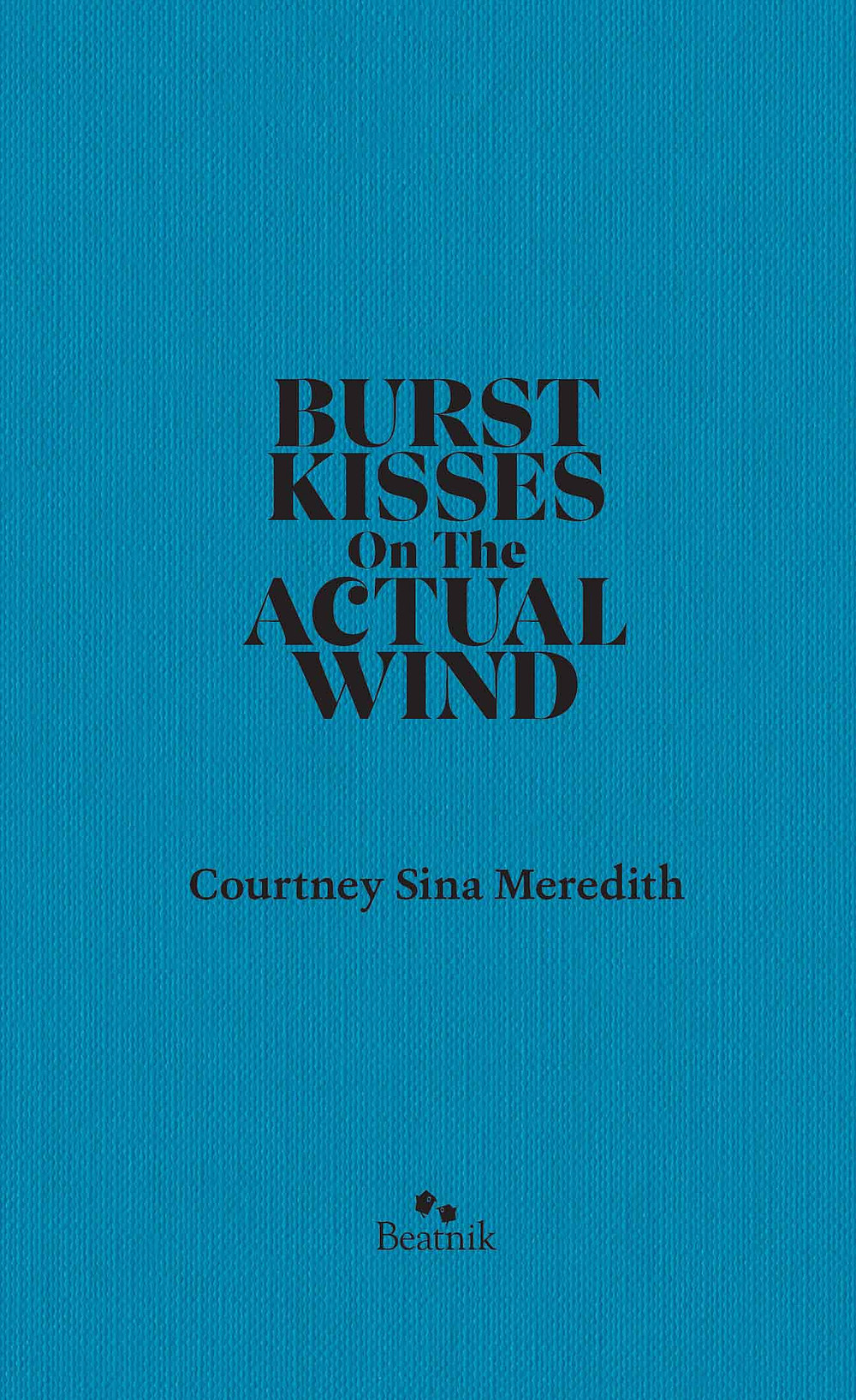
Burst Kisses on the Actual Wind acknowledges this current state of of contingency or haphazardness that reflects the world as we now know it as a given, but it is also a collection that seeks to resist opportunism and uncertain vagaries what is this poem actually about? by grounding the poems in the personal, the actual, things witnessed at first-hand, up close. As a collection, it offers poems made up of intimate diaristic confidences that are by turns sceptical, scornful, witty, euphoric, tenderly domestic. Meredith’s strategy is signalled from the get-go by the appearance and format of her book. Slim and small with a textured cover, it resembles a notebook for capturing thoughts, but also a wallet or purse, or perhaps a mirror compact whose contents might reflect glimpses of the peering poetry reader.

The book’s cover, a cool blue, presents a colour that seems to be channelling bliss, or maybe the blues and the Miles Davis jazz album Kind of Blue. And, kind of blue, it inevitably brings to mind, in this country, the ocean, from its surface to its depths. As the poem ’29’ puts it: ‘It’s been a long time since I knew dry land…’

Some of the poems mimic the status of a hug: they give us embraced immediate experience. Others suggest a hovering alert watchfulness, or else a distanced philosophical stance. Some poems seem deliberately nebulous veils of word association possessing a slippery dream logic. Where Meredith sloganises it is always with an ironic raised eyebrow. Her catchphrases and buzzwords may suggest notions of stream-of-consciousness, but her strategy is essentially programmatic: there are a few key tropes presented over and over. A central concern is ‘identity’ or rather, plural identities. ‘How about being a young brown queer single educated professional woman?’ she asks in the poem ‘How about being a woman?’

But the umbrella term ‘identity’ shelters a number of paradoxes or uncertainties, mysteries, doubts. The poem ‘Held’ states ‘identity is a luxury’, while the poem ‘Iowa House Hotel’ puzzles over the epistemology: ‘you looked so much like you, so much as I remember’. The poem ‘I was having a conversation with you’ indicates identity is a work in progress: ‘your tongue splits to make room/ for the new selves that bloom.’

And then, one poem’s title tosses out like a hand grenade the proposition that ‘Identity is a dangerous god’. Exploring this proposition requires a kind of remote bomb disposal approach. So she stands at an observational distance in this poem as ‘Old boy’, a white male English professor, gets bogged down in earnest mansplaining:


Brian will resurrect his significance
Brian will rescue his poignance
Brian will overcome Nabokov for Popper
Brian will get to the heart of it.


In a way, this is a generational divide being expressed millennial to boomer but also it’s about  an ideological shift. One might read this poem as a heretical rejection of the masculinist, if not puritanical, determinism pertaining to a shipwrecked culture cast away in the South Seas whose descendants are still in thrall to the spiritual baggage of their European forebears. But you could also read this poem as an acknowledgment of the truth of Brian Boyd’s assertion that stories and metaphor are paramount for cultural transmission. ‘Identity is a dangerous god’ ends with the lines:


…under melting willow
I expect to end there
recounting my white swan.


These heavily compressed lines conjure up the psychological power of fairy tales to give meaning to life’s randomness. And if the poet’s persona may have metamorphosed here into a kind of enchanted princess, a victim of circumstance, a waif under a spell gripped by a sense of malaise, this sympathetic identification is linked to another central preoccupation in this collection: familial bonds and allegiances.

Burst Kisses on the Actual Wind opens with an introduction, or rather an address, by the poet’s mother, the writer Kim Meredith, to her daughter celebrating milestones and achievements. But it also sketches out a landscape of belonging centred on the western side of the Auckland isthmus: creeks, peninsulas, harbours, wetlands, suburbs. Yet while the poet’s mother has an acknowledged role in this book as a mentor, the poet’s father is an absence.

Still, he is glimpsed and even invoked here and there in a book, which, in a manner of turning full circle, is also about the poet’s partner and their children. Here, the haunting absent father figure is made mythic, or perhaps cartoonish:


your father is the twinkling shark king
my father is running through the jungle
‘meaalofa’


And the poet, addressing her partner, states in the poem ‘Love is a resurrection’: ‘if I close my eyes/ my father will return to me and your father will return to you’.

Burst Kisses on the Actual Wind is a collection of poems that questions the authority of received wisdom and patriarchal imposters. It offers instead rebellious narratives that affirm emotional truth, with suffering and sorrow and anxiety and joy as evidence. It is a book willing to share a delicate quivering receptivity while also being set with sophisticated traps or trapdoors for the unwary. It’s an adversarial volume of poems, leaning on Jacques Derrida, Frantz Fanon, Epeli Hau’ofa and Teresia Tewia, and it conducts its own seminars on the power of poetic utterance as a form of resurrection or communion with the dead with considerable virtuosity. Meredith writes of her own maternal lineage as totemic, transcendental:


And there is her mother
at the top of the sky ablaze
lighting the islands below
into a string of tears.
‘I have stolen away into the secret room’


Shuffling the cards of identity, Courtney Sina Meredith lays out on the table a winning hand, a full house.



.


David Eggleton is a poet and writer living in Ōtepoti/Dunedin.


'My readers turn up...and I meet them as human beings, not sales statistics on a royalty statement.' Fleur Adcock

Read more

.

.

.

.

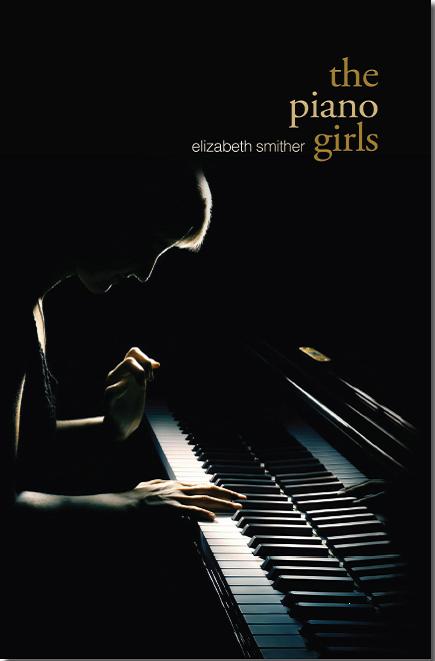
The Piano Girls
by Elizabeth Smither


Quentin Wilson Publishing


$35.00


ISBN: 978-0-9951329-8-6
Publisher: Quentin Wilson Publishing
Published: June 2021
Pages: 246
Format: Paperback


Reviewed by Josie Shapiro


Elizabeth Smither’s contribution to the ecosystem of New Zealand literature is immense. Award-winning poetry, six novels, six short story collections, as well as memoir. Her new short story collection, The Piano Girls, which was shortlisted for the 2021 NZSA New Zealand Heritage Book Awards, is dense with linked melodies and recurring motifs, and each story is composed with the gentle touch and elegance of a seasoned, assured writer.

The book is brimming with tales there are twenty stories in the collection, and while it might have benefited from a slight pruning of contents, this is a collection of gracefully told stories about women of a certain time. All the stories wander over similar ground, almost da capo, and the themes solidify with each repetition. Similar details appear in several stories the eating of poached eggs on toast with honey, the study of anthropology and apes, classical music giving the impression that, although the characters are distinct and separate, they are also connected. We don’t live in isolation, these stories assert. The echoes of the world reverberate and bring us closer together than we realise.

Relationships, both familial and romantic, is one one of these recurring themes. In the title story, three daughters commemoreate their late mother by playing a piano recital each year on her birthday. We learn the true relationship, the more honest and caring one, was with their father, and yet it is the mother they honour in this way, a feminine salute to the woman who raised them. The role of mother is further explored in the stories ‘Gravy’ and ‘Toothpaste’, and Smither worries at the burdens and intricacies of mothering, exposing hard truths. In these stories, the mothers help their daughters with little or no thanks. The mother toils in the background, sacrificing much for her children, even when they are grown, and mothers themselves.

Fathers often show their faces in Smither’s stories only to dole out money. In both ‘Money’ and ‘The Hotel’, fathers give loans along with unwelcome advice. The role of the father is almost quaint: the leather wallets opening to reveal cash notes, a relic of time before internet banking and EFTPOS machines. Though the fathers are peripheral, their impact on their children is lifelong; Jeny, the character from ‘Money’, finds the lesson learned from her father ‘A fool and his money are soon parted’ continues to influence her long after his death.

The opening scene of ‘Money’, when Jeny is on a dinner date with Fergus, is emblematic of many of the stories in the collection, with its subtle exploration of parents and romance. When their date is over, Fergus holds up the receipt for their meal, checking figures, ensuring meals and drinks are properly itemised. Jeny watches him, thinking ‘she had contributed so little, taken such care over her choice. No appetiser. She sat sipping water and toying with her fork while he ate fritto misto.’ Like many other characters throughout these stories, Jeny is playing a role a role of femininity and submission. She’s careful not to make too much of a mark, to take too much. She lets the man control the situation, and waits for him to let the woman know when she is safe to be truly herself. Jeny is playing the game of love, putting on an act of femininity that she believes he expects.

Jeny’s quest for romance has a happy ending, though not every story has such a neatly tallied outcome. In ‘The Hotel’, Rosie is taken by her boyfriend to a sumptuous and expensive lodge near the mountains. She is wined and dined, and although she is aware something significant will occur on the trip, she understands it will only happen on a timeline of his choosing. At no point in the story does Rosie have autonomy over her destiny and when the blow is dealt, it is done with Smither’s classic pianissimo gentleness. Love, as Amy Winehouse once sang, is sometimes a losing game.

In ‘Baking Night’, Antonia awaits the arrival of her most recent beau. She is worried about his expectations, recalling how a friend once told her, ‘It’s easier to seduce a woman in her own home . . . It becomes an extension of hospitality.’ Only Antonia isn’t ready to let this man into her bed. So she creates an elaborate lie in which scones, biscuits and a cake must be baked that night. She hopes the smell of biscuits baking and a cup of milk in which to dip them might subdue his libidinous desires. When reading this, one wants Antonia to tell him: I’m tired, I’m sorry, please go home. Instead, she manages him, taking care not to lead him on, while simultaneously not denying him. There is a lot of discussion about this issue today, the work women do to be submissive, attempting to dull a man’s disappointment and anger and hopefully prevent violence. While the tactic in the story is both comedic and memorable, there’s a nauseating sense of unease. The story is cleverly layered, making it a highlight of the collection.

There are other roles women play in these stories, other performances: Melissa is married to an artist in the story ‘Gravy’, and she’s playing at ‘domestic housewife’, hiding her deficiencies by having her mother deliver the perfect gravy to satisfy his appetite. Penelope, in the story ‘Tummies In, Tails tucked Under’, is performing too as a ballerina, observed constantly. Jacqueline in ‘Ten Conductors’ analyses and dissects the performances of both the musicians in the orchestra and the conductors themselves, with their ‘little dances that could fit onto the podium’. The stories examine the ways in which we are performing for others, and the ways in which we watch others perform.

There is much to decipher and interrogate in these stories. Smither’s restrained and elegant prose delights in the lives of these women: Eloise, Julianne, Lucy, Scottie. A male point of view is included, but only rarely, for this is a book about the female experience. Domestic scenes are given weight and thought. The preparations of food (salads, pies, casseroles) becomes a talismanic force. As the title suggests, music particularly classical music is ever-present in these stories, for it is the soundtrack to their emotional lives. The Piano Girls is a quiet book, resonant and thoughtful; it is a collection to be savoured from one of our most admired writers.


Josie Shapiro is a writer from Auckland. Her short fiction has been published in takahē, Newsroom, The Three Lamps and  Ko Aotearoa Tātou / We are New Zealand (OUP, 2020).  

'I felt energised by the freedom of 'making things up’' - Maxine Alterio

Read more

.

.

..


The Leaning Man
by Ann Harré


The Cuba Press
.

.

$37.00

.

ISBN: 978-1-98-859541-2
Publisher: The Cuba Press
Published: July 2021
Pages: 314
Format: Paperback


Reviewed by Paddy Richardson


Early in Ann Harré’s debut novel, The Leaning Man, the main character, Stella Weston, visits her favourite sculpture on the Wellington waterfront. She admires what she calls ‘the leaning man’, which she sees as ‘a fine pencil drawing.’ Beside the sculpture lies a small pair of jandals, ‘pink with a little flower that would rest between the wearer’s toes.’ The juxtaposed images: the beauty of the sculpture, the frailty of the child’s abandoned footwear, the ‘black, oily water’ and the ‘raw edge’ of night create the unsettled atmosphere that pervades the novel. Nothing is quite as it seems.

Characters slip away from first impressions. Stella’s lovely and conventional mother aptly named, Peace and equally lovely sister, Charlotte, have secrets. Mad-Dog, now a homeless man, was formerly a talented musician. Kate, Stella’s friend, is also Kitty LaFoy, a worker in a shady nightclub. Teri, the pretty party girl, ‘all halter-neck and cleavage,’ dies keeping a secret.  Is the mysterious Maurice Ravosky somehow linked to Teri’s death? how could you possibly put your faith in a man with buffed nails and a diamond ring on his pinky finger? Even seemingly solid and reliable Mitchell Lassiter, Stella’s friend and potential lover, comes under scrutiny. There are twists, slides, misunderstandings. Permeating all of this is Wellington, a city of culture and order. Chip away and you discover poverty, violence and exploitation of the vulnerable and the powerless.  

Even tough, cynical Stella reveals vulnerability, ‘She wanted to be the person who knew things, a person who could lean fearlessly into the unknown, forge ahead, get things. That had been her. Once.’  A former member of the New Zealand police force, Stella escaped to the U.K. to evade the scandal that erupted following the catastrophic ending to her affair with a married colleague. Being in Wellington is uncomfortable; she doesn’t want to be reminded that her life in London with her job as a private investigator surveilling cheating husbands is a poor substitute for what she had. Brittle, disobliging and carrying a grudge towards her more conventional sister ‘Her wedding had been ultra-traditional right down to the tears the bride had shed while walking up the aisle’ initially, she is provoking rather than likeable. Harré slowly and skillfully reveals Stella’s strengths as well as her failings; driven, impulsive and careless of herself as well as of her family, she is also loyal and determined. I enjoyed the way Harré has her change and grow over the course of the novel. She finally faces the shame which caused her to run away, yet recognises her own worth and the possibility of new and different choices.

Harré weaves her story in short, sharp chapters; the language is economical and tight, the characters surprise and the plot is deftly constructed. The opening chapter, where we are taken into the world of the homeless, the Wellington of Mad-Dog, creates immediate curiosity and intrigue. We move with him through the streets in his search for the cardboard which will keep him warm and protected at night. His voice is both compelling and convincing as he observes an angel falling from a balcony and discovers a fallen star.

The novel then shifts focus to Stella, home for her parents’ fortieth anniversary. At the party she speaks with Teri, her closest friend, who tells Stella she has a secret, information, she wants to share with her. That night Teri dies, falling from her fourth-floor apartment. While everyone suspects suicide, Stella refuses to believe it. Following her friend’s death, Stella discovers the drowned body of a child a little girl. The subsequent action of the novel, involving Stella’s growing suspicion that somehow the deaths are linked, leads her into the corruption beneath Wellington’s respectable surface: the spa, the night club, where her friend Kate works and the realities of those forced into homelessness. The plot twists and jolts; just as you imagine everything is solved and everyone safe, there is another startling revelation. It seems there is always a further side-street looming; ‘another alley dark and filthy a rotten smell.’

The narrative moves between Stella and Mad-Dog, the unfortunate witness to Teri’s death. As in the best crime fiction, The Leaning Man is slick, engaging and compelling, but this novel also provides insight into the homeless, a part of our society which hovers beneath our usual regard. Harré vividly shows us their world, the stories of their pasts, their poverty, deprivation, the friendship which binds them and the threat of violence they must live with. The novel also courageously exposes and confronts the exploitation of children used in the sex trade. While Stella saves one child, the chilling images of what she witnesses are powerful reminders of what may happen to the most vulnerable of our society.

The Leaning Man is a cracking good story, but what lingers most from the novel is the representation of the powerless, the homeless, their hunger, cold and fear. This is Anne Harré’s first novel. I’m looking forward to the next.

.


Paddy Richardson is the author of two collections of short stories and eight novels. She is a recipient of Creative New Zealand Awards, the University of Otago Burns Fellowship, the Beatson Fellowship, the James Wallace Arts Trust Residency Award and the Randell House Residency. Paddy is a mentor and assessor for NZSA and an experienced teacher of creative writing. Paddy’s latest novel, By the Green of the Spring is to be published early in 2022.


'I started to feel very guilty, as though I’d perpetrated a crime, a rort' - Stephanie Johnson

Read more

.

.

.

The Lobster’s Tale
by Chris Price and Bruce Foster


Massey University Press


$45.00


ISBN: 978-0-9951378-1-3
Publisher: Massey University Press
Published: October 2021
Pages: 96
Format: Hardcover


Reviewed by Ian Wedde


This book, combining texts by Chris Price and images by Bruce Foster, is the third in the kōrero series from Massey University Press edited by Lloyd Jones. The series ‘invites new and exciting collaborations for two different kinds of artistic intelligence to work away at a shared topic’. The first two in the series were High Wire, a collaboration between Jones himself and the artist Euan Macleod, and Shining Land by Paula Morris and photographer Haru Sameshima. I had the pleasure of reviewing High Wire, and wrote that ‘The Jones/Macleod kōrero debut is an ambitious place to start and on the strength of this launch we can look forward to the series.’ The Morris/Sameshima book was another ambitious collaboration, not least because like its predecessor it challenged assumptions of easy compliance or partnership in the ‘collaborations’. In neither case were the images just illustrations serving a text; nor were the texts extended captions or commentaries on the images. What made both books fascinating to engage with was the complex interplay of narrative and tonal distinctions between text and image; of individual sensibilities whose ‘collaboration’ often involved a mutual reveal of differences: not just the obvious differences between visual and written representations, but differences of perception and interpretation, of individual ‘takes’ on the situation.

The Lobster’s Tale press release uses the term ‘conversation’ in preference to ‘collaboration’, and in addition notes that ‘below the waterline of text and images, a modest voice can be overheard whispering’. This refers to the italic ribbon of text, Price’s ‘material adapted from’  the American naturalist William Beebe (1877-1962), that begins on the bottom of the first page of text and image and continues through to page 88. This running sotto voce, in effect a found poem, is a third component in the complex of elements in this conversation.

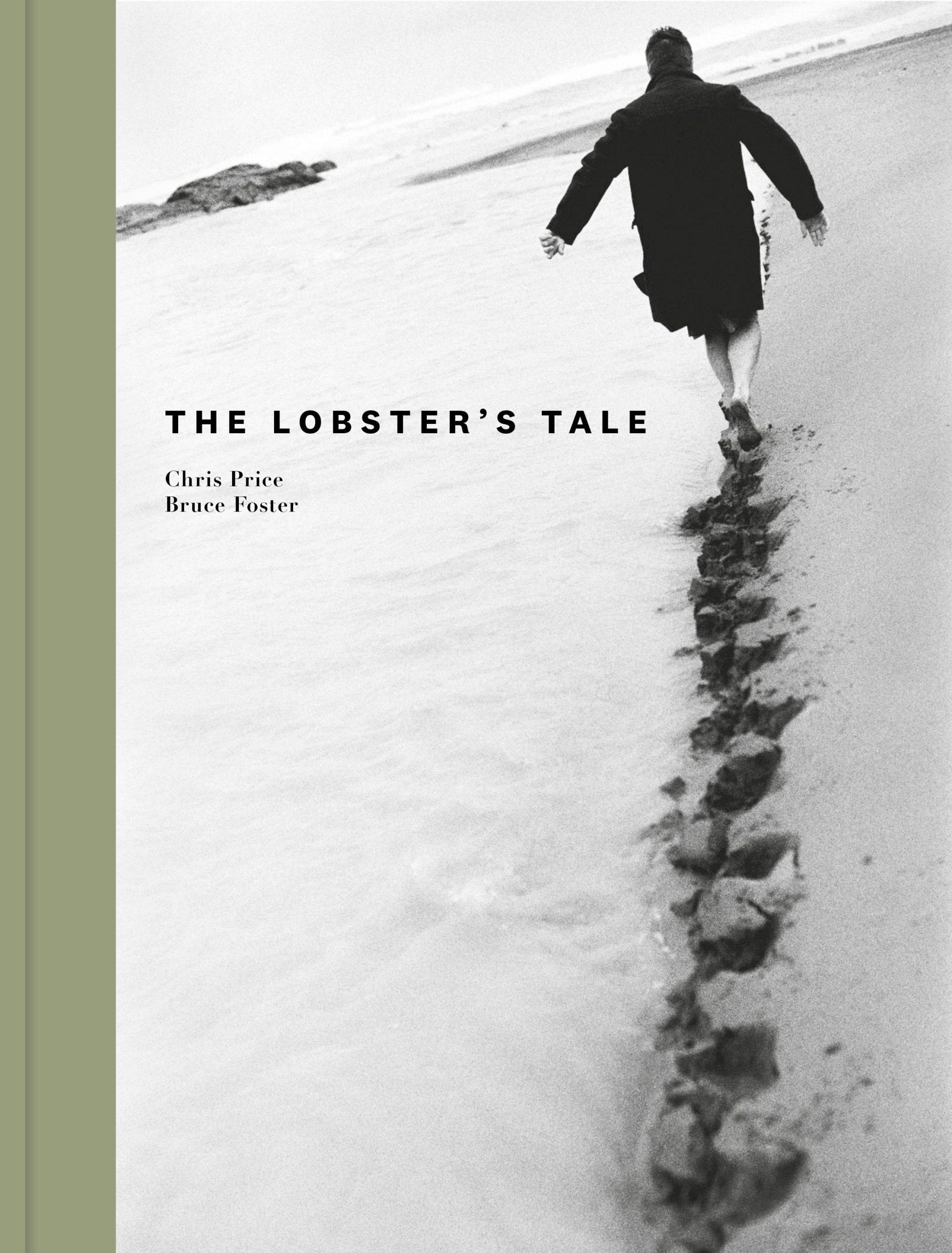
In addition to the sotto voce Price-Beebe ribbon, with its quotes from others. including Ursula K. Le Guin, the total complex conversation incorporates Foster’s visual plays across and between acutely observed details for example a tree’s spiney branches enveloped in windblown plastic sheeting; his richly textured close-up of what appears to be discarded plastic sheeting that might, at first glance, read as a ‘natural’ form; and his impressionistic patterning of light and textures in the ‘natural world’ that can appear artificial or at very least artfully composed. Other photographs are more straightforwardly documentary, for example a double page black-and-white spread of people fishing from a jetty; there are a number of what appear to be sea-wrack formations and materials; then there’s the black-and-white cover image in which a person walking across wet sand towards the sea leaves behind a footprint trail that resembles a lobster tail.

Price’s substantial prose body text is in conversation with the running bottom-of-page text ribbon, and with Foster’s tonally complex images that comment in diverse ways on the instability or vulnerability of the ‘natural world’. The body text has an overall modest tone, that of a carefully correct commentary, organised in short sections, methodical and elegantly low key. This punctilious, straightforward tone and style operate rather like the deadpan expression of a ‘you’re not going to believe this’ tall story or joke. In this principal text, ‘the lobster’s tale’ (or tall story) is told with narrative and documentary details incorporating and interweaving astonishing and surprising natural and cultural histories; like Foster’s photographs, they destabilise distinctions between the ‘natural’ and the ‘cultural’. These combinations include literary references, etymology, and the diverse lexica in which the lobster’s many names and descriptions are listed on one page, Price gathers (by my count) fifty names for the lobster, not including our familiar ‘crayfish’, a term most often associated with freshwater, claw-less varieties.

This principal body-text is rich in references indexed in two pages of notes at the end of the book. By my count there are twenty-four of these citation references; they include several natural historians (John Booth et al), poets (including Beddoes, also a physician; Nerval, Pindar, Donne, Creeley), novelists (David Foster Wallace, Camus, Franzen), artists (for example Karen Green, the widow of David Foster Wallace), philosophers (for example Camus again, the English critic-philosopher Cyril Connolly), and a variety of others fascinated by the tale of the lobster, and tale-tellers themselves in diverse ways.

In weaving these diverse voices and presences into her text, Price adroitly links them in ways that accumulate a number of running intertext narratives, as for example when she associates the novelist Jonathan Franzen’s account of David Foster Wallace’s suicide with the fact that Wallace ‘was reading Camus shortly before he deserted his post or was swept overboard’. This link is echoed when Price tells the story of the nineteenth century French poet Gérard de Nerval, who famously walked his pet lobster Thibault in the streets of Paris and ‘chose to take the same exit as Wallace, as it happens, at about the same age, and for similar reasons.’

There are a number of guides in the underworld Price negotiates, and the thread associated with Jonathan Franzen is one of the most adroitly sympathetic. In 2012, Franzen travelled to the island of Alejandro Selkirk, off the Chilean coast, to recover from the effects of  ‘a soul-leaching book tour and to deal with the loss of his friend David Foster Wallace’. He travels there aboard a lobster boat and arrives among a ‘dozen or so lobsterman shacks’ from which he hikes to one of the island’s highest points. Price notes that the lobsters of the region are Jasus frontalis and silentes, like their New Zealand relatives, and that in Selkirk’s day ‘they were three feet long’. She also records that Franzen took some of his friend David Foster Wallace’s ashes with him to the island of Alejandro Selkirk, known to the locals as Isla Más Afuera, or The Island Further Away. He scattered the ashes into the wind there, and Price suggests that, ‘This is as close to the Romantic sublime as Wallace will get, vanishing into infinity on Earth.’

In its understated way, this ‘tale’ of the lobster or of where the quest for it might end up is typical of Price’s engrossing and distinctive interweaving of anecdote, of histories both natural and cultural; and of a fabulous cast of characters gathered together around the edges or shorelines of Bruce Foster’s visual field, all under the lobster’s 180º field of x-ray scanner vision.


Ian Wedde is a poet, fiction writer, critic, and art curator, and the recipient of well over 30 major awards, including New Zealand Poet Laureate and Officer of the New Zealand Order of Merit. His latest novel  The Reed Warbler was published in May 2020, through Victoria University Press.


'I felt energised by the freedom of 'making things up’' - Maxine Alterio

Read more

.

.

.

Shelter
by Kirsten Le Harivel

The Cuba Press


$25.00


ISBN: 978-1-98-859542-9
Publisher: The Cuba Press
Published: August 2021
Pages: 84
Format: Paperback


____________


Brass Band to Follow
by Bryan Walpert

Otago University Press


$27.50


ISBN 978-1-99-004804-3
Publisher: Otago University Press
Published: May 2021
Pages: 88
Format: Paperback


Reviewed by Sophie van Waardenberg


Kirsten Le Harivel’s Shelter is a debut collection of poems in both prose and verse that pay devoted attention to the places Glasgow, Oakautere, Ahmedabad, Wellington and the people, both mildly acquainted and beloved, beginning in a speaker’s migratory childhood and following her through a roving adulthood.

Le Harivel proves herself throughout this collection as a quiet master of the prose poem. I was surprised, spurred on, by the first of them, titled ‘From one migrant to another’. It is built of condensed, assonant sentences that cling to and push away from one another: ‘You must see the gleam. We have heat. We have flowers. Let us make our merit.’ I was delighted to discover, as I read on, that Shelter is nearly halfway made up of these prose pieces. Each offers much to indulge in. ‘Returning to India for a wedding’ wields the logic of the sentence to increase the surprise of a fresh observation: ‘I knew where I was headed, but not if we were on the right road.’ And ‘Flashpoint’ betrays the speaker’s shifting dialect alongside her resistance to it; when describing a corner store in Scotland, she says: ‘I call it a dairy because I have lived here too long.’

Some of Shelter’s shorter poems lack the turbulence and depth of the collection’s more substantial pieces, and, in my first encounters with them, had the tendency to leave me feeling not quite full. They read as lists of description, often visually vivid while rhythmically slack. But, though they sometimes lack intensity as stand-alone pieces, they offer something vital to the journey of the collection. Le Harivel uses these briefer moments, micro-catalogues of the natural world, to bolster the broader chapters of the life, the locations attended to, in Shelter. And certainly, what these briefer pieces do record is freshly observed and excitingly verbed: ‘he dresses her in suds’ in ‘A daily task’; and in ‘Prey’, ‘She stands at the edge of the water, darkening her jeans.’

When Le Harivel’s rhythm is driven by syntax instead of line break, there’s a generosity of both observation and reflection, and it’s where I so often felt the magic of the poetry working best. These pieces are patient but not stilted, and turn Shelter into more than a clean window onto several beautiful, separate scenes. Poet Li-Young Lee is often quoted as saying, ‘Syntax is identity’, and this is demonstrated in Le Harivel’s work, wedding detail with the movement of a mind, making some sense of what it means to be both home and away from home at once. And, in rare moments like ‘You are an elegant thing’, the heart of the speaker bursts through in blocks of unpunctuated text that marry the poet’s micro-cataloguing approach with an unrelenting urgency:
.

an elongated calf muscle an oyster in its shell a slice of sashimi a mouse sleeping in a
walnut a bed draped in a mosquito net a sheet of oxidized iron sunlight on dust motes a
cross-section of a whelk the oily sheen of a starling the cut in a kite-flying fight a house
tucked into its surroundings the curlicue of a letter the mouth-feel of amore dunes against
the fading light
.

Where Le Harivel’s work skews towards transparency, the poems that make up Bryan Walpert’s fourth collection, Brass Band to Follow, are relentlessly, bouncily self-aware. Walpert begins his first poem, ‘Begin with’, as he means to go on: chatty, breathless, bold as a trumpet solo:


            .Begin with


something simple, something near,

not too near, it has to be distant

or you have to be distant enough from it

to see it coolly, like the moon.

No, stay away from the moon.

Okay, I don’t know, a vegetable […]


It’s clear that Walpert is unafraid of repetition and circularity, of seeming to chase himself around in circles. There’s nothing concrete in ‘Begin with’ until we get to the moon, which is itself rejected in favour of a vegetable. But which vegetable? Possibilities kohlrabi, lettuce, carrot are tossed around, and the speaker doesn’t settle until quite near the end. Because, of course, the poem isn’t about any vegetable, but the deciding, the evening in which the deciding happens, the darkness, all of it folding in on itself as the poem, as claustrophobically as a kind of reconstructed sestina.

The burgeoning, single-stanza, long-line, syntactically playful poems that make up a great deal of the collection are so vital, so effervescent, that when I came to some of the poems made up of one- or two-word lines, broken irregularly but often by white space, they came off a little stingy, too preciously deliberate in contrast. I know this seems like a superficial reading, but it’s more than just how the poems look on the page. Walpert’s great strength in much of Brass Band to Follow is in rhythm, in how image meets attitude within the same stanza, and how sparks rise from that meeting. When asked to consider single transparent sentiments siloed in their own strophes (as in ‘Monkshood’: ‘So few words / between us today’), I felt I was being asked to accept a stillness I hadn’t been prepared for.

So many of these poems travel a confounding distance from first to last line. ‘Prompted’, a poem that proclaims its intention to include twelve particular words opens up to hold lines like, ‘This is the sort of poem where we imagine / how you’d read this if you still lived with me’. It’s a pleasure to imagine where the poem came from probably one of those tried-and-true writing prompts and to trace its growth into a stand-alone expression of loneliness, where the ‘You’ and the ‘I’ seize the power from the conceit of the prompt. This kind of transformation is most evident in the five-part series, ‘Experiments touching cold’, after a quote from seventeenth-century philosopher-scientist Robert Boyle. Many of the sections begin distantly, in the vernacular of thought experiments or tracts of scientific theory, but finish in the tenderness of the physical world, as in ‘Experiments touching bodies capable of freezing others’:


                        Which is to say,

            in prosecution of this conjecture,

            it is perhaps not unworthy

            of an additional trial

            of the application of some heat

            should you be so disposed

            to attend in full to this message

            and call me back.


Walpert asks us to cross the wobbly bridge between icy academic pursuits in language and the concrete world, where each of us are only trying to reach each other in whatever way we can. The collection reaches backwards to call on poetic traditions, inwards to the poet-self, and always, crucially, outwards, not only to the people familiar to the poet, but to the ‘you’, the me, the reader, of whom Walpert is always aware.


……………..         


Sophie van Waardenberg
 is studying towards an MFA in poetry at Syracuse University in upstate New York, where she serves as co-editor-in-chief of
 Salt Hill Journal. Her first chapbook-length collection of poems was published in AUP New Poets 5.


'I felt energised by the freedom of 'making things up’' - Maxine Alterio

Read more

.

.

.

Ten Acceptable Acts of Arson and other very short stories
by Jack Remiel Cottrell


Canterbury University Press


$29.99


ISBN: 978-1-98-850325-7
Publisher: Canterbury University Press
Published: August 2021
Pages: 136
Format: Paperback


Reviewed by Victor Rodger


There is a certain irony that this review of Jack Remiel Cottrell’s Ten Acceptable Acts of Arson and other very short stories will be far longer than any of the stories contained within this very fine debut collection which are, indeed, very short.

Only a handful of the stories stretch out longer than a page (and, even then, barely); some are just two sentences in length; others are seemingly standalone sentences that appear to have been strung together randomly like a series of entertaining but unrelated punchlines.

Whether Cottrell’s stories fall under the category of flash fiction, microfiction or something else entirely may be up for debate amongst purists. What isn’t in doubt, however, is his talent. Here is a writer with a voice that is as distinctive as it is confident; who both recognises and leans into the absurdity of life, but is equally adept at embracing its beauty and its sometimes aching sadness.

Alongside Rebecca K Reilly’s Greta and Valdin, Ten Acceptable Acts of Arson ranks as one of the year’s most purely entertaining debuts, announcing a droll and original new voice in New Zealand literature.

Twists are a hallmark of flash fiction, and Cottrell’s an expert. In story after story, he takes the reader on an unexpected yet satisfying detour, often throwing new light on everything that has gone before. It’s a huge part of both the charm and the fun of this book.

Another hallmark of flash fiction: precision. There’s not an ounce of fat on these stories every word counts. And while Cottrell makes it look easy, it takes hard work to craft stories that appear this effortless. With economy and precision, he manages to bring characters and whole worlds into sharp focus with an impressively minimal word count.

None of the stories here is long enough to overstay its welcome, and perhaps this collection is saying something about Gen Z’s notoriously short attention span. What’s more likely, however, is that Cottrell simply wanted to share his distinct point of view with the rest of the world and I, for one, am certainly very glad that he has.

Ten Acceptable Acts of Arson is a wide ranging book, both in form and content: Faeries. God. Hell. Robots. Time travel. They’re all in here.

Some of the stories are in the form of lists, others are wonderful send-ups of the kind of mumbo-jumbo communications that can often be found circulating throughout bloated institutions.

If there is a connective tissue to each of these disparate stories, it is that Cottrell’s voice is unique; he has a strong capacity to surprise his audience, sometimes in truly remarkable ways.

On a first reading, it’s Cottrell’s keen sense for the absurd which stands out: In ‘Work and Income gothic’, a WINZ office is given a gloriously Gothic do over, replete with levitation, incineration and an appropriate sense of dread. In ‘They probably play the viola’ the author is seemingly dragging Jacinda for her Covid-inspired reminder that we’re all in this together with the droll inclusion of that whakatauki she is so fond of: ‘He waka eke noa.’ And Cottrell does a terrific lockdown-inspired spin on drug dealing in ‘The flour dealer’, wherein the narrator becomes an illicit supplier of the white stuff just not the white stuff that you would normally expect.

On a second reading, however, it’s the unexpectedly poignant pieces that stand out, featuring a terrific collection of memorable characters, all deftly drawn: the intellectually underestimated rugby player in ‘The prop forward’ who’s mistakenly written off as ‘a thicko, spending his life bashing heads with other thickos’; the young student who can’t help herself from eventually always saying the wrong thing in ‘Trying’; an anxious robot couple in another Covid-inspired piece ‘The android’s dream’.

In one of the list stories ‘An abridged taxonomy of little-known ghosts: A to L’ one of the ghosts is called Agraphorum imago: the ghost of unfinished stories. An example of this ghost gets his own standalone story later on wherein a character from a dying author’s unfinished book lies curled up at the end of their hospital bed, hoping that the author will hold on long enough to complete the book they are in before they die.

Perhaps it’s not surprising that Cottrell has much to say about writers and their process. Another list story, ‘Where writers get their ideas’, is terrifically funny and inventive. (For the record, my favourite was Number 9: Spite, followed closely by Number 3: Theft.)

Cottrell whakapapas to Ngati Rangi, and by his own account he is just beginning to explore what that means to him. Race only explicitly rears its head in a couple of the stories, but both are stand outs. In ‘Reasons why I called in sick rather than go to the mihi whakatau for new employees last Friday’ the narrator explores the complexities of having Māori whakapapa without a familiarity with the language or the culture and how that can lead to getting shit from both Māori and Pākehā alike.

‘Bombay Polo Club’ is told from the point of view of an Indian protagonist out on the town on a Saturday night with a bunch of white mates. When they all end up at the titular Indian-themed bar, he observes the ‘fake colonial décor’ with bemusement: ‘A century of struggle picked over like carrion, brought across the ocean to appeal to young white people.’

Writers telling stories from cultural points of views other than their own has become a minefield, but this feels both believable and right.

In the final piece, ‘There are no right words’, the narrator confesses:

I fell into writing, tripped into it the way I so often tripped over my awkward, gangly limbs. Except rather than picking up grazes, I picked up a little ability and a lot of passion. It’s dangerous to have things that way around.

It feels very much like the writer could be talking about himself here, except that Cottrell has much, much more than a little ability as his book triumphantly shows. He finds the right words again and again and again.

The pleasures contained within Ten Acceptable Acts of Arson are many and varied. Some stories may even cause you to reassess your life.

Bring on the follow-up.


Victor Rodger
(ONZM) is an award-winning writer and producer of Samoan and Scottish descent. Best known for his play
Black Faggot, he also produced Tusiata Avia’s acclaimed Wild Dogs Under My Skirt, which was performed Off-Broadway last year. He convenes the Māori and Pasifika creative writing workshop at the International Institute of Modern Letters.


'...we were there as faith-based writers, as believers in the mana of Oceania...' - David Eggleton

Read more